Software
Houzz Logo Print
leamonzgirl

Block vent return?

5 years ago
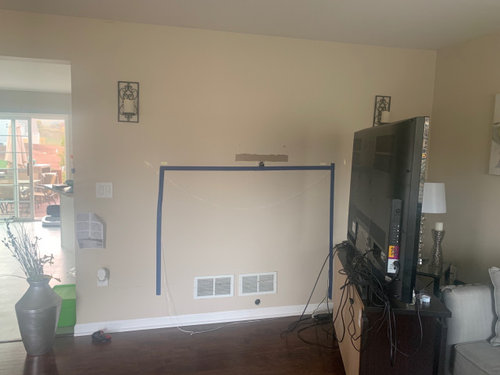
Can I build a faux fireplace here and block this return vent?

Can it be moved? Is this an easy inexpensive task?

Comments (17)

  • 5 years ago
    last modified: 5 years ago

    You may be able to have the vents moved, but, you cannot block them. Your heating and cooling system need those vents to work properly. What I am wondering is why you have two side by side and what is that below the right hand one.

  • 5 years ago

    Are you sure these are return vents? Normally returns are larger and near the ceiling. If they are returns it looks like there are ducts within two stud cavities covered by two small grilles.

    It should be relatively easy to raise the return up so that is it is near the ceiling. It this is the only return in the house then it probably needs to be increased in size. You can use one large grille to cover it. It suggest cutting out the stud in the middle and build a rectangular frame to match the grille opening.

    Are you planning to put the TV on top of the fireplace mantel? There may not be sufficient clearance for air flow.

    It is difficult to say how much this will cost where your live. The duct work has to be modified. The wall studs have to cut and modified. Sheetrock has to be cut, replaced, finished, primed, and painted. .

  • PRO
    5 years ago

    Evaluating the feasibility and cost of relocating the duct(s) and grill(s) requires a better evaluation of the existing conditions than can be done via the internet. You will be best served to direct your question to a local mechanical contractor in your area.

  • 5 years ago

    The returns in my house, and the dozens of houses in my neighborhood, the returns are by the ceiling. In my area supply vents are generally in the floor or if the house is built on a slab in the wall by the floor. Ideally the return should be at the opposite end of the wall compared to the supply. I'm in the north so this is what I generally observe. In the south it may be the reverse.

  • 5 years ago

    When I lived up north, all vents were in the wall, similar to the picture, both heating and return. Here they are still all in the wall. My last house, had the returns in the wall, and the supply vents were all in the ceiling.

  • 5 years ago

    Return vents in my house are near the floor on the first floor and near the ceiling on the second floor. I live in the northern part of the US.

    I also have two return vents that occupy double joist bays. No need to cut out the stud in between those wall return vents because most likely the stud bay is the 'duct'. (also, the center stud is a nailer for the metal pan cover--flat sheet metal-- of the 'duct') (And that could possibly be a load bearing wall!) If you want to cover them with one vent cover, just get a larger cover. You might want to paint the center stud the same color as the vent cover because, at certain angles you can kinda' see the stud if you want to look for it.

  • 5 years ago

    Using a stud bay as a return is a bad practice. If that is what is happening in this house I would recommend installing a metal duct.

  • 5 years ago

    "Psst....mike, return vents are almost always located at the floor."

    I've never owned a home where the return grills were other than in the ceiling or high on a wall. Including the two I own now. My experience is with homes in coastal California.

    I echo Mike's comment, using a wall cavity for any form of HVAC air ducting is an awful idea. And, I suspect, not permitted by the applicable building code.


  • 5 years ago

    If you really want a faux fireplace and mantel, I'd go with a wall mount electric fireplace and add whatever mantel you want. Is there any reason that wouldn't work? then those vents can stay.

  • 5 years ago

    I was thinking that @party but it won’t look nice in my opinion.

  • 5 years ago

    What Happens When A Return Vent Is Blocked?

    https://www.heating-air-conditioning.net/


    Very similar to blocking a heat register, blocking an air return vent restricts the air flow in your home. Blocking air return vents causes your system to work harder, as there is less air flow to move the air back to the furnace. This continued strain on the HVAC system can lead to a decrease in performance and more HVAC repairs down the road.


  • 5 years ago
    last modified: 5 years ago

    Building codes allow stud cavities to be used for cold air returns. International Residential code, chapter 16 Duct systems, section M1601.1.1 Above-ground duct systems. Almost every state and/or city in the united states have adopted the International Code Council's (ICC) Code standards so it would be rare to say "not in my city", oh and "I saw big foot".

    Stud cavities for returns are still common and an accepted industry practice for moderately priced homes. If you don't like it then Build a house and pony up the money if you want metal return ducts or cavities lined with duct board, or you can buy a Energy star certified home.

    "People who live in glass houses shouldn't throw stones."

  • 5 years ago

    "Stud cavities for returns are still common and an accepted industry practice for moderately priced homes"

    I accept your citation but will add that in my area, this practice is rarely seen and far from being a "best practice", it's a cheap expedient. It's not that hard to do it right for modest costs or to by-pass and replace with a better approach when a remodel is done.

    Even a house on a concrete slab with no attic can be fitted with a ducted return.

  • 5 years ago

    Below is line 7.3 section M1601.1.1


    7.3. Stud wall cavities shall not convey air from more than one floor level.


    This implies the furnace and the return have to be on the same floor. Let's say for a $2,000 square foot ranch, how much money do you think would be saved by not installing a duct for the return?

  • PRO
    5 years ago

    No, I don't think it requires the air handler and return ductwork to be on the same level.


    I believe the intent is that if a stud cavity is utilized as a return by an air handler, say on the 2nd floor, it should not also serve as a return for a different air handler, say one located on the 1st floor. If the same stud cavity were utilized to return air flow to two different systems they would be co-mingled with potential control and sizing issues as a result.

  • 5 years ago

    Code sections N1103.2, N1103.2.1, M1601.1.1, R602.8, and R302.11 all cover the same topic of sealing cold air ducts with M1601.1.1 Item 7.3 one of the more ambiguous parts. But It deals with sealing the wall cavities used as returns for leaks, and not implying the furnace and return must be on the same floor, and seriously where did you get this strange idea?

    This topic has went to court witch ruled in favor of the state code commission (Michigan), and stated each section standing alone could mean something different but together they mean return ducts need to be sealed. Michigan, and I think Oregon have amended the codes to clarify state code requiring sealing and pressure testing the entire system.


Sponsored
Hope Restoration & General Contracting
Average rating: 4.7 out of 5 stars35 Reviews
Columbus Design-Build, Kitchen & Bath Remodeling, Historic Renovations