Software
Houzz Logo Print
webuser_262924239

basement flooring question

5 years ago

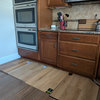
Hi all. I've got a corner room in my basement that currently has an old vinyl/linoleum over wood floor. That is on top of concrete. I'd like to put a new floor down right on top of it -- something like DMX and then cork or something else. I a bit concerned by the old wood floor, along with the sleepers they sit on. As that wood continues to decompose, is that going to create a permanent mold situation? Tearing up the old floor would be a colossal project that I'm really not relishing at the moment. Thanks.

-Jim

Comments (12)

  • 5 years ago

    Some hazards you can safely encapsulate and cover, such as asbestos tiles. Rotting wood, not so much.


    Consider hiring a demo person (or crew) for the job. Just because you can do something, doesn't mean you can't hire someone else.

  • 5 years ago

    Thanks for the insights, worthy. It's not just the demo but the added step of constructing a new subfloor, but my gut instinct tends to agree with you. This started out as just a cleaning project -- it always goes this way with an old house ;-)


    -Jim

  • 5 years ago

    the added step of constructing a new subfloor


    If the concrete is relatively level, the new subfloor can be as simple as a layer of Delta FL or equivalent.

  • 5 years ago

    Wait...you have a basement room that has a subfloor of concrete slab with a wood floor laid over sleeper subfloor with a type of vinyl product over that???? That's a LOT of flooring! I'm going to guess this concoction is worth 5-6" worth of ceiling height.


    You do NOT want to leave the vinyl in place over the wood that is over a sleeper subfloor when laying a new floor. I would NOT add a vapour/moisture barrier such as DMX or Delta FL over this construction. I really would not. You will be creating the dreaded "double vapour barrier" that is considered a no-no in construction.


    If you want cork, then go a head and install a cork floating floor directly over the vinyl. Yes you run the risk of damaging the ENTIRE set up (including the new cork)...but it would be the option I would go for.


    We are assuming the vinyl coating over the wood over the sleepers have reached some sort of equilibrium. If you add ANOTHER moisture barrier (DMX is SERIOUS moisture barrier...as in STANDING water) you will seal in any moisture that is currently 'airing out' in this room. Once you do that you guarantee 'rotting'.


    I would be tempted to find out how healthy the wood and sleeper system is. If it is still in good condition, I would plop down a cork floating floor right down over the vinyl. It would be the safest thing to do...aside from removing it all and starting over.

  • 5 years ago

    Thanks for all the thoughts, SJ. The sleepers have to be 50 years old but maybe considerably older. After poking around today I discovered a few soft spots clear through to the base and am now thinking that the floor has to go even though it's going to be a pain.


    What do you think of Delta FL directly over concrete? I watched a promotional video today in which the guy explained that the barrier actually forces moister back into the concrete. This corner of the house is actually (theoretically) the driest since it sits in the corner that has the wrap-around porch with roofing, so the basement exterior walls have about 10' out where no rain falls. Still, I know, it percolates up from the bottom.


    -Jim

  • 5 years ago

    I would prefer to see DriCore foam panels. Cork floating flooring requires a rigid product (without dimples) to sit on. If you use Delta FL you MUST use plywood/OSB over the dimpling if you install anything with an underpad/backing underneath the plank. So you might as well go whole hog and work with the high-end DriCore that is foam panels (not the OSB panels). You will get MUCH more out of it.

  • 5 years ago

    Thanks, man!

  • 5 years ago
    last modified: 5 years ago

    Hmmm. Can't google any DirCore product that doesn't involve OSB. After having cut out a chunk of the floor I can tell you that I would really like to avoid organic materials if at all possible. The existing floor had:

    • sleepers set directly in concrete (they were completely gone)
    • pine subfloor (badly deteriorated)
    • hardwood (kind of OK in spots, rotten through in others)
    • vinyl or linoleum


    The volume of mold food in there is staggering.

    In all my reading around on the subject of basement underlayment, I'm getting two contradicting messages: 1) you should let your slab breath and 2) you should seal it off. Any thoughts on that subject?

    -Jim

  • 5 years ago

    So your comment about cold floors got me thinking. We're in upstate NY and get pretty chilly in the winter too. But I'm not so sure we would mind a cold floor in the winter. It's not like this is going to be a cozy rec room with people lounging about in their stocking feet. Its intended purpose is an exercise room and possibly a small office. Our basement is never flooded and is extremely dry in the winter when the heat kicks in. The room in question has a large steam supply line that throws off considerable warmth when it's active.


    My expectation is actually that if I pull the old flooring up the concrete will dry out since that's what the rest of the basement is like and this corner of the house has the driest exterior walls. So that moisture I saw when I pulled the floor piece out could very well have been due to condensation.


    Anyway, we're now starting to entertain the prospect of just concrete flooring -- perhaps a tinted leveling coat -- or ceramic tile.


    -Jim

  • 5 years ago
    last modified: 5 years ago

    Instead of Dri-core or equivalent, you can lay down a layer of 1" XPS (extruded polystyrene) followed by a layer or two of plywood, as per Building Science Corp.

    If you're going the tile route, be sure to include a crack isolation membrane such as Ditra and Ditra-XL.

    In new homes, I have successfully used low-pile synthetic carpet direct glued. But that's over 5" of concrete on top of poly and 6" of gravel. Definitely not in an older home!

    No finish but throw rugs and exercise mats? Works fine too. (And lots cheaper!)

  • 5 years ago

    It is very rare for moisture to come from 'condensation'. So rare it has a name: Sweating Slab Syndrome (SSS). Traditionally SSS is seen in MASSIVE warehouses (40ft ceilings, raw concrete sitting on gravel, poor circulation, racks and stacks preventing air movement) in locations of HIGH humidity with cool ground temps.


    A 3" air space sitting underneath 3 layers of 'stuff' isn't going to fit into the category of MASSIVE warehouse. It *can happen...in the same way a cat can learn to play the piano. Intensely rare to the point that you don't think Siamese keyboarder when you hear a swingin' ditty coming from a piano bar!


    The chances of this being moisture moving UP INTO THE HOUSE from the wet ground = 99.999997%. In fact I would bet my first born on it (he's now 6'3" at 15!).


    Letting a slab 'dry out' is like letting a bottomless lake empty out of the valley bottom. Slabs sit IN dirt. Dirt is ALWAYS damp. In fact, our planet is an ocean world with islands of sea floor sitting above the surface. Our slabs are really more like dish sponges floating in a swimming pool. In relation to the sponge, the swimming pool is an endless source of water. By the time the swimming pool dries out, your sponge will have deteriorated to the point it will have returned to it's base make-up: sand, gravel and some crumbly white stuff.


    Don't 'wait' for the slab to dry out. It won't happen. You will THINK it has happened, but it won't have done so.


    To get a finish over the concrete, you need to have a 'dry' slab (you have to spend all that money sealing it) or it will have adhesion issues. To apply porcelain tile you might have to use an 'exterior grade' install because the slab is too wet/pourous. These damp basements get difficult to deal with.


    I've seen offices in cold basements. No one uses them because they are too cold. But if you are sure you have a 'steam' pipe somewhere that keeps things toasty warm then go for it. But don't think the slab will 'dry'. It won't. The water will evaporate off SO FAST that you can't see the puddles.

Sponsored
Kuhns Contracting, Inc.
Average rating: 5 out of 5 stars26 Reviews
Central Ohio's Trusted Home Remodeler Specializing in Kitchens & Baths