Software
Houzz Logo Print
katherine_padwa

ZZ Plant Propagation Help

6 years ago
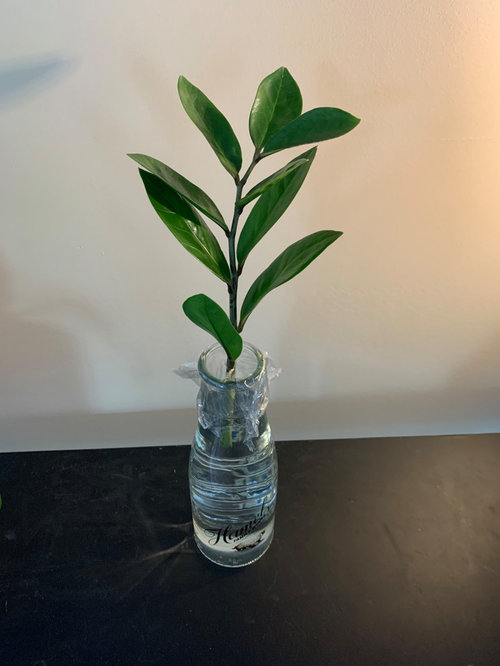
Hi, all!


I am new to ZZ plants. I was given a cutting a few days ago and popped it into a vase of water. It is only submerged about an inch at the base.


Should I have propagated it in soil? Should I make a switch or keep it in water? Any advice would be greatly appreciated!


Thank you!


Switch it to soil?
Keep it in water?

Comments (6)

  • 6 years ago

    I would let it root in water than put it in soil. That way you can know the roots are ok to pot.

  • 6 years ago

    One of my friends propagates hers in water. But she warned that it can take months for roots to show up. So don't give up. But be sure to change the water if it becomes yucky.

  • 6 years ago

    just add some peroxide to water like 1tsp per quart. it'll keep it fresh, but algae growth usually occurs in bright light/sun. you can pop the vase into something solid to block the light.

    it does not take that long for roots to form. even the tuber will form at the base fast enough. but to be on the safe side before you transplant into mix first just put it in pure perlite with water at the bottom: it'll firm up the roots . after a month or so in perlite you can plant it in the mix. or grow it longer in perlite: it's sort of semi-hydro.

    Katherine P thanked petrushka (7b)
  • 6 years ago

    Good info petrushka! Thank you.

  • 3 years ago

    Water the plant when it needs water, not before and not on a schedule. Once established in the pot, the plant needs watering when the soil is almost but not completely dry.


    It DOES make a difference if the plant is rooted in water or a solid medium - a big difference:


    Rooting in Water

    Though roots form readily and often seemingly more quickly on many plants propagated in water, the roots produced are quite different from those produced in a soil-like or highly aerated medium (perlite - screened Turface - calcined DE - seed starting mix, e.g.). Physiologically, you will find these roots to be much more brittle than normal roots due to a much higher percentage of aerenchyma (a tissue with a greater percentage of intercellular air spaces than normal parenchyma).

    Aerenchyma tissue is filled with airy compartments. It usually forms in already rooted plants as a result of highly selective cell death and dissolution in the root cortex in response to hypoxic conditions in the rhizosphere (root zone). There are 2 types of aerenchymous tissue. One type is formed by cell differentiation and subsequent collapse, and the other type is formed by cell separation without collapse ( as in water-rooted plants). In both cases, the long continuous air spaces allow diffusion of oxygen (and probably ethylene) from shoots to roots that would normally be unavailable to plants with roots growing in hypoxic media. In fresh cuttings placed in water, aerenchymous tissue forms due to the same hypoxic conditions w/o cell death & dissolution.

    Note too, that under hypoxic (airless - low O2 levels) conditions, ethylene is necessary for aerenchyma to form. This parallels the fact that low oxygen concentrations, as found in water rooting, generally stimulate trees (I'm a tree guy) and other plants to produce ethylene. For a long while it was believed that high levels of ethylene stimulate adventitious root formation, but lots of recent research proves the reverse to be true. Under hypoxic conditions, like submergence in water, ethylene actually slows down adventitious root formation and elongation.

    If you wish to eventually plant your rooted cuttings in soil, it is probably best not to root them in water because of the frequent difficulty in transplanting them to soil. The brittle "water-formed” roots often break during transplant & those that don't break are very poor at water absorption and often die. The effect is equivalent to beginning the cutting process over again with a cutting in which vitality has likely been reduced.

    If you do a side by side comparison of cuttings rooted in water & cuttings rooted in soil, the cuttings in soil will always (for an extremely high percentage of plants) have a leg up in development on those moved from water to a soil medium for the reasons outlined above.

    *******************************************************************

    While it's true we each have the freedom to propagate cuttings by whatever methods we prefer, it's also a universal truth that all methods are not equals. An interesting anecdote about how successful one has been at starting cuttings in water does not change the fact roots that form in water are much different than those that form in solid media. They transition poorly from water to a solid medium, and when the propagules started in water are moved to soil, those that survive will be nowhere near as far along in development as roots that came into existence in a solid medium. Anyone is free as the wind to ignore the information, without prejudice, but it can't be denied. One can handily evade reality, but one cannot evade the consequences of evading reality.

    Al