Software
Houzz Logo Print
dingoaint

gentle polishing technique for engraved brass?

5 years ago
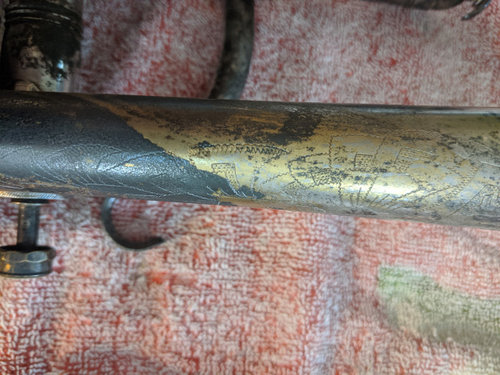
I'm trying to clean up a silver-plated horn that has sat for a while and tarnished. In some places, the silver is worn through to brass. (The wear is from use.) The silver polishes up okay.


The exposed brass is very rough and really hard to polish. I can get it acceptably smooth where there's no decoration but I'm concerned about polishing out the engraving so I don't want to use abrasives and elbow grease in those areas. This is after a light "polish". See the bumpy black stuff where there is zero plate left? It was also likely subject to corrosion from being held there after the silver was worn off. Anyway to clean that up a bit without losing the design? Thanks!


Comments (12)

  • 5 years ago

    Have you tried lemon juice and salt?

    Fori thanked colleenoz
  • 5 years ago

    Do NOT use salt anywhere near silver!
    The chances of any polish you might use on the brass wearing out the engraving are slim to none...but don't use an abrasive....use something like Brasso or that magic wadding stuff in a can. It's wool impregnated with a chemical that removes the tarnish....gently.

    Fori thanked lindac92
  • 5 years ago
    last modified: 5 years ago

    Lemon juice and soda:

    Lemon and Baking Soda Polish
    Combine the juice of half a lemon with a teaspoon of baking soda and
    stir until it becomes a paste. Apply the paste with a soft cloth. If the
    tarnish is heavy, let the piece sit with the paste on it for 30
    minutes. Rinse with warm water and dry

    Non gel toothpaste could also work. Let it set instead of rubbing too hard. I use toothpaste to clean my silver earrings sometimes.

    Fori thanked Olychick
  • 5 years ago

    Thanks all. I'll keep testing things and try not to worry so much about rubbing out the engraving--you do often see restorations of older instruments where it's been buffed down to almost nothing, but perhaps you need a tool for that.


    Question for folks with silverplate knowledge: when the design (like this) has shiny parts and matte/satin parts, that's in the silver and not the underlying material, right? So I should expect shiny brass where the bumpy silver has worn off, right? Or is the brass sandblasted (or whatever) before being plated and the texture applied at that stage instead?

  • 5 years ago

    Matte satin in what? the silver or the brass? is it a trumpet or something else? Is the wear where it would be held? Do you know the brand? Can you google images of such a "horn" and find maybe another like it that might tell you what was meant to be matte finish and what was intended to be shiny?

    Fori thanked lindac92
  • 5 years ago

    The worn spots are where it was held by someone with massive hands.


    I do know approximately what it would have looked like new (it's a cornet by HN White, 1939). It's a popular and inexpensive model with a solid documentation. The silver is matte except where the design has shiny bits. Naturally I can't find an image right now. :) It should look very similar to this undersized image: similar finish Mine is a few years newer with a slightly different pattern. Catalogs show that there were several trim levels available and "satin" silver was a few bucks more than plain brass.


    I'm working with the assumption that the matte texture was applied with the silver so in places where the silver was worn off, it'll be smooth. But I don't know--maybe the matte texture was applied to the brass before being plated? I don't know enough about the process. The brass only versions are shiny all over so I think any matte/satin texture should wear off with the silver.


  • 5 years ago

    Neither baking soda or toothpaste will wear off the silver. If you're seeing the brass being corroded, it might be just where the acid from someone's hand reacted with the brass where the silver is worn.

    Or take a look at this about the prep of brass for silverplating:

    https://www.sciencedirect.com/topics/engineering/silver-plating

    Fori thanked Olychick
  • 5 years ago

    I am not certain that the black was not there when it was originally purchased/made.

    Fori thanked maifleur03
  • 5 years ago

    I'm sorry, I misunderstood what you meant by polishing out the engravings. I thought the engravings were something very fine and you feared using something abrasive would diminish them. I now see that you just didn't want to remove the tarnish from the decorative bits.

    Fori thanked Olychick
  • 5 years ago

    AAH....that "matte finish" is called engine turning and likely the brass beneath has that same finish.
    Use a non abrasive brass polish...baking soda does nothing for tarnish beyond it's abrasive qualities, or electrolytic properties when used in conjunction with aluminum. And toothpaste also relies on abrasives. Don't use it on silver...particularly plated silver.
    Simichrome is a polish using a very very fine abrasive and in a pinch can be used on silver....recommending using on the brass and know it won't hurt if you get some on the silver....but a silver polish will be less abrasive.

    Fori thanked lindac92
  • 5 years ago

    No no you're right the first time, Oly. I was worried about flattening it out completely. It would be NICE to keep the grooved "antiqued" but it think it's not possible". Mai is correct--it probably wasn't there to start with (like with some flatware) and it's not going to make it through the process.


    Thanks for the info, Linda. I have a feeling this is going to take me a while...but what better way to spend a pandemic than playing with a lot of interesting chemicals!? :)

Sponsored
More Discussions