Software
Houzz Logo Print
webuser_370355740

Looking for range hood for specific scenario

5 years ago
last modified: 5 years ago
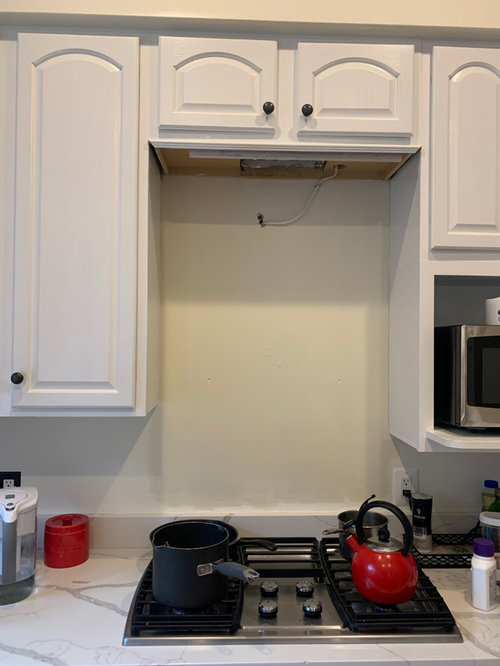
Hi there everyone! I’m hoping that all you knowledgeable folks might be able to recommend a range hood for the gas stove in the picture below.


Here’s the details of our specific situation:


-The empty space you see used to have a built-in microwave, which I removed since we wanted a proper hood above the stove.


-There is a duct at the top of the pictured space that does vent to the outside, The duct path is pretty short, just a few feet to the left of the area in the photo, on the other side of the kitchen wall outside


-I have to double check one more time but I believe the width of the hood area you see is 30 inches, is that some kind of standard?


-In terms of suction power, we would like very strong suction, I’m willing to pay more to get it.


-Going along with that, I’m also flexible on the budget if it means paying a little more gets you quieter suction. Although in the end, the strength of the suction is more important to me than the noise level of it.


-One thing I’d like to be careful about is making sure to get a model that provides good suction on the front burners as well as the back ones. One model I was looking at had reviews that complained that the hood did not provide good suction for the front as well as the back. This would be very annoying to me since Are use the front two burners much more often, since they’re easier to reach and more comfortable to cook on. So even coverage is important.


-We would like as short a hood as possible, (that people still feel would give decent suction) so that there is no chance of bumping my head on the bottom of the hood. I do understand that you get better suction the closer you are to the burners So I imagine there are trade-offs here.


-If possible, I would like the built-in lights to be new or LED types, as opposed to halogen ones, which I’ve heard can throw undesirable heat on your face when cooking


-Color is not as important, although the built-in wall oBen is stainless steel, and the refrigerator is a sort of darker gray gun metal steel, so stainless steel would probably look better than white. Between the white counters and white cabinets the seller went with when they remodeled the kitchen, there is already a lot of white everywhere.


My last question is in terms of installation, how easy or hard people feel this kind of thing is to install on your own.


Thanks in advance for any advice anyone can give! I have read through the different good discussions on the website, but specific models come and go quickly, and a lot of discussions are older, so I wanted to see what currently available models people think might fit the bill for the situation.


Thanks!


Comment (1)

  • 5 years ago
    last modified: 5 years ago

    Assuming those cabinets meet the installation requirements of the cooktop for distance to combustibles, then we have a lot to talk about.

    First, hood suction only applies very close to and inside of the hood. Kitchen hoods depend on the rising cooking plumes (up to 1.2 m/s) to bring the plume effluent to the hood entry aperture. Due to plume expansion with height, the hood should overlap the cooking surface area. In your case the cabinets provide partial plume control, so the overlap needs mainly to be front-to-back.

    What we use blower flow rate (CFM) for is keeping the velocity of the air at the hood aperture high enough that the effluent captured by the hood is moved past the baffles and expelled. One may correctly infer that the higher the hood, the larger it has to be (due to plume expansion) and that the larger hood requires more CFM to keep the intake velocity high enough for the moving air to entrain the plumes and pull them through the baffles.

    So your best approach is the use a 24 or higher inch front to back 30-inch wide hood and provide enough blower to achieve 90 ft/min through the hood aperture. (For more $$$, the cabinets could be replaced so the hood is also wider.) 90 ft/min is equivalent to 90 CFM per square foot of hood entry, and has to be achieved at the pressure losses incurred from:

    • baffle resistance
    • hood to duct transition losses
    • duct resistance
    • make-up air supply resistance

    Without analyzing these in detail, generally a blower rated at zero static pressure at 1.5 times the value obtained above will be sufficient. I.e.

    2.5 ft x 2 ft = 5 sq. ft.

    5 sq. ft. by 90 ft/min = 450 CFM

    1.5 x 450 CFM = 675 CFM rated.

    Higher or lower ratings may be sufficient or needed depending on the MUA scheme and other factors.

    You have a short duct likely too short to fit an in-line silencer.

    Your blower can be outside on the wall, or on the roof.

    Duct diameter should be sufficient to keep the velocity of the air in the duct between 1000 and 2000 ft/min. This is based on the actual flow requirement of 450 CFM.

    I would put the hood at a height sufficient that when you bend to look into a pot or reach a back burner your head height misses the hood. Otherwise, one trains quickly to duck.

    Read hood threads here as well as MUA threads for added insight.

    I don't suggest hood models that I haven't owned.