Software
Houzz Logo Print
poncirusguy6b452xx

Eliminating perched water table

5 years ago
last modified: 5 years ago

I use a vacuum cleaner and a tight fitting vacuum chamber to draw and collected the extra water in the soil of my citrus trees. This also aerates the root and goes a long way to prevent winter time blues root rot and leaf drop.


Steve

Comments (22)

  • 5 years ago
    last modified: 5 years ago

    Steve, the modern day explorer, the stay busy guy!, No stopping you. I am slacking of big time. The dormant season doesn’t mean only to plants.

    Evan, where are you, did you o.d. On citrus?

    poncirusguy6b452xx thanked Monyet
  • 5 years ago

    To reduce the perched water table from a container plant, simply tip the container to the side, and much of the water will drain out.

    poncirusguy6b452xx thanked Silica
  • 5 years ago

    I must give steve some props for creativity :)

    poncirusguy6b452xx thanked Nick (9b) Modesto Area
  • 5 years ago

    Clever. :-) I tend to not only tilt mine, but bounce them up and down a bit. Great for smaller plants, not so hot for larger ones. The down-bounce effectively increases gravity and pulls the water out of the pot much faster.


    I don't think a wick would drain the pot much better than a simple hole, however, as the gravitational differential isn't much more, the water/surface differential relative water pressure not much greater, and you give that up back on the surface/air side by the absorption of the wick to air at the bottom of the pot. Source: Physics, particularly gravitation and Bernoulli. I never did get that thread and figured it was just window dressing.


    But push me and I'll side-by-side it this weekend with equivalent saturated soils. I'll lay bets they both stay saturated to equal amounts and drain within 10% of the same amount of time. It's just that the wick will be wet.

    poncirusguy6b452xx thanked User
  • 5 years ago

    Props for ingenuity. Personally I use drainable rolling trays, ceramic pots with plenty of holes in the bottom and then break up the mix occasionally with a chopstick to aerate. Your method is probably a lot lighter weight and easier to move.

    poncirusguy6b452xx thanked bonsai_citrus_and_indoor_gardening
  • 5 years ago

    I came up with my idea 8 years ago when I planted in topsoil and peat 50-50. I had to ventilate quickly early in the cold season. I have considered Freezing 1/2 inch wet rope and feeding though a drain hole to serve as a wick. My way really aerates the soil thoroughly.

    Steve

  • 5 years ago

    If you're using it to aerate and break up a dense soil (with a frozen bit of rope), that's a bit different than placing a wick and leaving it there from the get-go. :-) I've actually done that with a screwdriver in the base of the pot through the drain holes when I've had a clogging problem (not like the ad), usually with an outside pot and a bit of flooding on the patio.

    poncirusguy6b452xx thanked User
  • 5 years ago

    I use the 3 rock hard frozen rope to push in the pot through the dirt 8 inches deep and leave them to serve as wicks.

    Steve

  • 5 years ago

    You might be better served to remove them. One, frozen solid rope might not be the best thing touching roots. :-) Although I'm pretty sure it'll unfreeze fast enough to avoid most root damage, I'd not sure I'd chance it on a lot of plants, particularly some tropicals.

    Two, the aeration channels can be useful and should collapse on their own. And three, water really doesn't use the wicks to leave the pot very easily, although the wick itself will absorb water...but if it was frozen solid, it's already saturated anyway.

    Wicks are weird. Capillary action happens in soils that function as wicks anyway, so adding a formal wick to outside the container doesn't really help all that much, although you might get some additional initial outlay into the drainage pot (I'd have to test). Intuition and a little snap math says it shouldn't be much, and you'd also have it reverse just as easily.

    (I have the math on-hand for most types of wicks, including glass, because I make candles on top of everything else [seriously, don't get me started]; the wick must be matched properly to the container or things get...interesting. Glass wicks because I like oil candles, although the math there is easy. Sub the coefficients for water instead of the waxes I use and a few little bits and bobs and bingo).

    Gravity, weak as it is, does most of the work for you already. Your vacuum, apparently, does the rest. :-) Strangely, I allow my soils to dry out and aerate that way.

    I may have to work a plastic bag solution with my old Mighty Mite. This looks fun and interesting and a way to annoy the Dear Spouse on a Saturday. "What the #&@# are you doing?" "Aerating the soil of the corn plant."

    poncirusguy6b452xx thanked User
  • 5 years ago

    We all agree that there will be perched water in regular mix. It does not depend on the number of drain holes. It only depends on the property of the soil mix. The height of perched water is fixed for a given soil mix. There are many ways to affect the PWT of a soil. One is to set the pot on another pot of soil making sure both the soil are in contact through the drain holes. Perched water from the top pot will eventually end up in the bottom pot. That is why outdoors I tend to dig in pots in the ground wherever possible. A few inches is plenty. The key is that the soil below be in intimate contact with the soil in the container. The earth acts a giant wick.

    Similarly a simple single rope wick will work. It is a simple way to extend the soil column below the pot.

    Wick will always work as long it is hanging free from the pot and IT'S perched water capacity is shorter than the length of wick freely hanging in air. Eg if you use a 'rope' from a regular rayon mop then about 5-6 inches of it hanging out is plenty. Eventually the bottom say 3-4 inches of the wick will remain saturated - its perched water capacity.

    It is easier to think of the wick as a siphon. Take a glass of water and drop a wick in there and let it hang so that the other end is well below the level of water in the glass. The wick will saturate and go over the edge of the glass and drip down the wick. The water level in glass will start dropping. As the difference between level of water and top edge of glass increases water will keep flowing as long the portion of wick inside glass is saturated. At some point it will be too much and exceed the perched water capacity of the wick. At the that point the siphon will be broken.

    In bonsai like mix PWT is very small or near zero. The action of watering draws fresh air into the soil as water exits out of the drain holes.

    poncirusguy6b452xx thanked tropicofcancer (6b SW-PA)
  • 5 years ago

    "We all agree that there will be perched water in regular mix..."


    Not as such, no. That's the point of soil wicking in and of itself, water tends to cling to itself and cling to soil particles just like any wicking particle. Add soil below it and you'll certainly get a damper substratum as long as the soil you use is identical and the interface contacts at every point. Add a tiny wick and you'll get a wet wick underneath and a stratum that's 0.01% less damp if you're fortunate--but the wicking pressure simply isn't that great.

    As your wick approaches the size of the entire base of the soil, you'll approach the equivalent of a damper substratum, depending on the absorbency of the wick type used (densely packed glass wick won't be particularly good, cotton wick should work fairly well).

    Your glass analogy, in this case, doesn't have any capillary action to the soil, so wouldn't apply. Also, try that with a good cotton wick and see how long it takes to drain a half ounce from the glass. Now try it with a soil that's exactly saturated--but not draining actively. There will be a static bind of water to soil just by the charges exposed.


    Any watering pushes air out of the soil and, as it dries, draws new air in.

    poncirusguy6b452xx thanked User
  • 5 years ago

    I think we are in disagreement over what perched water is. When a medium is saturated with water bulk of the water will flow out of the drain holes. But there will be a portion of soil in the bottom that will remain 100% saturated unless an external force is applied. The height of 100% saturated zone is called the perched water height. That is a property of the medium. All air space in saturated zone is occupied by water. Above that the soil is less than 100% saturated. Basically some of the spaces between soil particles are not fully occupied by water.

    When you tilt the pot or shake it disturbs the equilibrium of forces and some/most of the extra water in the bottom saturated zone will flow out.

    Instead of repeating it here again look at this post: https://www.gardenweb.com/discussions/5868967/how-can-one-determine-the-level-of-the-perched-water-in-a-container

    The post illustrates what perched water is using a sponge. A wick also acts the same way. A good wick will have better perched water properties or even more.

    The wicking material does not need to have exact same properties as the soil . As long it has better wicking properties than the medium it will draw the water out. The target for wicking is draw out the water that occupies the air spaces between particles.

    For a good medium we need good water holding capacity and air porosity. Perched water kills the air porosity. The whole purpose of wicking is to take out the water from the saturated zone. It has nothing to do with water held by and within the particles by adhesive forces and charges.

    Your glass analogy, in this case, doesn't have any capillary action to
    the soil, so wouldn't apply.

    No idea what that means.

    Also, try that with a good cotton wick and
    see how long it takes to drain a half ounce from the glass.

    To drain the perched water from a pot will take much less than half an hr. Otherwise add more wick. It is immaterial. A wick may be slower than shaking the pot but gets the job done especially if you have many pots.

    Now try it
    with a soil that's exactly saturated--but not draining actively. There
    will be a static bind of water to soil just by the charges exposed.

    Static bind of water to soil is of no consequence. We want water to be held by soil medium so that roots can use it. It is the water in the supposed air space between soil that displaces air is of consequence in a medium.

    In the glass analogy, as long as the level of water is within the perched water height of wick it will draw the water out. When the wick is inserted from the bottom of a pot, the perched water level is always above the wick and so will always work to draw the water out.

  • 5 years ago

    I think we are in disagreement over what perched water is.


    No, we're talking about the same thing.


    The water is being held by the soil, via electrostatic force. The water in the glass has gravitational potential energy. Which is how a siphoning process works both via wick (when it does, which is rarely) and tube (which does work because of good old Bernoulli again). The glass argument is completely invalid. That's not quite Physics 201, but it's close.


    While the water in the pot also has potential energy, it's being counteracted by that force or it would already be flowing (to confound that argument). Your wick will saturate, and may transmit that, via capillary action, to the lower tray (so that's one argument I'll allow you where it will work...if the lower tray's material has a material more attractive electrically than the soil as clay or some plastics would be). But you might as well just shake the pot a bit and save the wick volume for more roots.


    Or, as the OP does, use air pressure to pull out the water. Any force differential great enough to overcome the electrostatic attraction of water to the particle charge will work, and many don't require consuming the pot volume.

    poncirusguy6b452xx thanked User
  • 5 years ago
    last modified: 5 years ago

    The water is being held by the soil, via electrostatic force.

    This is why I think you have a different notion of what perched water is. The electrostatic force between water and soil is adhesive force. All it says is that water will cling to soil particles. No doubt about that but is immaterial. But perched water is not caused by that alone.

    Water is held between particles by cohesive forces between water molecules. If the air space is small enough then the cohesive forces will ensure that space is completely filled with water. As long as adhesive forces are greater than cohesive forces an upward capillary force will come into play. This is the capillary force that draws water up the capillary spaces. At some point gravity prevents it from pushing up the air space. Up to that point the soil will be saturated - meaning all air space will be occupied by water up to that height. It is this water that can be manipulated by external intervention. Be it shaking, tilting, wick or vacuum.

    Wick attached below the pot will alter that equilibrium and water will find a path through capillary action and assisted by gravity this time. Perched water (in the pot) will necessarily reduce since the combined capillary column (of wick and pot) is much taller than gravity allows.

    The glass analogy is to illustrate how an unbroken column of water created by capillary forces within wick can lead to siphoning using a wick. The key is unbroken column of water to keep the water moving. Consider it siphon assisted by capillary forces which in normal siphon can be ignored since usual tubes are so big in diameter.

    I do not see the point of introducing Bernoulli's principle unless one is also interested in how fast the liquid will be removed.

    poncirusguy6b452xx thanked tropicofcancer (6b SW-PA)
  • 5 years ago
    last modified: 5 years ago

    Sigh. Have it your way, then. :-) At least they don't do damage.


    ETA: I have to send this one off to a physics professor friend.

    poncirusguy6b452xx thanked User
  • 5 years ago

    Getting back to normally scheduled program.

    Steve how do ensure vacuum force is maintained across various size/shape of pots? I think you had shown a few gizmos before. Post them.

    The pot tilt and shake method is my preferred method for small pots and I have plenty of those. It is more effective if you also have drain holes right near the bottom edge. 511 has some perched water but bonsai soil has very small or zero perched water. Unless they are pot bound I just give them quick shake. During summer I do not bother that much though. If they are growing they can tolerate a bit of water saturation. Plus a large number of my pots are in direct contact with the ground.

    poncirusguy6b452xx thanked tropicofcancer (6b SW-PA)
  • 5 years ago
    last modified: 5 years ago

    My goodness all this talk............ After the pot stops draining, simply tip the container to the side and the excess water will drain out. Its not difficult.

    poncirusguy6b452xx thanked Silica
  • 5 years ago

    'After the pot stops draining, simply tip the container to the side and the excess water will drain out.'

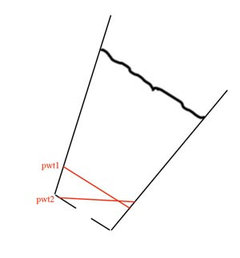
    That's only partly true. Some excess will drain out. The perched water table level remains the same with the container tilted, but the level is now above a different part and the water drains because it saturates a smaller volume of the filling. Returning the container upright does mean the PWT has lowered - but only a bit. The diagram may help explain. PWT1 is the original saturated level. PWT2 is the level when tilted which contains less water than before. The final PWT will be a bit below PWT1.


    poncirusguy6b452xx thanked citrange2
  • 5 years ago

    Tilting the container is plenty good enough.

    poncirusguy6b452xx thanked Silica
  • 5 years ago

    Cool stuff Steve.

    poncirusguy6b452xx thanked tropicofcancer (6b SW-PA)
Sponsored
High Point Cabinets
Average rating: 5 out of 5 stars21 Reviews
Columbus' Experienced Custom Cabinet Builder | 4x Best of Houzz Winner