Software
Houzz Logo Print
greasygranite

Can someone help with grease-stained kitchen backsplash?

5 years ago
last modified: 5 years ago
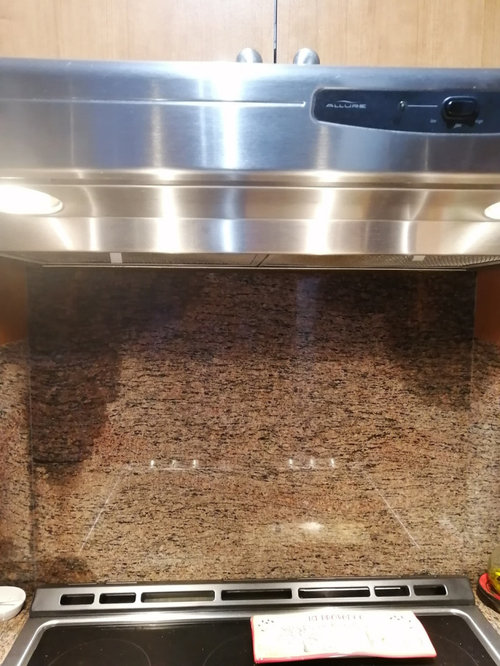
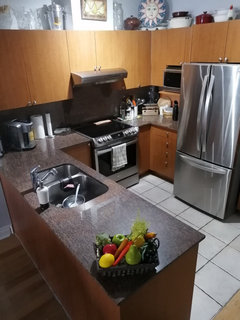
We have a granite kitchen counter with the same backsplash. Two years after buying the condo we noticed that the backsplash top edges were not sealed, permitting exhaust fan grease to seep into the pores of the stone leaving shadowy stains. Can we replace the backsplash with tiles and leave the counter as is? Or, do we need to change counter and backsplash completely? Also, we are having problems choosing style, color of tiles.

Thank you,

Waheeda


Granite Tadoussac

Comments (21)

  • 5 years ago

    Post photos, please.

    greasygranite thanked darbuka
  • 5 years ago
    last modified: 5 years ago
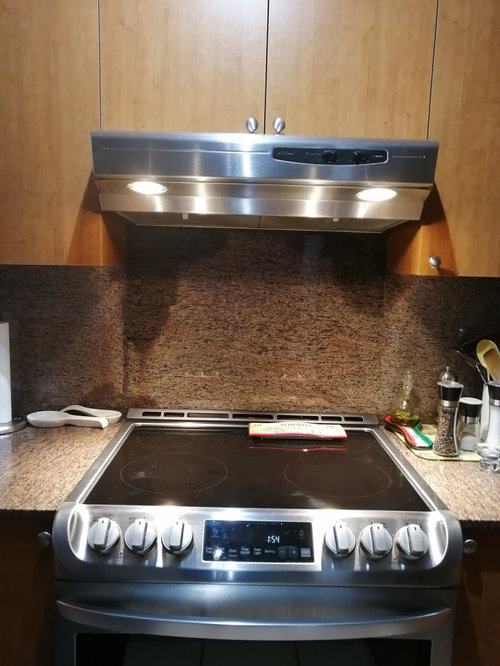
    Wow, now I can see why you’d want the splash replaced.

    If those were tiles, removal would be a fairly simple task. But, one long piece of granite, I’m not sure that could be done without damaging the counter.

    Perhaps @Granite City Services, or Joseph Corlett (can never get his name to hypertext 🤷🏻‍♀️), our forum fabricator/contractors/experts, will give their thoughts...

    greasygranite thanked darbuka
  • PRO
    5 years ago

    I am a fabricator. It should be possible to remove the backsplash without involving the countertop. I can't tell from the pic but if the taller splash behind the stove is a separate piece removing it should be relatively easy. If it is one piece with the adjoining sections of splash removal will be much harder.

    greasygranite thanked Granite City Services
  • 5 years ago

    Once we remove the backsplash, I feel that there is a challenge with choosing the right style and color of tiles. Any thoughts on color and type of tiles to match counter and cabinets (maple color)?

  • 5 years ago

    The vent is not mounted high enough is one of your issues. 30” from the cooking surface is where it should start.


    One other issue are that you need a tall backguard for that range, or anything you put behind it is going to be damaged.


    Het another issue is the vent itself isn’t nearly strong enough. And likely recirculates.


    There’s probably more.

    greasygranite thanked User
  • 5 years ago
    last modified: 5 years ago

    the granite splash can easily be broken apart and removed from the wall.

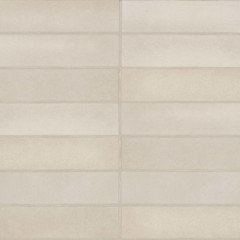
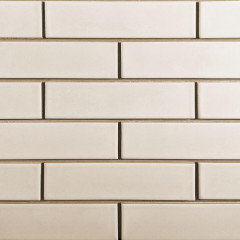
    pick a light color in the granite and use that in a larger subway tile. (something larger than a 3x6 size)

    Something like this soft white color would work. (I can't really see what colors you have or what the entire kitchen looks like).


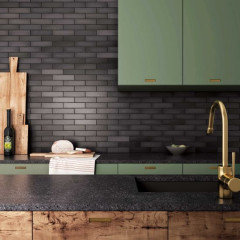
    Or this one. With your rather modern type of look to the kitchen, I'd lay the tile in this stacked layout, rather than the traditional off-set.

    This is Bedrosians Makoto Tatami in beige


    comes in other colors, including this black, which might look really cool w/your cabinets.


    https://www.bedrosians.com/en/product/detail/makoto-tile/?itemNo=DECMAKTAB2510M


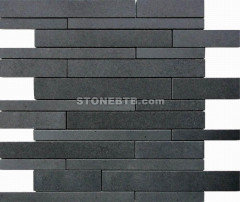
    There are a slew of colors that will work. Basalt or a black slate would also look nice.

    this is a honed basalt. and yes, you'd seal it. once sealed, it would be fine behind the stove. comes in subway tile size too


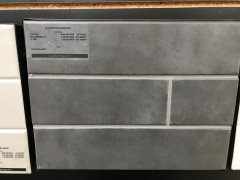
    or you could do a matte porcelain tile. (you can see the white one next to it if you want lighter)


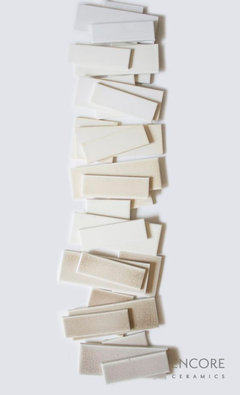
    this would look nice too. Kiln Ceramic in a 2x8.


    Encore Ceramics has a ton of colors, shapes and sizes


    greasygranite thanked Beth H. :
  • 5 years ago

    Thank you all for your responses. Yes, it is correct that the fan is not mounted high enough and it is not powerful. To JuneKnow, I do not understand the reference to a "tall backguard". Could you be more specific?

    To Beth H., the tiles ideas are great. One last question, do i need a general contractor to do all the jobs, such as removal of the backsplash, mounting the fan higher and the installation of tiles?

  • 5 years ago

    Maybe replace the stone behind the stove with a sheet of stainless steel. You could get a metal fabricator to finish the side edges somehow, maybe rolled edges. It looks like the stain may go a little beyond right behind stove so extended the sides of the metal to cover that up too. If the metal doesn't take up too much room you could install the metal over the stone.

  • 5 years ago

    I like Izzy's idea. Just stainless steel over the stove, right over the granite. (It looks like the granite in question is a separate piece so if it had to come out, you could leave the rest in place.)


    That doesn't appear to be the type of stove that needs a high backguard (the piece in the rear with the vents). The damage you have appears to have nothing to do with things a backguard would prevent.

  • 5 years ago
    last modified: 5 years ago

    some people say tile over it, or put something over it in back of the stove.

    I say, Take out the whole thing.

    If you have money to spare, the Tile guy would demo and tile for you.

    If you want save about $500-1000, DIY it. Protect your countertop, flooring and stove with super thick cardboard and thick canvas sheeting over that. get some eye protection. get a hammer and start slowly with breaking up the stone. I've removed my own granite countertop that way. you may be lucky and find they didn't use a lot of adhesive, and it will pull away from the wall if large chunks. if not, use the hammer or similar tools.

    mounting the fan higher. how exactly are you going to do that w/the cabinet right above it?

    optimal height is usually 24" to 30" from the stove top to the underside of the fan. what's your distance?

    Is the vent connected to ducting that leads outside? open up the cabinet above it. see any duct work?

    depending on how extensive that is, you could do yourself, or the tile pro you hire to do your backsplash could probably do it. just ask him first.

    I wouldn't hire a GC if all you're doing is the tile and the vent. He's going to sub it out and charge you a good percentage to do so.

    Check with a good, quality tile store and ask to speak to the manager or owner of the store. Ask him who tiled his house. get that number.

    Yelp is another place to check. only get the 5 star rating guys with more than 30 ratings.

    verify that he's licensed and bonded.

    If you purchase the tile yourself and have it ready to go, and already have the wall demo'ed, you'll pay a bit less than if he has to go and pick up the tile order and demo/dispose of the granite.

    lets see the entire kitchen countertop area.

    check on the ducting to see if it's there

    greasygranite thanked Beth H. :
  • 5 years ago

    Could the problem have been caused by an overflowing grease cup or baffle channel?

    greasygranite thanked ci_lantro
  • 5 years ago

    Thank you all for this wealth of information. To Beth H. I attached another photo of the kitchen from a higher angle. We measured the distance of the bottom of the fan to the stove top....only 23 "!. Yes, we can see that the vent duct is encased inside the cabinet above. The ducting goes outside.


  • 5 years ago

    Do you WANT this to be a bigger job or do you just want to fix the greasy granite problem?


    You can replace the entire backsplash or you can just replace or COVER the bit behind the stove which looks to be a separate piece.


    You can raise the hood or not (has its height bothered you before someone here told you it should?). Your cabinet style would be easier than most to chop down a door.

  • 5 years ago

    Thank you everyone.

  • 5 years ago
    last modified: 5 years ago

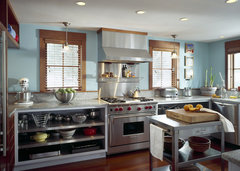
    If that piece behind the stove can come out by itself....I would use a tile that looks INTENTIONALLY different from the rest. Why drive yourself crazy trying to match the granite? Go for contrast. Maybe glass tile in a light blue (or back painted glass) - I see you have a sun platter displayed that has blue in it. And glass will be easy to wipe down.

  • 5 years ago

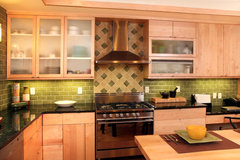
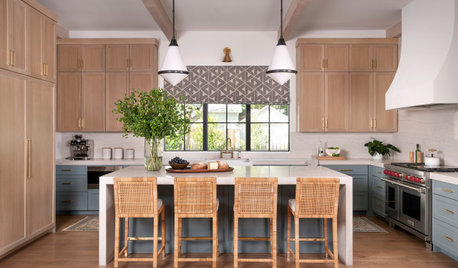
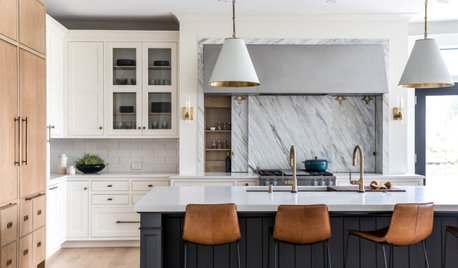
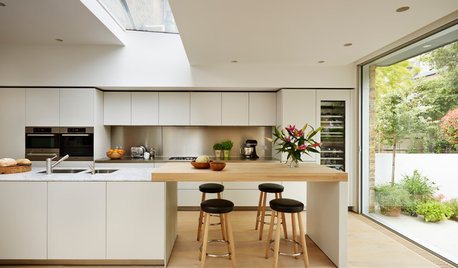
    Make it look intentional:

    Traditional Kitchen · More Info


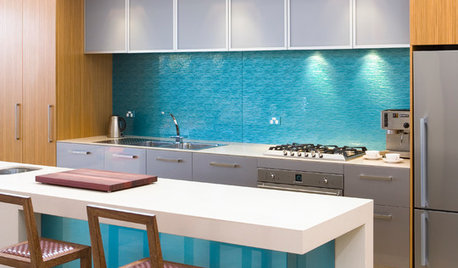
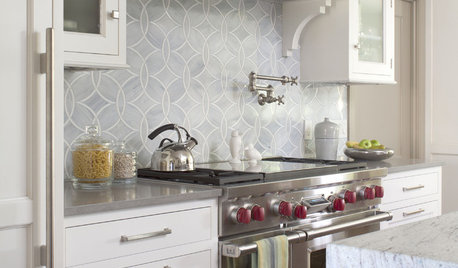
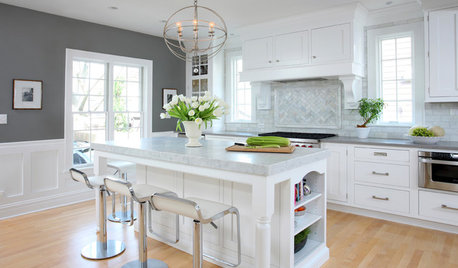
    Insert the color of your choice behind the stove:

    Kitchen · More Info


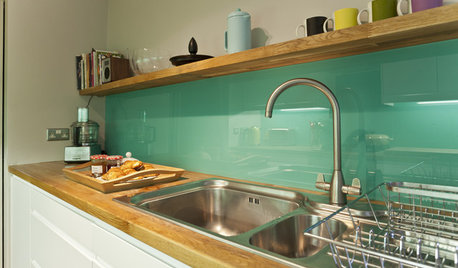
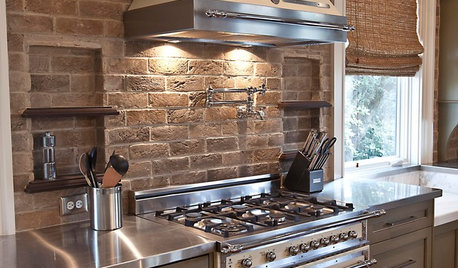
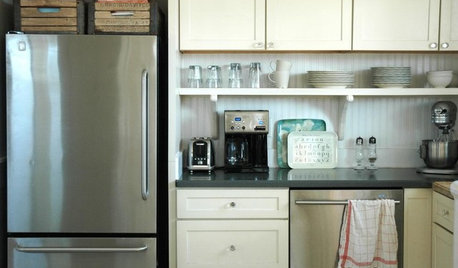
    The stainless behind the stove look:

    Contemporary Kitchen · More Info


  • 5 years ago
    last modified: 5 years ago

    In general, a typical mounting height for range hoods is 20 to 24 inches above the cooktop for electric stoves and 24 to 30 inches for gas stoves. Note that these are general averages and it is crucial that you look-up your range hood installation manual.

    Depending on certain vent hoods, 30" is what is required, but that's usually for gas stoves. Since yours is electric, they put off less heat than a gas stove, so your lower height is prob ok. (although, for comfort while using, I'd want it higher)

    .

    instead of guessing, why not look at the specs for your particular vent, and your stove, and see what they recommend?

    Code requirements diff from city to city, and also need to adhere to a few other acronyms.

    this should settle that argument (as for the backsplash, do whatever you like as mentioned above)

    What Is Required, and What Isn't?

    If you don't live in California, you may not even be required to have an exhaust system in the kitchen (be sure to check), but if you install one, the U.S. Department of Energy (DOE) requires it to conform to standards established by the American National Standards Institute (ANSI) and the American Society of Heating, Refrigerating and Air-Conditioning Engineers (ASHRAE). The relevant standard, which forms the basis for the California ventilation code, is ASHRAE Standard 62.2-2007.

    California requires kitchen ventilation in all new construction and remodels, and even if your local authorities don't require it, you should address it anyway. You can satisfy most local codes by installing a range hood. The capacity of range hoods is measured in cubic feet per minute (cfm), and you determine the required capacity by calculating the total heat output of the range in British thermal units (Btu) and dividing by 100 (for intermittent systems) or by 400 (for continuous systems).

    A range hood servicing a 40,000 Btu gas burner stove, which is standard, should have a capacity of 400 cfm if it's the kind you can turn off and on. If it stays on continuously, it only needs to be able to transfer 100 cfm, or a quarter of the capability of an intermittent system with an on/off switch. An electric stove doesn't generate as much heat as a gas stove, and it emits no combustion gases, so the capacity of the range hood is generally less, and you'll be compliant if you follow the requirements for gas burners.

    What Should the Exhaust System Do?

    The DOE cites ANSI/ASHRAE/IES Standard 90.1-2010 as the determinant for energy efficiency when it comes to range hoods. It lists two requirements that apply to all kitchens. The first is that they must use a limited amount of makeup air, which is air drawn from other rooms in the house, to avoid wasting energy expended by heating and cooling this air. The second is that they must not be short-circuit hoods, which are those that draw makeup air from outside. They should draw all the makeup air from inside the building with no outdoor air allowed.

    You can select from a number of options when choosing a range hood, including cabinet undermount systems, wall mounts (which include wall-mount exhaust fans) and downdraft systems that circulate air downward instead of upward (which is often necessary to vent a stovetop on a kitchen island). All of these should have a fan capable of at least five air exchanges per hour, which means they exchange all the air in the room at least five times every hour while running.

    Many ducted systems have a duct hidden inside a cabinet above the vent hood.

    Requirements for a Makeup Air System

    When you run an exhaust fan in the kitchen, it draws air from other parts of the house, and if your house is well sealed and energy efficient, you could encounter these problems:

    • Negative pressure could draw cold air from outside through the chimney and heating vents, and your heating bill could go up.
    • The exhaust system doesn't get the air it needs and operates at a lower efficiency.
    • Running a kitchen vent fan without makeup air can create negative pressure that pulls exhaust gases from water heaters or other gas-burning appliances into the house, an effect called backdrafting.

    Because modern homes are better insulated and more energy efficient than they used to be, the IRC was revised in 2009 to require that systems that exhaust more than 400 cfm require a system to provide makeup air at the same rate. The revision was further modified in 2018 to state that the makeup system must be capable of preventing depressurization in the house greater than three pascals.

    Some builders try to satisfy this requirement by creating holes in the wall, but this obviously reduces the energy efficiency of the house and drives up the heating bill. The code-approved method is to provide a fan that blows conditioned air into the kitchen whenever the exhaust fan is on. This fan is usually synched with the exhaust fan so that they come on and go off at the same time.

    Many building authorities regard this section of the IRC as more advisory than compulsory, and builders don't always follow it. Installing a makeup air system can add 3 to 10 percent to the cost of a kitchen renovation, which also provides negative incentive for homeowners to comply. However, failure to do so could mean significant extra energy costs, and it could shorten the life of the exhaust system, so the extra expenditure is probably worth it.

    Getting the Most From Your Range Hood

    One of the most common mistakes homeowners make when installing a range hood is to put it too far above the cooking surface. When you do this, the suction from the fan isn't strong enough to attract all the cooking gases and microscopic particles, and they are free to circulate throughout the kitchen. However, you don't want the hood to be too low, or it will get in the way, so 24 inches above the cooking surface is the recommended distance.

    Vent hoods should be close to 24 inches above the cooking surface.

    Many stoves come with their own hoods, and the hood is usually the right size for the stove. If you're installing a standalone hood, it's easy to make it too small, and that makes it less efficient. In particular, many people choose a hood that isn't deep enough to cover the front of the stove in order to avoid bumping their heads on it, and such a hood won't capture the gases from the front burners. Be generous when sizing the hood to make sure it will do the job it's supposed to do.

    Another mistake you might make is to choose an exhaust fan that's too small for your needs. Even if you have a small stove with a total output of only 10,000 Btu, you should choose a hood with a minimum capacity of 200 cfm to be sure all the air from the stove will circulate. Like recirculating hoods, ducted hoods also come with filters, and if you want to make sure your hood is working to its maximum efficiency, you should clean or replace this filter frequently.


    Personally I'd want it higher so it wasn't in my face while cooking.

  • 5 years ago
    last modified: 5 years ago

    I am 5'7". Mine, at 26" is never "in my face". In fact, I can lean all the way over to the back burner (which I certainly have no need of doing but just saying) and never touch the hood. My son is 5'11" and has done his share of cooking here, and also has never had the hood "in his face". Perhaps different style range hoods are more "intrusive" than others? I don't know, but I've been in this house for 22 years and had two range hoods - both at that height - with nary an issue.

  • PRO
    5 years ago

    That grease-sucking stone is disgusting. It's gotta go.

  • 5 years ago
    last modified: 5 years ago

    chessie, OP said hers was at 23". some models extend further forward than others. that's what I meant about in my face. wasn't talking about yours. do you have an electric stove top? anything down to 24" is fine. I have gas and my vent comes out 21.5" from the wall. it's at 30" high. if it was lower I'd be hitting my head.