Software
Houzz Logo Print
heruga

Umbrella pine planting site?

5 years ago

I have a 2 ft tall sciadopitys verticilla ‘Joe Kozey’ awaiting to be planted this spring and I’d like it to be in a site where it is pretty much in the middle of the yard and not necessarily protected. I hear that this conifer needs to be in a sheltered location or else it will suffer winter wind damage. How crucial and accurate is that statement? Is it really to the point I can’t plant it anywhere else than next to a foundation or fence? I guess my question is, CAN I plant it where I want to without having to worry about damage? Our winters sometimes can get brutal with harsh winds and gusts. Also our whole yard is fenced in(6ft), don’t know if that makes a difference.

Comments (23)

  • 5 years ago

    since its borderline z5 in my experience ..... im not sure your z7 knows what is a brutal winter ...


    i wish you would link to these sites where you pick up this info ...


    ACS says its z4: https://conifersociety.org/conifers/sciadopitys-verticillata-joe-kozy/


    of course.. until established.. all trees can have seasonal issues ...


    ken

  • 5 years ago

    oh now this pisses me off .. lol .. as i went to close the link window.. i noted the pic was from hidden lakes gardens ... which a the crow flies.. is about 7 miles from me ...


    i have killed at least 3 of these ... and they have this old specimen .. lol ... i used to be frustrated with all the stuff they got away with in their glacial kettle ... that i couldnt on my windswept plain ,... which brings us back to location.. location.. location ... aka.. micro climate.. micro climate.. micro climate ....


    anyway ... im not sure its an issue in your z7 ...


    ken


    https://duckduckgo.com/?t=ffcm&q=glacial+kettle&iax=images&ia=images


    and dont get me started on the crows ....i want to murder them all ... see what i did there ...

  • 5 years ago

    I’ve raised 3 of these species and killed one so far.. not the easiest to grow.

    Glad to hear they will do ok here, just didn’t know the wind factor part about it. Can they thrive with just 3 hours direct sun? Most say full sun and I don’t see a whole lot of websites saying part shade except in areas with hotter summer climates which I don’t know if northern NJ is considered hot summer climate.

  • 5 years ago
    last modified: 5 years ago

    Walls and solid fences compress winds making their effects worse. And a 6' fence isn't tall enough to shelter a tree very long anyway, same with a house wall that isn't multi-story.

    Where walled areas have a sheltering effect - in addition to the walls being on the tall side - is where there are angles producing protection from at least two directions as in a corner where two walls meet. With the most protective configuration being a courtyard in the midst of a building of some height that encloses the planting site on four sides.

    Walls can also promote better growth by reflecting heat onto plants. However placement against sunny walls can also backfire during Arctic conditions due to sun reaching susceptible plants (broad leaved evergreens in particular) while they are still frozen, causing their cells to burst open.

    Your new tree is a Japanese species = adaptation to copious summer rainfall. That said the biggest examples that come readily to mind for me in my summer dry State are in a heritage garden site and a cemetery. Both locations where it seems there may not have been much of a past history of diligent summer irrigation - I don't know. Otherwise:

    Occurs in mixed middle altitude cloud forest forest at 500-1000 m, with high rainfall and humidity

    And

    Sciadopitys makes a very attractive ornamental, with luxuriant rich green foliage and orange-brown bark, but it requires high rainfall and warm, humid summers for good growth (USDA hardiness zone 7)

    In addition

    This species forms old-growth forests with Chamaecyparis obtusa. Seedlings can regenerate beneath the forest canopy, although small gaps with exposed mineral soils constitute preferred establishment sites

    Sciadopityaceae, Sciadopitys verticillata (Japanese umbrella pine, コウヤマキ) description (conifers.org)

  • 5 years ago

    I have to chuckle when zone 6/7 people say their winter is brutal. Come to Minnesota in January sometime, though this January was wimpy. As I've mention on other threads, I must've gotten really lucky or something but I've had one here in Zone 4b since 2012 with the lowest temp of any of those years being -30f or so in January of 2019. No issues. Doesn't mean a MN winter won't come along and take it out, but in terms of cold temperature tolerance, I think these are tougher than given credit for.

  • 5 years ago

    Page I linked to above says under Citations

    Thanks to M.P. Frankis for preparing the description and much supplementary material

    which makes it sound like he probably came up with the USDA Zone 7 designation.

  • 5 years ago


    Hi Heruga, I am seeing more and more of this problem with umbrella pine in Maryland.

    Whatever the brown is, it spreads and the trees become unsightly and are removed.

    Winter cold is not a problem in your area, also with UP, the more sun the better.

  • 5 years ago

    Maryland Cooperative Extension should be gotten on the case.

  • 5 years ago

    When I meant brutal, I didn’t really mean the temperatures. it’s just the strong wind days that happen every at least once a week here and when you combine that with below freezing temperatures I didn’t know if this species can tolerate that or not since it seems like it’s the most wind weak conifer of all.

  • 5 years ago

    The night before -30 was -25 with winds gusting 30-40mph.


  • 5 years ago
    last modified: 5 years ago

    Sister's house in z6b MD had a healthy umbrella pine prb'ly 6-7 yrs old & 10 ft high. Survived a cold snowy winter fine, grew well in the spring/summer, then rapidly turned brown & died in early fall. Was guessing some kind of root-rot, but who knows....

  • 5 years ago

    I have trouble with this species, and I'm not entirely sure about the reference to "warm, humid summers." I guess it depends on how we define "warm," but here in north Georgia (7b/8a), these seem to require shading from afternoon sun in the summer, and even then I've had them die.

  • 5 years ago
    last modified: 5 years ago

    Japan hot & humid has more consistent rainfall and cloud cover than SE US, meaning soil temps probably stay somewhat lower. And the soil is volcanic and mountaineous on most of the Japanese Isles. One gets the impression Georgia-style red clay is ucommon there.

    Hence the fact that even as far south as Fukuoka there are large Cordyline australis and Rhododendron 'Mars' in gardens, things you are rather unlikely to find in the zone 9 parts of the US SE.

  • 5 years ago

    They just might not have resistance to the endemic diseases present in the east US that native trees aren't usually affected by.

  • 5 years ago
    last modified: 5 years ago

    Notice in depiction I posted above it says "middle altitude cloud forest" and not "hot sticky lowlands".

  • 5 years ago

    Anyone here ever hear of Dr Sidney Waxman? He started the conifer collection at Univ of CT and the U.Pine which doesn't bronze in winter, 'Wintergreen' was selected by him. ACS article

    about him. Heruga is interested in conifers, would be worth the trip to Storrs, CT to see his Umbrella Pines. Observation is a great way to learn about trees.

  • 5 years ago
    last modified: 5 years ago

    Alarming dieback problems - sounds like a water mold is attacking them in some cases. Glad I'm not too emotionally invested in this species (snicker, snicker). I have a couple rare cultivars I bought from Bethlehem Nursery. No apparent disease problems although they are very, very slow growing. I wonder if this is something they've always been prone to and now just more noticeable or prevalent for some reason? We seem to have longer spells of higher dewpoints and heavy rainfall than we used to.

    It is definitely 6b hardy...there is a huge one north of Boston in Wenham, MA.

  • 5 years ago

    I think I'll put mine in a large pot.


  • 5 years ago

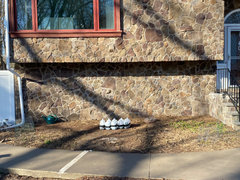
    Hey guys how does this spot look for my Joe Kozey? Where all the water jugs are now or maybe a bit forward. The widest they’ll get after many decades is 6-8 ft so spacing wise I think it is ok. It gets like 3-4 hours direct sun and then shade/dappled the rest of the day. Soil is very good too.


  • 5 years ago

    Looks ok to me although with the window being offset maybe a case for offsetting the tree to the right so that it doesn't block the view?

    I had a Joe Kozey in my very first garden, bought from the old Roslyn Nursery on Long Island (mail order - driving to Long Island when I was in high school would have been like driving to outer Mongolia) but wasn't able to move it when my parents sold the house. No idea what happened to it but might have been shaded out by a Cunninghamia that grew from cutting sized to absolute monster in about 20 years. (was at least 45' high). The 3rd people to own the house after my parents finally cut it down as it was overshadowing the entire rear of the house. That was near the septic box and I will always be convinced the roots of the Cunninghamia got in there LOL.


  • 5 years ago

    Yea I was thinking more to the right as well. How long has this cultivar been in trade? I always thought it was more of a recent one.