Software
Houzz Logo Print
christian_duret38

Ponytail palm dying - Help

5 years ago
last modified: 5 years ago

I've had a Ponytail palm for 12 years now and its been the easiest plqnt to manage in the house. I mastered its watering/lighting needs over the years.2 months ago, I bought a big christmas tree for the Holiday and put it in the Ponytail space ; so and had to move the Ponytail in my dining room (less natural light). A few days after xmas I realized that too many leaves were dried and others were in process of drying. I realized that my wall AC unit which I use for heating (Canadian Winter) had been pushing a lot of heat and was just under 20 feet away facing the plant.Ever since that moment, I moved the plant back to my living room and placed it right in front of a big window and started watering it more often while keeping same quantity (from every 10 days to every 6 days). The baby leaves are still fresh and growing but had to chop about half the leaves which were too damaged.
I noticed that the trunk is also soft when I press it. Same for the round part in the planter :(
Any advice on how to speed up recovery ?

Comments (8)

  • 5 years ago

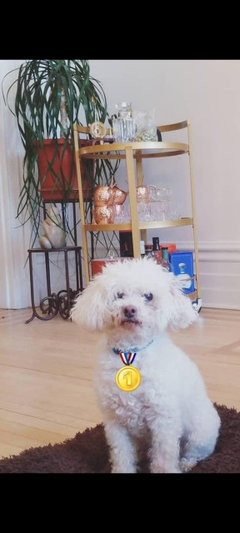
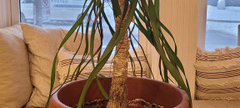
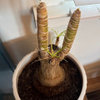
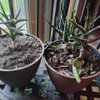
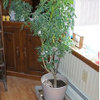
    Here are 2 pictures

    - 9 months ago (picture with dog)

    - Today


  • 5 years ago

    I noticed that the trunk is also soft when I press it. Same for the round part in the planter.


    Sounds like another case of root rot gone systemic. Not much to be done other than allowing the plant to go completely dry before you water it again. I suggest using a "tell" to "tell" you when it's time to water (see below).

    If you're the proactive type, you could lift the plant from the pot, remove all soil from the roots, inspect roots and caudex carefully for symptoms of rot, and, if appropriate (you think the plant is still viable), repot into an appropriate medium (one that is very well-aerated and drains exceptionally well.


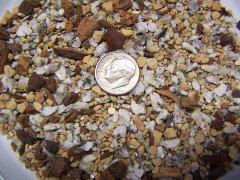
    What I use:


    Using a 'tell'

    Over-watering saps vitality and is one of the most common plant assassins, so learning to avoid it is worth the small effort. Plants make and store their own energy source – photosynthate - (sugar/glucose). Functioning roots need energy to drive their metabolic processes, and in order to get it, they use oxygen to burn (oxidize) their food. From this, we can see that terrestrial plants need plenty of air (oxygen) in the soil to drive root function. Many off-the-shelf soils hold too much water and not enough air to support the kind of root health most growers would like to see; and, a healthy root system is a prerequisite to a healthy plant.

    Watering in small sips leads to avoid over-watering leads to a residual build-up of dissolved solids (salts) in the soil from tapwater and fertilizer solutions, which limits a plant's ability to absorb water – so watering in sips simply moves us to the other horn of a dilemma. It creates another problem that requires resolution. Better, would be to simply adopt a soil that drains well enough to allow watering to beyond the saturation point, so we're flushing the soil of accumulating dissolved solids whenever we water; this, w/o the plant being forced to pay a tax in the form of reduced vitality, due to prolong periods of soil saturation. Sometimes, though, that's not a course we can immediately steer, which makes controlling how often we water a very important factor.

    In many cases, we can judge whether or not a planting needs watering by hefting the pot. This is especially true if the pot is made from light material, like plastic, but doesn't work (as) well when the pot is made from heavier material, like clay, or when the size/weight of the pot precludes grabbing it with one hand to judge its weight and gauge the need for water.

    Fingers stuck an inch or two into the soil work ok for shallow pots, but not for deep pots. Deep pots might have 3 or more inches of soil that feels totally dry, while the lower several inches of the soil is 100% saturated. Obviously, the lack of oxygen in the root zone situation can wreak havoc with root health and cause the loss of a very notable measure of your plant's potential. Inexpensive watering meters don't even measure moisture levels, they measure electrical conductivity. Clean the tip and insert it into a cup of distilled water and witness the fact it reads 'DRY'.

    One of the most reliable methods of checking a planting's need for water is using a 'tell'. You can use a bamboo skewer in a pinch, but a wooden dowel rod of about 5/16” (75-85mm) would work better. They usually come 48” (120cm) long and can usually be cut in half and serve as a pair. Sharpen all 4 ends in a pencil sharpener and slightly blunt the tip so it's about the diameter of the head on a straight pin. Push the wooden tell deep into the soil. Don't worry, it won't harm the root system. If the plant is quite root-bound, you might need to try several places until you find one where you can push it all the way to the pot's bottom. Leave it a few seconds, then withdraw it and inspect the tip for moisture. For most plantings, withhold water until the tell comes out dry or nearly so. If you see signs of wilting, adjust the interval between waterings so drought stress isn't a recurring issue.


    Al

  • 5 years ago

    Sounds like another case of root rot gone systemic. Not much to be done other than allowing the plant to go completely dry before you water it again.


    ==>>>


    well al ... yes there is something big to be done ... just get rid of it .. and buy another if you insist on said plant ...


    and i simply dont buy that moving it for a few weeks for the xmas tree is the root of the problem.. lol.. see what i did there ...


    in the 12 years you had it.. when is the last time you repotted it??? .. media does wear out.. leading to watering issues ...


    ken


  • 5 years ago

    Thanks for the feedback.


    1) I repoted it a few times in the last 12 years. Last time being 2 years ago.


    2) I usually know its watering need and never overwatered the plant. This is why its been doing great for the last 12 years.


    3) when I moved it around xmas, it received to much heat from my AC unit which was right in front of it (about 20 feet away) and a lit of leaves had already dried out. I figured that I would need to provide a lot of water to help the plant. This where I think I got it wrong and overwatered the plant.


    In a nutshell, is your suggestion to let it dry for a few weeks ? Is it too late or can the plant still make it ?

  • 5 years ago

    The simple process of potting up differs considerably from the more thorough act of repotting.

    Not having seen the plant, it's tough to guess at what the future holds. I will say though, the fact you've observed a soft/mushy stem and caudex is not heartening news. I really don't have anything to add to what I've already said. If there's something you didn't understand or something that needs clearing up, just ask.


    Al

  • 5 years ago

    Hi Al, I'm new to plants and posting. I'm trying to absorb as much info as my brain can handle! you mentioned using dowels to check plant water needs. I'm using bamboo skewers but will switch to dowels, but I was wondering how far should I push them in? I have most of my plants in your gritty and a few others in 5-1-1. Seems like at the bottom of the pots it is always damp, but up where I think the roots are is probably pretty dry. I think I've made a mistake of over potting my plants (small plant, large pot), and I usually put the skewer in the plant in the morning then don't check them for hours, I figured it needed time to absorb moisture. I appreciate any advice you can give. Since I started using your mixed, I have had zero fungus gnats! I do have a hard time not planting plants that are top heavy too deep (snake plant), or I have a hard time keeping Donkey's Tail anchored in gritty. I have killed several plants but I am learning from my mistakes. Is there a list anywhere out there that says what plants do better in gritty and which would benefit with 5-1-1? thanks again

  • 5 years ago

    Sorry I didn't post this in the right spot, should have started a new one, sorry christian direct.

Sponsored
Peabody Landscape Group
Average rating: 3.5 out of 5 stars8 Reviews
Columbus' Reliable Landscape Design & Contracting