Software
Houzz Logo Print
chad_wismer0

Helping my indoor plants bounce back

5 years ago

My indoor plants that are inside of an indoor grow house have taken a pretty big beating from mites and mealy bugs. As the plants are small I am going to put bonide 951 or bayer 3 in 1 systemic. I know about the systemic, but it's time to go nuclear. I also need to find a good miticide, not sure which one to go with. But the main thing now is that they are suffering from an iron or manganese deficiency. Im currently using espoma citrus tone. I need some kind of micro nutrient fert that is granular. And also would like to find something that I can use a a foliar spray to try and green stuff up as quick as possible. Any thoughts or recommendations on pesticide and miticide. I'm currently using bonide orchard spray which is sulfur and pyrethrins, which is labeled of the mealy bugs and the mites, but it just isn't doing much. I have also been using a pressurized hand sprayer to spray water to try to knock of the pest. But I've decided it time to go systemic and something that is more effective against mites. Most of them need to be reported. I would like to try a foliar spray to try to freed things up quick, then in about a week or so pull them out to wash the whole plant( could use some pointers, I've never done this) and mix in something for micro nutrients and my regular npk fert. Unless someone has a better fert that they recommend. Then when the report and washing is done I would like to put down a systemic(mix with soil when repotting?) And then before putting them back spray them down real thoroughly with a miticide. I'm also thinking of venting my enclosure to outside and dropping a bug bomb in it to try and kill anything that may be crawling around in it. Could that be done with plants in it? To maybe try to get some of the bugs as well that are on them.

Comments (24)

  • 5 years ago
    last modified: 5 years ago

    Excellent control of all insects that attack citrus (scale, mealy bug, aphids, white fly, mites etc.) can be eradicated with a horticultural oil spray. If your trees are container grown, organic fertilizers are a poor choice. Organic fertilizers need to first be broken down into a useable form that the tree can use by microorganism. Container mediums do not contain the microorganism needed.

  • 5 years ago

    Any thoughts on a good fert to use?

  • 5 years ago

    "Container mediums do not contain the microorganism needed."


    Actually, this statement is not true, as evidenced by the fact that liquid organic fertilizers work just fine and are widely available (and I use solid ones as well, although these require more judicious application). However, the argument isn't really worth the time it takes to have it, I suppose.

    So in this case, the Espoma Citrus Tone actually wasn't too bad a choice as the nitrogen is 40% water soluble and that's available quite quickly. The other sixty percent? Well, that requires decay, and indoors, that can take a while. It's certainly not as efficient as it will be in better environments, but "mediums do not contain the microprganisms" is completely untrue. They will as soon as you add the food. That's why things rot.


    For a good balance, I wouldn't use more than 10-20% solid organic feeding with the remainder liquid organics and synthetics. For beginners or the casual plant grower, restrict it to 10%.


    Other than that, a good synthetic would be a slightly nitrogen rich mix, most places recommending about 2-1-1 ratios give or take a lot. There are plenty of specialty fertilizers around, but if you have a lot of plants, that would mean that Miracle Gro 24-8-16 would be within spitting distance.


    Espoma makes insecticidal soaps, insecticidal sprays, and neem oil (horticultural oil), all of which will help. I have a home brew that works perfectly, if temporarily, but I'd rather have a day off from being screeched at by the ignorant who can't figure out basic chemistry. Ask me if you want it, though, I'm at the point of simply telling them to bugger off. It works, and I can't fix stupid.

    You may have to keep after spider mites; the mites are easy to kill. The eggs are not. And things can hide in the smallest of spaces on the tree and in the leaves. Try to hit everything when you spray.


    Repotting of citrus isn't best-done in February. :-) And mites don't generally inhabit soils anyway. Hold off until late-ish spring for that when the tree is in active growth, unless you're somehow forcing the issue now and the tree is in active growth (it doesn't sound like it, though).

    Leaf yellowing is also normal in the off season, and I'd rather see you try a foliar spray of iron or a soil drench of iron well before manganese. Note that the Miracle Gro mentioned above contains both at maintenance levels, but adding a bit more iron won't be a problem (I do it myself at times). Manganese...must be done delicately.


    You can source ferrous sulfate (and manganese sulfate) online through any good chemical store or eBay or the like. Make sure they're reputable. For MnSO4, you'll probably never need more than an ounce for one tree. For iron, if you use it everywhere, probably start with a pound. For the iron, I'd suggest ferrous sulfate heptahydrate as you'll see ferrous sulfate monohydrate as well (I have both, but use the latter for other purposes).

    Iron can be applied a little loosey-goosey as it's not what I'd call a delicate procedure nor something that the vast majority of plants object to--certainly not any citrus tree. Take a tiny pinch, put it in a quart container or so, add water, stir to dissolve. Water the plant. That's the iron needs for about three months. If your soil was already high in iron? No problem, iron binds easily, and levels aren't toxic until over 50,000 PPM and very low pH, if even then.


    Manganese is not something I recommend adding blindly and should only be done at the recommendation of a very good soil test, however. It's not the most touchy of micronutrients (that would be boron, copper, and cobalt), but can be an issue if it rises too high. I happen to be in an area with an excess of manganese, but everything does fine; levels are in the 125 PPM range, which is astronomical.

    Take about three grains of magnesium sulfate and do the same, or, if you can measure that finely, measure out 1 gram of sugar, remove 1/10th of that volume, and replace it with manganese sulfate. Sweep the manganese into a cup (if some sugar goes, that's not a problem). Put it in a quart container or so, add water to dissolve, and water your tree. That's the manganese it's going to need for at least three months.


  • 5 years ago

    A second thought; if what you have is also fungus gnats, you may actually have gnats arising from the soil. In that case, mosquito dunks can be broken up over the surface and apparently that works with each watering. I haven't tried it yet.

    I use 1 part hydrogen peroxide to 5 parts water, and water the plant. That kills the larvae on contact and it's something I keep around the house for several purposes anyway. It can also be used to combat root rot, although I find it of limited use there (however it's almost the only thing that has any impact on it, so...)

  • 5 years ago

    Horticultural oil will take care of most of your problems. Turn the lights off after spraying. For fungus gnats get the mosquito bits, or anything with bti as it's main ingredient. Or go the low tech way and put a layer of sand over the soil. The sand method is guaranteed to work. Stay away from organic fertilizers in containers.

  • 5 years ago

    morphespa, your posts are about as wordy as AL's posts. As I wrote, and Ken B wrote, don't use organic fertilizers when growing in containers.

  • 5 years ago

    Probably the best fertilizer you could use for any houseplant (or pretty much any containerized plant, indoors or out) is Dyna Gro's Foliage Pro 9-3-6.

    Formulated in the ratio most plants prefer and how they utilize the primary nutrients, it also contains a full range of micronutrients. Fully water soluble and with dilution rates specified for various fertilizing programs. Also avoids the reliance on the boom or bust soil microbial populations in potting soil that make organics much less effective.

  • 5 years ago

    Chad: Although, I would not use it on edible crops, Bayer 3-in-1 should take care of spider mites. Recently Bayer 3-in-1 changed its formulation and removed Imidacloprid - at least in our state. Bonide 951 is only Imidacloprid. You can use both together if you want. BTW Imidacloprid is very harmful to bees. Europe has banned its usage. In US it is still allowed but I see recent trends in removing it from household pesticides.

    I would encourage you to seek other means. You asked about washing a plant. It is just what it implies. Hose down a plant with water. DO it well and try to hit every surface and corners. You will have to repeat. Same with HO or soap treatment you will have to repeat every 4-5 days or so. Indoors I use the bath tub for the larger plants. Replaced the standard hose on hand held shower attachment with a 7 foot one (from HD) to make it easier.

    Ultimately, proper soil, cultural conditions, watering habits, being vigilant keeps a lot of pests at bay.

  • 5 years ago

    Boom/bust situations do NOT occur with inground plantings, which is why organics are much more efficient under those conditions. Populations simply continue to grow as long as organic matter is available. This is not at all the same with containerized plants potted with any recommended soil-less mix. Nor are the populations anywhere close to what they would be in garden soil or compost.

    Trial a good synthetic against your organic of choice - the differences are obviously noticeable. But some just prefer to cling to unsubstantiated personal theories. Organics rarely offer a full range of micros either.

  • 5 years ago

    Chad: post some pics your plants, especially the leaves to determine what kind of deficiency you have. In winter several apparent deficiencies show up because of altered cultural conditions. Not all of them are critical.

  • 5 years ago

    LOL! Feel free to unsubscribe to a few more :-) Your longwinded comments are invariably overly complicated and confusing and typically diverge widely from the subject at hand. And typically presented in a very heavy handed, sarcastic and patronizing tone.

  • 5 years ago

    For a small number of plants, many of use Dyna Gro (foliage pro, iirc).

    I have switched to Peter's 25-5-15 that is more cost effective for the number of plants I have.

    Both have micros and are liquid.

    I also use a chelated iron with micros in the spring (Jan thru March is suggested for commercial growers). I have been using it as a foliar but am going to simplify and just do it as a soil drench. Fertilome Chelated Iron is what I use.


    Hort Oil really is effective, of course you do need to coat all the insects for best control, and that can be a little tricky to get all the surfaces treated. You might look at Spinosad, as well.

  • 5 years ago
    last modified: 5 years ago

    Pardon me from butting in again. It is on organic soil and fertilizer in containers. Long piece so feel free to ignore. Fair warning.

    Earth is a very different beast than containers. A few simple observations will illustrate that and why organics do not work well (especially in the long term) in containers.

    Ground is a relatively very stable environment. In general, the temperatures in subsoil remain stable over long time and rises and falls slowly. Moisture and air content also changes remains stable. Exceptions do occur but those parts of world either have little vegetation or some extremely adapted ones. This stability is ideal for microorganisms. Their population and diversity follows the seasons. There is only one boom (summer) and one bust (winter) for them. Organics work exceptionally well here.

    It is not that containers do not have microbes. They do but they do not have the luxury of the above stability. The conditions can wildly fluctuate on a daily basis. Temperature can swing wildly. A container can easily reach above 100F killing a good chunk of the microbes. Smaller containers are more vulnerable for obvious reasons. In a greenhouse this wild fluctuation can be somewhat controlled. They resort to shade clothes, misters and other mechanisms to keep environment in a stable zone.

    The other part of the equation is moisture/air balance in container soil. Much has been written about it especially by Al. Most bagged soil will hold too much water especially near the bottom of the pot creating anaerobic conditions. Bad for the roots and bad for the good microbes. In ground this situation is less likely to occur and even if it does there are various means to correct it.

    Presence of organic decomposing material in containers makes this balance even worse as organic matter decay. What starts out as a workable soil mix ends up being compacted. Often because of excess moisture and low air content, anaerobic bacteria start dominating - not a good thing - and contributes to decline of plant health and root rot.

    The effect of poor choice of soil becomes much more apparent when plants are brought indoors in winter. Plants come in stressed and weaker than should have been. GW/Houzz explodes with post on plant problems in winter. Not a coincidence. They can all be traced back to poor cultural conditions and it all starts with soil and fertilizer choice.

    A good example is number of posts on fungus gnats. All solutions point to a combination of Bti, sand, peroxide, neem, soap, systemics etc etc. But no one wants to admit that it is fundamentally a cultural problem. Organic matter in soil, organic fertilizer and too much moisture in soil is like a fully paid vacation resort for the fungus gnats. Eliminate the source and you are done.

  • 5 years ago

    If you’re so busy, why are you still responding? If you have so much going on in your life, you probably shouldn’t have time for this forum. Paint under your yellow lights and enjoy your evening.

  • 5 years ago

    Morph said: Thank you folks, but please stop PM-ing me to this thread. I don't care
    and I'm sure I'd see the problems if I were to bother to read the
    blather, but I'm not going to. I'm busy this evening.

    I am wondering who PM-ed you given the posters on this thread are limited and their inclinations can be deciphered. Whoever did probably would like your opinion. Not nice to throw him/her under the bus publicly.

  • 5 years ago

    Lol at morephus. His/ head must be huge!

  • 5 years ago
    last modified: 5 years ago

    Lordy, lordy!! Talk about some over the top overreaction to opinions that might differ from yours. Does it not make you wonder why - even slightly - your one-sided opinions are not greeted with the respect you seem to think they deserve? That yours seems to be the only dissenting voice? And an overly loud one at that. You might want to ponder that a bit.

    "some adults who don't try to scream and insult down an alternate opinion"

    An apt description of exactly what is happening here.......although it would seem to be you that is doing the bulk of the screaming and insulting. And the source of the histrionics and poo-hurling.

    Really, how childish can we get?

  • 5 years ago

    Thank you. I tried to post some pics, but they didn't make it on here nor the post that went along with them. So I have tried spraying with water every day, and hort oil, with minimal results. So I got what I could today while I was at the hardware store. I put a pinch of espoma iron tone in each pot, mixed it in, the watered with miracid. The miracid seemed to have a good bit of micro nutrients. Then I made up a cocktail of southern ag citrus nutritional spray, and bayer 3 in 1. And thoroughly sprayed all lead surfaces underside and top side, and also got the trunks and branches. I am thinking I probably will give them the bonide house plant granules. I am not going to be letting any fruit grow until the plants are back to being healthy and full of leaves. My blood orange is exploding with new growth, but it was recently re potted. The others need it to. But some of the other plants have some new growth and some are getting ready to push out new growth. I will say that I have plants in the grow enclosure at 70 to 75 degrees and 12 hours of full spectrum light. So as far as the plants know ita not winter.

  • 5 years ago

    Yes, people, it's another long post. It's a complex subject. Deal with it and if you have an opinion, I'll print it out and stick it in the pocket next to my heart. As for the rest of you, you know where you can stick it. :-)


    Unfortunately, they always seem to know it's winter. :-) But that should help!


    "Then I made up a cocktail of southern ag citrus nutritional spray, and bayer 3 in 1."

    I'm not sure about how edibles (if you eat the produce off that tree) have to be handled post-spraying and for how long, but I'd check on that.


    For mild outbreaks caught early in the future, I'll avoid recommending a bit of soap because, although it works perfectly, the screaming will start again and while I'm armored and don't care, I'm sure you would rather it didn't. But in the interest of not recommending 1/2 tsp of soap in 1 gallon of water, spray, let sit for 5 minutes, then rinse off in the shower, which you'll note I did not recommend, but will kill adult mites.


    Iron tone is another organic fertilizer. Again, I'm not going to take you to task for this. By the time any of the major issues above (and they do play a factor) are a problem, you're going to need to repot the durned trees anyway--which you should be doing. I find the arguments spurious at best. But even I don't recommend more than 20% of fertilizer as solid organics, and it does seem like you're going past it (too much absolutely will clog the soil's ability to naturally drain itself and it does need time to decay appropriately--this takes longer for potted plants).

    Most of the...uh, esteemed opponents...above ignore the 10-20% recommendation and seem to think I'm advocating pouring it on by the kiloton. I'm not.

    Save the rest for outside. In the future, I'd recommend ferrous sulfate heptahydrate, which will both acidify the soil a bit AND add iron.


    Miracid's fine, but don't overuse it. Citrus trees prefer a soil pH of 6.0 to 7.0 and Miracid will push your pH below that. I'd say get Miracle Gro or any of the recommended brands above...or really anything else with micros in it. Honestly? They're all about the same and they all completely dissolve in agitated water. These days, it's even easy to DIY your own if you want to!


    It's possible to correct pH...but easier just to repot the tree. Iron accessibility is just fine at a pH of 6 to 7.

    (Forget most pH home tests, they're awful, and the few that are "good" have variances of 0.2 to 0.3, which is...tolerable...and still tell you absolutely nothing about how to fix the problem if there is a problem. Do you add Ca, Mg, K, dispel Na? The test is silent on these points, but if you're using it to tell you if you need to repot, that would be acceptable).


    Yep, sorry for the information dump, but that pretty much covers it. I'm sure somebody will complain about it somewhere since they already did... :-)


  • 5 years ago
    last modified: 5 years ago

    Chad: Generally it is not a good idea to mix several chemicals together unless you know how what you are doing. Daily application of a pesticide is also not a good idea. Wait at least 3-4 days between applications. You are probably doing that but from your post it seems you are doing something everyday.

    Couple of more things. Bayer 3-in-1 is not a contact killer. It will take a few days for the effect to show. Second, you also need to drench the soil so that the plant can also take it up through the roots. Same with Bonide granules.

    Fertilizers take time. If something is wrong with the soil adding more fertilizer can cause even more stress. I would try a reset. Flush the soil very well. Use warm water. Flush it at least 3-4 times in a row with about 10+ min gap. Then lightly fertilize it and also add the systemics if you want.

  • 5 years ago

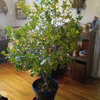
    I use compost from my compost pile with pine bark shreds an Perlite. There are a lot of earth worms in it. I don't know how well organic fertilizer will work with my trees. I have found that all of the organic fertilizers do not come close to the 5-1-3 NPK ratio and Miracle Gro 24-8-16 properly mixed with 20-0-10 grass feed does for a much lower price. your-in doesn't have a proper ratio either. From Bud burst till now this is my Fukushu kumquat tree on Flying dragon rootstock in 4.5 month of growth.


  • 5 years ago

    "I use compost from my compost pile"

    Organic feeding becomes compost after it decays for a while. This is another reason I find the arguments above to be of somewhat dubious merit when compost is a recommended addition to base soils. Per one argument, it won't decay in the pot, but will decay in the pile with nothing else but itself? :-)

    Compost, like any other organic, eventually decays off to essentially nothing (or, at least, incredibly long-chain humates, but pots aren't peat bogs either, and neither is my outside soil). Regardless, most of the mass is lost to the air. But you would be repotting before that happens, hopefully.


    "I have found that all of the organic fertilizers do not come close to the 5-1-3 NPK ratio"

    Tru dat. They do vary, but tend to be a bit low in the K. Soybean comes close at 7-1-2. I'm not really a fan of adding resources blindly (P and K can be thrown out of balance very easily, particularly in a constrained environment), but with repotting, one should generally throw out the soil before it becomes too out of balance. Hopefully.

    For the most part, once I'm sure I have enough P in place, I generally feed with N and K (which will leach more easily and where a bit of overapplication is far less serious; discarding the soil later is not considered pollution).


    And again, I'm not saying to use organics as 100% of the feeding; closer to 10-20%. I balance out with liquid kelp (N and K primarily) and dissolved urea (pure N). People keep ignoring that.

  • 5 years ago

    So I just checked on my trees, just got off work. I think that the nutritional spray has helped. Things are looking a bit greener, and the yellowing is starting to darken up. Also I did see a difference in bugs crawling around. I hit a couple hot spots with a spray bottle, and also sprayed everything with the nutritional spray again. I'm hoping they are on the fast track to being back to normal. I just need to get the imidacloprid in the soil and I think my infestation issue will be resolved after I was and repot some of them. It was definitely nice to see an improvement as opposed to the decline I have been seeing.


  • 5 years ago

    "I just need to get the imidacloprid in the soil"


    Just a quarter inch of watering in takes care of that. Keep in mind, it doesn't work instantly.


    "Also I did see a difference in bugs crawling around. I hit a couple hot spots with a spray bottle, and also sprayed everything with the nutritional spray again."


    Most sprays do take 3 to 14 days to reach full effect, so I'd back off for now. I don't think the nutritional spray will be a problem at all (foliar absorption isn't that great in terms of what you can get into the plant and I've never heard of an issue even with boron and cobalt). But the insecticides definitely shouldn't be overused. They're not good for you, and they can also harm the plant.

    Even things as simple as Neem aren't harmless. Far from it. http://npic.orst.edu/factsheets/neemgen.html

    You aren't a cat and you sure aren't pregnant, but this should give you some indication of how cavalier people are about recommending it...and how little we've studied the stuff. "But people drink it!" they'll cry. Yeah, and we used to put lead in our makeup and Red #2 in food. We study, we learn. :-)