Software
Houzz Logo Print
weedyacres

This hood is too low, right?

5 years ago

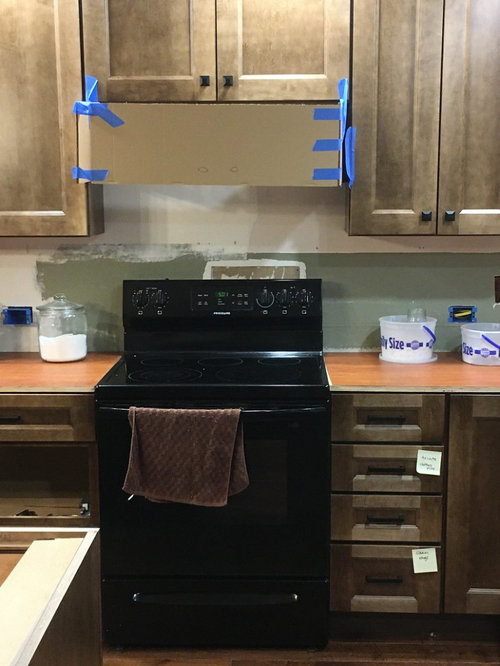
I'd like a decent 600 CFM vent hood. Not super showy, as it's not that kind of kitchen/house, but something that will whisk away the fumes and grease. I found one, but it's 10" tall and 22" deep, which makes the bottom of it be only 26" above the range.


We did a cardboard mock-up and it seems very in-your-face (quite literally). I've pantomimed cooking stuff and I don't exactly bump my head, but it just seems closer than I've had hoods before. But past hoods have always been the stock big-box ones that are <6" tall and less deep. Or OTR microwaves, which are less deep.


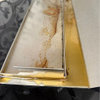
Here's a photo from the side. There's a black sharpie line showing the slant that the actual hood has to its shape.


And here's a front-on view. I drew sharpie eyes where my eye level is. I'm 5'-7".


What think you, fellow Houzz-ers?


If this is a no-go, are there any shorter hoods that can give me 600 CFM and have SS baffles? I haven't managed to find any yet.

Comments (20)

  • 5 years ago

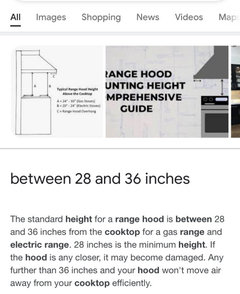
    I Googled:

    weedyacres thanked Painted Peggies (zone 6a)
  • 5 years ago

    Can you remove the cabinet and do a chimney hood?

    weedyacres thanked Painted Peggies (zone 6a)
  • 5 years ago

    Chimney hoods are more budget than I want to spend. I was looking in the $300 range.

  • 5 years ago
    last modified: 5 years ago

    I think the problem is over constrained. You can trade off among performance, cost, and aesthetics, but when the cost is set so low, there is no level of ignored aesthetics that gets you adequate capture and containment performance from a hood system. I also doubt the baffles and 600 CFM capability for that price. Please let us know the brand (with a link if possible) and what ducting you have or intend to install.

    In many municipalities, the IBC is adopted, and this requires deliberate make-up air above a rated 400 CFM. So what will be your MUA scheme?

  • 5 years ago

    I think you might have to give up the baffles. And the $300 range. I've been pretty pleased with slideout hoods before, but again, no baffles and no $300 if you want decent CFM. They kinda disappear though (especially when you bang your head on them).

  • 5 years ago

    I would think you have to look at the installation instructions for the hood and what the minimum and maximum height from the stove top is. Our hood specified 30 inches from range top for best performance.

  • 5 years ago

    It does look just a smidge too low to me Weedy.

  • 5 years ago

    If it's in your face and bugs you, it's too low!

  • 5 years ago

    Several height guides recommend 20-24 inches above an electric range so your 26 inches is definitely not too low, the lower it is the better the capture. If I remember correctly my Venmar hood instructions said 24-30 inches which would be appropriate for both electric and gas. That 28-36 inch guide does not make sense to me. Venmar and I think most prostyle home hoods are 18 inches tall and can be equipped with a 12 inch tall duct cover above hood which means for a standard 8 foot ceiling height the hood is mounted 30 inches above stove top so max of their recommended 24-30 inches.

  • 5 years ago

    My local code requires the hood to be a 30" minimum above the stove...

  • 5 years ago
    last modified: 5 years ago

    I'm asking about height for appearance and user comfort, mostly the latter. I think part of the in-your-face is that it comes out 22".

    This is one that I was looking at. We'll put in whatever ducting it calls for (6" or 8"). It's an outside wall.

    In retrospect, I should/could have made the cabinet above it shorter, but I wasn't thinking that far ahead. ;-)

    I don't think makeup air is an issue. This is in a 29x32 wide open great room.


    I guess the question is: can I find a 6" tall hood with high CFMs? Taking price out of the equation.

  • 5 years ago

    Hmm, I found this one. I've not heard of the brand, but it's 6" tall, claims 800 CFM, and costs $315.

  • 5 years ago

    Our hood is 30” above cooking surface as was the recommendation. My dh constantly bumps the top of his head on the corner of it. Wish I had gone a few inches higher.

  • 5 years ago

    The requirement for capture is that the hood overlap the rising and expanding cooking plumes. For analysis purposes, one can assume that the plumes are conical and expand at a ten-degrees from vertical angle from every hot point on any pan that might be used on any burner. So higher implies using a larger hood, but even at zero height the hood has to encompass all the pans.

    The requirement for containment is that no plumes reflect from the hood guts and spill out before being entrained in the air flow into the baffle gaps. For hot cooking (where the oils and greases are partly vaporized), and common residential hood configurations, 90 ft/min at the hood entry aperture seems sufficient.

    Insufficient hood airflow over a griddle as viewed with schlieren photography of hot rising air.


  • 5 years ago

    "I don't think makeup air is an issue. This is in a 29x32 wide open great room."

    It you will truly have a 600 CFM hood then MUA is critical for both safety/health and hood performance (which affects safety/health). The room size makes little difference. The only exception would be if you live in a climate such as Hawaii where you have windows & doors open to the outside nearly full-time.


  • 5 years ago

    I just measured mine for the heck of it. Mine is 30". I'm short and even I wouldn't want it any lower than that.

  • 5 years ago

    "I don't think makeup air is an issue. This is in a 29x32 wide open great room."


    If you have ANY fuel burning appliances ANYWHERE in the house, like a water heater, furnace, or fireplace, it is an issue. It is code IRC M1503.6, and is there for a reason. You don't want to create backdrafts and bring deadly CO into your space. Merely opening windows does not comply, the intake must have a mechanical damper tied to the exhaust.


    If your entire house's appliances are electric, carry on. If not, you will find a plethora of available hoods at 400cfm - buy one and it will save you lots of trouble.


    Besides, with that 30" electric range I don't imagine you'll be doing the cooking where a 600cfm hood is critical. BTW, not to zing you, but your upper cabinet is 36", your lower cabinets don't match the width.

  • 5 years ago

    "I don't think makeup air is an issue. This is in a 29x32 wide open great room."

    It is an error to assume that the house volume can feed air to the ventilation hood without any repercussions. If one had a positive displacement pump, one could pull 600 CFM from a 29 x 32 x 10 room for 15 minutes until reaching a state of pure vacuum. Of course, if the house is constructed of standard materials it would implode long before reaching complete vacuum.

    Kitchen hoods blowers have a low tolerance for pulling a vacuum on one side of the fan. 2 inches of water column is about the limit. As the water column supported by atmospheric pressure is about 407 inches, two inches is 0.005 of that. Hence, the great room would allow only about 5 seconds of blower operation before the flow would become negligible (assumes a vertical fan curve to 2 inches).

    Either supply make-up air or operate with the hood blower gagged to some level determined by house leakage while also enjoying whatever the resulting modest pressure drop pulls through the wall cracks.

  • 5 years ago
    last modified: 5 years ago

    Yeah, our 30-year-old house has plenty of leaks around doors and windows. I think it unlikely that we could get anything close to a vacuum.

    We are (sadly) an all electric house. I miss having a gas stove, but the closest gas supply line is 1/2 mile away.

    Fair point that 400 CFMs are probably plenty. I don't anticipate needing to ventilate massive volumes of smoke, so perhaps I should downsize my wishlist.

    I purposely made the upper cabinets wider than the stove, to allow for a wider-than-stove vent hood. Plucked from the Houzz compendium of standard kitchen design recommendations.