Software
Houzz Logo Print
brandiatl

How to properly plug skirt board?

5 years ago
last modified: 5 years ago

Background:
Over three years ago, I hired a flooring contractor to replace carpeted stairs with red oak treads and risers. The majority of the treads and risers were not cut for an acceptable fit, leaving large gaps between the treads and risers and skirt boards which they asserted can be filled with caulk and be unnoticeable despite both my treads and risers being stained rather than painted. They also left large holes in the skirt boards that they also asserted could be filled with caulk. I rejected both and demanded all treads and risers be replaced and that they figure out how to repair my skirt boards. I never saw them again.

Fast Forward:
I’ve sulked long enough and have decided to have the treads and risers ripped up and replaced a second time once life is “normal” given they are in my entry stairwell and I’m sick of them being unfinished.

Question:

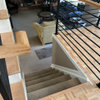
  1. Is wood filler the appropriate way to fill in the shallow hole - some of the others are much deeper - seen in the included picture?
    Note: The previous contractor stated that the builder-grade OSB treads were accidentally removed from these holes when cutting off the OSB lip to prepare for install of red oak treads and risers. I don’t know how “accidental” it truly was given there are 12 holes across 14 steps where the areas are either noticeably too shallow (10) or thru-and-thru (2).
  2. Might it work if wooden plugs are cut to fill in as much as possible, sand down the wooden plugs to be as flush as possible with the skirt boards, then fill in what is left of the holes with wood filler before painting?
  3. If not wood filler given it oftentimes cracks, what should be used to ensure no noticeable depressions (relative to the flushness of the skirt boards) at boundaries?


Comments (8)

  • 5 years ago
    last modified: 5 years ago

    @SJ McCarthy I appreciate your response however...


    Stringers are actually on the outside of a stairwell that is open on one end. My stairs are sandwiched - that is not open on either end - between walls so the sides are called skirt boards. It isn’t a matter of semantics given location matters.


    I would encourage you to re-read my original post as you have made some very inaccurate assumptions, heavily deviated from the intent of my original post, exaggerated the work required, and have also not directly addressed my questions.


    Namely:

    1. This project was cosmetic meaning there were no structural alterations. It seems you may be unfamiliar with how the lip of existing stair treads that remain in-place are adjusted to receive hardwood treads and risers right atop to preserve the minimal costmetic nature of the “renovation“. Regardless, references to code are therefore entirely irrelevant. This is a quality/ craftsmanship issue from an aesthetic perspective!

    2. I get that the average homeowner may not be the most informed, although NOT everyone is so “green” to pay upfront giving a contractor no incentive to do the job in which they were hired to complete.

    3. Similarly, one shouldn’t assume that the ‘big boys’ always perform as they are contracted. Unfortunately, in my case, Class A contractors who are insured and bonded with decades of experience aren’t immune to performing subpar work nor subcontracting out to those who perform subpar work. Thankfully, I had hours of video footage to substantiate what was/was not done!


    With all of this said, I am seeking insight into how this - filling shallow holes/depressions should be flushed out with skirt boards - NOT who should be hired to do the work. If you cannot answer, that is fine although I would appreciate responses to my actual questions.


    Note:

    1. It is NOT necessary to replace skirt boards therefore all of the extra mentioned is beyond overkill, and, quite frankly, off topic.

    2. This inquiry is limited to flushing out depressions and filling in boundaries between wood plugs and skirt boards.

  • PRO
    5 years ago

    Use Bondo wood filler and fill all the holes you have, sand, and finish it. Bondo can easily be shaped if anything along the profile needs to be repaired or filled. Use trim on top of the stringer that will take care of the wall.

    If you have never done this type of work, as SJ McCarthy suggested get a finished carpenter he will take care of everything all you have to do is apply desired finish.

  • PRO
    5 years ago

    I agree with GN. I've successfully stained Bondo. These repairs are no where near eye level, so you've only got to get them close to pass.

  • PRO
    5 years ago

    You can remove the scotia and do one of the following:

    • Install wooden plug, sand and paint. Be sure to have the face grain showing and not the end grain.
    • Pack it with baking soda, apply super glue, sand and paint.
    • Fill with Bondo as suggested, sand and paint.
  • 5 years ago
    last modified: 5 years ago

    @GN Builders L.L.C I appreciate your response. I’d never heard of Bondo but will certainly look into it.

    BTW, I do all of my trim work myself - baseboards, crown, shoe molding - even scribing filler strips and casing for cabinets and windows/doors, respectively, to adjust for wavy walls and due to my distaste for caulk as a bandaid for poor craftsmanship. I’m 98% sure I could scribe replacement skirt boards if I cared to do so but it’s entirely unnecessary. So, I’m a bit of a perfectionist and self-taught the “finish” work that you all keep referencing years ago. I’m sure you all mean no harm, although please stick to answering what is being asked.

  • 5 years ago

    @G & S Floor Service Thanks for your response. I’ve never heard of using baking soda to pack/fill holes...interesting!

  • PRO
    5 years ago

    Give it a try. It will be hard as a rock. once the super glue dries. It’s ready for sanding.