Software
Houzz Logo Print
leander_laugs

Beans roots are thinning and breaking

5 years ago
Hi,


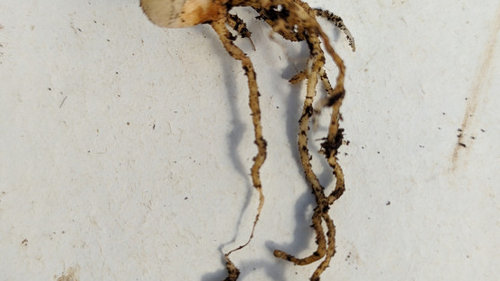
I planted some black eyed peas in to the ground of the field (olive grove in Crete, Greece). They sprouted in small coffee cups with potting soil and grew great, but now that I transferred them to tge ground they get yellowish and stunted growth. I dug a few up to see the roots. They haven't been growing beyond the potting soil from the original cup, and the roots are actually degrading. The roots have spots where they became hair-thin. This reminds me of the way pythium killed most of my seedlings last year, but that was by thinning the stem, not the roots. I can't find any pictures on Google displaying the same problem. I hope you can help me identifying what this is.


I noticed the same with a few overwintered chili plants btw, which also show yellowish leaves and slow growth, as if they can't get enough nutritients.


The soil feels and acts like a sand-clay mix, and has a quite high ph. Other than the olive trees it grows mostly oxalis, some wild asparagus, oxeye daisys, mustard greens... It has never really been worked and only fertilized directly under the trees, but the roots of the beans aren't even trying to grow into the soil from its little bit of potting soil.


Also *every* bean I planted as seed in this soil turned mushy. So what is going on here?


Asking around uf I can get the soil tested results in the typical patenta answers like "your soil composition doesn't matter if you only grow 50m²", besides being quite expensive here to have it done.


Comments (9)

  • 5 years ago

    Some additions to the original post.


    "I noticed the same with a few overwintered chili plants btw, which also show yellowish leaves and slow growth, as if they can't get enough nutritients."

    - The chili plant where I noticed this is in a pot. It did go through a period of extremely dry potting soil, and although with this chili I didn't notice this strange limited sport of thinned roots, all of its fine roots were like dried hairs. So here I can imagine it was just drought damage, so perhaps this has nothing to do with the beans in full ground. However, working in a sterile way and keeping soil from getting in cintact with pots or even the bags of potting soil is neigh impossible here, as I live in the field in a caravan and space is very limited and everything can be considered outdoors.


    When I took the beans out of their cups the roots were looking good, healthy and white with no thinning. They weren't rootbound as the plants aren't old yet. Was it too soon to put them into the ground?


    The cups in which I grew the seedlings are small 4oz paper coffee cups.

  • 5 years ago

    Another addition to the above. (Houzz.com is very annoying on mobile browsers it seems, editing removes all newlines, it doesn't work with firefox, ..., so my apologies if multiple posts in a row by the same author would be against forum rules)


    Just took a look at a bean seedling that was still in a cup, and also looking weakish. Same kind of roots. Thinned at random spots. Same potting ground. Also same brand (different bag, bought 6 months later) as the potting ground that had The Great Damping Off last year. Perhaps it has nothing to do with the field soil, but with the potting soil? I also took a look at a tomato and a chili seedling, those however were looking very good, and are also growing without problems. So it's the beans both in cups and in ground and some of the overwintered chili plants (see the linked topic in the first post) that are visibly struggling.


    But wether it's the potting soil or not, the question remains. What is it that is causing this? If it's indeed some fungus I could treat all the seedlings with H2O2 at the next watering. I have been cautious this tear that I let the plants dry out quite well between waterings and due to the very mild winter they are outdoors most of the time. I only bring the seedlings indoors at night because of the snails.

  • 5 years ago
    last modified: 5 years ago

    It’s February and even in Crete wondering whether it’s warm enough for black eyed beans or chillis outdoors. They’re both heat loving crops.

  • 5 years ago

    South Crete has a North African climate. Chilis are perennials here, even in full ground. On a bad winter they might loose their leaves, but this winter so far the temperature hasn't dropped below 10°C at night, with daytime temperatures sometimes rising past 20°C.


    But say that it would be the temperature, could that thin the roots in the way like visible on the picture in the op? It did cross my mind. I am building a little hoop house, so I could move them there if it would help.

  • 5 years ago

    I’ve never grown either crop because my climate is too cold. But I do wonder if those temperatures are high enough for young plants. Cold soil would affect root growth and encourage rot.

    Leander thanked floral_uk z.8/9 SW UK
  • 5 years ago

    Kind of my thought, too. Root rot doesn't necessarily kill the root (although those look rather healthy, if small). H202 isn't going to do any harm in a 1:5 dilution (using 3% hydrogen peroxide) and won't harm you and doesn't have a residue, so I don't see a problem trying it.

    Root nematodes are common on beans, but I wouldn't expect those on recently-planted seeds in discrete pots with fresh seeds and potting soil. Even so, if they're there, the hydrogen peroxide should give them a big setback, if not necessarily get rid of all of them, if they're there.

    50 degree nights seem rather chill for beans. 'Round here, they're a late May thing and still benefit from a bit of protection on cooler nights just to kick them along into June.

    Leander thanked User
  • 5 years ago

    The problem-part on the photo is on the left, where a part of the root thinned to less than a hair's diameter. The other parts broke off just by looking at it, that fragile.


    It's still very early in the season indeed, so I set up some of the bean seedlings that are showing the same symptoms as tests, different soils, with and without H2O2 treatment, inside at night vs outside, etc. Of course I hoped for a clear "oh it's this problem and this is the solution", but I love to experiment as well. :)


    The beans were mostly started just as an experiment. Had some dried beans, so why not try to germinate them.


    I'm new to gardening in anything else than pots, and also new to this climate (moved here from the Netherlands). So there's a lot to learn for me.

  • 5 years ago

    There's certainly no problem with experimenting! And the H2O2 experiments aren't going to blow up in your face, figuratively or literally, so no issues there.

    It's how I figured out how to use organics in pots, grow flowering plants quite well indoors over winter, and so on. It's never without losses and disappointments, but it also features tons of triumphs and learning experiences!

  • 5 years ago

    See if you can talk to some locals, Leander. They’ll know more about your conditions than people in the US or U.K. I would have thought you’d be growing stuff like faves, peas, salads and greens at this time of year. It’s a long time since I was in Crete but it was in February and, though way warmer than at home, it wasn’t boiling by any means. I still think it’s just too cold for those crops.

Sponsored
Mary Shipley Interiors
Average rating: 4.8 out of 5 stars34 Reviews
Columbus OH Premier Interior Designer 10x Best of Houzz