Software
Houzz Logo Print
daninthedirt

home heating with a gas range

5 years ago
last modified: 5 years ago

OK, I know this is a no-no, and the reason is carbon monoxide. But I'm a little confused. I cook with a gas range. I have a microwave range hood, but it isn't venting if I don't have the fan on. My range can be running for an hour with pots on top and I'm not dead. So why am I dead if I have it turned on for an hour without pots on top to get heat?

I have to assume that it's a matter of degree, and twenty four hours of gas range exhaust is more deadly than, say, an hour of gas range exhaust. Is that what's going on here? The caution would be more credible if it made half-sense. I understand that in restaurants, where the gas ranges are running continuously, range hood venting is required.

Comments (28)

  • 5 years ago

    Simple rules are made to allow for the extreme circumstance, and when you are using your gas range to heat the house you are in that extreme range. It would probably take quite a while to drop the O2 level enough to hurt anyone, but how long is too long? And what if you have also shut all the doors to the kitchen so that you have a smaller area to heat?

    In my experience if you told someone to not run it more than an hour at a time to get heat, once it got real cold they would ignore that rule and run it just a little longer to get more heat. At some point it becomes dangerous, but its hard to predict when, so its better to just tell them not to do it.

    Bruce

  • 5 years ago

    A properly operating gas stove and oven should not be creating carbon monoxide. If it did, you would be in danger every time you cooked a meal. The big danger in my opinion is leaving an open flame unattended for hours at a time. Something near the stove could fall into the flame and cause a fire.

    Cooking a turkey in the oven for 3-4 hours doesn't seem to be a problem. If you have a power outage and you need some heat then I don't see why you couldn't turn on the oven. Set a timer so you won't forget to turn it off.

  • 5 years ago

    dan, I hope you get your power back soon. Lots of folks around the country feel for what y'all are going through.


    mike, I'm not so sure cooking a turkey in a gas oven is all that safe. People often fall asleep after eating it and often need to be woken up, doesn't that tell you something? ;-)

  • 5 years ago

    I live in Dallas Tx and we have been without power more often than we have had it over the last 72 hours. My only saving grace is we have a generator and space heaters. If it weren't for this foresight things would be a lot more grim for us like many family's here. I hope and pray you guys can find a way to keep warm and this will end soon.

  • 5 years ago

    Elmer I love your sense of humor. I am just trying to help our friends in Texas. In New York City heating an apartment with a gas stove where the landlord doesn't provide enough heat happens every winter. I don't encourage people to do it.

    You can always bake a ham if you don't trust yourself with a turkey..

  • 5 years ago

    It is not directly the lack of O2 that is harmful. At lower oxygen levels, however, the combustion product changes from CO2 to CO. The latter is very bad for you. Another problem with heating with an unvented appliance is the moisture build up on modern well-sealed homes. Lacking a good heat exchanger and a flue to retain heat more efficiently and direct flue gasses out, you can open a window, but the result is pretty inefficient. Maybe best to treat the oven it like an open pit fire -- window open in the kitchen and stand in front of it alternately warming front and back. Turn on a burner and toast some marshmallows.


    Kevin, can you find a heat pump window unit? You will get a lot more out of your fuel than with resistance heaters.

  • 5 years ago

    @ionized_gw


    We are operating two 1500 watt heaters in our 300 sq ft den. Anything that produces heat is going for a premium now since it is in demand. Not only that getting out is treacherous so even if I could find one I would be nervous about going to get it. These two heaters are more than enough to keep us warm and in t shirts if I crank them all the way up. We have ample wattage left over for the computer, router, modem television and satellite receiver so we are in a much better position than many. The generator is a fuel hog no matter what so, the $54.00 I have spent in fuel seems about normal since the last time we used it. I do have NG and will be purchasing a Dearborn once this is over.

  • 5 years ago
    last modified: 5 years ago

    Thanks Mike. Ham does seem to be safer than turkey in a gas oven, it may be the glaze on the meat absorbs or reacts with to neutralize the dangerous combustion gases. Like a catalytic converter does.

  • 5 years ago
    last modified: 5 years ago

    I know, I'm sorry. I expressed my sincere concern first but was trying offer some lightness. No intended disrespect or suggestion that it's other than a huge catastrophe for millions, about whom I'm hoping for the best. I haven't experienced a cold or other weather disaster but I've personally experienced several large earthquakes a few times and I know how hard such things can be. My very best to all and wishes for an end to too many dark and dangerously cold days.

  • 5 years ago
    last modified: 5 years ago

    I don't think anyone answered my question. (Though they made up lots of other questions.) We're told that gas ranges produce CO, but I can use a gas range for a long time, and even be standing right over it, and I'm not poisoned by CO. I might believe that if you have all your burners turned on for a whole day, you could get into trouble, but keeping a few burners on for an hour or so isn't going to hurt you.

    Oh, in the winter, when it's freezing outside, NO ONE is worried about water buildup. The relative humidity is pretty close to zero.

    C'mon, anyone with any real knowledge of gas combustion products out there?

  • 5 years ago
    last modified: 5 years ago

    A properly functioning natural gas appliance shouldn't produce any significant level of CO. The primary byproducts of gas combustion are H2O and CO2. For emergency use (a day or so) you should be fine providing you open a door for several minutes to get some fresh air in the house.

  • 5 years ago
    last modified: 5 years ago

    EVERYBODY ANYWHERE says that you shouldn't use a gas range for heating because of CO. (Well, except for individual posters here.) That's what the "experts" say. I'm trying to understand why they're saying that. Gee, maybe there is even an "expert" here!

    Oh, also, I have heat and power. I appreciate the best wishes and sympathies from everyone, but I really don't need them. I'm trying to understand this for friends.

  • 5 years ago

    I suspect an Expert will not comment without instrument readings/air samples.

    The OP has been opinionated in garden forums, perhaps this is karma.

  • 5 years ago

    I've lived in three houses that were heated with portable un-vented propane space heaters: all in the south. I don't think the oxygen could be used up as those houses were very leaky. I've also used propane ranges with all the burners on to keep the house from freezing when the furnace went out. I would never leave the house or go to bed with it turned on.

    I tried to find a definitive answer to how quickly a propane or natural gas heater will deplete oxygen in a space and struck out. It is interesting that oxygen sensors for modern vent- free heaters shut the heater off when oxygen gets to 18% of air by volume. Given oxygen is around 21.5% of air, that's not much oxygen to use.

  • 5 years ago
    last modified: 5 years ago

    The experts have already commented, left, right, up, and down that you do NOT NOT NOT use a gas range for heating. None of these experts had ANY instrument readings/air samples. Seriously, just Google "gas range house heating", and you'll find a bundle. It's a FACT, without any explanation (except that CO has something to do with it, and getting killed as well).

    Oxygen definitely doesn't get used up. The infiltration rate of any house is large enough that there will be plenty of oxygen. You start to worry when the volume of natural gas burned is on the order of the volume of the house. No stove comes anywhere near that.

    BTW, this isn't about opinions. It's about facts. I have a few, and I'm just asking for others.

  • 5 years ago

    In my house we used a vent-free natural gas fireplace for several years. Based on the manufacturer's recommendation, we also installed a CO detector when we bought the fireplace.

    During the time we used that fireplace I never saw the digital CO detector show any reading other than zero. The detector was on a wall about 10 feet across the room from the fireplace, and the gas range in the kitchen was about 10 feet on the other side of the detector. Based on this factual, but anecdotal information it does not appear that a natural gas appliance (fireplace or range) with an open flame has much impact on the CO level in the house. However, I have an old, moderately insulated and sealed house. YMMV.

    Bruce

  • 5 years ago

    I don’t think you understand. The experts did not test your house.

    You are posting recommendations based on your experience.....maybe for a lawn or shrub that is acceptable...the loss of a person, pet because “it worked for you” should not be acceptable.

    I wear a seatbelt when driving, I have never needed them.


  • 5 years ago

    For warming, isn’t a pot of water on the burner more efficient than just an open flame?

  • 5 years ago

    Burning natural gas or propane produces quite a bit of water: enough water that it can be bad for your house. So adding more water is probably not a good idea.

  • 5 years ago
    last modified: 5 years ago

    As I said, in the wintertime, the relative humidity in the house is close to zero. Burning gas or boiling water isn't going to hurt much. When I use my gas stove for an hour, the humidity in the house (yes, I have a meter) doesn't change at all. So the fact that burning gas produces water is a problem in principle, but very much not in practice.

    Bruce makes a good point. If an unvented natural gas fireplace doesn't increase CO, a gas range won't either. Now, I suspect that if the flame is not properly adjusted, such that burning is incomplete, CO might be a hazard, which is why a CO detector is recommended. That's probably the answer to my original question. If your flame is not good, CO could be an issue. A blue flame signifies complete combustion. A yellow flame signifies incomplete combustion, and is dangerous. So the rule of thumb for people who aren't aware of that is that you shouldn't use gas flames for heat.

    "For warming, isn’t a pot of water on the burner more efficient than just an open flame?"

    Not sure what that means. The heat is all from the flame. The flame heats the house and the water. Same amount of heat being generated. If you want the heat to go into the water before it goes into the air, I guess that's your prerogative, and if anything it would just slow the heating of the air. Oooh, sorry. Don't want to sound "opinionated"!

  • 5 years ago

    You best be careful firing up a gas oven to heat a home. I started with some calculations, but I lack some data to complete the problem ending up with a hard number. Assumptions need to be made in order to end up with something that is a starting point for discussion.


    A big residential gas oven, "properly functioning" can make say 20,000 btu/h. A "properly operated" oven will burn a lot less than that because nobody bakes a cake or roasts a turkey with the door open, but let's look at some numbers.


    To make 1000 btu takes 11 cu ft of natural gas (sea level pressure, I guess) and 9.4 cu ft of air (not oxygen, but the oxygen that 9.4 cu ft of air contains). That means that running your oven flat out for an hour uses about 20 x 9.4 = 188 cu ft of air/h. Assume that your kitchen is 10 x 20 x 8 = 1600 cu ft. That means that running your oven flat out will use about 1/9 of the air or oxygen in your theoretical kitchen. OK, there is air exchange. One study looked at a bunch of homes in several urban areas and came up with an average of 0.71 air exchanges/hour over the entire house.


    Bingo: Average air exchange more than makes up air for average combustion . Maybe you even get increased air exchange with a stack effect, bonus.


    Not so fast. What if you fall a little short . Maybe someone turns on the burners as well. What if the room is much better sealed than most. As the oxygen levels decrease, the combustion becomes increasingly biased towards CO rather than CO2. I see in a 2005 paper the following data. At 21, 19 and 17% oxygen, methane produced 1400, 11,800 and 12,500 ppm CO respectively. Now the other burning conditions, temperature, moisture, burner design, fuel flow rate,... will also have an effect. Note that 1000 ppm CO puts you in a coma.


    The flow rate used in the paper was 2l/min. That is 4.3 cu ft/hr which makes about 390 btu/hr. We can conclude that to make 20,000 btu/h would make 72,000, 605000, and 641,000 ppm, respectively, but in what volume? That gets a little dicy, but lets just use the 11:9.4 ratio from above. If 20,000 btu/h = 51 cu ft/h then with oxygen the gas product is 51 x (11+9.4) = 1040 cu ft. If all of this is without error, you have the potential for filling your kitchen with the above concentrations of CO in a couple of hours assuming no air exchange. That is at least 72 times what puts you in a coma.


    Care in this kind of operation is highly recommended if approached at all. Maybe there is something off in my calculations. I am no boiler engineer. If anyone sees something wrong, I'll not be upset. You may have noticed that there is an apparent disagreement between the volume in the first and the penultimate paragraphs. (If you add the air volume to the gas volume, you get 408 cu ft.) It is only off by a factor of 2.6 and easily chalked up to things like temperature differences in calculations and experiments coming up with the figures. A temperature difference of 80C (room temperature vs boiling) accounts for half of that. There are various assumptions that can be moved around so have at it.

  • 5 years ago

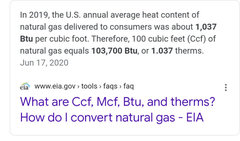
    1000 btu from one cu. ft. natural gas.

  • 5 years ago
    last modified: 5 years ago

    Fair points, ionized_gw. I agree that firing up your oven AND all burners on your range might well use up oxygen. But I wasn't suggesting that.

    I should say that the proper reservoir volume for air is the house volume, and not the kitchen volume. But the caveat on that is that if your HVAC system isn't running, your fan won't be running, and mixing is less effective.

    But where we are cautioned never ever to use a range for heating, we're warned about CO. Not about lack of oxygen. As I explained here, with enough oxygen, you get CO if your burners aren't adjusted properly, and your combustion isn't complete. I wouldn't do this unsupervised, in any case, but if you have a CO alarm in your house, you're not going to get into trouble. That is IF YOU'RE CAREFUL, there is nothing wrong, in principle, with heating your house with your range.

    But blasting the range full force, and walking away, without a CO alarm, is plain dumb.

  • 5 years ago
    last modified: 5 years ago

    Let me just add that a blue flame indicates complete combustion, and no CO. A yellow or red flame is an oxygen starved one, and combustion is incomplete, and CO is produced. While heating your house with a blue flame sounds completely safe, it would still be smart to have a CO detector operating.

    So, bottom line. You NEVER NEVER use your gas range to heat the house IF you aren't looking at the flame color, and if you don't have a CO detector.

  • 5 years ago
    last modified: 5 years ago

    Seabornman, the figure you have is for gas delivered at a particular pressure higher than standard sea level air pressure whereas the figure I found were at the lower standard sea level pressure. That'd be real gas volume instead of pipe/meter gas volume.


    Dave..., my calcs were for oven only, but burning flat out with the oven door open and kitchen doors closed. How do unvented gas heaters compared to that? I forgot to look it up.


    To anyone that will listen on land and all ships at sea: No safety equipment can be relied on to preserve or save lives unless it is tested at a reasonable interval. That includes Chimerican CO detectors. I've got ultimate responsibility for an oxygen sensor safety alarm in a room with cryogenic gas Dewars. With it comes a little can of test gas, but it don't help if it is not used.

  • 5 years ago
    last modified: 5 years ago

    While that's a fair point, that it's not smart to trust your life to a cheap CO monitor, we routinely trust our lives to cheap smoke alarms.

    I believe ventless gas fireplaces have an oxygen detection system (ODS) that automatically turns off the unit if oxygen levels in the room fall below a certain level. The fireplaces may also have built-in CO detectors that also automatically shut off the fireplace if high levels are detected. Those aren't necessarily cheap sensors, but you're trusting your lives to those as well.

  • PRO
    6 months ago
    last modified: 6 months ago

    there's no CO risk (to operate a stove outside the parameters for what was intended as proper use)

    Even AI knows better than you, Thomas Lee.

    It falls under common sense rule 102: Use the proper tool for the job you are attempting to do.

    AI OverviewNo, that is incorrect. Using a gas range or oven to heat a structure poses a severe risk of carbon monoxide (CO) poisoning, as well as fire hazards. Gas ranges are designed for short-term cooking, not for heating, and can emit lethal levels of odorless, colorless CO when operated continuously or improperly. Facebook +4Key risks include:

    • Carbon Monoxide Poisoning: Inadequate ventilation allows CO to build up, leading to symptoms like headaches, dizziness, nausea, or fatal, sudden death.
    • Fire Hazard: Leaving stove burners or ovens on for extended periods unattended can easily ignite nearby, flammable materials.
    • Indoor Air Quality: Prolonged use of a gas range for heating can release, besides CO, significant combustion byproducts that aggravate respiratory conditions like asthma. Facebook +5

    It is highly recommended to use proper, safe heating alternatives, such as electric space heaters with tip-over safety features, or to have a professional repair your primary heating system.

    culling of the herd is a likely result if you choose to ignore beneficial logic.