Software
Houzz Logo Print
k_calliope

SoCal Lawn Makeover Help

5 years ago
last modified: 5 years ago
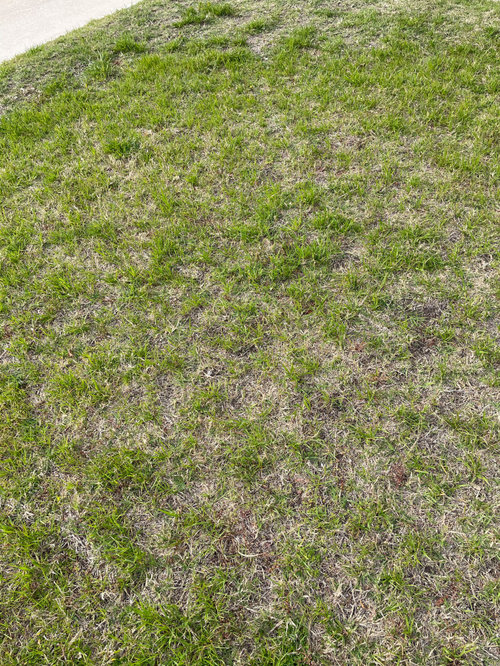
Desperately need advice on getting my lawn looking better. It's never looked great except one season when I reseeded in the Fall with a fescue and it was gorgeous, but after a few months it reverted back to a patchy, weedy mess. Have been using Ortho to kill a lot of weeds recently. However, they just keep popping up. Doesn't help that my neighbor's lawn is connected to mine and also full of weeds.


I'm in Southern California - about 15 miles east of the 405 in the 90630 zip code. I'm guessing my lawn is bermuda grass. I just know I really dislike what we have now and always wish for a green lawn that's drought resistant for my area. Was considering reseeding again but after lurking on some discussion boards, it seems sod might be a better choice? I've never put down sod but willing to learn. There seems to be a lot of info and would appreciate a breakdown for someone not well-versed in lawn care.


Have been looking at St. Augustine in particular but it doesn't look to be available in my area currently. There's a place that touts a Dwarf fescue and Kentucky bluegrass blend. Is that a good sod to lay down in my area? The price is very reasonable but I'm worried I'll end up with an ugly lawn again in a few months. Any good advice on what I can do to give my lawn a fresh makeover and tips for maintenance would be well received. Photos included. Recent contract work parked on our lawn for a month has made it worse.


Comments (7)

  • 5 years ago
    last modified: 5 years ago
    @dchall - Thank you for taking the time to help! The front yard is south facing and gets full sun pretty much throughout the day. The area closest to the house starts to get some shade in the late afternoon. Good to know that the neighbor's yard won't make any difference to mine.

    Roger's Garden's didn't have any fresh sod but recommended Southland Sod as a possibility. I spoke to someone at Southland and they do have St. Augustine but strongly suggested a Marathon I or II. Sorry I'm not too familiar with these grass types so will defer to experts like you. I really just want a uniform-looking lawn that's not too difficult to maintain.

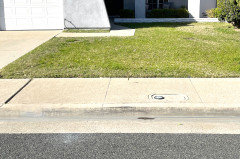
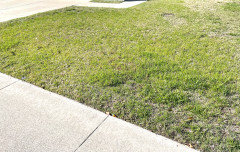
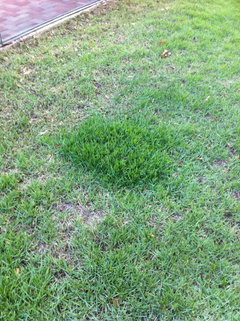
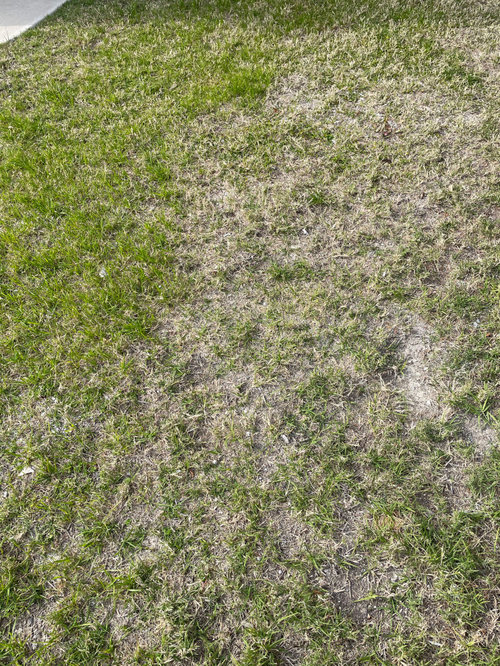
    I've included a few photos -- 2 of the yard from the street and a couple of close-ups in different spots. Please let me know if you need something more specific than these.


    This photo was taken at 4:30 pm PDT.


  • 5 years ago

    Marathon I and II and III are varieties of tall fescue. They are dwarf varieties indicating that they grow more slowly than normal turf type tall fescues. My fear is that what you have currently is one of the Marathons, and it's not looking so hot. Fescue is what we call a bunch grass. That means the plant grows from a seed and grows from that one spot. St Augustine, bermuda, zoysia, and Kentucky bluegrass are called sod forming grasses, because they spread via rhizomes (underground) or stolons (over the surface). If a lawn gets damaged, a sod forming grass will restore itself; whereas, a bunch grass must be reseeded to repair the damage. Since seeding is best done at certain times of the year, you might have to leave bare spots bare for awhile until the best seeding time comes around. Leaving a spot bare gives weed seeds a chance to germinate leading to more hassle. So my preference for your area is St Augustine with bermuda being a mid-range second.

    St Aug is much less hassle on a week to week basis than bermuda. Both grasses spread over the surface and will invade flower beds. You can trim that back with a string trimmer. Bermuda, however, also spread underground and will invade deeply into flower beds on the sly. You can't see that coming. Bermuda also really likes monthly feeding, and I don't have time for that. Bermuda is more easily invaded by weeds than St Augustine. In fact, St Augustine, when mowed high, will obliterate bermuda and most other grassy plants/weeds. It does suffer when it comes to clover, oxalis, dandelion, or a plant we get here called horse herb. In Texas I can get an herbicide which takes care of anything that St Augustine cannot take care of, but California has banned that herbicide. Bermuda really needs to be mowed weekly to keep it low to the ground. St Augustine can be mowed weekly, but it performs best when mowed high and even mowed biweekly (semimonthly?). I mow mine every 2 to 3 weeks. You can tell my preference would be for St Augustine.

    Your distance picture showed me what I wanted to see. You have a slight bit too much topsoil in your yard. Toward the house it looks good, but out toward the sidewalk it is raised up a bit. That is not a problem, or does not appear to be a problem from this view. It would be a problem if you have low spots toward the house which collect water when it rains. Water should drain to the street and not back up toward the house. Unless you have water pooling issues, I'd leave it alone and remember to never bring in any more topdressing or topsoil. You could topdress with compost, but not sand or soil.

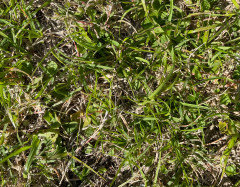
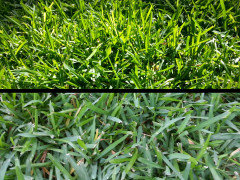
    The close up pictures are hard to interpret. I forgot to ask you to take the pix on a cloudy day or when the Sun is low in the sky. The Sun gives too much contrast in the image making it hard to get through the glare. This picture shows what I'm talking about with high contrast on top and low contrast below.


    So I couldn't see much in your close up pictures. Sorry.

    The reason your neighbor's poorly kept yard will not affect yours is that you are going to have a much more dense turf which prevents weeds from getting started. He could have 100% crabgrass, and it will come to a halt at your border...if you do this right.

    If you lay sod, are you going to do it yourself or hire someone. Laying the sod is the easy part. Prepping the yard for sod is more like work. Sod needs to go down onto bare soil. A really easy way to get bare soil is to scrape away the turf on top. There are machines you can rent to remove the sod from the surface. That would be a good way and would remove some of your extra topsoil along the way. Then you have to have a place to put that or haul it away.

    Once you have bare soil, it's time even it out. Work only at the surface to scrape off any high spots and fill any low spots. You can use a hoe or rake to hit the high spots and drag excess soil to the low spots. Then walk on the low spots to press the fluffy soil down. Once you have it level as you can get it, it's time to try and grow some weeds. Why? So you can kill as many as you can before you lay the sod. Water lightly, 3x per day, for a week to germinate all the weed seeds at the surface. After a week of that, spray RoundUp on anything that's green. Continue watering for another week to get the straggler weeds. Then RU those, too. NOW it is finally time to put the sod down.

    Don't get the sod until the day you want to put it down. It should be fresh as possible to avoid problems. Put the sod down like a bricklayer stacks bricks. The sod pieces should not be aligned like a checkerboard squares are aligned. Each row should overlap seams...like bricks. Butt each new piece tight up against the previous pieces. Cut the pieces to fit around obstacles with a knife. After all the sod is down, walk on every square inch of it to press the sod down onto the underlying soil. I should have mentioned the soil should be dry when you put the sod down.

    Once you have walked on the soil, it is time to water it. For the first 2 weeks you will continue to water it like you did for the weeds. The idea is to moisten only the surface of the underlying soil. You don't need to saturate anything, and it should NEVER feel squishy to walk on. If it seems too moist, then skip a watering to let it dry out. St Augustine is fairly forgiving as long as it's not squished down into the mud. After 2 weeks try to lift the sod off the ground. It should resist pretty hard as it becomes knit to the soil. When that happens you can back off on watering. Again, St Aug is very forgiving at this point. I would start skipping days at a time but keeping an eye on it for signs of drying out. If you see it drying out anywhere, water it heavily all at one time. Very quickly (in about a month) you should transition to deep and infrequent watering. Deep means 1 inch all at one time. About 2 weeks after the initial 2 weeks of watering, measure an inch of irrigation with cat food or tuna cans placed around the yard. Time how long it takes to fill all the cans. That will be your watering time from now on. Warning here: my time to get an inch is 8 hours using my oscillator, hose, and water pressure. Your time will vary, but it might seem like a scary long time. The kicker is you won't be watering very often. When you water a full inch, the grass will grow deep roots which can take water out of the soil for weeks at a time during cooler weather. With temperatures below 70, you should deep water once a month. With temps in the 70s, deep water once every 3 weeks. With temps in the 80s, deep water once every 2 weeks. With temps in the 90s, deep water every week. With temps in the low 100s (about your max on the hottest of days), deep water every 4-5 days. Note that you never water every day. Use what I've said here as a guide. Your soil, humidity, wind, shade/sun, and grass type will change things, but not a lot. My personal lawn gets about 3/4-inch of water every 10 days with temps in the 90s. I would think you'd be watering more like every 20 days in your area.

    As for fertilizer, new grass will come to you already fertilized. If you get it down very soon, then you could fertilize St Augustine about Memorial Day, again on Labor Day, and again on Thanksgiving. Don't use a weed n feed product (EVER).

    I'm sure I've said more than you needed to read at this point, but at least you have a detailed reference. What questions have I raised?

  • 5 years ago

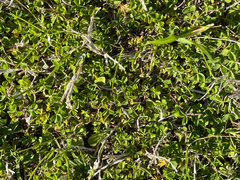
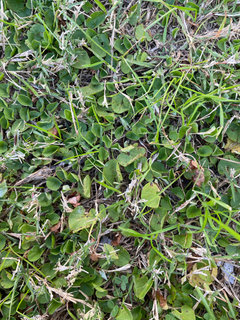
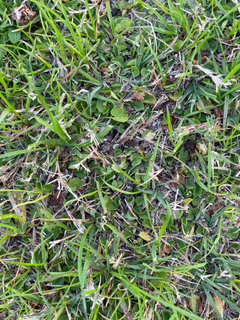
    Thank you for the sound advice. Attaching a couple of the close-up photos but I think I'm sold on the St. Augustine after reading this.


    I'd be laying the sod myself, and as you pointed out, the prep work is what I'm most concerned about. Is renting a sod cutter best suited to get to the bare soil level? I think I read on another thread that you don't recommend rototilling - which I have no complaints about. I wonder why others insist on it if it isn't necessary.


    Many of the online how-tos also say you need to add nutrient-rich topsoil. As you mentioned, I have a bit too much topsoil, but do I need to add anything else, or loosen the soil before walking on it? Or will removing the sod be sufficient? I'm guessing that walking on the soil is equivalent to using a lawn roller, which would be easier than having to rent another piece of equipment.


    8 hours is a crazy long time! I certainly hope that won't be the case here but will give the tuna can trick a shot and see how things go. Appreciate your thoughts and help!


  • 5 years ago

    add nutrient-rich topsoil

    What the bleeping bleep is that? Say for a second you have poor soil. Why would you think bringing different soil in would be better? You can either improve your current soil or you can improve new soil. It costs the same, so...your choice. The way to improve soil is to improve the soil biology and chemistry. You can get started improving the biology immediately by putting down some corn meal, alfalfa pellets, soybean meal, or any ground up nut, bean, or seed you can find at your local feed stores. You can even use DuMOR Poultry Crumbles or Catfish Food from Tractor Supply. Any food that an animal can eat is food for the soil microbes. Once they are well fed, they make your soil healthy. I have used no chemical fertilizers for 20 years. All I use is corn meal and alfalfa pellets. Here is a motivational picture of alfalfa pellets at work.


    This picture was posted here by mrmumbles in 2010. In mid May he tossed a handful of alfalfa pellets into his zoysia lawn. The picture was taken in mid June. It is pretty easy to see the improved color, density, and growth. Anyone who things organics are a myth needs to see this picture. And since I said it on the Internet, it must be the truth ;-) Well I believe it, because I've been doing it for a long time. I firmly believe organic fertilizer is the only way out of a poor soil situation.

    You can possibly improve soil microbes' ability to improve the soil by fixing any chemistry issues in the soil. The $25 soil test from Logan Labs in Ohio is the best soil test in the country. It is much better than the UCR or UCD soil tests you get locally in SoCal.

    Thanks for the picture update. I was looking to see what grass I could identify. I can't ID anything except dichondra (weed in your case). Dichondra can be tough to get rid of because it goes to seed fast and furious. If you spray Weed-b-Gon in mid April, that will get the living grass, but the seeds are plentiful and ready to pop the next time it rains.

    The sod cutter can be adjusted to take more or less soil. It would be a great tool for bringing down your soil level.

    On Rototilling: This is like a cultural tradition. I'm not sure when it got started, but people started rototilling their gardens to make the soil fluffy for planting veggies. Later garden writers started advocating it just because even for lawns. If daddy did it it must be good. Well, not in this case.

    Nobody was more surprised than I was when my cans didn't fill up in half an hour.


  • 5 years ago

    Thank you for taking the time to respond in detail. Lots of good info.

  • 5 years ago

    I like to take the time to reply in detail, because a lot of what I suggest goes against the common things you see in magazines. Typically those articles are just making stuff up or copying something they saw that does not apply in your situation. For example if you live in SoCal, don't look to the University of Buffalo for lawn care advice. Let us know how your project goes whether you follow our suggestions or not.