Software
Houzz Logo Print
emma_assad

Please help my coffee plant

5 years ago
last modified: 5 years ago
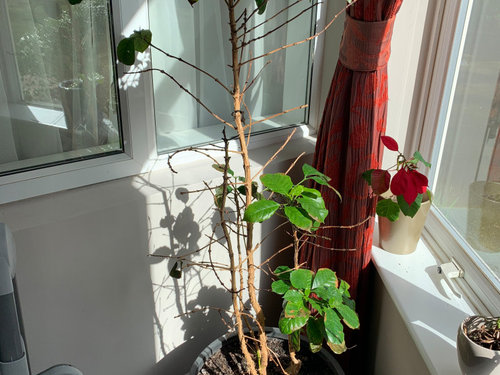
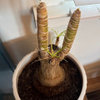
Im Really hoping someone can help me. I have had this coffee pods for around 12 years and up until the last two-ish years it has been very healthy and has even produced berries/beans. but now, the leaves have become very sparse, some brown and some with yellow spots and I fear it is dying. I’m doing all I can to save it but nothing seems to be working can anyone help me? Thank you in advance


Comments (11)

  • 5 years ago

    soil is mother earth ... it is hard to deal with such in pots ...


    is your pot full of soil???


    could you repot it into potting media???


    media is a water management system.. retaining what water the plant needs.. and shedding excess ... soil does not do that ... [and the media varies according to what plant is in the pot...]


    ken

  • 5 years ago

    Thank you so much for your comment Ken, any help is so appreciated.


    Iv never heard of a potting media but I will research and see if it’s something I can do.


    my fear is that repotting again might distress the plant further in its already weak state and it might not make it. Any thoughts?


    thank you

  • 5 years ago

    The words/phrases soil, potting soil, potting medium, medium, grow medium, are all used interchangeably. Mineral soil/ garden soil/ topsoil are each and all a poor choice for use in containers because of excessive water-retention and soil compaction, which limits both oxygen supply to roots and gas exchange in the root zone. It's important to know what type of grow medium the plant is currently rooted in and how long ago it was repotted or potted up in order to provide you with appropriate suggestions. Repotting includes bare-rooting, root pruning, and a change of grow medium, while potting up is essentially moving the plant to a slightly larger pot and filling in the bottom and side voids with fresh soil.

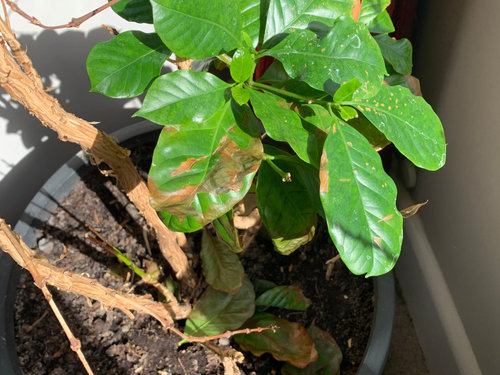
    From the look of the plant, it has been suffering for quite some time from root congestion, and the necrotic (dead) areas on the leaves suggest over-watering and/or a high level of solutes (salts) in the soil have also been a factor. More info is needed, but you might find this Overview of Good Growing Practices to be helpful.


    Al

  • 5 years ago

    Tapla, thank you for such a detailed answer. I am a complete novice with regards to plants.


    I am aware that overwatering or sitting the roots in water I s a big no no for coffee plants, so good drainage is a must, which I thought I had done. Obviously not.


    I have found a grow media made from coco fibres which appear to allow good air and water retention which I thought might help, but I’m unsure as to whether I should just pot solely in this and continue to spray the leave with a liquid fertilise or whether soil is also needed and some sort of draining at the base such as stones.


    Iv been nurturing this plant (which was a present) for over 10years so i will be quite upset if it does not survive.


    thank you again everyone for Your much needed help!

  • 5 years ago

    Coir-based media requires a set of work-arounds which aren't necessary when working with sphagnum peat. Large fractions of coir in the grow medium preclude the use of dolomite or calcium carbonate as a liming agent. Coir is extremely high in potassium, might contain a high level of salts (if processed in ocean/sea water), and compacts severely in larger pots watered from the top. In all cases where I have tried a medium with notable fractions of coir or CHCs, I was disappointed in the results.

    I would urge you to forgo the foliar feeding program and use the root pathway to deliver essential nutrition. It's far more efficient, and the only reason you would need foliar applications of nutrients is if your plant was growing so fast it couldn't keep up with nutritional demands. If you actually do need to feed by way of foliage, it's a certainty root function/health needs to be worked on or the fertilizer regimen you're using (or not using) isn't working. Foliage-Pro 9-3-6 will do an admirable job of providing all nutrients essential to normal growth, and it's all you need to simplify nutritional supplementation.

    Stones/rocks/other objects, if used appropriately, can help to limit the amount of excess water a medium can hold, but they don't improve drainage or aeration. If used incorrectly, they actually exacerbate issues related to drainage and/or grow medium aeration.

    The link I provided above (Overview .....) will provide you with some food for thought, and might even trigger the urge to inquire into areas where you would like more clarification, either by way of your own research, or easier, by asking whatever questions you're left with. It was written to help others avoid almost all of the most common pitfalls found on the journey to green thumb status.

    Al

    Emma Assad thanked tapla (mid-Michigan, USDA z5b-6a)
  • 5 years ago

    Gosh you really do know your stuff. Thank you again.


    having search, unfortunately I cannot get foliage pro here in the uk and I am struggling to find a feed with a 9-3-6 composite.


    I will try and find similar and feed from the roots weekly (once Iv re-potted).


    I have found a good soil with a blend of sphagnum moss peat, compost, worm castings, perlite (to help drainage and aeration).


    would you have any good suggestions as to how to pot to prevent drowning the roots?


    My thoughts are, potting with loose soil in a pot containing plenty of drainage holes and having It elevated on large stoneS or other to allow the water to drain freely. Your thoughts would be much appreciated.


    thank you!

  • 5 years ago
    last modified: 5 years ago
    "..... having search, unfortunately I cannot get foliage pro here in the uk and I am struggling to find a feed with a 9-3-6 composite." Use this (click link). It is a 2:1:2 ratio fertilizer and should work fine for houseplants grown indoors. It has almost all the essential nutrients aside from Ca(lcium) and Mg (magnesium), which should be supplied by the liming agent (dolomitic lime) in the potting medium/compost.

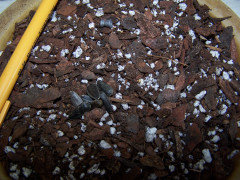
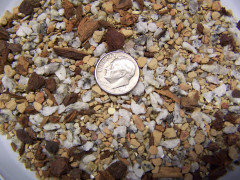
    "I have found a good soil with a blend of sphagnum moss peat, compost, worm castings, perlite (to help drainage and aeration)." Drainage/aeration is directly related to the size of the particles in the grow medium. Try to find a potting medium/compost based on a very large fraction of coarse material, preferably pine or spruce bark. I make my own media and the two I use almost exclusively look like this:


    I focus on the structure of media and media's ability to retain that structure for the expected life of the planting, or between repots when plantings get root-pruned and a fresh change of grow medium.

    "..... would you have any good suggestions as to how to pot to prevent drowning the roots?" Without question, the best way is to use a medium that holds no or a small volume of water in the open spaces between soil particles. The media above are specifically formulated to keep as much space between soil particles as free of water as possible. That said, there are several ways to limit how much excess water a planting can hold. Wicks and ballast work passively and effectively


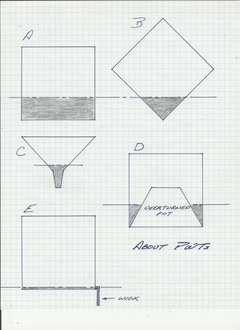
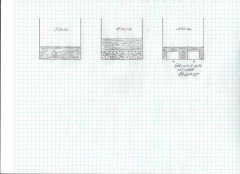
    All the pots above are filled with grow media. The shaded area represents a perched water table (PWT), which is water that can occupy up to 15cm of soil or even more, that resists the force of gravity to remain in the pot. Figure B shows what happens when you tip the pot after watering. Figure D illustrates the significant reduction of excess water that can occur when a pot is overturned in the main container (ballast). A few bricks or empty drink containers (caps on) work well, too. You'll be very surprised that you can remove ALL excess water if containers are a manageable size, by putting the following to work:

    Newton's First Law

    Under conventional container culture, it's a given that saturated/partially saturated media rob roots of the oxygen they need to function normally and efficiently. At best, soil saturation robs your plants of immense measure of potential in areas like growth, appearance, yields, ….. At worst, plants unable to cope with the strain of drought stress caused by saturated media will succumb to it. This isn't a 'scare tactic, it's a very simple and straightforward observation that will be difficult to disagree with a straight face.

    Newton's First Law of Motion states that an object will remain either at rest, or in motion at a uniform rate and in a straight line unless acted upon by an external offsetting force. In this case, we will designate the 'object' as excess water in your potting medium. At risk of my being redundant, the 'law' can be seen as a simple statement about inertia, that objects will remain in motion and in a straight line unless a force acts to change the motion. To put the law to work for you/your plantings, you should water to beyond the point of total soil saturation - so the medium has been completely saturated and at least 15-20% of the water you have applied has exited the pot. Unless your soil is purposefully constructed to eliminate all/nearly all excess water, it's extremely probable, when the pot has stopped draining, there will be too much water in the potting medium for the plants' liking.

    To eliminate this excess water: immediately after a thorough watering, hold the pot in one hand over the sink, lawn, or over-sleeping significant other and move it downward, then sharply reverse the direction to upward. You'll immediately note that a good measure of 'excess' water will “continue downward in a straight line” and exit the drain hole. The sharper the reversal of direction, the more water exits the drain hole. When you have repeated the exercise until water no longer exits the drain hole on the reversal of direction, you will have eliminated all excess water and your plants will regard you with a newfound sense of awe.

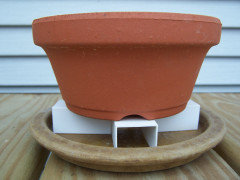
    "My thoughts are, potting with loose soil in a pot containing plenty of drainage holes and having It elevated on large stones or other to allow the water to drain freely. Your thoughts would be much appreciated." There should be no pathway by which the effluent which exits the drain hole can make its way back into the pot/grow medium.


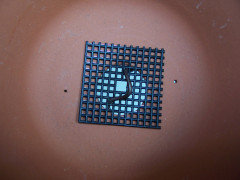
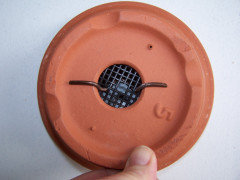
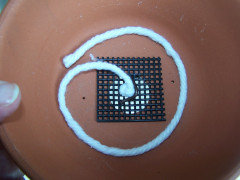
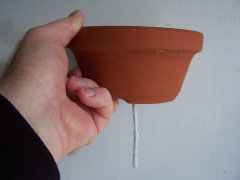
    If you use a wick to help limit the volume of excess water, the hole for the wick should be through the sidewall where it connects to the bottom (see fig E above). Tip the pot so the wick is down (fig E + fig B above), and leave it in position until it stops draining. The wick shouldn't be allowed to dangle in the effluent which collects in the saucer.


    Allow 7-8cm dangle below the pot while it drains.

    The number of drainage holes don't affect drainage or aeration. One hole of 1-2cm is all you need. The plant doesn't care if it takes 1 minute or 10 minutes for the pot to drain.

    Don't forget to read the link I left. If you want another that discusses long term care of woody material (trees/shrubs) in pots, let me know. That's an important read if you're caring for trees long term.

    AL

  • 5 years ago

    Wowzer! You have been so helpful. I won’t lie, much of has taken a few reads to sink in. My plant is rather large, so lifting and tilting etc is not an option as it’s very heavy. I do wonder if the roots like To be hugged somewhat and my pot is too big?

    I’m going to purchase Cana Terra professional soil which has added perlite and possibly a thin layer of hydro granules at the bottom. I will also use what you have shown to ensure the water has no way back up.

    I am drinking the advice you are giving me so anything else you can share would be greatly appreciated .


    Thank you again so much

  • 5 years ago
    last modified: 5 years ago

    The idea some plants like or prefer being rootbound is a myth and unsupported by science. When you hear the advice to grow a plant snug w/o qualifications that center on the grow medium being used and the grower's watering habits, you're hearing the perpetuation of that myth. If anyone was to look into WHY the advice might be repeated, it would be quickly revealed.

    About the in time when the root/medium mass can be lifted from the pot intact, the stress of root congestion has begun to limit the plant in areas most growers view as essential considerations; among them, growth rate, vitality (health), appearance (in several ways), yields (for crop plantings), natural defenses, and more. Still, and given the negative consequences associated with root congestion, it's viewed to be less pernicious than over-potting a plant and (to a point) suffering even more severe stress-induced limitations that usually come from the plant being forced to endure long periods of soil saturation caused by repotting.

    While there is some logic in trading the potential for a more severe stress (over-watering/ soil saturation) for the potential of a less severe stress (tight roots), accepting either loses luster when both can be avoided by adopting a medium or arranging the planting so it that supports very little in the way of excess (perched) water. You've heard the phrase "damned if you do ..... damned if you don't?" or even better, "on the horn's of a dilemma?" Why choose either horn of a dilemma (root congestion or long periods of soil saturation) when the bull is so easily eliminated?

    I can't attest to the efficacy of the medium you chose. It lists peat as the main ingredient, but it does say it contains bark, but not in what stage of decomposition it will be in, particle size, or % by volume. I do know you won't need hydro granules. The fertilizer I linked you to above is the best choice I could find, but it does lack Ca and Mg, but those nutrients will be in the lime charge incorporated into the medium to adjust pH.

    I strongly urge you use a good measure of ballast in the bottom of the pot. Ballast differs from a "drainage layer" that does nothing at all to promote drainage. Often, the same materials used for a "drainage layer" can be used as ballast if the grower understands how to use this passive method of limiting the volume of excess water a planting can hold.


    To see what happens when you use a drainage layer of coarse material (gravel/ packing peanuts, ......), compare the middle image to the image on the left. Drainage layers cause roughly the same amount of water that would normally reside in the grow medium at the bottom of the pot to "perch" in the medium above the drainage layer - don't shoot yourself in the foot.

    The ht of the perched water column supported by any given medium is a constant (note that in the images above) in any pot when the medium is at container capacity, which means it is holding as much water as it can after a thorough soaking and drainage has ceased), regardless of the pot's size or shape. You can see the 2 bricks in the pot on the right have reduced (displaced) the volume of excess/perched water by the volume of the bricks. Imagine rolling the 2 bricks on edge and adding 2 more! You will have eliminated a huge fraction of the amount of excess water that planting CAN hold.

    You needn't use bricks - be inventive. Plastic storage containers from the dollar store work VERY well as ballast. If you decide to use ballast - we can talk more about it.

    Your choice of grow medium is the foundation of any conventional container planting you will establish, and goes a long way toward determining your level of success. Light is a close competitor, and many other cultural factors are crucial to success, but the grow medium stands out as being virtually unchangeable after the planting is established, unless you do a full repot. As a fairly inexperienced grower, you'll gain the most traction by learning how to get to a place where you can water to beyond the point of soil saturation at will, in such a way you're flushing the soil when you water, w/o the medium remaining soggy so long it limits root function, or worse, destroys root health by setting the table for fungal infections of the root system. I know for a fact that excess water in the grow medium can rob plants of nearly 100% of their genetic potential, w/o the grower having any sense the limitations even exist. I see it here with such regularity it can't be denied.

    You might want to bookmark this thread. I didn't start it, but it lists a fair number of the most frequented threads I've started.

    Al

  • 5 years ago

    My pleasure. I hope you found some measure of value in it.

    Al