Software
Houzz Logo Print
westes

Planted Genetically Identical Roses in Three Different Container Soils

I received some climbing roses from a seller and decided to plant them in three different container soil mixes. I have a different result than I expected, and I wanted to share it for discussion.

First, the plants in question were supposed to be Honeymoon climbing roses. Whatever I was sold, they are apparently a very weak genetic specimen. I learned a lesson here to buy climbing roses from reputable growers like David Austin. That confession made, these should be genetically identical specimens, taken from the same mother plant. That should give some fair basis for comparing their growth in different container media.

Here are the soil mixes and the result for each:

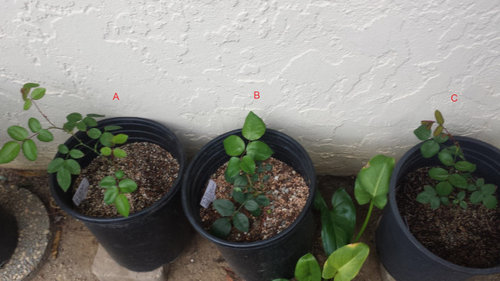
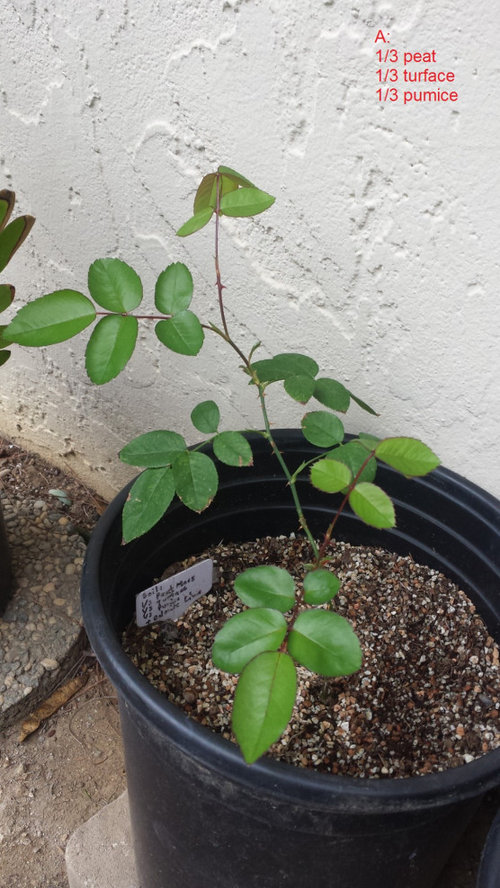
Mix A: 1/3 peat, 1/3 turface, and 1/3 pumice. Notice how in this mix the plant is becoming leggy. There is more vertical growth than in Mix B or Mix C.

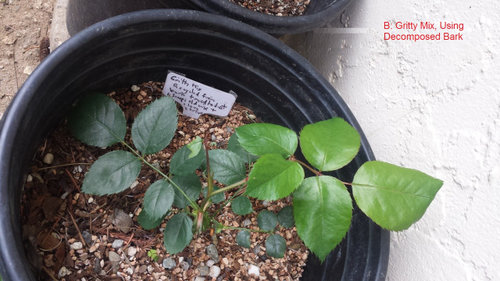
Mix B: This is the Gritty Mix, but I used a decomposed bark from a very old Gritty Mix container, so it holds more moisture. Note that this Gritty Mix uses 1/4 inch granite stones, so in some ways, the more decomposed bark makes up for the too-large stones. The growth result for this one was a real surprise. Notice how the plant is stunted low to the ground and there is very little vertical growth. But the energy seems to have gone into leaf growth, and the leaves are bigger than Mix A and Mix C.

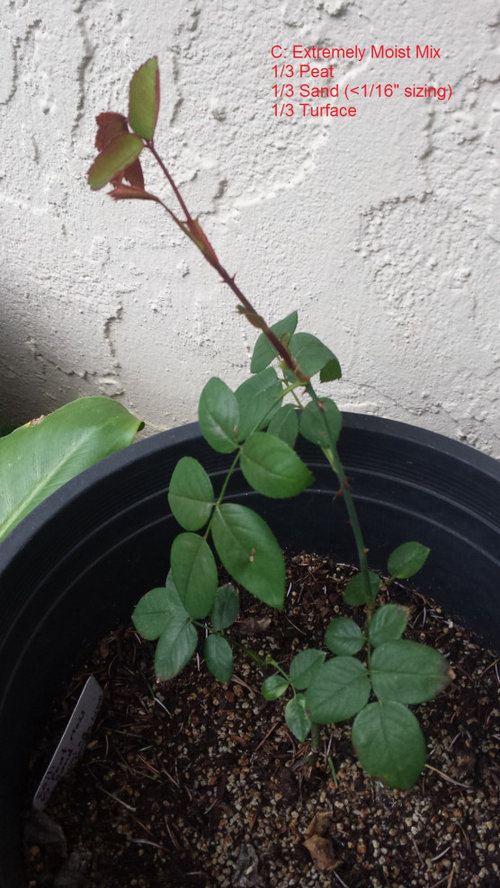
Mix C: 1/3 peat, 1/3 sand (< 1/16" particle sizes, so too-small), and 1/3 Turface. This mix is an extremely wet mix. I expected a relatively thirsty plant like a rose to do at least acceptably well in this mix. To my surprise, this mix provided the best overall aesthetic balance between vertical growth and leaf growth. The plant looks more "balanced" than with Mixes A and B.

I did not fertilize these plants. They were grown in the shade. I pH balanced Mixes A and C with dolomite lime.

Does anyone have any explanation for these results?

Photos below, labeled with the Mix ID.


Comments (130)

  • 5 years ago
    last modified: 5 years ago

    Okay, potassium chloride, magnesium chloride, and table salt are clear. The article you linked says "Fresh manure is high in soluble forms of N, which can lead to salt build-up and leaching losses if over applied." That statement is what leads to my question.

  • 5 years ago

    Nitrogen in a soluble salt form is either nitrate or ammonium. Fresh manure contains high levels of ammonium from urine and this is typically what causes the 'burning'. Composting or aging the manure allows the ammonium to volatize so it is much less of concern. Nitrates are seldom an issue.

    westes Zone 9b California SF Bay thanked gardengal48 (PNW Z8/9)
  • 5 years ago
    last modified: 5 years ago

    @gardengal48 (PNW Z8/9) Okay, let me summarize to make sure I get this. Fresh manure contains soluble nitrogen in the form of ammonium nitrate, and ammonium causes plant burns. Composting manure turns ammonium nitrate into organic nitrate. And in this case, the form of nitrate salt does not matter much because plants tolerate almost all organic nitrate well. Is that close?

  • 5 years ago

    Pretty close, yes :-)

    westes Zone 9b California SF Bay thanked gardengal48 (PNW Z8/9)
  • 5 years ago

    Nitrification is soil bacterial converting organic material in to nitrate salt ions. Mineralization is soil bacterial converting organic materials into ammonium salt ions. The plants takes in these ions and gets nitrogen from them. These are the very same ions that may burn a plant if to much fresh manure is applied. This is not due to any difference in the ions but to an excess of the ions.


    If too many salt ions are in solution around a plant, then instead of the plant taking in water through it roots, the water travels out of the plant into the soil. The plant loses so much water that plant tissues die.


    Too much fresh manure is a bad thing, but so it too much water.


    When you fertilize with non soluble nitrogen, then it must be converted into nitrogen salt ions. This happens slowly so burning seldom occurs. Also you end of with a nitrogen "bank" where the plant will be fed for many months or maybe even years.


    Lots of nitrogen in fresh manure is lost to the air or leached away during composting. Fresh manure applied in correct amounts to mature plants with when the soil is warm can really promote greening and growth. I do this in my own garden to try to use all the nitrogen that my chicken's are producing.

    westes Zone 9b California SF Bay thanked ValRose PNW Wa 8a
  • 5 years ago
    last modified: 5 years ago

    @ValRose PNW Wa 8a I think your first paragraph is confusing the issues. Per the previous conversation, the problems with manure are:

    1) The presence of salts like sodium chloride and potassium chloride, neither of which have anything to do with nitrates

    2) The nitrate is in ammonium nitrate, which in excess quantity can harm the plant.

    So the reason composting helps is that it removes the salts in 1) and it converts the salts in 2) to the organic salt form.

    Your first paragraph is confusing the issue because you are combining ammonium and organic salt forms together and saying the problem is just "excess". But excess of organic nitrate is not a problem for the plant. It just leaches away. And you are failing to see that manure contains other types of salts as per 1) above.

  • 5 years ago

    Hi Westes.

    1. Manures do not normally contain high amounts of sodium chloride, except from saltwater fish manure. (I don't really know, just made that up). High levels of salt intake are bad for most animals.
    2. Manure is high potassium, I don't know its chemical make up but I doubt its is potassium chloride.( could be wrong here, I honestly don't know)
    3. Ammonium nitrate is a synthetic salt not found in nature. There are two type of nitrogen found in manure one is Ammonium/ammonia nitrogen and is also produced as part of the natural composting process. The other is organic nitrogen.
    4. Composting does not help remove salts from manure. Composting may make salts more concentrated by reducing the volume of the manure and having the salt content stay the same. The only way to remove the salt is through leaching by applying lots of water
    5. There are two major downsides to raw manure. 1) Too much nitrogen 2) Pathogens


    Fresh manure is high in soluble forms of N, which can lead to salt build-up and leaching losses if over applied Avoiding salt injury from nitrogen fertilizers in orchards - MSU Extension


    Plants can take nitrogen from the soil in two forms: ammonium or nitrate. Chemical fertilizers provide these two forms directly to the plant. Organic fertilizers contain more complex compounds that must be broken down by organisms (bacteria, fungi, protozoans) in the soil to release ammonium and nitrate Backyard Gardener - Nitrogen Fertilization of Garden and Landscape, April 28, 1998 (arizona.edu)

    westes Zone 9b California SF Bay thanked ValRose PNW Wa 8a
  • 5 years ago
    last modified: 5 years ago

    @ValRose PNW Wa 8a Let me say first that chemistry was by far my least favorite subject in school. And this conversation reminds me of that. :) Ammonium ion vs ammonium nitrate is an example of this. I just find the whole subject of chemistry filled with random arbitrary details like whether ammonium exists as an ion in a solution or whether it is joined to something else like nitrate in a salt. It drives me crazy having to think about such things. Physics and math I love. But too much chemistry is definitely going to drive me insane. So yes in manure ammonium is apparently found as an ion, not as ammonium nitrate.

    The sources on manure management I find online all warn about raw manure creating a risk of salt build up in plants, and this is always said to be from ammonium and soluble salts of sodium and other minerals. For example:

    https://courses.missouristate.edu/WestonWalker/AGA375_Forages/Forage%20Mgmt/References/1Guides/3Renovate/AltFert/UKAGR165AgronomicsManureUseCropProd.htm

    "Another possible concern related to high rates of manure application, particularly over several consecutive years or areas in a field where manure has been stockpiled, is a “salt” build-up. In this situation, high concentrations of ammonium and soluble salts of potassium, sodium, calcium, and magnesium can accumulate...."

    I cannot find any reference that quantifies how much of the manure is going to be soluble salts of sodium, but I guess the risk is more from build up over repeated applications. So a very small percentage of sodium chloride can - with repeated applications - create a salt build up problem.

    Your description of what composting does to manure does not match what the online documents on manure management state. All of the documents I found described hot composted aerobic processes for manure that change ammonium into organic nitrate. For example:

    https://www.nrcs.usda.gov/Internet/FSE_DOCUMENTS/nrcs142p2_043440.pdf

    Using the Aerobic Lagoons process:

    "In these situations, N will be retained in solution as NO3 and NH4, and in the bodies of aerobic microorganisms as organic N. Nitrogen converted to ammonium will be mineralized as NO3"

    Composting:

    "A portion of the N in the compost pile is volatilized as NH3, and a small amount may be emitted as N2O. The remainder is found either in the bodies of microorganisms as organic N, or as NO3, which is available to plants."

    So composting does change the ammonium into more organic forms of nitrate (NO3), by at least two processes.

    I have no idea how the soluble salts of sodium get removed by composting. All I know is that the guidelines for raw manure warn that it is there and can build up. By the time the hot composting process finishes on manure, those salts somehow disappear or get reduced sufficiently that the concern about salt build-up goes away. It is impossible to have a discussion about this because the online documentation of the issue is poor.

  • 5 years ago

    Not following this discussion closely, but I would say that composting manure can/will reduce or moderate salts - particularly nitrogen compounds as it will volatilize and evaporate, etc. And if manure is composted/aged outdoors, some leaching may occur from rainwater, at least those of them which dissolve in water. Whether that's enough for the specific case - haven't followed the discussion closely.

    westes Zone 9b California SF Bay thanked armoured
  • 5 years ago

    @westes - there's manure and then there's manure. Both the types of animals and how the manure is held or stockpiled - mixed with copious amounts of bedding (for example) or in some operations, a slurry with lots of urine which may be held in a tank or pond. Not a scientific measure, but smell can tell you a lot - heavy and at times even sharp ammonia smell vs aged and earthy smell. Farmers may spread 'fresher' manure - in a garden, just be cautious if you get that strong whiff of ammonia. IMO.

    westes Zone 9b California SF Bay thanked armoured
  • 5 years ago

    @armoured I hope to avoid becoming a fine connoisseur of manure by sticking with garden waste compost. :)

  • 5 years ago

    True connoisseurs can tell the difference by taste. ))

    I should have added, for 'composted' manure - i.e. the type you might buy at a garden centre, not fresh off the farm - it most often would have been mixed with something woody so any salt concentrations would be diluted from that, too.

    westes Zone 9b California SF Bay thanked armoured
  • 5 years ago
    last modified: 5 years ago

    Westes

    I too have always disliked chemistry ( too much memorization for a dyslexic). I also prefer physics and calculus. In this discussion, I feel your pain.


    My understanding is that is the same as Armoured: "composting manure can/will reduce or moderate salts - particularly nitrogen compounds as it will volatilize and evaporate, etc."


    I think that the increase in organic nitrogen during composting is not from the conversion of ammonium. It comes from microorganisms digesting the plant residue. (Might be nitpicking here)


    I think that we can agree that the end result of composting manures is a superior product with little ammonium and high in natural forms of nitrogen.

    westes Zone 9b California SF Bay thanked ValRose PNW Wa 8a
  • 5 years ago
    last modified: 5 years ago

    Increase in organic nitrogen during composting: it's not so much an increase in 'organic' nitrogen but plant-available nitrogen. I think you've covered the types of plant-available nitrogen at least in brief.

    I think the simplest way to think of this is: proteins (amino acids) are 'organic' but are not in a form that's plant-available; the amino in amino acids is another nitrogen (-NH2) but locked up in the proteins. For plants to take up the nitrogen in a usable form, cell components - from everything in the compost - need to get broken down and the proteins 'digested' by bacteria, fungi, worms, etc, who just like us break down the proteins and expel what we don't need. Plants (and all the other associated organisms they need) then use that to make their own proteins and chlorophyll and etc. I think fair to say that all organisms need proteins to survive (eg all enzymes are proteins).

    [I'm sure I'm over-simplifying and there are plenty of other N-containing bits of life that I'm forgetting, surely DNA/other cellular nucleic acids do, but protein is the easiest shortcut and a pretty obvious "N" component.]

    westes Zone 9b California SF Bay thanked armoured
  • 5 years ago

    Ammonium ion cannot exist independently. It is one part of a salt like ammonium nitrate, ammonium phosphate, etc. In water solution, a soluble salt dissociates into ions but always remains close it's counterpart. All it means the ions are now mobile and can take part in other reactions or get absorbed by roots. Each half of a salt has a electric charge, one is positive like ammonium and the other half is negative. The net charge should always be zero. So if one ion is absorbed by roots then a same charge has to be added by roots or absorb the opposite ion too. In the case of ammonium nitrate both are absorbed.

    westes Zone 9b California SF Bay thanked tropicofcancer (6b SW-PA)
  • 5 years ago

    @tropic, I never have a good handle on this stuff, but is perhaps part of the confusion here ammonium vs ammonia? Ammonia being the volatile smelly stuff - which can be present in eg a manure but will off-gas relatively quickly (or react with other stuff to different forms). And ammonium being the ion...

    But happy to be corrected, I get confused.

    westes Zone 9b California SF Bay thanked armoured
  • 5 years ago

    You guys/gals can talk about how fertilizers work in a minute. I just wanted to answer the original question, Does anyone have any explanation for these results?

    Yes, I do. If you like mathematics and physics, then the type of math you need is statistics. The answer is you have no results to explain. You can't explain differences from three plants. If you grew 100 plants in Mix A, you would see the same variations you see in your 3-pot trial. You need to make 100 pots with Mix A, and Mix B, and Mix C. Plant 300 plants in the three mixes and try to take equal care of them. You noted that Mix C was wetter, so you can't give the same amount of water at the same frequency to all 300 plants. Already you have different experiments going on. Also, do you have a control soil mix? An old friend used to use Wal-Mart brand generic products, because anyone could buy them and replicate his experiments.

    Once you have 100 pots of each one growing, then you'll be able to see differences in color, growth, and density of growth. You'll likely get 30% wipe out from disease in one mix or another. Who knows? But without a statistically large enough sample, you really cannot draw any conclusions, regardless of how fertilizers work.

    30 plants each would be a good start, but 100 plants will give you a lot better handle on differences.

    westes Zone 9b California SF Bay thanked dchall_san_antonio
  • 5 years ago

    Right. Ammonia is a molecule and a gas form and can escape. Ammonium is part of a salt.

    May be it will be easier if we look at household ammonia. It is ammonium hydroxide which is alkaline substance. Obtained from "mixing" water and ammonia gas. A bit of ammonia always escapes from this giving it that distinct ammonia smell. That is the reverse reaction ammonium hydroxide breaking up into ammonia and water.

    Mix ammonium hydroxide (alkali) with an acid like nitric acid you the salt ammonium nitrate.

    During decomposition some ammonia escape, some go into water solution as hydro-oxide and some of that reacts with acids or other salts to produce ammonium salts. All forms of N can co-exist, some are more stable than others.

    westes Zone 9b California SF Bay thanked tropicofcancer (6b SW-PA)
  • 5 years ago

    Hi dchall, well said. It takes a quite a bit of math to come out with proper design of experiments - it is a field by itself.

    In 2013 I had the pleasure of visiting museum dedicated to Gregor Mendel (father of modern genetics) in Brno, Czech republic. The guy who did the famous experiments with pea plants. https://en.wikipedia.org/wiki/Gregor_Mendel

    I learned, from visiting the museum, that he was a prolific experimenter with plants, collected and documented data meticulously. He also logged daily temperature, pressure, rainfall, cloud cover, etc. He used these huge ledgers and made tables and tabulated and graphed data. Mind boggling genius.

    westes Zone 9b California SF Bay thanked tropicofcancer (6b SW-PA)
  • 5 years ago

    @dchall_san_antonio That was a good summary. I concluded early in this thread that the sample size was too small to show anything, sadly.

  • 5 years ago
    last modified: 5 years ago

    @tropicofcancer (6b SW-PA) Here is an online article on ammonium:

    https://www.differencebetween.com/difference-between-ammonia-and-vs-ammonium/

    "The key difference between ammonia and ammonium is that ammonia is an uncharged polar molecule existing as a gas at room temperature, whereas ammonium ions are charged and exist as free ions in solution or as crystallized salt compounds."

    Now, what is the actual form of ammonium found in raw manure? I read three documents on manure management, and all of them use language consistent with ammonium being an ion, but none of them ever say that explicitly. None of those documents ever identified a specific salt form of ammonium in raw manure. If you have a reference for that and can identify the name of the salt, I would be grateful. Otherwise, it looks like ammonium can exist as an ion in solution.

  • 5 years ago
    last modified: 5 years ago

    Sources I read generally say ammonium nitrate predominates - assuming you're referring only to the ammonium ion. But it can convert into ammonia. Note also liquid type manure may have a lot of urea which will also convert to other forms. In other words, it changes over time and is not a stable 'fraction' of the N forms. https://www.google.com/url?sa=t&source=web&rct=j&url=https://www.gov.mb.ca/agriculture/environment/nutrient-management/pubs/mmf_manurenutribehaviour_factsheet.pdf&ved=2ahUKEwj9mozApdrvAhXJvosKHVtzCQcQFjALegQIDRAC&usg=AOvVaw07aqvE-p_42zajIrj7RCS8

    westes Zone 9b California SF Bay thanked armoured
  • 5 years ago
    last modified: 5 years ago

    @armoured Valrose previously stated that ammonium nitrate is not found in nature. The terminology NH4-N in your paper means ammonium nitrogen, not ammonium nitrate.

    I tried to get a good definition of NH4-N and how it might be different than just ammonium NH4 only to find a research site where 15 PhDs could not come up with a clear common definition.

    Nothing in your reference rules out the possibility that NH4-N expresses ammonium in an ionic form without a specific salt. None of these papers make this point clearer (so far).

  • 5 years ago

    You may be right, I won't claim expertise on this. I think part of the answer is that you're asking about the salts, but in manure it is more likely to be in solution, hence the ammonium ion. There will be nitrate ions (NO3) in that solution as well as other negatively charged ions in the solution - but I don't know that it's proper to call that ammonium nitrate. But as noted in all of these sources, they react and take different forms in solution, including conversion to ammonia.

    Not a chemistry person though so I'm not sure I've got this right.

    westes Zone 9b California SF Bay thanked armoured
  • 5 years ago

    When they say free ammonium ions it means it is free to move around in a solution as opposed the ammonium as a salt in a solid form. Just like sodium ions and chloride ions in a water solution of table salt. Ammonia is NH3 and is charge neutral gas just like nitrogen gas and can exist freely in nature. Ammonium is NH4+ ions with a positive charge. It needs something with a negative charge to exist eg NO3- which is nitrate ion, or a phosphate ion, etc. In solid form they are still ions but tightly held together.

    Water is H2O but is slightly polar called a dipole. Water molecule is H-O-H and one end is a bit positive and the other end is bit negative at any given point in time. When you dissolve a salt positive side of water will attract NO3- and negative side will attract NH4+ separating the two. When water is able to do this successfully we say that salt is soluble in water. and the ions can freely move around in water. You cannot, of course, keep on adding salt and expect all of it to dissolve. At some point an equilibrium is reached and water cannot dissolve (disassociate the ions) anymore.

    Needless to say I simplified the above explanation a lot. But notice that it is also quite a bit of physics involved :))

    westes Zone 9b California SF Bay thanked tropicofcancer (6b SW-PA)
  • 5 years ago

    Thank you, @tropic, that makes sense. Does it make more sense, then, to think of ammonium in manure as the ion in solution, with 'some corresponding ions (eg anions)' also in solution - or conversely as some variety of ammonium salts/compounds that just happen to mostly be in solution?

    Or possibly I found a complicated way to say the exact same thing twice.

    Would these mostly be nitrates?

    westes Zone 9b California SF Bay thanked armoured
  • 5 years ago

    Perhaps chasing which form ammonium is in soil, compost., manure is a moot point. Soil solution complex will have the corresponding negative ions and they could be a mix of chloride, nitrates, phosphates, sulfates existing in equilibrium. They have to be present to maintain charge neutrality. Similarly there will be postive ions like Ca, K, Mg, Na etc present in the mix. In a mix it will be hard to distinguish the salt and separate them into individual components reliably. May be that is why there is no specific scientific publication stating which form is present because it could be several forms. All they care is how much of ammonium and nitrates are present to determine available nitrogen for plants. Similarly for other nutrients, the amount present is important and not the specific form.

    westes Zone 9b California SF Bay thanked tropicofcancer (6b SW-PA)
  • 5 years ago

    armoured, I we posted at the same time. It seems I sort of answered above without knowing your question. Yes I think it is a mix of cations and anions in charge balance and would be difficult to tell which salt it is once in solution.

    westes Zone 9b California SF Bay thanked tropicofcancer (6b SW-PA)
  • 5 years ago

    Ammonia is a gas that when it reacts with water, it steals a hydrogen anion to make ammonium, the left over part of water, OH is a base ion and will raise the ph. The higher the ph, the more ammonia gas is released. Ammonium binds tightly with most soils and does not usually float in water.


    Ammonia is bad, it burns living things and flies away. Ammonium is good, it is the raw material used by soil organisms to make nitrates to feed plants. (At least this is the Nitrogen cycle as I understand it)


    Manure, unless it is very fresh, does not have a lot of ammonia, it flies off of into the air or is turned in to ammonium. (At least this is the Manure as I understand it)

    westes Zone 9b California SF Bay thanked ValRose PNW Wa 8a
  • 5 years ago

    Tangential to this discussion, I am reading that fresh manure stores nitrogen as ammonium and contains very little nitrate. It is the composting of that manure that causes the various processes I listed before to form organic nitrate and reduce ammonium levels.

    In one reference for hydroponic gardening, they suggest that a good fertilizer's ammonium to nitrate ratio should be about 5% to 10% ammonium, rarely more than 15%:

    https://www.cannagardening.com/how_ammonium_nitrate_ratio_affects_your_plants

    So that seems to argue indirectly for the value of composting manure, to develop a more optimal ammonium to nitrate ratio.

  • 5 years ago

    Westes


    In hydroponics you are supplying the fertilizers in solution and plant must take up the nutrients in the ratios given. Too much of one nutrient can result it a deficiency of another. The same can be said for growing in an essential sterile soil, that's why I use a complete, slow release fertilizer in my pots.


    I not sure what you mean by organic nitrate. Nitrates are not organic, though they can come from natural sources. Naturally occurring nitrates are created by soil organisms breaking down ammonium produced in the decomposition of organic material in the soil. That's where the nitrates come from in compost also. Nitrates are useful plant fertilizers but they if they are not used quickly by the plant, they leach away. Ammonium that is not taken up by the plant binds to soil particles until it is decomposed by soil organisms into nitrates. Plants require both nitrogen sources.


    The longest lasting nitrogen in compost is the one that is the hardest to measure, the organic nitrogen in plant material. The beauty of using compost is its ability to feed plants is so much greater than its numerical analysis nutrients indicate.


    westes Zone 9b California SF Bay thanked ValRose PNW Wa 8a
  • 5 years ago

    ValRose,

    Can you help me understand what you mean? You said, "The longest lasting nitrogen in compost is the one that is the hardest to measure, the organic nitrogen in plant material." What is the organic nitrogen you're talking about?


    You also said, "The beauty of using compost is its ability to feed plants is so much greater than its numerical analysis nutrients indicate." Can you elaborate on this idea? A lot of people believe the NPK is all you need.

    westes Zone 9b California SF Bay thanked dchall_san_antonio
  • 5 years ago
    last modified: 5 years ago

    Chemical compounds that coming from living organism is long and complex C, H, O, plus few others. Bacteria and other microorganism consume and break them down into simple ionic form that useful for plants. In nature, density of those ionic products always low and steady, only enough, not over that harming plants root. That's the positive side of organic approach on growing plants. Nutrients content can't be easily measured like NPK. On organic farming, organic fertilizer basically feeding bacteria in soil. What kind of bacteria in there mostly unknown because they are too many and science only cover less than 20% of it's kind. From ash test, organic fertilizer might be only contain 3% of N that can be used by plants, seems not much, but in organic soil ecosystem, some bacteria might be able to grab N from air along the way, we can't be so sure on that. All things related to living organism isn't as easy as we thought since we don't create them. Food/plant industries prefer all things countable, that's how NPK and all stuff become primary approach, at least till today.

  • 5 years ago

    NPK in plant materials are not included in the NPK analysis since they are not in form that the plant can use until released by soil organisms.


    Organic nitrogen is the nitrogen in plant residue. This is not easily quantified until the soil organisms release it. It is a nitrogen bank contained in your soil that slowly pays out nitrogen as ammonium and nitrates. Some soil labs give "an organic credit" when recommending nitrogen fertilizer so too much nitrogen is not applied.


    Compost also is high in minors, many of which also need to be released by soil organisms.


    westes Zone 9b California SF Bay thanked ValRose PNW Wa 8a
  • 5 years ago

    The microbes, like all animals, are made up of what boils down to proteins (amino acids) and a few carbohydrates. That's where the "nitrogen" and "carbon" comes from. With the grain type organic fertilizers, most of those are carbohydrates with some protein. We figure you can quantify the nitrogen content and dividing the protein number by a factor of 9 to get an approximate N value after it gets processed. For example catfish food, which is 36% protein, would approximate to an N value of 4. But as you say, you cannot measure that in terms of ammonium, because it's in animal or vegetable form.

    westes Zone 9b California SF Bay thanked dchall_san_antonio
  • 5 years ago
    last modified: 5 years ago

    @ValRose PNW Wa 8a You said:

    "I not sure what you mean by organic nitrate. Nitrates are not organic, though they can come from natural sources. Naturally occurring nitrates are created by soil organisms breaking down ammonium produced in the decomposition of organic material in the soil."

    That's what I mean by organic nitrate: "naturally occurring nitrates created by soil organisms"

  • 5 years ago
    last modified: 5 years ago

    Westes

    I now agree that properly composted manure is better than fresh manure. Its been a long journey and disagrees with common agricultural advice "to get the manure underground as quickly as possible or most of the nitrogen salts will be lost." This is true if you don't manage the composting and lose much of the nitrogen by leaching and conversion to ammonia gas.


    Composted manure is best because it is high in organic nitrogen. Micro organisms consume ammonium and it becomes part of a living organism hence the designation "organic". Organic nitrogen is insoluble . Nitrates and ammonia can be natural (but not organic) and are soluble. Nitrates are easily leached, ammonium binds with soil particles but it is quickly converted into nitrates, so it is not much better.


    It was very difficult to find information that explained what happened to the nitrogen in properly composted manures. I began to suspect that it was being consumed by bacteria and it is was the dead bodies of the bacteria that contain the organic nitrogen.


    Microsoft Word - #7-Manure Chemistry.doc (usda.gov) . Explains succinctly but in detail manure composting.

    westes Zone 9b California SF Bay thanked ValRose PNW Wa 8a
  • 5 years ago

    dchall-san_antonio I guess what I was trying to say that quantifying the amount of organic nitrogen made available to plants during any given time is hard to quantify. Too many unknown variables such as microbe activity, temperature, ph ect.

  • 5 years ago

    ValRose, no problem. You had a good reply above. The topic of compost is highly misunderstood, as the Manure Chemistry reference (above) shows. That article looks like it was written by a small group of college chemistry sophomore interns for NRCS. I recognize the writing level because my daughter is graduating this year with an agriculture degree, and I've helped critique some of her writing assignments. Composting is a biological process and to neglect that fact and treat it like a chemical process alone is, well, incomplete, to be polite. Clearly it is complicated and both chemistry and biology must be considered. I'll see what I can find on that. Sadly the author who had it right and succinct has passed away and his website is taken down, but I'll see if I can find remnants of it.

    One thing I kept seeing in the article was references to the escape of ammonia gasses. Proper compost piles don't smell. If they start to smell then the solution is to cover it with a layer of finished compost or even dry leaves. These materials have the ability to absorb the ammonia gasses and capture them for further processing later on. This ammonia recapture process was discovered by a Soviet researcher during the times when the USSR was not publishing anything to the Western world. His discovery was in reference to recapture of gasses in mulch on the soil. There used to be a Russian GardenWeb member active in the soils and compost forum who brought this to our attention. His screen name was Valery (pronounced in Russian as vuh LARRY). The discovery further went on to note that morning dew would reabsorb the ammonia gas from the mulch and drip down to refertilize the underlying soil. It's really a beautiful concept as it mixes biological recapture of otherwise wasted chemicals.

    westes Zone 9b California SF Bay thanked dchall_san_antonio
  • 5 years ago

    @dchall_san_antonio Run the URLs that you saved for the website of the deceased author through the Wayback Machine. That will likely find old versions of his website.

  • 5 years ago
    last modified: 5 years ago

    @dchall_san_antonio Loss of nitrogen as ammonia gas is not an issue for compost. That is about raw manure left on the ground exposed to the air. In that situation, large amounts of nitrogen can be permanently lost. The quick solution is to cover up the manure with any kind of dirt.

  • 5 years ago
    last modified: 5 years ago

    I'm not sure that manure in-ground or covered with a bit of dirt would be an 'anaerobic environment.' If it were consistently anaerobic, bluntly,, that'd be really bad soil in most senses.

    I would be interested in seeing that research, or a name of the author (I might even look up the Russian).

    I could think up some complicated reasons why the 'Russian' theory or approach works (although it's not that weird, since beginning of time you cover smelly compost with woody/fibrous stuff, it's the 'recapture' part that's specific), but I'd be out of my wheelhouse, knowledge-wise. But a gas like ammonia off-gassing or 'filtered' through a somewhat humid thick layer of eg wood chips dry leaves etc would likely be reacting and kept in the pile, at least somewhat more. (Vague handwaving on my part about variable vapour pressure, gas/liquid interactions, gaseous liquid solutions, biological filtration, etc)

    One thing I'd repeat (from discussions here somewhere, don't recall): there's manure and there's manure. What's often called "fresh" manure is a quasi-liquid and dense stuff, typically with a lot of urine (and maybe a bit of straw and other stuff but not much); sometimes it's really a slurry and kept in a retaining pond. Or stuff that was piled up in a great big pile with not much added, and very anaerobic. (I don't think it's 'fresh' in the sense of recent, fresh like not cured/composted)

    In farm country you can tell pretty easily when and where someone's spreading this 'fresh' stuff - it typically will a pretty strong ammonia / nitrogen smell; I grew up with it so I like it - within reason. (Obviously there's different ways of spreading, possibly discing it in, or if liquid stuff, 'injecting' it). The smell fades pretty quickly as exposed to air. How much the smell is from the manure or the urine, no idea. (Manure from different animals/operations widely varies, too - I'm mostly talking about cow manure)

    Aged or composted manure - completely different, less liquid, usually had pretty large amounts of woody/fibrous stuff added and may have been turned. Much more of the process would be aerobic (not always 'hot' composting though).

    westes Zone 9b California SF Bay thanked armoured
  • 5 years ago

    Ivan Ovinsky is the Russian researcher. Here's a link to a topic from 2009. It has other links to Ovinsky's book and translation. I did not check to see if the links were still alive.

    Westes, thanks for the Wayback Machine. I had heard of it but never used it. I found what I was looking for and am checking links for more information to save y'all time hunting it down.

    westes Zone 9b California SF Bay thanked dchall_san_antonio
  • 5 years ago
    last modified: 5 years ago

    Here's a link (up to date) of the book in Russian: https://royallib.com/read/ovsinskiy_ivan/novaya_sistema_zemledeliya.html

    I'm sure the enterprising can figure out how to use google translate to point to this.

    I did find while noodling around that the Ivan Ovsinsky name is now being used to sell a whole bunch of 'fulvo-humic' (fulvic and humic/humate) additives for plants and animal (!) feeding. I'm not in a position obviously to say whether the claims are really credible, but it's a thing that is sold.

    From a bit of noodling it looks like it's extracted from lignite or 'leonardite' which is indeed an oxidation product of lignite that's rich in humic acid and has some established uses in soil and also contains some macronutrients.

    https://en.wikipedia.org/wiki/Leonardite

    Of course I don't know if there's much connection to Ovsinky's theories or only a loose one and using the name for a sort of old world branding purpose (my guess is the latter).

    westes Zone 9b California SF Bay thanked armoured
  • 5 years ago

    @armoured None of the links on the Royallib site are working for me. I think the problem is the site is using Flash technology, which Google has officially removed from the Chrome browser. Microsoft is actively trying to remove Flash software from the computer as well. Is there any other place that publishes the book?

    Would someone like to summarize the key points from this book?

  • 5 years ago

    Don't know, works for me on three browsers, all the main ones, on a mac. Try firefox for example.

    You could also go into google translate it and point it to that site (I think).

    westes Zone 9b California SF Bay thanked armoured
  • 5 years ago
    last modified: 5 years ago

    @armoured The site you linked relies on Google Flash. You must have some older browsers. In the US at least Flash is being phased out and the manufacturers are not doing that as a request. They are forcing the decision on people by removing Flash support from key software like browsers.

    I found the book in static HTML here:

    https://coollib.com/b/134896/read

  • 5 years ago

    None of my browsers or systems support flash - can't speak to what problems you're running into, but that's not why it's working for me.

    westes Zone 9b California SF Bay thanked armoured
  • 5 years ago

    I still can't understand why there should be any attemp to recapture N that gone as amonia since that process happen naturally to reduce N density on compost so plants and bacteria in it able to work in harmony continously. Whatever it coming from, all organic matter that are good for plants will have almost similiar nutrien density. If it have more, there're ways to remove it, if it has less, there're ways to recapture it from the air. The existence of microorganism in organic matter make the +/- nutrients can't be managed as easy as non organic approach.

    westes Zone 9b California SF Bay thanked Ekor Tupai
  • 5 years ago

    Ekor Tupai Utilizing the ammonia/ammonium to fuel micro organisms and as plant food is a much better alternative then allowing it to pollute the air. Proper composting of manures converts the ammonium into organic nitrogen. Ammonia in the air is a major cause of air pollution. If you want to learn more:. The surprising way fumes from farms are harming our health | Ensia

    westes Zone 9b California SF Bay thanked ValRose PNW Wa 8a
Sponsored
Bella Casa LLC
Average rating: 5 out of 5 stars17 Reviews
The Leading Interior Design Studio in Franklin County