Software
Houzz Logo Print
webuser_214990251

Rainwater in our basement

5 years ago

Last August, we bought our first house in Seattle. In our first winter in the house, Seattle had massive rainstorms (even for Seattle), causing rainwater to leak into our basement. We had to rip out about 2 tons of wet carpet :(


After the first big storm, I realized I had not even done even the bare minimum to ensure our house was draining properly. We had clogged gutters, leaking downspouts and gutters hanging off the fascia. The first step was just to ensure all of this was in order.


Those changes had an impact, and in a regular rainstorm, our basement stays dry.

However, during a massive downpour (say, over 1" of rain), our basement gets water, mostly on one side of the house. A puget sound architect I asked about this situation said that underneath about 30" of dirt there usually resides a hard, glacial till material that is essentially impermeable. He did not evaluate our house but the sense I'm getting is that hydrostatic pressure builds up from underneath our house causing groundwater to get pushed through the area of least resistance -- aka into our basement.


I've had 4 waterproofing companies come out to provide us with an estimate. Their estimates range from $8k to $18k with most recommending an interior perimeter drain and a sump pump.


I'm at the point where I'm going to pull the trigger with one of these companies, but am slightly uncomfortable with spending this much money without getting 3rd party validation that this is the right direction to go. The waterproofing companies I'd go with have good reputations, but are still incentivized to offer the most expensive option.


I'd be happy for any opinions this community in terms of how to evaluate these proposals. Right now, I'm using the following criteria:

  1. Guarantees -- length, transferability
  2. Customer references
  3. Price
  4. Asking around / common sense about the solution presented

Am I approaching this the right way? Should I be considering other options? Are there professional, objective 3rd party evaluations I could get done?


Thank you.

Comments (21)

  • 5 years ago

    Did all four companies tell you/reccomend same thing?

  • 5 years ago

    The first one I had was really a mom and pop joint and he recommended a kind of patchwork solution (which I didn't know at the time as patchwork). Discounting that one, yes, pretty much.

  • 5 years ago

    The best (and most expensive) way to deal with foundation drainage problems is from the outside. If that isn't practical, the methods you described are typical and usually work. It's best if there's already a layer of gravel below the basement slab, so that water can freely move to the newly installed perforated drain lines, but piping around the perimeter along with a sump usually solves the problem.

  • 5 years ago

    When you call a "basement waterproofing" company, their solution will be what they only do. They trench the floor, install a drain tile, some dimple board, and call it done. They don't really care about what's happening outside, how you are going to finish the basement, or anything else. Is it a solution? Yes, Is it the only solution? No.

    You have water entering your basement. You will still have watering entering your basement, just now with an outlet to go somewhere. The real solution is addressing it outside. That can entail a mighty expensive proposition, which is why "basement waterproofing" companies exist as a cheaper alternative. But at $18K, I think the list of options is now comparable, and you should look at the exterior issues.

  • 5 years ago

    I have found the book "5 steps to a dry basement" by Ronald Gay to be helpful.


    What is the grading like around the house? How much impervious surface is near it?


    What is planted around the house? A colleague had no water problems until a neighbor ripped out a lot of arborvitae, at which point his basement started flooding. Apparently the bushes had been sucking up a significant amount of water.

  • 5 years ago

    I agree with the assessment that these companies tend to do what they do best - which are these tile drains.

    Is there a separate category of contractors who do exterior drainage work, or have I just not found the right waterproofing company?

  • 5 years ago

    It depends. A landscaper can do drainage work. But the same problem there, some calling themselves "drainage experts" only install french drains and drywells no matter what. Others that do typical landscaping design and plantings actually own a skid steer so they can then suggest proper grading options. If you have problems with footing drain tile then a foundation/excavator contractor would probably be the one to call.

    So first thing is to detemine the extent of the problem and what can solve it. If you cannot do that yourself or internet learning has not caused an "aha" moment, then reviewing what many different kinds of contractors have to say may ultimately arrive at a Problem+Solution.

  • 5 years ago

    @Isaac, thanks for the book recommendation.

    The house is elevated, but the ground around the house is level, leading in most directions to a retaining wall.

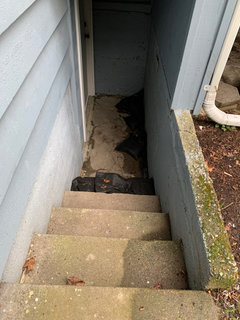
    The outside has some challenges but is perhaps not insurmountable. One challenge is the back of the house - it has concrete stairs leading down to a landing with no drain.

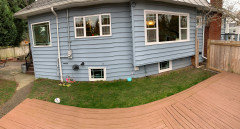
    The side of the house that most leaks has a free standing deck nearby, but otherwise is mostly clear. The property has a couple trees, one quite large (not pictured).

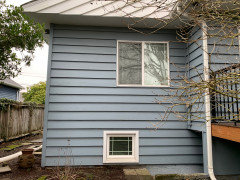
    Pictures are 1) basement landing in back 2) the back leading to the stairs and 3) the side of the house that leaks the most

  • 5 years ago

    What kind of foundation do you have? We believe ours to be a "rubble" type which means that digging a deep exterior drain could destabilize the foundation (!) - hopefully that is not your situation.


    Is the tan area in the last photo a driveway? Would it be possible to replace that with a more permeable parking surface like Turfstone? If grading is an issue on that side, I assume you would need to rip out the driveway anyway if you were to regrade.

  • 5 years ago

    No that’s a freestanding deck made of wood that stands on concrete pilons.

    The foundation is concrete cinderblocks I believe.

  • 5 years ago

    My very, very basic understanding is that if water is coming up from below from a rising water table that re-grading won’t necessarily solve the issue. Happy to be told otherwise as that is a more localized change I think, at least on that one side of the house.

  • 5 years ago

    Theres more to this than has been revealed. Common sense should tell us previous owners haven't been replacing carpet every time it rains heavy. Or possibly the floor has always been bare until the people you bought it from installed carpet to increase sale price. Was carpet brand new? Sellers can be held liable for concealing problems like this. Realestate agents often neglect to repersent their client. Do you trust yours? If so,discuss possability of decetful seller. Otherwise consult with another realestate expert concurning decetful pratice. Another approace is asking previous owner(s) what they know about the problem and what all has been done in the past to remedy it. Hopefully a drain system was installed and now only need's repair or maintainance. Unless you are convinced no remedy was attempted,search for clues around founation of buried drains and low ares where those drains might run to ''daylight''. Try and direct rainwater away from foundation as far away as possible. I find that people keep filling low places in yard when a ditch is a better solution. If there's a place where water pond's but there's no way of redirecting,consider temporary using a portable pump to see if that's where basement water origionates. You will have to figure this out because internet buds don't even know what color the home is,much less what it and the lot look's like so how can they tell you what's wrong?


    0

  • 5 years ago

    The water table is the first thing people blame. If that was a problem, there would be water along many locations at the wall/footing connection and coming up around floor drains and such. During dry weather. Also when the basement was originally built there would have been problems during excavation.

    During a heavy/continued rain, the ground gets saturated. Any additional water beyond that saturation finds someplace to go, and basements are the perfect fool. If you can minimize the water leading to that oversaturation, or gather it and cart it off when you can't, problem solved.

  • 5 years ago

    The carpet was brand new - the basement was finished (barely) prior to sale.

    I also discovered recently that that standalone deck (pictured above) has its own drainage that points towards the house. I’d like to say that this is the primary cause of the basement water issue — it does point at the side of the house that gets water — but it’s also about 7 feet away from the house which is in the range of recommended distance. Addressing this would be much easier than trenching our basement.

  • 5 years ago

    I have been resisting going after the previous owners in part because I think it’d be a hassle and unlikely to yield anything. There’s no obvious signs that they knew and concealed (even if they did).

  • 5 years ago

    I wasn’t saying the water table is at the foundation during dry times fwiw. The theory is that the water table only rises to the level of our house during massive, record storms like we’ve had. Still seems plausible to me. And seems plausible as well that water would come in where it finds the least resistance, not equally in all areas.

    Not sure you’re saying anything much different.

  • 5 years ago

    I also discovered recently that that standalone deck (pictured above) has its own drainage that points towards the house.

    That would be a good start. There's no "safe distance" that I am aware of, you can't pinpoint exactly how the water behaves underground.

    Noah Davis thanked 3onthetree
  • 5 years ago

    So I ended up buying the book “5 Steps to a Dry Basement”. (Thanks Isaac!) I’m on step one. So far, so good. :)

    One thing the author says in the beginning is that he used to be a consultant helping people diagnose seapage issues. To keep objectivity, he would not repair the issue himself or get cuts from others who did, merely make recommendations.

    Honestly this kind of service sounds amazing but I haven’t seen anything like it. Does such a thing exist? Are there well respected professionals in this space?

    Thanks.

  • 5 years ago

    @Noah Davis on a related issue (mold) I found such an independent expert, but he seemed to be the only one in the region. So - hopefully you can find someone? Asking neighbors is probably the best route. Online seemed a lost cause in my experience.

    Noah Davis thanked Isaac
  • 5 years ago
    last modified: 5 years ago

    My parents home, 60 years old, has had water that seeped in, up from the basement cement slab probably 4 times. It has only happened during extreme rains, we are in Minnesota.

    They do have a walk out basement so the back half of the house is "floor" is more accessible. To solve they made sure

    1) ground drains away

    2) 10 foot extensions on gutters

    3) sump pits dug. 1 in basement unfinished area and one one the outside near the area water tends to come up from.

    The heavy clay soil doesn't drain and pools and the hydrostatic effect if coming up through the basement slab, least resistance comes into play.

    Since the water problem is really quite rare, but a problem, they didn't want to have the basement floor dug up for drain tile, plus the expense. They dug out the holes, place a sump pit plastic liner thing, filled with gravel on bottom and sides, and a sump pump and attached a garden hose to pump any water away from house, the interior one too. They only really turned it on during spring and summer during rainy times. The pits are deep enough so they are lower than the basement slab and have been in place for about 10 years and pumps go on, but very rarely. Are they working to keep basement dry? Not sure, but basement has been dry.

    Noah Davis thanked Izzy Mn