Software
Houzz Logo Print
trapezemit

Should this screen be blocked to stop air flow between attic - house ?

5 years ago
Hi All,


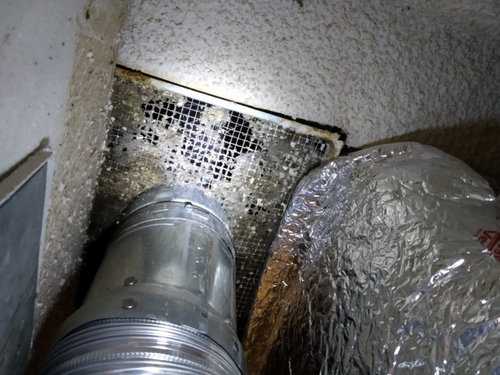
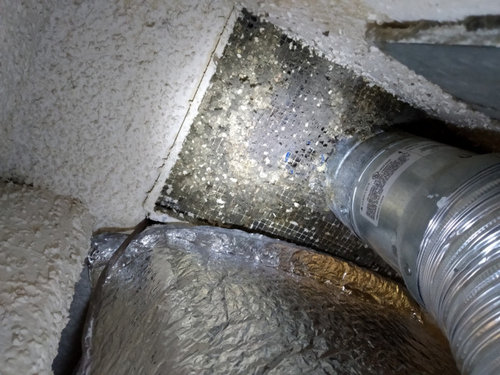
Below two pictures are when I look up the ceiling inside the whole house heater compartment in the house. As you can see the screen is dirty and almost blocked by insulation materials.


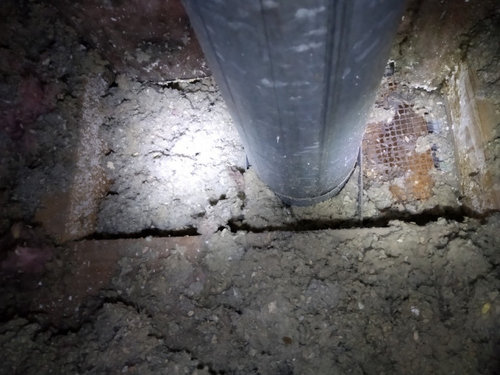
Below picture is when I look down at the screen in the attic.


Should this screen be blocked to stop airflow between attic and house inside ? Or should airflow be allowed thru this screen ? What is the right way ?


Thanks.

Comments (28)

  • 5 years ago

    Clean the screen and keep it clean. That's where furnace get's combustion air. Without screen,unit can burn rich lowering fuel effeciency and increasing c monoxide.

    R J thanked klem1
  • 5 years ago

    I don't know what the requirements are but I can share what I observe in my own house.


    I have two natural gas appliances with atmospheric vents (ie, hot air rises) in interior "closet spaces" in my house. One is a regular water heater and one is an 80% furnace. The "closet" each is in is used for no other purpose but for housing the appliance. In each, there are screened holes in the floor (to the unsealed crawlspace) and a second high hole - one to the attic appearing as in your photo and in the other one on a wall to the outside (that part of the house has two stories and this closet is on the lower floor). The doors to each closet are well gasketed (weather stripping) and have thresholds that equally seal the door gap at the bottom.


    My assumption always has been that the two together provided combustion air and, for the higher one, an escape route should there be a leak of lighter than air natural gas. And that the doors are well sealed to prevent combustion products from entering living space.


    All of that suggests: clear off the insulation on top of the screen so that the air passage isn't blocked.

    R J thanked Elmer J Fudd
  • 5 years ago

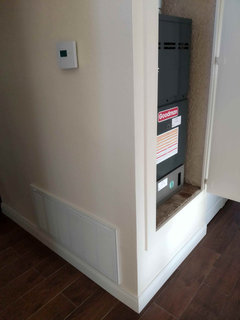
    Thanks @klem1 @Elmer J Fudd. Attached is the return air filter grille. I know the grille sucks air in as I can easily feel the airflow.


  • 5 years ago
    last modified: 5 years ago

    I agree with klem, the return air grill routes air from the room, thrugh the furnace's heat exchanger and then blows it out through the supply ducts. No direct contact with the combustion chamber. This is an upflow furnace. The bottom vent I was talking about would be on the platform the furnace sits on and would supply air to the interior of the "closet" but not in the airflow path of the heated air. It would do the same as the hole in the ceiling does. . Maybe it's at the back or maybe there isn't one. Make sure to clear the screen on top and put weather stripping around the frame of where the door closes, on all 4 sides.

    R J thanked Elmer J Fudd
  • 5 years ago

    Thanks @klem1 @Elmer J Fudd I am trying to seal the closet door but having some issue. After I put seal strips around the interior side of the door on the perimeters I am not able to shut the door properly with a good seal and there are still small gaps around the door. The seal strips I have are not thick and I need a good lock/latch to shut the door properly to close those small gaps. Any lock/latch suggestions and even on the seal strips ? Thanks.

  • 5 years ago

    I suspect, that you shouldnt be sealing that closet door. Its all that way for a very good reason. Clean the screen, remove the seal strips, and leave it alone.

  • 5 years ago

    As has been stated, the grille at the ceiling is for combustion, dilution, and ventilation air for the closet, because you have a gas-fired appliance with a B-vent in it. It is allowable to have a single permanent opening as long as the attic can obtain air from outside. What you can do is build a perimeter frame out of 1x or 2x in the attic to prevent the blown-in insulation from falling over into the grille again. Also, it looks like the flex duct is for a dryer, not B-vent flex.

    For fun, you can do a math equation: take your furnace BTU, divide by 3,000, then divide by 0.75. That is the size of a single clear attic opening you should have (e.g. 60,000BTU/3,000/0.75 = 27sq inches of opening).

    The weathersealing of the closet door is required when the furnace only has access through a bedroom or bathroom, accompanied by a self-closing hinge. If not meeting that criteria, I would disregard adding weatherstripping.

  • 5 years ago
    last modified: 5 years ago

    @cat_ky During hot days in this summer season I can easily feel heat coming from the attic seeping thru the gaps of the closet door. Even though I haven't investigated yet, I feel it would be the same during cold winter nights where the cold air from the attic would seep thru those gaps(or heat escaping).

  • 5 years ago

    @3onthetree I am not quite following "The weathersealing of the closet door is required when the furnace only has access through a bedroom or bathroom..." The furnace is located at family room/kitchen area. I have heat registers in bedrooms, bathrooms, living room, family room.

  • 5 years ago

    I presumed after Elmer's post that you were following his setup with weatherstripping thinking you had to have it. However, it is only a requirement when you have a gas-fired unit accessed only from a bedroom or bathroom (nothing to do with where the ductwork goes). In your case you don't have that requirement.

    If you choose to do a little airsealing on the door, try a felt version which would be thinner than a foam tape or vinyl/rubber.

  • 5 years ago

    Thanks @3onthetree Any idea how to still have a locking mechanism rather than the door just resting on the airsealing ?

  • 5 years ago

    The vent might also need air exchange, and by sealing the door, it will not get that. It is something you need to discuss with the Hvac company, before sealing the door.

  • 5 years ago

    cat_ky

    "The vent might also need air exchange, and by sealing the door, it will not get that. It is something you need to discuss with the Hvac company, before sealing the door."

    Cat I believe your comments are usually informative and helpful but this one doesn't seem to be either. I don't want to be harsh,only point out that folks come here expecting free expert advice rather than pay for it. In many cases where responders are obovously giving bad infornation ,your advice to ignore it and consult a pro would be the right thing to do. There is no reason to exchange air between closet and living area. Seeing proxemity of return air grill ,it might be advisable sealing door to prevent "back drafting" of combustion by-products in the event of "negative pressure" within living space. I don't see any possible negative result from sealing door but willing to hear other opinions if based on science.


  • 5 years ago

    For some locking hardware, try googling images of "cabinet catch styles" and "window lock." Depending on how much you have to push the plywood(?) panel to seat, and how much casing reveal there is and meat available to screw into, find a style that works best. You may wind up having to have 1 low/1 high to compress the weatherstrip thickness enough and uniformly for the panel to sit "flush-ish."

    R J thanked 3onthetree
  • 5 years ago

    Thanks @3onthetree I just met a utility guy in my area. He said I don't need to seal the gap and furnace needs lots of air to operate, but I can optionally do so just not airtight seal. So here is my question that came up after he left: The air filter grille at the bottom on the side sucks cold air in thru a filter which then goes thru the bottom of the furnace also thru another filter, then the 'filtered' cold air gets pushed up by a fan thru the heat and becomes hot air. If the furnace does need the cold air coming thru the closet door gap that air is unfiltered, which theoretically I assume would not be used as heat. If so, how does the furnace utilize that unfiltered cold air ? In reality, I guess people might say that unfiltered cold air is so tiny compared to the cold air coming from the air filter grille so it's negligible then I guess that is that. But that tiny unfiltered cold air still needs to get "inside" the furnace to go thru the heat to be made into hot air. However I don't know if that is happening in reality.

  • 5 years ago
    last modified: 5 years ago

    I wonder if the unfiltered cold air thru the door gap(seems too small in volume) is the fuel the furnace needs. If that's the case, I wonder if the unfiltered air from the attic thru the air vent in the closet can be used as fuel instead.

  • 5 years ago

    The return vent on the side of the closet is where the unit gets all of it's air to condition and send out to the rooms (barring a ducted fresh air outside intake not shown in pics). It does not pull any air from the closet itself or through gaps around the access cover panel to mix with the air coming through the side grille (theoretically).

    The open vent in the ceiling which was the main focus of this thread is to provide surrounding air that a flame needs to fire up and stay lit (combustion). It also vents any surrounding air that could be parsed with carbon monoxide or gas (ventilation). It also dilutes any surrounding air that could be parsed with carbon monoxide or gas (dilution). Again, any air coming through a gap around the access cover panel is not theoretically designed to help in this function. Code sections IRC G2407/IMC 304 covers "Combustion, Ventilation, and Dilution Air" requirements.

    R J thanked 3onthetree
  • PRO
    5 years ago

    It also vents any surrounding air that could be parsed with carbon monoxide or gas (ventilation). It also dilutes any surrounding air that could be parsed with carbon monoxide or gas (dilution).


    False. A properly operating gas furnace will not / should not produce ANY carbon monoxide. If it does, it should be disabled and red tagged.


    A properly operating gas furnace produces carbon dioxide as a waste product. (CO2)

  • PRO
    5 years ago

    "False. A properly operating gas furnace will not / should not produce ANY carbon monoxide. If it does, it should be disabled and red tagged."


    By that standard, a lot of folks with gas furnaces would be left out in the cold, so to speak. Even in controlled laboratory conditions, complete combustion is rarely achieved. In the real world, burners are tuned by measuring the composition of the furnace exhaust and adjusting the burner as needed to maximize combustion efficiency. Here's an excerpt from TruTech Tools Combustion Guide:


    "During combustion, carbon in the fuel oxidizes through a series of reactions to form carbon dioxide (CO2). However, 100 percent conversion of carbon to CO2 is rarely achieved under field conditions and some carbon only oxidizes to the intermediate step, carbon monoxide or CO."


    https://www.trutechtools.com/assets/images/EducationalMaterials/TruTech%20Tools%20%20Combustion%20Guide.pdf


    It is reasonable to expect combustion products from a natural gas-fired furnace to include carbon dioxide, carbon monoxide, nitrogen oxides, some trace sulfur compounds, some VOCs, and of course, water vapor.

  • 5 years ago

    "False. A properly operating gas furnace will not / should not produce ANY carbon monoxide. If it does, it should be disabled and red tagged."

    Not false. The code excerpt is titled "Combustion, Ventilation, and Dilution Air," not just "Combustion" air. It does not care what the gaseous recipe % is for a unit not running as designed, but CO is the immediate concern. Next, you are going to argue that the T&P valve on a water heater is for high-iron content water only.

  • PRO
    5 years ago
    last modified: 5 years ago

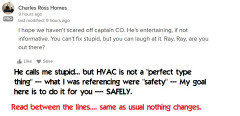
    I hope we haven't scared off captain CO. He's entertaining, if not informative. You can't fix stupid, but you can laugh at it. Ray, Ray, are you out there?

  • 5 years ago

    Are you writing all this down RJ so you don't forget?

  • PRO
    5 years ago
    last modified: 5 years ago

    In a home supplied with gas there are multiple appliances that can produce CO. You are paying me to determine that your furnace is safe to operate. So these are the guidelines I use in the comments I made was referring to what causes "unsafe operating conditions" with a gas furnace.

    I prefer to KISS. --- others like to chase rabbits down holes that go no where good.

    These people couldn't do my job, oh but do they love to come here and chide me. You would think if they were any good at their "original profession" they would concentrate more on that....

    People who like to argue and yack...

    Click to enlarge if necessary.


    Scare me off? LOL. good one.

    See I actually do work outside this board. I'm not just here yacking for the sake of yacking like all these people who only "think" they know something.

    I am here to do it for you safely. Not to teach you or tell you how to do it.

    click to enlarge if necessary:


    That's right below 70 ppm is considered safe.

    Indoor levels vs outdoor CO levels?

    So why didn't I say that?

    My job is to do it for you... If you want to learn it, this isn't the place for that. Trade Schools exist for a reason. That is not the function of this board.

    When it comes to CO you don't look at just one thing... I like to call this "the bigger picture".

    A fact that is lost by builders like Mr. Ross & Company.

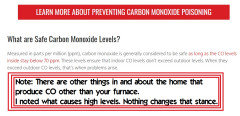
    Note: To be able to test to levels and determine CO ppm content requires expensive testing equipment.


    -------------------

    Next, you are going to argue that the T&P valve on a water heater is for high-iron content water only.


    A new arguer with too much time on their hands? Welcome to the party! ----- T&P stands for Temperature & Pressure. I am not a plumber and yet I know this? miracle alert.

  • PRO
    5 years ago

    @Austin Air Companie,

    You stated:


    "A properly operating gas furnace will not / should not produce ANY carbon monoxide. If it does, it should be disabled and red tagged."


    I think that's a pretty explicit statement.


    Now you provide a copy of something that says:


    "Note: There are other things in and about the home that produce CO other than your furnace."


    Which is it, Ray? Does a gas furnace produce CO as a product of combustion or not? The question is not taking anyone down a "rabbit hole." The hazards of CO are very much relevant to this thread. Of course, if a gas furnace doesn't produce CO....


  • PRO
    5 years ago

    These things are measured in PPM. You know what PPM stands for?


    Clearly the objective here is 0 ppm inside the house. The purpose of what I posted is what causes dangerous conditions. It is not my objective to go down every possible rabbit hole on a forum board.


    You are trying to fit something that varies into a nicely fit perfect equation. It doesn't work that way.


    If its 20 ppm in a flue, if it's 10 ppm, 4 ppm, 30 ppm, 100 ppm?


    So where do you draw the line if inside the home's air stream the ppm count is 0?


    Grey areas... not the place for a forum board.


    In this video he says you won't have 0 ppm, but just a few seconds later it's exactly that... 0 ppm.


    So the answer is: It varies. ------ BUT for safety sake --- it is not my goal on a forum board to suggest any amount is good. Because many come here to "do it themselves".


    Best to avoid that kind of controversy. "The bigger picture" is the name of the game here at the end of the day.


  • PRO
    5 years ago

    @Austin Air Companie,

    I'm not buying it, Ray.


    You are a frequent source of misinformation on houzz.com When someone holds you accountable, your standard defense is "KISS" or "I'm focused on the big picture." If that doesn't work you go into internet "bully" mode. You made it clear that furnaces produce CO2 but not CO. That's just plain wrong. It could lead readers to believe there isn't a safety hazard when there clearly is.


    The average houzzer is, I believe, reasonably intelligent. Accordingly, you don't need to dumb anything down for a houzz.com audience, especially considering the level you're starting from.

  • PRO
    5 years ago

    Did you watch the video I posted all the way to the end? (note it's not my channel, not my video)


    It's there in full living color. Yet you say "it's not so"?


    Truth is stranger than fiction.


    I'm not here to make you believe, Chucky. In the court system all you need is reasonable doubt.... I believe I've provided you with the evidence you claim I don't have.


Sponsored
Miller Woodworks
Average rating: 5 out of 5 stars23 Reviews
Franklin County's Trusted Custom Cabinetry Solutions