Software
Houzz Logo Print
amy_druanbriggs

What’s going on with my lemon tree?

5 years ago
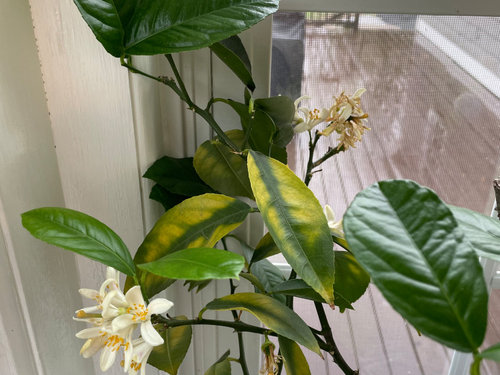
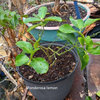
Some advice please. I have noticed some of my lemon tree leaves are looking strange! also, I watered it today and a bunch of earthworms came crawling to the top of the soil. What should I do?

Comments (10)

  • 5 years ago

    What do you mean earth worms? Where do you grow it? On a deck?

    Cold to very warm to cold can cause the leaves to do that. Looks like the newer leaves are crinkly from the changes in weather.

    As for the yellowing, that is a nutrient issue.

    What do you feed it, how often? What is potting mix like? Does it stay wet for long periods? Do you water in sips? Is it a peat mix? Old? What have temps been like? And what pH is your water?

    Amy Briggs thanked Meyermike(Zone 6a Ma.)
  • 5 years ago

    Your tree has a magnesium deficiency. To correct the deficiency dissolve 3 oz. Epsom salts (Magnesium Sulfate) in a gallon of WARM water and apply as a foliar spray. You can also pour a cup of he solution into the container's soil. Leaves as damaged as the one shown in the above picture might never regain full coloration. To prevent this from happening again give the soil a cup once every 2 months.

    Amy Briggs thanked Silica
  • 5 years ago

    Hi, Amy. It's generally a poor strategy for hobby growers to look at a nutritional deficiency and decide that dosing to provide a single nutrient (Mg) is the answer because someone thinks it might be a single nutrient issue. The wiser strategy would be to flush the medium thoroughly the next time the plant needs water. Do this by slowly applying a volume of water, = to at least 10x the volume of the pot the plant is in, slowly through the soil. This will flush out any accumulation of salts in the soil/ soil solution. It's essentially like hitting the fertilizer "reset button" and resetting fertility status to zero (well, as close as you can get). Then, fertilize with a quality soluble synthetic fertilizer that contains ALL nutrients essential to normal growth. I would suggest Dyna-Gro's Foliage-Pro 9-3-6 as your 'go to' fertilizer for containerized plants except perhaps tomato or hibiscus. I still use it for those plants, but up the level of potassium for hibiscus and tinker with both the phosphorous and potassium for tomatoes. All else I grow gets Foliage-Pro 9-3-6. What I described is simple, gives you full control, is extremely easy to replicate, and there is no guesswork or second guessing. It's all you'll need. Not only that, but there is no chance of inadvertently supplying too much Epsom salts, which could cause the plant difficulty taking up enough calcium and/or potassium.

    I've never been a fan of trying to diagnose then treat symptoms of a single nutrient deficiency issue for the simple reason its far more likely the effort will end up being limiting than a benefit. Too, the root pathway is the best way to get nutrients into the plant; so, if you ever need to fertilize a containerized plant by way of a foliar pathway, you can consider it a 'tell' that whatever program you have in place for supplemental nutrition needs to be reassessed.

    If you do decide to apply an Epsom salts solution, I suggest you tie a light string around a few affected leaves and spritz only those leaves you marked. After 2-3 days, you should see a change in symptoms if it was of any value, but again, the smart play is the holistic approach by which you avoid too many eggs in the one basket.

    Al

    Amy Briggs thanked tapla (mid-Michigan, USDA z5b-6a)
  • 5 years ago
    last modified: 5 years ago

    Unfortunately, citrus trees from time to time become deficient in one element or another. In the above case it is a magnesium deficiency, but there are also many other deficiencies that befall citrus, such as iron, nitrogen, calcium, potassium, manganese, boron, zinc and on and on. The common practice is to identify the element that is deficient and apply it. To go through all of the above instructions each and every time a deficiency occurs seems quite unconventional, unnecessary, and frankly far from the norm.

    Amy Briggs thanked Silica
  • 5 years ago
    last modified: 5 years ago

    What's most "common", by a very, very large measure, is to do what I described. In fact, it's very uncommon for hobby growers with trees/plants in containers to try to identify and isolate a deficiency then treat it, and when they do, it's usually because they were influenced by someone with good intentions. To suggest something is good or right because it's 'common' is a logical fallacy called 'appeal to tradition'. Grand theft, cheating on your taxes, driving while impaired, or choosing junk food over healthier fare, are all "common".

    It's worth repeating what I said above about hobby growers adding this and because someone said it would be good for my plant. The effort usually end up being limiting, not beneficial. There is no substitute for a sound nutritional supplementation program, and 99.999 hobby growers will never achieve one by dosing with elements/compounds chosen because they provide 1 or 2 nutrients.

    "To go through all of the above instructions each and every time a deficiency occurs seems quite unconventional, unnecessary, and frankly far from the norm." Poisoning the well by suggesting what I described is somehow a laborious chore that must be repeated with great regularity is very misleading. Mixing the fertilizer solution requires no more effort than mixing a solution of water and Epsom salts. You flush the soil thoroughly ONCE, one time. Then, you fertilize with Foliage-Pro 9-3-6, which ensures every nutrient essential to normal growth is A) in the soil solution, and B) immediately available for uptake C) at a ratio extremely favorable to the plant. After that, Amy needs only to water appropriately and fertilize regularly - standard care. The suggestion to simply dose with Adding Epsom salts does nothing to correct any existing nutritional problems not related to Mg, and has a significant potential to add to whatever problems might exist. What I suggested ensures she'll be on solid ground with regard to all nutrients. It's always important to remember that anything in the soil solution in excess of what the plant needs has only the potential to limit the plant; and an excess has the same potential to be limiting as a deficiency.

    IF, we were talking about trees in the ground or an orchard, "appropriate" would be having a soil test done and adding the nutrients suggested by that soil test facility. I can't imagine an orchardist looking at a few leaves, determining the cause is a Mg deficiency, then start spraying Epsom salts on the leaves. Without tissue analysis to confirm nutrient deficiencies pro growers are very often dead wrong in determining what's causing symptoms to appear in leaves, and that's when they have the leaves in hand and a history of the plant. Here, we have another hobby grower diagnosing from an image in the internet with no cultural clues or background and writing prescriptions for a cure, when the wisest thing by far would be to get the plant on a sound and very easy nutritional supplementation program ASAP.

    Finally, you're asking Amy to bet with you that the most limiting issue of all issues with the potential to be most limiting (including cultural issues) is a deficiency of MG. If it isn't, it's an absolute certainty the application of the Epsom salts solution will be a limiting factor. See Liebig's Law of the Minimum for confirmation.

    AL

    Amy Briggs thanked tapla (mid-Michigan, USDA z5b-6a)
  • 5 years ago
    last modified: 5 years ago

    Al I will just leave it here. We are never going to agree, no matter how many words, or how long the explanations. Amy can do what ever she wishes. Have a good day.

    Amy Briggs thanked Silica
  • 5 years ago

    Exactly right, Alex. Hobby growers dosing willie nillie with an element or compound targeted specifically at supplementing a single nutrient often supply too much, which leads to an unnecessarily high level of dissolved solids (salts ..... as in Epsom salts) in the soil solution, or, too much of that nutrient such that it leads to an antagonistic deficiency, which is what you alluded to and I mentioned when I said an excess of Mg can cause deficiencies of ca(lcium) and/or K (potassium). What a deal - two deficiencies for one! That info can be gleaned or confirmed at a glance from a quick look at Mulder's chart. Notice the red lines from magnesium to its antagonists, calcium and potassium.

    Not only that but many deficiencies, especially of those nutrients considered immobile in the plant, are caused by cultural conditions like cold temps, pH levels, or soil saturation, even though there is an ample supply of the nutrient in the soil. From that, the conclusion can be made that even if the plant IS suffering from a deficiency of MG, the cure may well be cultural as opposed to chemical.

    For conventional container culture there is just no safer or more effective way to cure a nutrient deficiency (w/o a soil test) than by resetting the soil fertility level to zero (by flushing) then supplying a fertilizer calculated to supply all essential nutrients in an appropriate ratio.

    ..... appreciate your comments.

    Al


    Amy Briggs thanked tapla (mid-Michigan, USDA z5b-6a)
  • 5 years ago

    Thanks Al! Really cool stuff, I have a lot still to research but all of your posts have been fantastic starting points.

    Best of luck Amy, hoping your tree makes a quick recovery!

    Amy Briggs thanked alexcm [z6a]
  • 5 years ago

    Thank you for everyone’s input! I greatly appreciate it.

Sponsored
Buckeye Basements, Inc.
Average rating: 5 out of 5 stars40 Reviews
Central Ohio's Basement Finishing ExpertsBest Of Houzz '13-'21