Software
Houzz Logo Print
dbarronoss

Native Plants Inventories and Want Lists

5 years ago

Actually not going to put mine here...because the topic isn't about MINE. I'll add a reply.

Comments (29)

  • 5 years ago
    last modified: 5 years ago

    Ok, here's the link to mine:

    https://docs.google.com/spreadsheets/d/1yJ6qg6ocOYrsWNlYsBqip7ND_CKg-6Gh8Qy-9gUrqNE/edit?usp=sharing

    This is a list of native plants (annuals, perennials, shrubs, and trees) that I am currently growing.

  • 5 years ago

    Yes, good to have a propagation column.

  • 5 years ago
    last modified: 5 years ago

    You do need to use the link that grants everyone access or go grant me access (I requested). :)

    Hadn't occurred to me, but I can look and see what others have and ask how they're doing for them (that would be neat).

  • 5 years ago
    last modified: 5 years ago

    Nice...I can see it ;) Can I suggest (for both of us) that we add a title to what the link is? Ie yours is a native shrub list, but we have the mechanics down.


  • 5 years ago

    Okay, just clicked "Share with Anyone who has the link." Obviously, my list needs lots and lots of info added. If you all have the correct info, feel free to add.

  • 5 years ago

    It's view only unless you grant me specific access rights. At this point, I need to populate my own...maybe tomorrow?

  • 5 years ago

    I think perhaps I need to know how you defined "native" when you put this together. In other words native to north America? Native to state? Native to county?

    Nancy host plant page is fascinating.

  • 5 years ago
    last modified: 5 years ago

    Good point Amy, no one agrees on those terms. I'm going to go with native to my state and near-native (adjoining states). It might still be a stretch to call lantana native (lol, even if it is to Texas), I dunno, what do you think ?

  • 5 years ago
    last modified: 5 years ago

    Amy, I go with the experts' definition of native (and they're largely dependent on Tallamy's research, supported by Audubon, Natl Wildlife Federation, other experts. I was developing my lists to be as specific to NE OK as possible--and that list is far from complete at this point--and definitely needs some culling. That is, what is native here may not be native for OKC. Some of my entries had been struck through, but when I copied the spreadsheet to Google doc sheet, the strike-throug disappeared. There were several that were native further north or west or such.

    I'm taking the same approach Danny is taking, only perhaps even narrower. I was going by eoregion conditions. Thus, Kansas, for example, even though a neighboring state, is nowhere near close to my ecosytem. We are definitely not "plains" here. I'm not calling lantana, cosmos, tithonia, or zinnias native. . . but admit that pollinators seem to appreciate them all--and having said that, I've no plants to quit growing them for now.

    Here is something funny--even though Lincoln is only 10 miles from here, it is full plains/grassland. A whole different deal. Some/many plants, of course, overlap and are truly native in wide regions or several different habitats.

    I'm sure the more I study and read, the better idea I will have--same for all who are interested.

  • 5 years ago

    Nancy the Grand river dam was built in 1940. There were very few lakes probably before that time, so in say 1900, your habitat and the school's were probably much more alike, at least as far as being dry. I'm trying to picture the Osage hills when I was a child. They didn't really have lakes, just rock and grass (child's memory). The Osage hills should be a similar comparison to where you are now, without lakes.

    I've been going through my list, fine tuning the native designation. I've included a note for native cultivar, too.

    I'm pretty sure if the vendor is prairie moon or Missouri wildflowers I got them because NWF had them on my zip code list. If not they are plants I've seen on FB native plants group.

    I also want a hummingbird designation, because I want flowers, not feeders. (Nothing wrong with feeders, but i have trouble with them.) And by the way, what are y'alls thoughts on putting out watermelon and bananas for butterflies? Is that just to bring them in so you can see them?

  • 5 years ago
    last modified: 5 years ago

    Can you afford to buy fresh fruit for butterflies? It's essentially the same as hummingbird feeders (which I agree are not a good idea..too often the brew sours and kills, congregation encourages disease spread, plus they have to have the insects from native flora to raise a brood). I don't think soured fruit will kill butterflies though ;) Seriously fresh fruits and veggies are kinda expensive (imo). Of course if you're putting out waste that you couldn't get eaten..I guess that's another thing.

    Those hummingbirds do seem to have a preference for red flowers (lonicera sempervirens and salvia coccinea being two that draw them a lot in my yard for nectaring), I assume they police other flowers for insects as that's part of their diet and an essential protein for the young.

    Yes, my idea of Oklahoma was much drier than it is now. In fact people talk about having horned toads in Oologah when they were kids.

  • 5 years ago
    last modified: 5 years ago

    I have loved studying the unique topography and geology of our unique state---and at our home in very tippy NE corner of Wagoner County--it's different than Osage Hills, from a reading of the topography and geology of that area. We are right at the very westernmost edge of the Springfield Plateau, part of the Ozark uplift. I was determined to figure out why our growing conditions were so different from what Dawn used to describe, and embarked on studying OK's geology and topography.

    I think it's safe to say our state is one of the most diverse states in the union geologically--if not THE most diverse! Just fascinating. Yes, the manmade lakes enlarged the amount of water, but still, being next to the Neosho originally on rocky bluffs, this land is ROCK, no clay. Barely any dirt! lol Indeed, just 2-4 miles to the west, the land levels out to grassy plains (which is what Wagoner has). And with those other two magnificent rivers, the Arkansas and Verdigris, WOW is this area surrounded by water!

    My goal is to build a healthy ecosystem, first. While I used to think it was about butterflies, now realize it isn't. For me it's about putting the right (native) plants in the right places. Amy, I don't get the "flowers not feeders" comment. ? I have no thoughts on watermelon and/or bananas or other fruits. They all just go to the compost pile.

    (AND though I haven't found any horned toads here, the kids in town do. Doesn't mean they're not here. . .)

  • 5 years ago

    I have problems with hummingbird feeders (they leak on me) Nancy, so the last few years I've been looking for flowers to attract hummingbirds rather than having feeders. My coral honeysuckle died last year, so I've replaced it and gotten a cross vine start. However they're both cultivars. I think the Hummers won't mind. I've got seeds for salvia coccinea, some are cultivars. I grew cardinal vine last year. This year is kind of a loss, just trying to keep things a live.

    Sounds like you do have a wetter environment. I went to church camp outside Chouteau. I remember the cliffs, though there was a lake by then (yours?).

  • 5 years ago
    last modified: 5 years ago

    Amy, my Major Wheeler attracts them just fine...and it's the most floriferous vine I've ever grown, with flowers all through mild winters.

    I also have 'Blanche Sandeman', but the Major is my favorite.

    I think the cv business applies mostly with host plants, not pollen/nectar (unless the flowers are double).

  • 5 years ago

    Major Wheeler is the one I got and Tangerine Beauty cross vine. They were what was still in stock when I decided I had to have them (last thing I bought).

    I've been updating my spreadsheet.

  • 5 years ago

    Are you going to share your spreadsheets with us (given that it may take me a month to populate mine..puppy, estate, etc), Amy ? :)

  • 5 years ago

    Of course, but I realized mine wasn't current. I use a formula to populate a sheet from the master list based on a particular column. But the "native" sheet was copied and pasted so it wasn't updated from 2020. Doesn't make sense. I make a copy of the master list and rename it from year to year. But my sheet is mostly seeds I have already. The "want" part is hard, because every picture posted on the native plant page ends up on my want list, LOL.

  • 5 years ago

    I do understand relentless 'want-itis'. Luckily I'm running out of room and I'm kinda tired of having to baby plants for a year till they're sizable enough to play in the yard unattended.

  • 5 years ago

    Ok, so how do I share?

  • 5 years ago

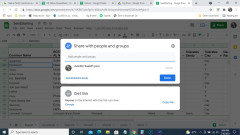
    Amy, if you have it in Google Drive, open the spreadsheet, click File, then Share. It will then open a window that allows you to either type in an email and share with someone specifically, or an option to share the link and anyone with the link can view it. Click the "Copy Link" button, then paste it here.


  • 5 years ago

    Haha--loved your want list!

  • 5 years ago

    I'm annoyed at the formatting. It didn't put the frozen labels at the top. There are hidden columns, but those seem ok. If I change formatting directly will it change it here?

  • 5 years ago

    Yes, I would think so, as long as the link stays constant. I'm annoyed by ALL the spreadsheet programs. Just enough different to keep me screwed up. I've been working a bit on stuff.

    I made mine editable by anyone but would appreciate if y'all didn't without discussing. In a few instances I see a shrub that doesn't say native to OK, but says it is for KS, MO, AR, Tx. WHAT? lol I'm claiming N for here.


  • 5 years ago

    Import and export of documents has always been fun (no, not really).

    Nancy, sometimes that's just because no one has documented it yet..and sometimes it may only be occurring in the N most part of Kansas and the E most edge of Arkansas...in which case Oklahoma loses out ;) Sometimes Texas gets something because of the canyons with streams running through them that otherwise wouldn't have lingered there (just like the fern I mentioned, just less extreme).

  • 5 years ago
    1. Zizia aurea (Golden Alexander)
    2. Polytaenia texana (Texas Prairie Parsley)
    3. Polytaenia nutallii (Nuttall’s Prairie Parsley)

    Natives for Swallowtails.


    I'm going to put this here to make it easier to find later.

    Thanks, Nancy.

  • 5 years ago

    And don't forget sium suave (I'm growing it)