Software
Houzz Logo Print
webuser_5480302

What’s this tree/shrub?

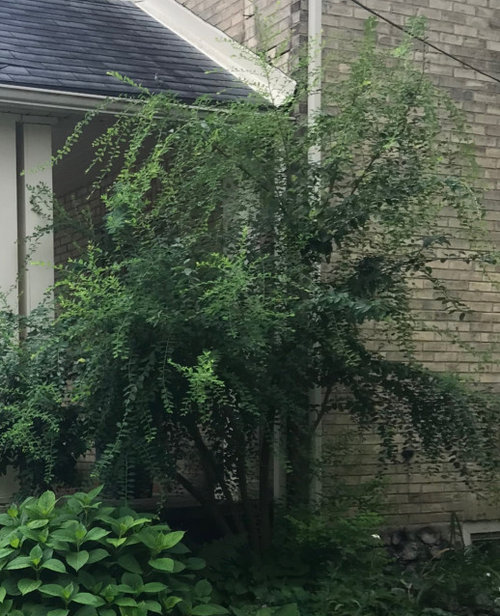
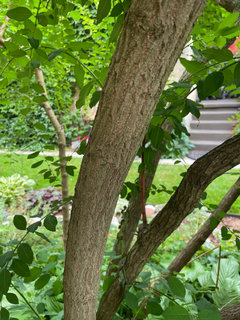
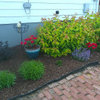
This multi-trunked tree/shrub came with my house and it’s the only plant I haven’t been able to identify!

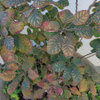
The leaves are fine and alternately arranged. It has small cream coloured flowers at the base of the leaves in late June that has a light honey fragrance and that attracts bees. There are no fruits or berries and the leaves are yellow in autumn. It takes well to hard pruning and seems to max out at about 15ft.

Comments (23)

  • 5 years ago

    What is the geographical location?

  • 5 years ago

    Canada zone 5

  • 5 years ago

    it really doesnt matter what it is ... it has too much potential to be planted that close to the house .. imo... remove it.. and redo that part of your landscape ... is there a nice window behind it???


    and it too big to bother with moving it ....


    looks like the typical spot where a bird stopped on the rain gutter.. and offered a prefertilized seed ... and the birds rarely bring anything of value ...


    see.... to me.. it doesnt even matter what it is ...


    ken


    ps: my WAG of the day .... im wondering about a burning bush or its kin ... a somewhat invasive carp shrub/tree... that the birds do spread around.. which does have wierdo flowers ...


    https://duckduckgo.com/?q=Euonymus+alatus+flowers&t=ffcm&iax=images&ia=images


    https://duckduckgo.com/?q=Euonymus+alatus+canada+invasive&t=ffcm&ia=web

  • 5 years ago

    Looks maybe honeysuckle of some type? Snip off a twig, lay it on a white background & take a closeup pic.

  • 5 years ago

    Ken, thank you for your input and I appreciate your perspective. I do agree it’s too close to the foundation. So far it hasn’t caused me any trouble and I think the plant has reached maturity…. But I guess you never know what’s going on underground!

    The tree is beside an open porch and it provides some privacy from the neighbours as well as architectural interest in the garden. In the 6 years I’ve been here, it hasn’t really changed in size and it seems to have been intentionally planted by the previous owners over a decade ago (based on google street view).

    It produces no seeds, doesn’t run at the root, and plays nice with the other plants around it. The flowers have a nice fragrance but I suspect it’s a sterile cultivated species or a male of a dioecious species?

    So far I’ve ruled out Gleditsia triacanthos (honey locust), Robinia pseudoacacia (black locust), and Gymnocladus dioica (Kentucky coffee tree)…though a lot of the characteristics match Kentucky coffee tree other than height and flower arrangement (at least from the info available about the female flowers).

    I’ll explore the Euonymous genus as per your suggestion about burning bush.

    My intellectual curiosity just won’t stop me wondering what this tree/shrub is :P

  • 5 years ago

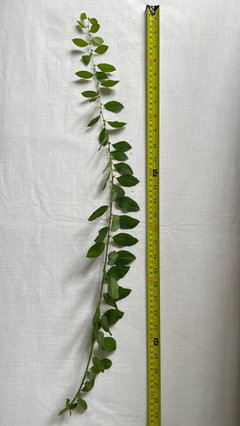
    More photos on a white background with a measuring tape for scale. I’ve also included a closeup of the bark.

  • 5 years ago

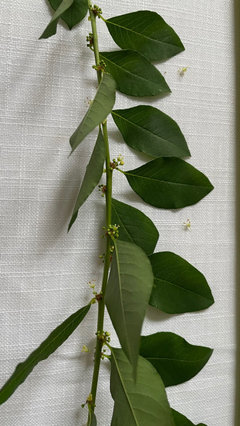
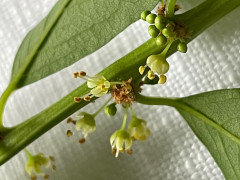
    Closeup (as good as I could get) of the flowers.

    They appear to be perfect (has both male and female parts), but possibly incomplete (missing either sepals or petals or maybe it’s fused). I counted 5 stamens and 5 perianth structures.

  • 5 years ago

    Not honeysuckle which has opposite leaves.

    Are the leaves somewhat leathery? or are they less rugged?

  • 5 years ago

    Leaves are not leathery at all. They are quite thin and flexible…More thin than rose or amelanchier or ligustrum.

  • 5 years ago
    last modified: 5 years ago

    It cannot be either honey or black locust or Kentucky coffee tree because they all have compund leaves (many leaflets to make up a single leaf.)

    The flowers do remind me somewhat of Euonymus which can include 5 parts, though most I know have 4 parts. But the thin, flexible leaves rules out most of the ones I know, and I think they all have opposite arrangement which your plant doesn’t.

  • 5 years ago

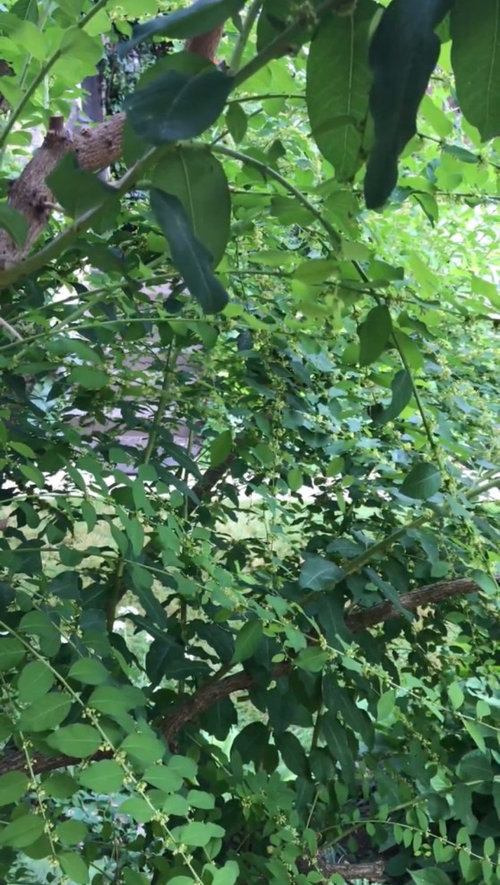
    I’m wondering if this tree is indeed bi-pinnately or pinnately compound. The picture with the measuring tape is what appears to be a single leaf. In the autumn/winter, the long naked petiole is left and in the spring these usually fall away, but they don’t leaf out again.

  • 5 years ago

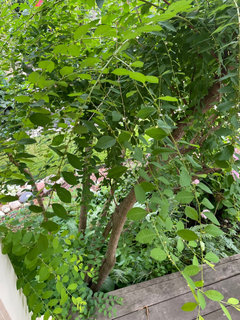
    Here’s another picture that shows the leaf arrangement… bi-pinnately or pinnately compound?

  • 5 years ago

    compare your plant with Ilex longipes

  • 5 years ago

    @sam_md I think my zone 5 (technically USDA zone 4b) is too north for Ilex longipes, but thank you for suggesting Ilex…I will investigate that genus.

  • 5 years ago
    last modified: 5 years ago

    It cannot be either honey or black locust or Kentucky coffee tree because they all have compund leaves (many leaflets to make up a single leaf.)

    Not to mention no Fabaceae has such embarrassingly small and dull flowers!

  • 5 years ago
    last modified: 5 years ago

    wow this one is frustrating...so many thing I'm thinking it can be are opposite leaved, not alternate...thought it could be a Forestiera but I think not, they are opposite too

    the fact the small flowers are fragrant would seem to rule out any deciduous holly?

  • 5 years ago

    @davidrt28 agree it’s not fabaceae…flowers don’t match. I even considered Salix, but they have catkins. I’m reconsidering the compound leaf though…see my posts above. It’s indeed been a puzzling and frustrating plant! Any way I can cross-post to the Name That Plant! discussion? Or do I have to manually post there? (I’m new to posting mechanics on Houzz!)

  • 5 years ago
    last modified: 5 years ago

    I think before a message has replies you can edit the original message and change which groups it was posted to, but it's too late for that now, probably.

  • 5 years ago

    Not a plant I'm familiar with, but compare with Securinega suffruticosa (genus apparently renamed Flueggea )

    Tina (4b SW Ontario) thanked arbordave (SE MI)
  • 5 years ago

    Arbordave, you’ve nailed it! Securinega suffruticosa (aka Flueggea suffruticosa) is totally it!! It’s hardy to zone 3 and dioecious, which explains why I don’t get any self-seeding. Thank you!!

  • 5 years ago
    last modified: 5 years ago

    Good LORD that is obscure! I haven't even heard of the family, Phyllanthaceae! Arbordave holds the Houzz Plant ID world cup for now!


  • 5 years ago

    Arbordave - Thanks for the link to Randy Stewart’s blog. I checked it out and I’m facepalming myself after seeing pictures of this small tree at the Guelph Arboretum. It’s a 30min drive from me and I’ve visited many years ago. Good to know Randy Stewart and Guelph endorses it. I may have to try to take cuttings to propagate more of it now that I know I have a little green gem :)