

please help, michellia leaves petiole turn yellow
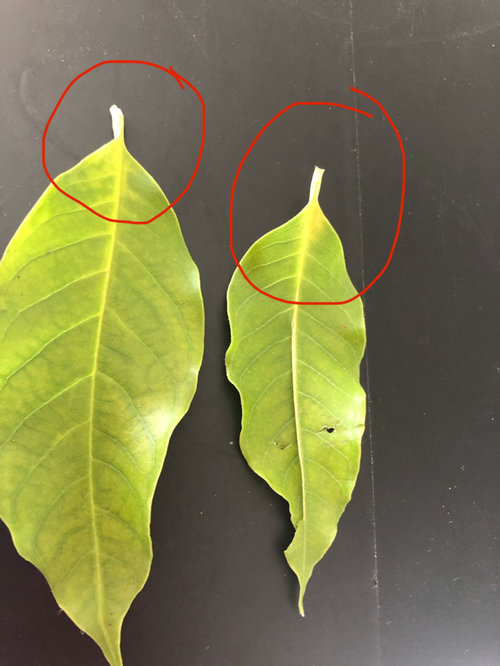
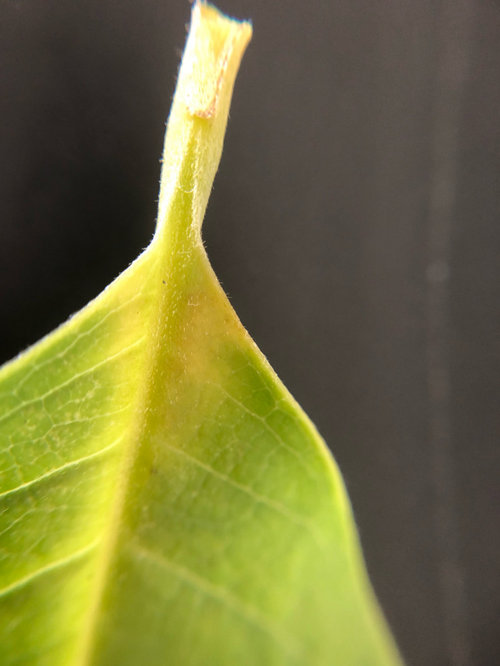
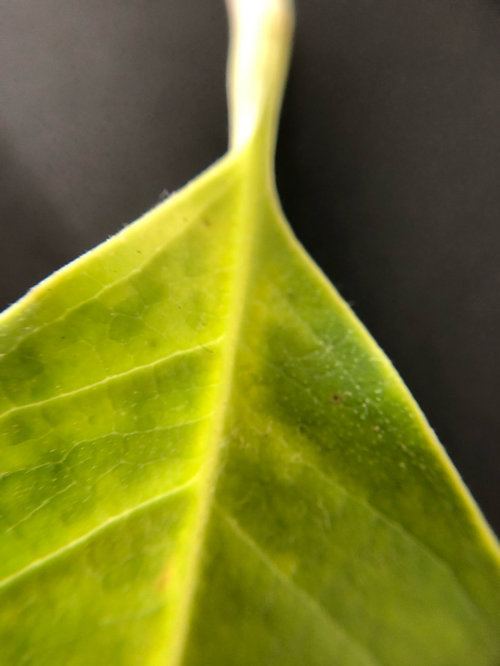
hi, my white champaca is unhappy again these days. some of the older leaves petiole turn yellow and if I touch them gently, they fall off. these leaves are just few weeks old. the other problems of this champaca is 1. new leaves are slow to uncurl. 2. leaves on upper branch stay small. they will grows a bit bigger but won't grow to full size. does anyone know what happen to my champaca and what can I do about it? thanks in advance for any suggestion.
Comments (11)
 5 years ago
some of the older leaves petiole turn yellow and if I touch them gently, they fall off. these leaves are just few weeks old.
\==>>>>
ok.. those are the leaves.. can we see the plant ..
and explain all cultural variables ... light.. water... etc ..
and how are the oldest leaves only a few weeks old???
kenRelated Professionals
London Landscape Architects & Landscape Designers · Crestview Landscape Contractors · Orlando Landscape Contractors · Yuba City Landscape Contractors · Rockford Kitchen Remodelers · Selma Landscape Contractors · Kahului Landscape Contractors · Wichita Landscape Architects & Landscape Designers · Elkton Landscape Architects & Landscape Designers · Anderson Landscape Contractors · Chillicothe Landscape Contractors · Potsdam Landscape Contractors · Jacksonville Interior Designers & Decorators · Anderson Interior Designers & Decorators · Waterbury Interior Designers & Decoratorsjasmine UKzone9a
Original Author5 years ago@ken_adrian Adrian MI cold Z5 " how are the oldest leaves only a few weeks old???" cause whenever the leaves turn a few weeks old they will fall off.
 5 years ago
Hi, Weilin. I rec'd your message. Some observations:
* The plant is nutrient deficient o/a. What are you doing to supplement nutrition as your grow medium should be considered to have none.
* The Seramis is a good foundation for a grow medium, but you nullified it's primary attribute (good aeration) by adding the sand and peat to the mix, which did nothing other than fill in the large pores between the Seramis particles. Decreasing pore size (by adding peat/sand) invites water to take up residence in pores which otherwise would be filled with air. This can account for a plant being nutrient deficient even if you ARE fertilizing appropriately because it limits the plant's ability to take up water; and, since nutrients would be dissolved in a diminished water supply.
* Avoid adding fertilizer salts or any salt formulated to be delivered in a solution, including Epsom salts, directly to the grow medium. This also limits water uptake and can cause plasmolysis (fertilizer burn).
* The Mg in Epsom salts is available as soon as it is dissolved into the soil solution and that would occur (the dissolution part) as soon as you water. A handful of Epsom salts in a single container is more than enough to kill most plants in some situations.
"Some of the older leaves petiole turn yellow and if I touch them gently, they fall off." There are 2 potential causes for the early shedding of leaves. A) A normal drought response. I see 2 conditions each of which can work individually or collectively to cause leaf shedding. The first is the high level of salts caused by application of the Epsom salts, which as we already learned can limit water uptake. As a survival mechanism the plant sheds leaves which reduces transpirational water loss through leaves and helps to conserve water. The second part of a is over-watering itself. Your grow medium will not allow you to water correctly (to the point of soil saturation, so you're flushing salts from the soil when you water) w/o the soil remaining saturated or partially saturated for extended periods. Excess water limits the roots' air supply which limits root function which limits the plants ability to keep the top of the plant hydrated which leads to plant central thinking the soil is dry which leads to the drought response of leaf shedding. B) Poor nutrition forces the plant to rob older foliage of nutrients and other compounds which are mobile in the plant in order to fuel new growth. Called resorption, it's the first step in the shedding process. The other problems of this champaca is 1. new leaves are slow to uncurl. This would be an energy driven process. A plant's primary obligation in terms of energy usage is maintaining existing living parts. Your plant is at approximately the balance point between producing enough energy to keep it alive or not producing enough, so it has little or nothing to devote to growth, which only occurs when the plants cells are dividing in order to make space for more energy storage. 2. leaves on upper branch stay small. they will grows a bit bigger but won't grow to full size. See reply to 1, immediately previous.
I'll leave you to digest that. Let me know what questions you have or where you need additional clarity.
Al
jasmine UKzone9a
Original Author5 years agohi @tapla (mid-Michigan, USDA z5b-6a) , thank you for trying to help my champaca again. just to let you know. I am one of your followers on this website. you are always so generous to share your gardening experience and I enjoy reading them. talking about fertilizer, here are what I use. I use a liquid fertilizer called "chempak no.3" it's a 20-20-20 fertilizer. I diluted 1/4 teaspoon in 500ml water and give about half of it to my champaca and the rest for other plants. I use chempak no.3 once every two weeks. chempak no3 also has other micronutrients as well. here is a photo of it.
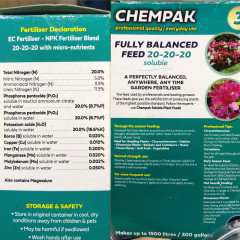
since last week I also use another fertilizer as well. it's Westland Horticulture 20100448 Ericaceous Plant Food Granules Jar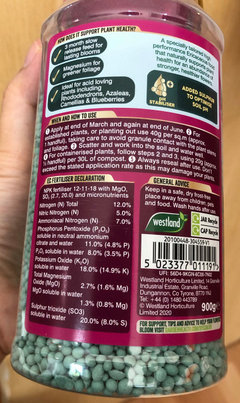
I add about 10 to 15 grams in my 15cm wide 13cm height pot. it's more than instruction recommend cause I think my soil mix doesn't has much nutrient. so maybe it's ok to add more plant food in soil. I just sprinkle these blue fertilizer on soil surface. they seems to dissolve quickly. I doubt it will last more than 3 months.
so,the above are two types of fertilizer I use. should I use them more often? now, can I confirm with you to make sure I understand what you said on previous comment. did you mean I should add MORE peat in the soil mix. so it can retain more water and fertilizer in the soil? I think you said the problem of my plant is cause from not enough water and fertilizer. am I right? about adding epsom salt. how much should I use, how often should I use, on my 15cm pot? should I dissolve them in water first? I add calso4 and mgso4 on soil at the same time. will that be ok?- 5 years ago
"Can I confirm with you to make sure I understand what you said on previous comment. did you mean I should add MORE peat in the soil mix, so it can retain more water and fertilizer in the soil?" No. The peat and sand nullified the most important benefits offered by Seramis, good drainage and aeration. It would be bast if you could eliminate the sand and peat entirely and mix the Seramis into 2 parts of pine or spruce bark which has been screened to remove the fine particles. Ideal bark size range is 3-7 or 8mm. This preserves the large spaces between soil particles that promote aeration/drainage where peat/sand fills those spaces and ensures too much water and too little air in the medium. I'll leave something I wrote about how to eliminate excess water from the medium, but it only works when the pot is small and manageable. ('See Newton's First Law' below) If your champaca is not stable in the pot, you might not be able to use the trick below as you don't want to uproot the plant unintentionally. "I think you said the problem of my plant is cause from not enough water and fertilizer - am I right?" No, I said the opposite about water (your soil holds much too much water) and didn't make any judgment about fertilizer because I didn't have enough information. From your most recent post, it doesn't sound like you're under-fertilizing. If anything, my guess would be you might be over-fertilizing. "About adding Epsom salts. How much should I use, how often should I use, on my 15cm pot? should I dissolve them in water first?" Many of the questions you're asking have already been asking, which makes me wonder if there's a language barrier here? There is absolutely no sarcasm or intent to diminish you in that question. Epsom salts should always be dissolved in water when applying it to containerized plants. If your fertilizer does not contain Mg, use at the rate of 1/4 tsp/ 4L of water. "I add caso4 and mgso4 on soil at the same time. Will that be ok?" It's ok to use gypsum as a Ca source in situations where using lime would create soil pH issues. Gypsum (CaSO4) will not change pH appreciably. Gypsum, however, is much less soluble than Epsom salts (MgSO4). You'll likely only need to apply the gypsum once per year and maybe not even the second year. The Epsom salts should be added to your fertilizer solution at the dose I suggested whenever you fertilize, but only if your fertilizer lacks Mg. IF you're flushing the grow medium when you water (the proper way to water) you should fertilize at somewhere near 3ml of fertilizer + the Epsom salts/4L water.
Newton's First Law
For conventional container culture, it's a given that saturated/partially saturated media rob roots of the oxygen they need to function normally and efficiently. At best, soil saturation robs your plants of immense measure of potential in areas like growth, appearance, yields, ….. At worst, plants unable to cope with the strain of drought stress caused by saturated media will succumb to it. This isn't a 'scare tactic, it's a very simple and straightforward observation that will be difficult to disagree with a straight face.
Newton's First Law of Motion states that an object will remain either at rest, or in motion at a uniform rate and in a straight line unless acted upon by an external offsetting force. In this case, we will designate the 'object' as excess water in your potting medium. At risk of my being redundant, the 'law' can be seen as a simple statement about inertia, that objects will remain in motion and in a straight line unless a force acts to change the motion. To put the law to work for you/your plantings, you should water to beyond the point of total soil saturation - so the medium has been completely saturated and at least 15-20% of the water you have applied has exited the pot. Unless your soil is purposefully constructed to eliminate all/nearly all excess water, it's extremely probable, when the pot has stopped draining, there will be too much water in the potting medium for the plants' liking.
To eliminate this excess water: immediately after a thorough watering, hold the pot in one hand over the sink, lawn, or over-sleeping significant other and move it downward, then sharply reverse the direction to upward. You'll immediately note that a good measure of 'excess' water will “continue downward in a straight line” and exit the drain hole. The sharper the reversal of direction, the more water exits the drain hole. When you have repeated the exercise until water no longer exits the drain hole on the reversal of direction, you will have eliminated all excess water and your plants will regard you with a newfound sense of awe.
jasmine UKzone9a
Original Author5 years ago- @tapla (mid-Michigan, USDA z5b-6a) , I think you maybe right about over fertilize. I water my champaca once a week and fertilize it on every other watering. I also did some search online about "symptom on leaf when over fertilize". Yellowing and wilting of lower leaves, defoliation, and Very slow or no growth. these happens to my plant. so, maybe I should change all the soil or flush out the soil with a lot water? also when I water my plant, I don't flush. I give it a bit more water than it needs. so there won't be too much water in saucer and I get rid of those water in an hour or so.
- about soil mix. I am really surprised you said I need even less peat. it's not that I don't believe you. I just don't understand without peat, how does the medium hold up water and nutrient for the roots? I understand Seramis is good for drainage but does it hold up water and nutrient for the root too? I think one of the reasons I will over fertilize my champaca is because the soil mix is mostly seramis. I am afraid it won't retain enough nutrient for the plant. on every feeding and watering. I see water goes in then come out right away. it doesn't seems there is much water and fertilize had in the medium. I could be wrong and I am sorry I didn't understand you the first time. long answer can confuse me sometimes. but please bear with me.
- 5 years ago
"I think you maybe right about over fertilizing. I water my champaca once a week and fertilize it every other watering. I also did some search online about 'symptom on leaf when over fertilize'. Yellowing and wilting of lower leaves, defoliation, and very slow or no growth. These happens to my plant." Yes, I recognized the symptoms your plant displays as possibly being from a high level of fertilizer salts in the grow medium, and potentially worsened by the addition of a "handful of Epsom salts". So, maybe I should change all the soil or flush out the soil with a lot water? That is for you to decide, but I can assure you that once you get to the point where you can water plants in your grow medium to beyond the point of saturation, so 20% or more of the total volume used to saturate the medium exits the drain hole, transporting any fertilizer salt build-up out of the pot, you should see a marked difference in how your plant's vitality (health), growth, and appearance. You can achieve this plateau by learning what makes a medium good, bad, or soso, and avoiding the bad or soso media that hold too much water. "Also when I water my plant, I don't flush." That is a problem. As fertilizer salts build in the soil, it becomes more and more difficult for the plant to take up water and nutrients. Serious cases actually cause water to move out of the plant cells by the same mechanism curing salts pull water from ham/ bacon/ sausage, .... . This kills the cells and causes symptoms of fertilizer burn. "I give it a bit more water than it needs. So there won't be too much water in saucer and I get rid of those water in an hour or so." The purpose of flushing the media is to remove salts.If water exits the pot when you water, your plant should not sit in the water as it very quickly allows the level of salts in the water in the collection saucer to equalize with the level of salts in the soil solution (water in the pot). It's best to water over the sink or set the pot up on blocks so there is no pathway by which the salts in the saucer can make way back into the grow medium.
"About soil mix - I am really surprised you said I need even less peat. It's not that I don't believe you. I just don't understand without peat, how does the medium hold up water and nutrient for the roots? I understand Seramis is good for drainage but does it hold up water and nutrient for the root too?" Seramis is calcined (baked at high temperature) clay. Our US counterpart to Seramis is called Turface. It holds much water and holds nutrients well. I think one of the reasons I will over fertilize my champaca is because the soil mix is mostly seramis. I am afraid it won't retain enough nutrient for the plant. on every feeding and watering. I see water goes in then come out right away. it doesn't seems there is much water and fertilize had in the medium. I could be wrong and I am sorry I didn't understand you the first time. long answer can confuse me sometimes. but please bear with me. If you're flushing the medium when you water, the best way to determine when to fertilize is by tying fertilizer intervals to watering intervals. When flushing the medium regularly, you should be able to fertilize at full recommended strength every 3rd or 4th watering. To keep track, drop a marble or other object in the pot when you water. When you're about to drop the 3rd or 4th marble in the pot, fertilize instead and remove the marbles from the pot and start over. Do not fertilize a dry plant. If you think your plant is dry, water it lightly, then wait an hour or two to fertilize, or wait until the next day.
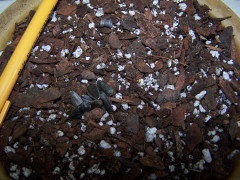
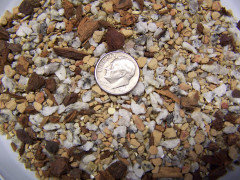
These are the 2 basic media I use. The second image is the most productive medium I've used to date. Note that it is entirely absent peat. That's intentional.
BTW - I left you the short piece titled 'Newton's First Law' (2 posts upthread) to help you eliminate excess water from your medium. It works like a charm.
Al
jasmine UKzone9a
Original Author5 years ago@tapla (mid-Michigan, USDA z5b-6a) "once you get to the point where you can water plants in your grow medium to beyond the point of saturation, so 20% or more of the total volume used to saturate the medium exits the drain hole" I use 2L of water to flush my 3L pot soil. hopefully that's enough to flush out the build up fertilizer. I know different people use different medium to grow the same plant due to different micro-climate and watering habit. I am used to have a lot compost or peat in my growing medium. so, I am a bit hesitant to remove all the compost from my champaca's growing medium. but may I ask what soil mix you have on the second photo ( the one with coin)? just in case I want to change medium in future. I had look for pine chips for growing medium. it's very difficult to find the correct size. the well rotten bark I found ( it looks dark brown as the one you have) is at size range 1 to 2cm. the smaller bark I found on bonsai shop looks like this , but I am not sure if it's well rot and ready to use as potting mix. what do you think?
I read your newton's first law water eliminate method on your other post before. I agree it's a good method for smaller plant with more establish root. my champaca has bad root(root grow slow and easy to break like a ginger, now there are only a few root left on my champaca). I tried not to move it so much. I think it maybe better to put it on a wire plant stand and put a saucer under the plant stand. so the pot will never sit on water and I can throw away water on saucer without move the pot. I think that's similar to your another method with legs under the pot.
- 5 years ago
"I use 2L of water to flush my 3L pot soil. hopefully that's enough to flush out the build up fertilizer." If you're adding 2L of water at a time, at least 400ml should exit the drain hole. This is particularly important when the NPK ratio of the nutrients supplied isn't close to the ratio at which the plant actually uses the nutrients. "I know different people use different medium to grow the same plant due to different micro-climate and watering habit." Most of the growers who frequent the Houzz/ Garden Web forums are a step above the average grower who has very little if any idea about what impact the grow medium has on what opportunity the grower can provide the plant insofar as realizing its genetic potential. It's a LOT. Light availability and grow medium choice are probably the two most critical influences on our ability to grow proficiently. Light is easily changeable but changing the grow medium, without a magic wand, after the planting is established is quite a chore. "I am used to have a lot compost or peat in my growing medium. so, I am a bit hesitant to remove all the compost from my champaca's growing medium. but may I ask what soil mix you have on the second photo ( the one with coin)?" That is a medium I make myself, but it might be difficult for you to replicate. It consists of:
1 part screened Turface MVP (our counterpart to Seramis)
1 part pine bark screened 3.25-6mm
1 part crushed granite or quartzite/cherrystone 2.4-4.5mm screened to remove dust
"The smaller bark I found in a bonsai shop looks like this , but I am not sure if it's well rot and ready to use as potting mix. What do you think?" Sorry - the link is broken, so I can't see the bark. Partially composted bark works best, but raw, uncomposted bark works nearly as well. This is what the bark I use looks like:
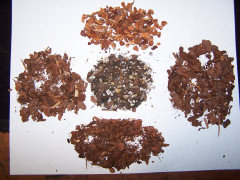
The product at the top ^^^ is what I use in this:
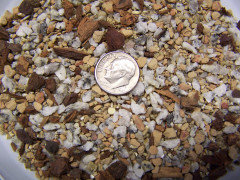
The other piles at 3, 6, 9 o'clock are used in this mix:
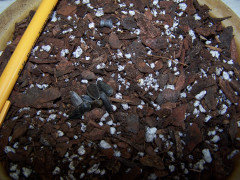
or I screen all fines out of it (<3.25mm) and use in the gritty mix, the first picture.
Anything you can do to reduce the amount of excess water your plantings can hold is very beneficial. A perfect medium would hold all its water inside of porous particles, on the surface of all particles, and at the interface where particles contact each other, leaving all the spaces between the soil particles filled with air. Peat prevents that from being made manifest in a grow medium.
You can start with an assorted size range of ingredients capable of being assembled into a superlative grow medium, but you can also assemble those ingredients in such a way as to make it unusable.
I read your newton's first law water eliminate method on your other post before. I agree it's a good method for smaller plant with more establish root. my champaca has bad root(root grow slow and easy to break like a ginger, now there are only a few root left on my champaca). I tried not to move it so much. I think it maybe better to put it on a wire plant stand and put a saucer under the plant stand. so the pot will never sit on water and I can throw away water on saucer without move the pot. I think that's similar to your another method with legs under the pot. OK, I wish you much success and plenty of rewards for your efforts. I'll leave you with links to 2 of my threads that have a lot of information that should be helpful. The one about how water behaves in container media should be especially helpful as an aid to understanding water retention.
Overview of Good Growing Practices
How Water Behaves in Container Media
Al
jasmine UKzone9a thanked tapla (mid-Michigan, USDA z5b-6a) jasmine UKzone9a
Original Author5 years ago@tapla (mid-Michigan, USDA z5b-6a) thank you for all the info. I think I learn something new after this conversation with you.






jasmine UKzone9aOriginal Author