Software
Houzz Logo Print
drsaj

Fiddle Leaf Fig: Stay or Go?

5 years ago
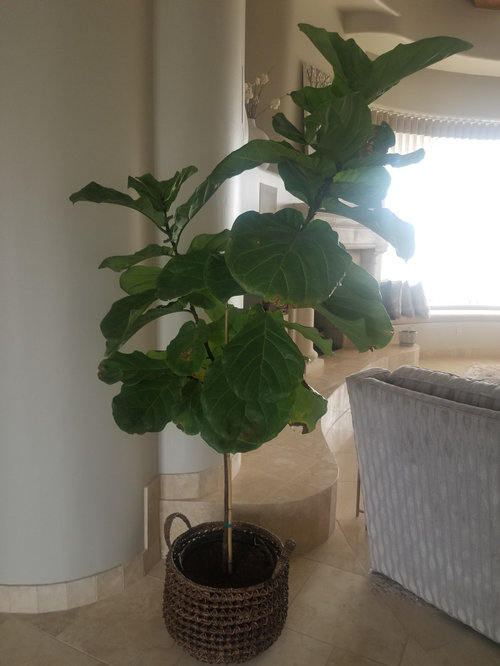
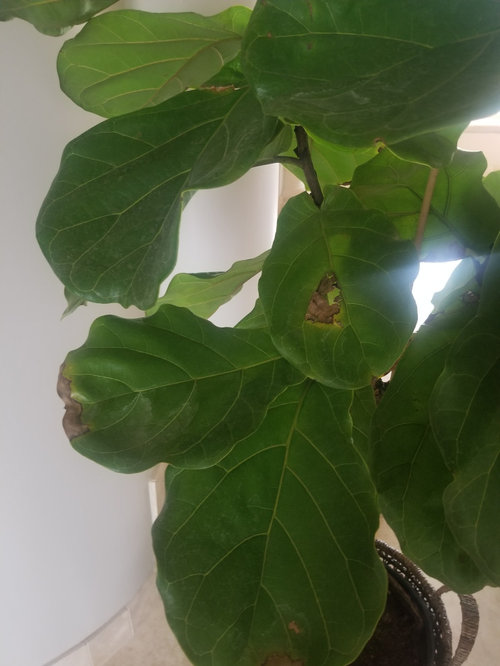
I bought this 6 ft tall fiddle leaf fig from a local nursery in the Phoenix area the other day for $299. Like the rest of the fiddle leaf figs, it was being kept outside under a shade cloth, but apparently got a little bit of sun according to a nursery worker. Plus it's been 108 degrees outside. It was the best looking one of the lot so I took it. Should I be concerned about this leaf damage? I have an opportunity to return it and purchase a 5 foot fiddle leaf from another nursery for an amazing $50 and their bunch of fiddle leaf figs look much greener and with no leaf damage. Sounds like a no brainer, but I kinda got attached to the one I have. Weird, I know. What should I do? Keep this one or return it?

Comments (13)

  • 5 years ago

    Sounds like a no brainer, ==>>AGREE


    but I kinda got attached to the one I have. Weird, I know. ===>>>. VERY


    crikey ... take it back ASAP ... and send me the the 240$ for services rendered ... crikey ...


    ken


    ps: ALWAYS .. buy smaller.. save money for more plants ... and grow them to bigger size .. its all about more plants.. not spending money.. in my world anyway.. warped as it may be ...


    pps: its an inanimate object ... how attached can you be.. lol...


    ppps: if it truly rocks your world.. and you dont care about more plants.. keep it.. who am i to say otherwise .... ignore the sunburnt leaves ... or remove them if few and they bnug you ...


    pppps: let us know


    ppppps: AND PROBABLY .. MOST IMPORTANTLY... this plant is going to start flopping over because one side is growing larger than the other.. and it will be a constant tipping hazard ... get a better formed plant ...


    pppppps: the format of this answer is a direct result of my afternoon coffee ... had i not had it before typing.. i probably could have written a coherent reply with all the ps"s ... lol ...

  • 5 years ago

    Almost all the damage is due to mechanical injury (think bruising) and over-watering and/or a high level of dissolved solids (mostly fertilizer salts) in the soil solution. I only saw one leaf with some recent damage in the center of that leaf that could possibly, maybe, perhaps, seemingly, semi-plausibly, be caused by too much sun.

    You should follow the course you feel is right for you, but I can't help the feeling there was a measure of exploitation in the transaction that left you the proud owner of the tree in the image.

    In all honestly there is nothing about the plant's shape that says future problem, though it really should be cut back to force branching closer to where the trunk bifurcates (divides to form a 'Y' shape, like a slingshot).

    Al

  • 5 years ago

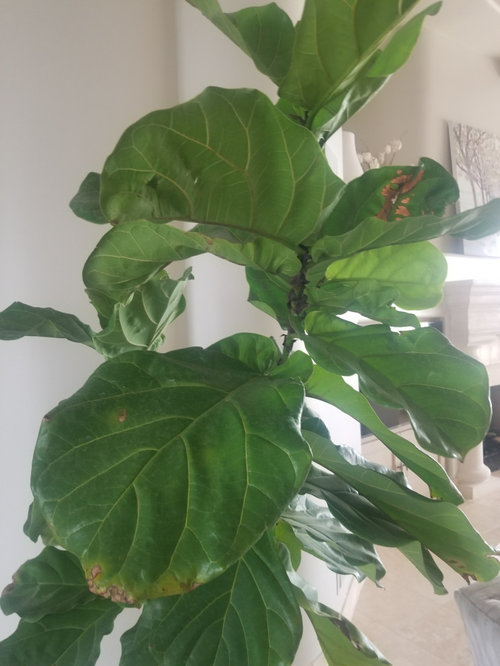
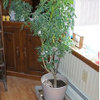
    I took it back and am getting this one instead. Looks better, right?

  • 5 years ago

    The only slightly damaged leaves are here near the bottom.

  • 5 years ago

    They all seem to have branches shooting off the main stem. Can they be cut off to keep it growing mostly tall and straight?

  • 5 years ago

    And the center stalk has been cut on all of them. Won't that keep it from growing taller on a single stalk? Seems like that will encourage it to grow outward versus upward. Help! I need to pick one.

  • 5 years ago

    Direction it gets light from will determine the direction it grows.

  • 5 years ago

    tropocbreezent, I plan to rotate it weekly as I water it.

  • 5 years ago

    So I just read that some variety of fiddle leaf figs don't grow tall. Oh, no! I hope that isn't my variety. I'll call the nursery tomorrow to verify. I want it to be at least 6 feet tall.

  • 5 years ago

    "So I just read that some variety of fiddle leaf figs don't grow tall." Your tree is capable of growing to be very tall, so the idea they might grow to only a few feet is untrue and more than a little absurd. In situ, the tree can grow to be >100 ft tall. That potential is genetic, so the only thing keeping them from rubbing against the tallest of ceilings is pruning tools or a grower who isn't dedicated to ensuring they get the cultural conditions they prefer. If you meet the tree's cultural needs, the tree will do the rest.

    If you want the tree to be 6 ft tall (from the floor, you'll need to sever the main trunk somewhere between 3-4 ft from the floor to give the canopy room to develop. Look at a tree in nature and you'll see the bare lower part of the stem is only a small fraction of the tree's o/a ht.

    "..... and the center stalk has been cut on all of them. Won't that keep it from growing taller on a single stalk?" This is a Ficus cutting:

    I cut the top off of the "trunk", which significantly reduced the flow of the growth regulator 'auxin', which inhibits buds in leaf axils (crotch formed by leaf stem and branch it attaches to) from growing into branches. While all plant organs are capable of synthesizing auxin, the lion's share is produced in apical meristems at branch tips, where extension growth takes place. Witness the 2 new branches growing in the axils of the 2 mature leaves. These branches will continue to extend until the apical meristem at the branch tip is removed or damaged; then, those branches will be forced to bud as soon as the apical meristem is no longer producing the chemical which inhibits lateral growth.

    Your tree will grow new branches from the leaf axils immediately proximal to the pruning cut. Remember, you'll need to allow 3-4 ft for the canopy to mature, so it's important to consider where you want the top to be, then cut the trunk back so it's about 2/3 of that ht. If you don't, you'll be forced to do it later at some point in time in order to keep the tree in bounds, and you'll have wasted all the time between now and that point in time.

    "They all seem to have branches shooting off the main stem. Can they be cut off to keep it growing mostly tall and straight?" You CAN cut them off any time you please, but it would be unwise to do so. Reason 1) is, it would significantly slow the tree's development. Leaves are where the plant's food (photosynthate/ carbohydrate/ sugar) is synthesized. Any reduction in the food supply limits growth. Reason 2) is, there will be a steady flow of food from the leaves to the roots through the tree's phloem. This increases additive growth, so the trunk and branches will thicken. A trunk that is thick at the bottom then tapers is a highly desirable feature.

    Note the little Ficus natalensis growing as a future bonsai. The large "sacrifice branch" will never be a part of the end composition, it will eventually be sacrificed when its job of thickening the trunk is finished. You already have several of these branches. It would almost be a shame to remove them now, which would set the tree back in terms of development AND cause you to forfeit their trunk thickening potential. If you allow the branches to remain on the tree, you can still keep working to further whatever vision you imagine as the end result, just as though they weren't even there.

    One of my ficus microcarpa with a fat trunk. It took about 8 years to develop this trunk from a cutting. Image taken immediately after a hard pruning in mid-June:


    Same tree 8 weeks later, in early August


    After another pruning and its first real styling/wiring. It will take about 4 more years before it deserves a quality bonsai pot.

    Al


  • 5 years ago

    @drsaj regular rotation is best for indoor trees. F. lyrata only grows to a medium tree size but that's more than enough potential for the size you want.

  • 5 years ago
    last modified: 5 years ago

    Looks better, right?

    ==>>> i dont know.. i cant see the price tag... lol ..

    but yes it does look better .... especially the leaves all the way down .... eventually... the trunk will bare ... as normal annual leaf fall takes them ... but in the meantime.. they will help provide energy to the plant ...

    and it doesnt look like it going to fall over any minute ...

    ken

    ps: .. you knew i had to add .. is there any greater thrill... than walking into a greenhouse like that.. pulling a wagon ... knowing you are going to put stuff in it and take it home ... lol

  • 5 years ago

    Trees growing in situ are limited in ht because their structure limits the ht to which water and nutrients can rise. Where it occurs naturally, F lyrata's genetic code makes it capable of growing to more than 100 ft tall. There isn't a living tree that grows to a particular ht then stops growing, and the genetic code of the tree we're talking about is the same as those growing in situ. As long as trees are creating more food/energy during photosynthesis than they use to maintain their dynamic mass during the respiration phase, they grow. When they are not creating more energy than they use during respiration, they are dying; this, because any organism using more energy than it can create is an unsustainable condition.

    Now, it might be that a F lyrata growing indoors would tend to lay over once the leader grows to a point taller than the tallest window (because the trunk would be too weak to support foliage mass above the window due to the reduced amount of light striking the foliage), but even that is correctable interminably by judicious pruning.

    The only things that can stop the tree from growing through the ceiling are A) the ceiling itself, B) pruning C) asking the tree to deal with cultural conditions it is not programmed to tolerate. Keep the tree in a high state of vitality and it will continue to grow for many decades.


    Al

Sponsored
Kuhns Contracting, Inc.
Average rating: 5 out of 5 stars26 Reviews
Central Ohio's Trusted Home Remodeler Specializing in Kitchens & Baths