Software
Houzz Logo Print
victoria_owen44

Mitsubishi vs American Standard Heat Pump... Help!!

5 years ago

Hello! I have received quite a few different estimates to get a heat pump. We currently just have a furnace and it's costly to run the heat. Looking to add AC and save some money on my electric bill.


Anyways, I'm trying to decide between 2 different estimates from 2 different companies--

American Standard Platinum heat pump system vs a Mitsubishi heat pump system


I prefer to go with the Mitsubishi system. It's a bit more affordable for me, and the company has a good financing option for me. I just am curious to know if there are any cons or negatives to the Mitsubishi heat pump system.


Model numbers for Mitsubishi - PVA-A36AA7 & PUZ-HA36NKA

American Standard Platinum 18 seer variable speed heat pump (18 seer 10.0 HSPF)


TYIA!

Comments (16)

  • 5 years ago

    Victoria,

    Are you replacing an electric furnace?

  • 5 years ago

    Replacing an electric furnace

  • PRO
    5 years ago

    Mitsubishi is the market leader for mini split heat pumps in our area. We have not experienced problems with spare parts--either availability or service-- but other markets may be different. The coefficient of performance (COP) in heating mode for a mini split is typically around 3.0 so you get 3 times the heating output as the kWh electrical input. Whether that's economical for you depends on the cost of gas vs. electric.

  • 5 years ago

    Thanks! I’m not too worried about the Mitsubishi’s heating performance. What are your thoughts/experiences with its cooling capabilities? we like to keep our house on the cooler side ~70°. I don’t see outside temperatures getting above mid 80’s on avg, but I want to make sure on the heat spells of 90-100° that it can also keep the house pretty cool. It’s their Hyperheat ducted unit I’m looking into. I have a 3000 sq ft house.

  • PRO
    5 years ago

    We've installed lots of Mitsubishi mini splits for conditioning newly added spaces in remodels e.g., sunroom addition, bonus room over a garage, etc., but never a ducted mini split. Design of such a system begins the way any HVAC design does--with a heating and cooling load calculation, equipment sizing, and duct design. Ask your HVAC contractor to walk you through the design process.

  • 5 years ago

    If your house has never had a central AC system then it important the HVAC contractor does a heating and cooling load calculation. The Mitsubishi model you posted has a rated capacity of 33,000 BTU. The capacity seems marginal for a 3,000 sq. foot house. You should ask to the installer how the size was determined. Sizing based solely on the area of the house is not the proper way to do it.

    Do you have the model numbers of the American Standard equipment? If the equipment size is larger, then it is not a fair comparison comparing prices. If you were not given model numbers then you don't have a valid quote in my opinion.

    The Mitsubishi heating and cooling efficiency seems to be a little better than the American Standard Platinum, but probably not enough that you would notice on your electric bill. I am not sure how well the Mitsubishi equipment holds up over time. Mitsubishi is know for their mini split systems, where as American Standard (which is Trane equipment) is know for its split systems.

    No matter which one you choose, you want a company who will do a good installation and be responsive if there are problems in the future.

  • 5 years ago

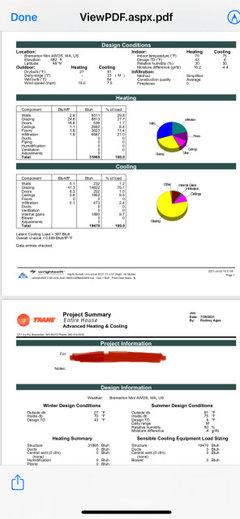
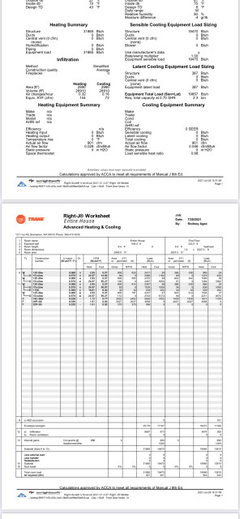
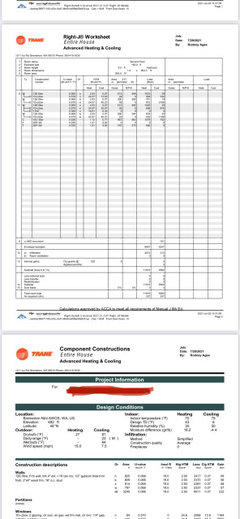
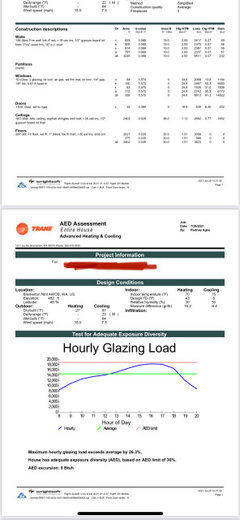
    There was a heating and cooling load calcuation done


  • 5 years ago


  • 5 years ago


  • 5 years ago

    The load calculation was done with an summer outdoor design temperature of 81F degrees. However you mentioned heat spells of 90-100F degrees. How many times of the year does the temperature go above 90F degrees?

  • 5 years ago

    July and August are the warmest months of the year here—3x this summer we’ve had a 90-100° heat spell lasting for maybe 3 days (on avg). The normal temps for July/Aug are low to mid 80’s. Even during heat spells, our lows can drop to 60’s at night.

  • 5 years ago

    The calculation shows the sensible plus latent cooling load is 2.3 tons. I don't think the AC will be able to keep up during the hottest part of the day when the temperature is in the mid 90s. However it will be able to recover when the sun goes down in the evening. If you can accept a few days during the year when the house may be a little warmer than 75F degrees then you can keep the 3 ton size.

    The heating calculation was done with a 27F degree outdoor winter temperature. If that is the normal low temperature then the heating load is only 31,865 BTU. That means the back up heat strips will rarely be needed for heating. Your heating costs should be about one third what they currently are with your electric furnace.

    Is there a big price difference between the American Standard and Mitsubishi equipment?


  • 5 years ago

    The average lows are around 35° from Dec-February, with some colder times which bring us some snow (however we’re primarily rainy here in the winter in the PNW). I remember the man saying he ran the report at that low temp just to make sure we’d be safe throughout the winter. Most people live without AC around here where I live, but turn on their heaters most of winter because it can get pretty cold. Technically our backup heat source would be a gas fireplace, but I think he was curious to see if we would be set with the Mitsubishi, if we were in a low temp range for a while. However, I don’t remember him saying anything about the outdoor temp being set at 81°, nor did I ask.


    We’re in the woods surrounded by trees, so our house has a good amount of shade, still some sun. Inside temps can get up to 78° on a very warm day (90°+).


    Price difference wise yes… looking at 25k out the door for the American Standard, and $17k for the Mitsubishi. Two different companies, and the company offering the Mitsubishi offered 0% financing for 5 years with no down payment or security deposit, making it highly desirable for us.

  • 5 years ago

    The American Standard is very over priced. I don't understand how $25K can be justified. You are in a mild climate. You don't need a 18 SEER AC. You could scale back to the American Standard Gold series. But given the price this installer has quoted for the Platinum series it will probably still be higher than the Mitsubishi.

  • PRO
    5 years ago

    Selecting any HVAC system requires considering a number of variables of which SEER is only one.


    Higher SEER units generally have variable-speed compressors with better turndown ratios, and higher HSPFs which should be considered too, since heat pumps provide both heating and cooling. The typically longer warranties and comfort levels provided by the higher SEER units should be considered as well.


    American Standard's 18 SEER heat pump (Platinum 18) has a variable speed fan in the air handler and a variable-speed compressor with a turndown ratio of 4:1 That compares with their 17 SEER heat pump (Gold 17) which has a fixed-speed fan and a two-speed compressor with a turndown ratio of 1.4:1 The greater turndown ratio of 18 SEER unit will enable longer run times, better dehumidification and better comfort. Whether it's worth the incremental cost over a 17 SEER unit is up to the buyer to decide.