Software
Houzz Logo Print
webuser_568099585896805609819597107

Cut the rest of the spike?

5 years ago

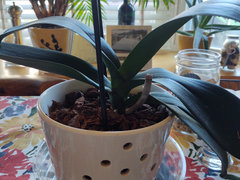
This is my first orchid to that I got over the winter. When the flowers fell off I cut the spike to where it is. It then grew another leaf but didn't reflower on the spike as I have heard they can. Should I cut off the rest of the spike now or just leave it?

Comments (9)

  • 5 years ago


  • 5 years ago

    Ok, without having all of the old spike in the photo, this may be a bit difficult to explain, but lets try. To start off, Jane is mostly correct. Some Phal's are very prone to producing Keiki's along a bloom spike that has bloomed out. Others just won't. It's a genetic thing(.), The trait goes back to a few species Phal's, and if those plants are not in your plants genetic makeup, it won't produce Keiki's. Unfortunately the people who produce these orchids for the "big box store" market have no concern about the genetics of the plants they are producing. They purchase seedling orchid plants from breeders who produce a sufficiently high enough volume of plants with blooms these marketers think they can sell, they are grown to blooming, and the "dogs" are thrown out. The quality plants are then cloned to produce thousands upon thousands of exact genetic copies of these specific plants, and when they bloom, they are shipped out for sale. If you want to see if your plant is one that will produce keiki's, here is the process I suggest you try. First, Jane is correct, just go ahead and cut the stem you left on the plant. It's too short, and will only dry up and look like a crooked pencil sticking out of the side of your plant. Next year, when the plant blooms for you, let all the blooms fall off the spike, and go back to the point where the first bloom was located on the stem (the closest flower to the plant on the stem). from that point down to the point where the spike exits the main trunk of the plant, notice that the spike has joints, similar to a small piece of bamboo. Starting where the first flower was attached to the spike, count back toward the plant to the second joint. Come back toward where the first flower was, and cut the stem approximately a half inch above the joint. The end of the stem should have a joint, a half inch of stem and a cut. (sharp sterile blade-clean cut). Now, you wait. If the plant decides to grace you with a baby, the little one will appear at one of the joints along the spike-usually the top joint. If not, the spike will begin to turn brown from the top end back toward the plant. You can go back to a point a half inch above the next joint and cut again, until you finally run out of stem, or you convince Mama orchid to present you with a baby. It is rare that you will get a baby from any but the top joint. Usually your plant will see fit to only grace you with a branch off the main spike which will give you more blooms. Perhaps "mama" is telling you its hard work raising kids, so flowers is all you are going to get. Accept that gift gracefully, "mama" is usually right. I have a Phal. that has had at least one bloom spike with blooms for as long as I have had it. That's right at two years now. I intend to repot it as soon as it stops to take a deep breath, but don't know exactly when that will be. It is also still planted in the containers it was sold in-clear plastic inner liner which is inside a non draining ceramic outer container. A friend was given the plant when she was in the hospital, and she gave it to me because she just knew she could never keep it alive. They can be grown that way for extensive lengths of time, if you are careful

    Have fun Ken, and good luck.

    Bill

    Ken B Zone 7 thanked Billsc
  • 5 years ago

    Bill, I've been growing orchids for a very long time. I've grown them for over 25 years in the N. East (NYC) and now in S. Florida. I had great mentors in the beginning. I belonged to a fantastic Orchid Society in NYC.

    Personally, the only keikis I accept are basal keikis from a Phal. I grow my orchids for the display of flowers.

    To me there is nothing worse than looking at a Phals with a long straggly spike with a flower here and there. A keiki on the spike, no way. If the Phal was a favorite and was dying, I might, but I do not grow for keikis, I grow for blooms well presented.


    I like basal keikis on a good Phal as they make a incredible show when they get big enough to bloom. They stay on the mother plant (at the base) and I let them grow. I have a Phal which has made 4 basal keikis over the years and the display of mama and babies is beautiful

    I do not care, nor recommend leaving a straggly spike sticking up on an Phal.


    That my personal feeling. and it's not worth doing unless the mother plant is dying and you want a copy of her. Otherwise, spike gets cut off after the main bloom. I won't even leave a long spike with just a few flowers on the top. Just my preference. I always recommend cutting off the spike an letting the plant grow.


    Jane

  • 5 years ago

    Jane, I agree wholeheartedly with the vast majority of what you just wrote. Few things in life are more pleasing to me than a well grown orchid plant well presented with exceptional quality blooms. As a matter of fact, the plant really does not have to be an orchid, I'll appreciate any plant God placed on this earth that pleases my sense of sight and/or smell. I just love them all, with the possible exception of a Hawthorn tree and a Thistle bush, but I have a few of both in my yard right now.

    It sounds like you and I have been following each other around the country. I was given my first orchid plant by an aunt on a trip to central Florida to show off my new bride. I was serving in the Navy, and living in a mobile home in Summerville, SC at the time. My schedule required me to be gone for three months at a time-I mean really gone! Then I was home for three months. The first winter I had that silly plant I was gone, and that "flop eared Cattlea bloomed. After that I decided it must need to be re-potted, so I purchased some Osmunda fiber(don't ask me why) and proceeded. Why I did not kill that poor plant I'll never know, but it was more determined than I was.

    In the spring we stumbled into the first orchid show sponsored by the South Carolina Orchid Society. The bug did not bite, it devoured us. We purchased another Cattleya in bud, and we were off to the races. (Little did we know the lady who sold us that plant would one day become one of our bosses.) The next large expenditure and project was a portable 8 X 10 foot greenhouse. Don't let my wife hear that, for she seems to think the birth of our first son should fit in there someplace!

    From Charleston I was transferred to Lawrence Kansas for three years. That's the most westerly location we had our collection, and from Lawrence we were transferred to Jacksonville Beach, FL. the most southerly location. After Florida, I was transferred to Newport News, VA, (the most easterly) where we kept the orchids for another three years. OH, that same little fiberglass greenhouse followed us to all those places. Most visitors required a three hour fast to get inside the greenhouse door by then. After Virginia, we were transferred back to Charleston, and wound up with the same trailer and the same little greenhouse, a second son, back in Summerville. There is one additional geographic dimension that I grew orchids in, but since part of that information remains classified, I won't delve into just how deep they can be grown, and what happens when you do that to them.

    Toward the end of my career we purchased a real house, and I proceeded to built 12 X 16 foot aluminum and glass greenhouse onto the back of that. In that monster I could grow orchids-and-any thing else I wanted to in pure bliss.

    After I retired, we immediately found ourselves living in another small town in the center part of SC, and gainfully employed by one of the largest orchid nurseries in this part of the country, complete with the most modern propagation lab I had ever seen. The job came complete with trips to AOS sanctioned shows, shipping and delivering plants literally all over the world, and at least being able to observe the secrets of an orchid hybridizing program.

    Having said all that, let me share some of my growing philosophy with you, and anyone else who has managed to stick with my ramblings this far.

    As I said, everyone should be exposed to many really well grown well cared for plants as possible in their lifetimes. I believe it is one of God's true blessings. However, I also believe that in the age we live in where anyone can afford to go into a roadside convenience store and purchase orchid plants in full bloom, at a price most anyone can afford, they are tempted to do that without knowing the first thing about their culture or where they grow. This tends to create an atmosphere where most orchid owners are petrified by their plants, and since most only hear stories about how many orchids all their neighbors have killed, they are convinced long before they get the plant home, that it will surely be dead before it drops its blooms, so they turn in desperation to blogs like houzz seeking culture advice from many of those folks who have been bragging about all the orchids they have managed to kill over X number of years, or some similar story.


    I would like to be able to help that person who has always secretly wanted to have one of those beautiful orchid plants blooming in their house for weeks at a time, but until just now has never gotten up the nerve to waste that kind of money purchasing something they are surely going to kill next week. If I can help that person get past the initial panic stage, and learn something basic about the care of this "mysterious" plant, keep it alive until it blooms next time, and perhaps the next, then, perhaps I can, one day, bring that person to you and other connoisseurs of exceptionally well cared for orchid plants and let them along with me marvel at the beauty you have grown that plant into. Perhaps we can cultivate a number of orchid care experts that can create many of these exceptional plants that we can all view in awe. I know I for one would love to have a part in just such a project. You?

    Thanks for hearing me out.

    Bill


  • 5 years ago

    I agree with your last paragraph,

    Unfortunately, I've been unable to post photos.


    Maybe growing for so long, mostly in the North East taught me that people need to educate themselves about the plant they are growing. Posting on forums, Facebook, etc. is not an education. Learning from experienced growers is.


    The best way to learn how to grow orchids is to join a local Orchid Society in your area. Learn from people living in your area. It costs about $25.00 a year. Its a bargain when you spend money on orchids you know nothing about and they die.

    Subscribe to the AOS.org website and educate yourself about the orchid you are trying to grow. Much of it is free, but a $50.00 digital subscription per year is really a bargain.


    I appreciate your story on how you got into this hobby. Its probably the best way to learn. However, for newbies I feel simple instructions work best.


    Cut the spike. Its important to know where the grower lives. Zone 7 will have to get through the winter indoors. Not the best environment if the grower doesn't learn how to get his orchid through the dry winter.


    The best advice I can give someone, learn about the plant you are growing. If you want to succeed and grow different varieties, join a local Orchid Society, meet people who live in your area at the meetings. Take your plant along for the meeting and ask other growers your questions.

    Join the American Orchid Society and read and research your orchid so you get expert advice on keeping your plant healthy and blooming.


    I feel with newbies, the best advice is to educate yourself. Learn about what you are growing. Orchids are not simple houseplants. They require education.


    The photo Ken presented shows a Phal with dark green leaves. That Phal needs more light, will require a temp drop in the fall if its going to bloom again. He might not realize that and will post back next year asking why his Phal didn't bloom.


    Cut the spike off. Give the plant more light. During the dark days of winter, move it to your brightest window. Don't overwater during the winter and the lack of sun. Phals need a 10-15 degree drop in temps in the fall to get flowering during winter. When I lived in NY I left my Phals outside until the night temps got down till the mid 40's They were all spiking when I brought them back inside. I had flowers Dec/Jan.


    Simple directions but if a grower really wants to succeed, they need to research and not on a forum. Otherwise, they will not succeed.


    We were all newbies. Learning to succeed came from research, teaching and experience.


    Jane


  • 5 years ago

    So quick update, I cut off the spike clean like was suggested, it just started growing it's second leaf of the summer so it seems happy. Hopefully after this leaf grows the temps will be dropping and it blooms again.

  • 5 years ago

    Growing a new leaf is always a good thing. Keep up the light and follow the outside temps come fall. You are in zone 7, you could put your plant outdoors and leave it there until the night temps drop about 10-15 degrees. Leave it out for two weeks and then you can bring it in.

    You are in zone 7 so those night temps might not drop that much in September/October.

    The main thing is the plant needs that temp drop to initiate spiking and flowers a few months later. It needs the temp drop for a few weeks and it should be night temps.


    Jane

    Ken B Zone 7 thanked jane__ny
  • 4 years ago

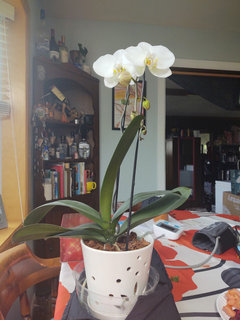
    Quick update, seems to be doing well, I have gotten it to flower this spring. When I was gifted this orchid it had blue/purple flowers but now they are yellow/white. Do they put some sort of dye into them originally to color them?


Sponsored
NME Builders LLC
Average rating: 5 out of 5 stars2 Reviews
Remodeling Company in New Albany, Ohio