Software
Houzz Logo Print
librarian_gardner_8b_pnw

Normal development or cause for concern?

4 years ago
last modified: 4 years ago

I have learned so much in this past year from many experienced gardeners and for that I am thankful.
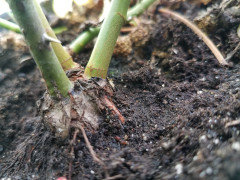
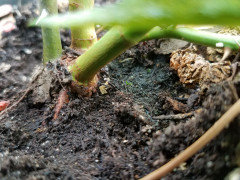
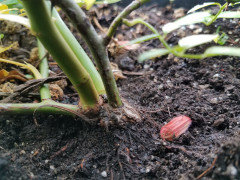
I've got a beginner's question today.I recieved a band of Mel's Heritage in the late spring and have been growing it in a 3 gallon pot to encourage root growth before I plant it out. Now that it's fall I'm getting ready to plant it in the ground but I noticed this bulge of growth at the base. Is this normal growth for this plant? Or should I be concerned that it may be early crown gall? I did a little gentle moving of the soil and could not find any signs of Crown gall just under the soil surface...just a lot of root development. I have not taken the plant out of the pot to look further because I didn't want to needlessly disturb the plant. Many thanks in advance for any insight shared.

Comments (24)

  • 4 years ago


  • 4 years ago

    This is a budded rose?

    librarian_gardner_8b_pnw thanked jerijen
  • 4 years ago

    Thank for the clarifying question. This was sold to me as an own root band.

  • 4 years ago

    Thank you, @User! I was thinking it was likely normal but as a beginner I've made my share of mistakes so I thought I should ask. I really appreciate that you took the time to look and answer. This rose forum is truly a kind and wonderful corner of the internet.

  • 4 years ago

    Someone just wrote a long post (on the Fall thread, I believe), about a seller sending out roses with crown gall recently to her, and one of those roses was Mel's Heritage. They were own root, I'm pretty sure. Diane

    librarian_gardner_8b_pnw thanked Diane Brakefield
  • 4 years ago

    @Diane Brakefield What is the name of the thread, please?

    librarian_gardner_8b_pnw thanked User
  • 4 years ago

    It was Fall into Spring, currently near the top of today's listings. It was Katharine's post. Pretty interesting. Diane

    librarian_gardner_8b_pnw thanked Diane Brakefield
  • 4 years ago
    last modified: 4 years ago

    Diane, good to know! Ugh.

    Librarian Gardener, always good to ask! It may help to know that crown gall is lumpy like a 1960’s sci fi mutant brain or, in the vegetable world, cauliflower.

    Carol

    librarian_gardner_8b_pnw thanked portlandmysteryrose
  • 4 years ago

    I got one with crown gall a few yrs ago from the same seller mentioned by the poster on the Fall into Spring thread.

    librarian_gardner_8b_pnw thanked sultry_jasmine_nights (Florida-9a-ish)
  • 4 years ago

    Thank you for that description @portlandmysteryrose. I think what confused me was the early signs descriptions on some ag extension office pages....that at very early ages it can be a green abnormal swelling. My rose certainly doesn't have the mutant brain look!


    @sultry_jasmine_nights (Florida-9a-ish) I'm sorry that happened to you, too.

  • 4 years ago
    last modified: 4 years ago

    One of the unfortunate effects of someone announcing that "Nursery X sold me plants infected with crown gall" is that some people will get very nervous about their purchases from Nursery X and assume their plants are going to have the same problem. I've seen posts here on GW after someone mentioned a bad case of Rose Mosaic including a warning about the disease, in which the person described panicking and destroying their roses without even verifying whether or not they had diseased plants. We don't need more of that.

    If Rogue Valley admitted to Katherine that the plant she purchased from them did indeed exhibit crown gall (and lets face it: she's right in that it didn't develop crown gall a few weeks after it had arrived at the customer's place - it had to have been present at the time of shipping), then that's something to be aware of, and plants purchased from RVR need to be carefully inspected upon arrival.

    However, it should also be noted that Katherine herself stated - a year after first finding an infected plant - there is no way to prove where the recently discovered gall-infected plants got it from. Agrobacterium tumefaciens lives in the soil, pretty much everywhere. If you injure a rose below the soil, you open an opportunity for infection by the bacterium. While I am inclined to think that roses that show up with Gall, all having come from the same source at the same time, were all infected at the time of purchase, there's no way to prove it so long after receiving the plants. That said, I wish Katherine had posted photos of the gall infected plants.

    Going back to the OP's photos of her 'Mel's Heritage': I see nothing wrong with the plant. What we are seeing is the very base of the plant, where roots first formed during the rooting process, and that area tends to manifest as a swelling at the base. Remember what happens when you root a rose cutting? It forms a large white callus of undifferentiated tissue - the precursor to root formation. That callus can mimic crown gall (although it remains small and doesn't create the same lumpy, distorted mass) and to those who have never seen a real gall before, it can rightfully raise suspicions.


    See: http://pushingtheroseenvelope.blogspot.com/2012_03_09_archive.html

    @librarian_gardner_8b_pnw I still think your plant is perfectly healthy, and until such time that something else might happen, I urge you to regard your plant as healthy and allow it to mature.

    librarian_gardner_8b_pnw thanked User
  • 4 years ago

    Just to share something about disease prevention that might be helpful:

    I think it’s a good idea (under most circumstances and whenever possible) to pot up newly arrived roses and grow them in nursery pots before planting them out in beds. Small ones, like bands, have time to mature with coddling and without competition. But it is also true that when temps are at least 70 degrees, gall visibly develops within a few weeks. This means that by planting later in the season or year, gall should be visible when the rose is removed from the pot…before it enters garden beds. I pot up and wait with other bare root plants, and I wait a bit after I purchase already potted plants in case the gall or other diseases have yet to make an appearance. I once thankfully spotted a hideous case of root knot nematode on a pre potted rhodie before I planted it. Whew! For the record, so far so good with all my roses from RVR, ARE, Heirloom, Northland, High Country, Burlington, Joy Creek,…. Carol

    librarian_gardner_8b_pnw thanked portlandmysteryrose
  • 4 years ago

    As a check one could paint a suspicious growth with drug store 3% hydrogen peroxide. An infection should produce bubbles. See page 43 in the following:


    https://ir-library.ku.ac.ke/bitstream/handle/123456789/21424/Management%20of%20Crown%20Gall%20Disease%20in%20Selected....pdf?sequence=1&isAllowed=y


    H. Kuska comment: I personally have not checked the above so if someone has, please comment.


    librarian_gardner_8b_pnw thanked Henry Kuska
  • 4 years ago

    And Librarian, I’d like to add congratulations for acquiring your Mel’s Heritage! I have been trying to find a spot for that amazing rose, but alas, I think I have shoehorned my garden plan to the limit and will have to abstain. My garden is just a tad larger than a pinhead. Angels could dance in it and inspire philopsophers. Ha, ha. I do have a young Jeri Jennings 🎉 and am very excited about that one. When your Mel blooms, I’d love to see photos! Carol

    librarian_gardner_8b_pnw thanked portlandmysteryrose
  • 4 years ago

    I just read a Rosarian in Tacoma kept a Rose Mosaic rose alive for 15 years and even exhibited from it....


  • 4 years ago

    ann beck, rose mosaic is not the name of a specific rose virus. It is the group name of a virus or viruses that exhibit mosaic type symptoms on the leaves. An actual test or series of tests would have to be performed in a scientific laboratory to determine the specific virus(s) involved. Also, there are more than one strain of a particular virus (one strain can do more or less damage than another strain. Also, since most roses are hybrids, they can differ in their ability to fight off the virus(s). In addition many rose viruses are more infective at low temperature than at high temperature due to the characteristics of the individual roses' immune system.


    https://sites.google.com/site/temperatureandrosemosaicvirus/home


    Even rose rosette viruses are reported to follow this behavior, see:

    https://www.houzz.com/discussions/6182726/ph-d-thesis-rose-rosette-virus#n=1

    librarian_gardner_8b_pnw thanked Henry Kuska
  • 4 years ago

    Please don't equate Rose Mosaic Virus with the various communicable diseases to which roses may be subject. Roses can do just fine with RMV, and in fact most do. I have grown roses which I KNEW must be virused for 20 years before seeing a sign of it. And a 'Sombreuil, Cl' which we planted in 1987 is still going strong by our front gate.


    Gall, by contrast, is a bacterial disease -- NOT a virus of any kind. THAT is something I will remove from my garden when I find it.


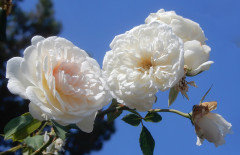
    'Sombreuil, Cl.' Planted in 1987, and still going strong:


    librarian_gardner_8b_pnw thanked jerijen
  • 4 years ago

    And, btw, Librarian . . . Congratulations on your 'Mel's Heritage'!

    librarian_gardner_8b_pnw thanked jerijen
  • 4 years ago
    last modified: 4 years ago

    I want to express my heartfelt thanks at the kindess of people on this forum. Experienced rosarians always respond quickly and patiently to newbie questions and I have learned so much from reading threads here. The kindness and care I've received on response to this question is heartwarming. Gardening has been such a joy and comfort for me and this community here has been such a support, especially during these difficult times.


    I wanted to respond earlier but between working a full time job, raising two young children and gardening, it's just hard to keep up.


    Im really excited to have Mel's Heritage! We're going to build a pergola over our patio just for it.

  • 4 years ago
    last modified: 4 years ago

    jerijen has posted her personal experience with the behavior of (mosaic) virus infected roses. She has omitted her temperature zone. (In another forum she states: Coastal Southern California (Zone 13a)). In that post she states: "The RMV issue with the leaves, though, really is unsightly. Does that disappear when the weather warms up? (That's common, with RMV, in my experience.)"

    https://garden.org/thread/view/125114/Replacing-a-Rose-bush-with-RMV/

    To summarize what I attempted to say earlier in this thread:

    Roses have an immune system that is more effective against many (most) mosaic type viruses at higher temperatures. Someone's experience in a hot climate may not apply to a cool climate rose grower.

    librarian_gardner_8b_pnw thanked Henry Kuska
  • 4 years ago

    I believe the takeaway message we should embrace is: Rose Mosaic is not something to panic over. (Gardening and Panic don't mix!) Yes, we know a lot about the viruses that cause this disease (most instances are the result of Prunus Necrotic Ringspot Virus infection), and yes, most roses do not perform as well as an uninfected specimen will. Its also true that a virused plant will be at greater risk of damage (and even less likely to perform well) in cold climates. But if you are growing strong varieties (proven track record) that are suitable for your climate, and you are cultivating them to the highest standard, the odds are you will have good plants that grow well enough and perform reasonably.


    In the past, discussions like these have tended to make new rose growers very panicky and some have even destroyed plants that exhibited mosaic symptoms. There's no need for that. (unless you are militant about keeping virused specimens out of your collection, which for some is a reasonable goal: but the issue is by far a cosmetic issue, and less of a health/performance issue) And along those lines, I must remind folks that the viruses that cause Mosaic are NOT spread through your garden by casual means. In 99.95% of cases, a plant becomes infected only through grafting of one infected plant to another, or by propagating (by cuttings) of a plant known to be infected. Yes, its a good idea to clean pruning equipment when moving from one plant to the next, but even that may be an unnecessary precaution.


    Lastly, we should also remember that with some varieties of rose, there are no uninfected specimens out there. I suspect 'Rose de Rescht' is one of those. So if there's a rose you want, and you suspect you cannot buy a virus-free specimen, grow it anyway. 'Rose de Rescht' hasn't been grown and shared for over 100 years for no reason - its an excellent plant and performs beautifully, in spite of being virused. I have owned several plants of it over the past 30 years, and every one of them has eventually displayed mosaic on at least a few leaves once in a while.

    librarian_gardner_8b_pnw thanked User
  • 4 years ago

    Paul Barden stated: "And along those lines, I must remind folks that the viruses that cause Mosaic are NOT spread through your garden by casual means. In 99.95% of cases, a plant becomes infected only through grafting of one infected plant to another, or by propagating (by cuttings) of a plant known to be infected."


    H.Kuska comment: I am interested in seeing the documentation for the above statement.

  • 4 years ago

    Henry, we all know how much you like "documentation", and I know you have a different opinion, so I'm not going down that rabbit hole with you. Sorry, but no.