Software
Houzz Logo Print
webuser_595678684

Help with basement condensation!

4 years ago

I have a brand new home that is just about a year old. The basement is finished completely. The exterior walls have the insulation blanket still up with no apparent rips or tears. Under the concrete slab is a moisture barrier to prevent moisture from getting into concrete. On extremely hot days the AC ducts condensate extremely badly, to the point it has dripped onto the drywall ceiling seams and through the drywall. We have thermal readings and doesn't appear to be anything out of the normal. After running a humidity reading, inside the wall has a humidity reading of 60% while the relative basement is only 35%. I am lost in where to look next. There are two dehumidifiers running currently emptying twice a day.

Comments (22)

  • 4 years ago

    So when finishing the basement, the insulation blankets (fiberglass with poly scrim wrap?) were left up and the walls were framed beyond those? What was done to the rim joist area in terms of insulation and air sealing? Was any fireblocking done? Is the condensation in one particular spot or every duct route that is servicing the upstairs? The humidity is relevant to how much moisture is theoretically available, but it's the contact of the cold ducts meeting warm air that is creating the condensation, so how is that air circulating within the affected joist spaces and why is it so much warmer than the basement or upstairs air?

  • 4 years ago
    last modified: 4 years ago

    Too late to insulate the ductwork with Armacell sheet insulation or equivalent that will prevent condensation.

    Air leakage is the likely source of the humidity condensing on the ducts. Correction on a finished basement requires some un-finishing. As suggested above, poorly insulated rim joists are a possible culprit. A production job--fg stuffed into the rims--does nothing useful. They should be spray foamed or tightly fitted with foam board.

  • 4 years ago
    last modified: 4 years ago

    So when we had a thermal reading around the joists it doesnt show anything really significant. This is happening on all ducts going to upstairs. The basement was firetaped from the builder and ceiling done all the way to the foundation but then completely finished after. The insulation blanket was left on the foundation wall but then framing was done a few inches from that to build the walls and connect to the ceiling. The main thing we are trying to figure out is what is causing this amount of humid air and the condensation.

  • 4 years ago

    You will naturally have more moisture near the concrete foundation walls, but the big differential is probably from the insulation blankets allowing lots of air movement to behind it and meeting the colder wall.

    The temperature of the basement air, however, should be relatively stable at around the upper 60s. So other warmer air is meeting the ducts in the ceiling and coming from somewhere. Speculating on an uninsulated rim joist or having direct sun hitting the floors where the registers are and the condensation is near the register boots.

  • 4 years ago

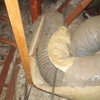
    On extremely hot days the AC ducts condensate extremely badly, to the point it has dripped onto the drywall ceiling seams and through the drywall.

    inside the wall has a humidity reading of 60% while the relative basement is only 35%

    Is the duct work inside the walls and ceiling where the humidity is 60%. What is the air temperature of the air surrounding the duct work and duct work itself?

    Are you saying the basement air has a relative humidity of 35%? If so what is the air temperature? The humidity seems very low, but I suppose it is possible if your running two dehumidifiers around the clock.


  • 4 years ago

    The tenp in the basement was 72 when these readings took place. All of the duct work is in ceilings, none is inside the walls, but the highest level of humidity was from the wall space. The ceiling area was reading 47% humidity.

  • PRO
    4 years ago

    First, what area of the country are you in?
    Second, have the dehumidifiers been running all summer?
    Third, how large is your basement?

  • 4 years ago

    I am in Illinois, they have been running all summer and its about 400-500 square foot. smaller town home

  • 4 years ago

    If the temperature is 72 degrees and the humidity is 47%, then the dew point is 50.7 degrees. The air temperature in the duct must be below that temperature for condensation to form. Have you measured the air from the the supply vents? Start with the one closest to the to the furnace or air handler.

  • PRO
    4 years ago

    I agree that for condensation to occur the temperature of the condensing surface needs to be less than or equal to the dewpoint of the surrounding air. That's simple physics. However, you're measuring relative humidity that is the average condition in a particular volume--e.g., the basement or a wall cavity. What matters are the conditionslocal to the area where condensation is occurring. Those conditions can be very different from average conditions in a larger volume like a room. Consider the leakage of hot, humid air around a window. Condensation can occur in the immediate area around the leak, while none may occur elsewhere in the room.


    In my forensic work, I've seen HVAC systems where high duct friction losses (poorly designed duct work) reduced air flow to the point that it resulted in very low air temperatures leaving the coil. The poorly insulated ductwork allowed humid air to contact the cold duct surface and caused condensation--which, in turn, saturated the duct insulation and caused drips from the insulation. This could be what is happening and it would be worse on hot, humid days when run times are longer. Measuring the temperature at the supply grills nearest the unit, as suggested by a previous poster, would help validate or dismiss this possibility.


    I think your troubleshooting efforts will benefit more from the use of an infrared (IR) camera than a thermohygrometer. You can purchase modestly priced versions that work with a cell phone.


    Good luck.

  • 4 years ago

    We had an actual thermal gun reading done that showed no signifigant heat intrusions. We also did a blower door test through an energy company to see if there was any immediate drafts pulling from anywhere. So ill measure the temp at the supply, what should this reading be compared to the thermostat or the air of the room? like what would a normal reading be in comparison?

  • PRO
    4 years ago

    The temperature at the supply should be within 20 degrees F +/- of the setpoint temperature in the room. A differential of more than that could indicate an issue.


    A blower door test isn't particularly helpful in your situation. It measures the total air leakage rate of the home, but provides no insights as to the specific areas where the leakage is occurring. The condensation problem is local--not global.


    An infrared camera would be helpful in locating areas of air leakage and areas where condensation is occurring.

  • 4 years ago

    We have holes cut out in the drywall ceiling and see condensation on all the AC ducts when its more warm outside. The ducts are not insulated but just taped from the builder. I will have to get a reading of the temp at those supplies. If the temp is 20 degrees colder what issue would that suggest is going on? I did have the furnace and AC inspected for any issues and none came up. When running a thermal reading the only hot points appeared around the rim joists because its just sill seal there. Do you think the rim joists that are not visible on those outside walls could be the culprit? We didn’t look at those with thermal imaging?

  • 4 years ago

    Measure the temperature and humidity inside the ceiling cavity. The readings are likely to be higher than what you what you measure on the interior side of the basement ceiling. For example if the humidity is 50% and the temperature is 75 degrees, then the dew point is 55 degrees. A 55-57 degree supply temperature is in the ideal range in my opinion.

    Have you discussed this with the builder? You may be able to raise the air temperature in the duct by increasing the blower speed, but the change is likely to be small and probably not enough. Your investigation may reveal a fix, but I think the solution would be to wrap the duct work with insulation. Propose this to the builder before the one year warranty expires.

  • PRO
    4 years ago
    last modified: 4 years ago

    Okay, that's helpfuI.

    I think you've got a domino-effect problem. First, you've got moisture being introduced into the basement through masonry walls, potentially through capillary action from the footing, and likely through moist air entering due to leakage at the rim joist as well. Moist air is less dense than dry air and will accumulate at the highest level--which would be the volume in which the duct work is installed (it will migrate to the upper floors through openings in the floor, too.) Holes in the drywall provide a nice, easy path for moist air to reach the ductwork. Since the ductwork is uninsulated, its surface temperature is clearly at or below the dewpoint, and you're getting condensation as proof.

    Mike_Home has taken the time to look up the dewpoint for the conditions you stated. My guess is that the surface temperature of the ductwork in air conditioning mode would be in the neighborhood of 50 F so there you go.

    You can either insulate the ductwork to prevent humid air contacting the cold surface (the Armacell suggested by Worthy is a really great choice) or you can control the moisture content of the air to keep the dewpoint lower (with an appropriate margin of safety) than the surface temperature of the duct. That would involve some combination of air sealing, foundation waterproofing, and drainage to include managing storm water and directing it away from your foundation and dehumidification. Depending on the particulars of your air conditioning system, you may also be able to alter the fan speed to increase the air temperature leaving the coil.

    I don't know what warranty your builder offers, but if they delivered the home with the finished basement, you should consider submitting a warranty claim during your first year. They really need to be engaged in fixing the problem and learning from it so others don't have the same experience.


    ETA: Mike_Home, I was typing--and multitasking--when you posted. I think you're spot on.

  • 4 years ago

    Charles Ross, thanks for the compliment. Insulating the duct work would seem the easiest and most fool proof solution based on the data presented so far. It means opening up the ceiling which in the grand scheme of things is not that big of a deal for a good sheet rock installer.

    I get the feeling the builder is dragging his feet on this one and trying to run out the clock on the warranty. Once the outdoor temperatures become cooler and the humidity drops the condensation will stop occurring. You have to move quickly if you don't want to get stuck paying for this repair.

  • 4 years ago

    The problem is the builder didnt finish the basement. They just did fireproofing for drywall on the ceiling. The previous owner was the one who finished it within the first year of ownership. The home is 10 months old so not even at the one year mark, but the previous owner said they compeltely finished the ceiling and put up the walls and dry walled.

  • PRO
    4 years ago

    The "clock" should be fixed when the warranty claim is made--even if implementing the remedy falls outside the one year period. To this end, the OP should be creating a paper trail. Hopefully, if they open up the ceiling they will take advantage of the opportunity to air seal the rim joist. It's also worth looking at gutters, downspouts, etc. to make sure they are properly capturing storm water and directing it away from the foundation.

  • PRO
    4 years ago

    HU,


    I don't know what contractor laws are in your state, but if you're not the original owner, whatever warranty the builder offers may not have transferred at the change in ownership.

  • 4 years ago

    Honestly im not looking to have them fix it, I just want to figure out what is causing it. I will measure the temp at the supply this afternoon and then im thinking cut open the ceiling to see if i can get a thermal reading at the sill that i couldnt see before to see if that may be causing it. I have a feeling its a mix of everything

  • 4 years ago
    last modified: 4 years ago

    Some points of clarification:

    - You are the 2nd owner and the prior owner bought from the builder and stayed <9 months?

    - "Fireproofing": A builder installing drywall with firetaping only on the ceiling (without the original owner paying extra for this - doubtful request) would be needed if there was a garage in the "basement" - is this 25x20 "basement" actually a garage with a big leaky overhead door?

    - Is your townhome the middle unit with 2 exposed walls or an end unit with 3 exposed walls?

    - 2 dehumidifiers in a 25x20 space emptying twice daily is a lot of moisture. Aug-Sep in IL is dry time. Is your sump pump ever running (or are they tiny 1pint appliances?)?

    - Do you run your thermostat at, say, 70degrees and the unit is on for extended lengths of the day?

  • 4 years ago

    The original owner only stayed 9 months due to buying a single family. This is a duplex so only two walls exposed on the basement side. The floor is open web trusses so it had to be fire taped due to code restrictions. Two sides are exterior walls, one side is in line with the garage wall going into the home so the basement sits below the main home. The dehumidifers are on the smaller side but we have had excessive humid days this summer. And it was normally set at 70 from my understanding. This was an issue prior to me moving it from what i can tell.