Software
Houzz Logo Print
_____________3720

Help shaping fiddle leaf fig

4 years ago
last modified: 4 years ago

Hi!
My fiddle leaf fig seams to be growing too well so I need and advice.
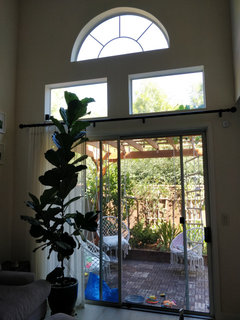
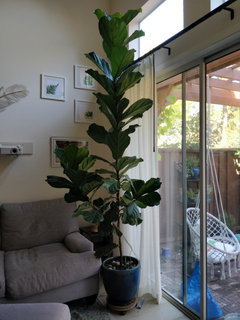
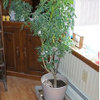
It is about 10 feet tall right now and not going to stop. I have double height ceilings so they allow it, bit it is starting to lean even though it is right next to the window (facing East in California). Also, it has two branches going outward that looked in place when it was little but look weird (and obstruct the view) now.
Should I cut the branches and just leave a single long stem? How do I stop it from leaning being that tall and thin?
Should I cut the main stem to encourage branching? I prefer the tree shape but then I would have to move it away from the window to get more space, not sure the light will be enough. And it would be devastating to cut a significant part of the top when it is so healthy.
Please advise!

Comments (11)

  • 4 years ago


    Couldn't add photos to the post, so here they are.

  • 4 years ago


  • 4 years ago

    Let me preface my reply by saying wherever I might sound critical, I'm not criticizing you personally; rather, I'll be critical of a particular perspective. I'll start by first musing about the perspective you share with millions of other hobby growers, which was revealed when you said, "And it would be devastating to cut a significant part of the top when it is so healthy." The overwhelmingly large fraction of growers harbor the sense that any growth a plant puts on is sacred or automatically protected from removal. A grower might consider how long it took the plant to grow so large, not understand how to judicially bring the plant back in bounds by pruning or dividing/repotting, or simply looks at growth as a manifestation of his/her accomplishments. This mindset is so prevalent that most plants are left to do as they will until the grower realizes the plant is/has grown out of bounds to the degree that a major sacrifice in appearance or top mass needs to be made to bring the plant back to a structure that promises realization of the grower's goals insofar as what the plant should look like. The overall message is, if we start pinching and pruning well before we arrive at the point where a serious intervention is required, we never arrive at the intervention stage.

    Just as life is largely a product of the decisions we make, what our trees will look like in several years depends on the actions we take today. Set aside our ability to keep trees healthy and you find how the tree was pruned/ pinched will have had the most influence on what it looks like as it grows.

    "..... it is starting to lean even though it is right next to the window (facing East in California). Also, it has two branches going outward that looked in place when it was little but look weird (and obstruct the view) now." Your tree is leaning because cells away from the light source are elongated by one of the trees growth regulators, auxin. This causes the tree to bend toward the light. Or, it is bending because the trunk is not thick/strong enough to support all the top mass. Your best bet would be to summer the tree outdoors where it would respond with much greater enthusiasm (and thicken) due to increased light load and air movement. If you can't or don't want to do that, you'll need to keep supporting it mechanically, which certainly detracts from its rye appeal, or prune it back so it can support itself. You have noticed, I'm sure, that between 2 sticks of the same thickness but varying lengths, the longer stick is easier to bend than the shorter. The trunk of your tree is the same. My tree? I shorten it next June to the degree you can get rid of all the mechanical rigging that now supports the tree, and I would shorten it to about 2/3 of the ht at which you want to maintain the tree. Using the 2/3 suggestion is in anticipation of the room needed to develop a canopy. It will be exceedingly difficult to do that if you simply pinch the top (remove the growing tip of the stem/trunk). That will terminate extension of the trunk and force branching from 1 or more nodes immediately proximal to the pinch. I don't think you really want a bare 10 ft tall trunk with 2-3 branches at the top? Using the ultimate ht of a tree you want to maintain at 9 ft, you would reduce the ht to 6 ft (June) and let the branching start immediately below the 6 ft mark. That gives you 3 ft in which to develop the branches.
    Should I cut the branches and just leave a single long stem?
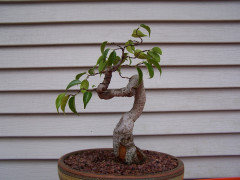
    No, at least not if you're asking from the perspective of eye appeal or trunk strength. Think of the trunk as a river and the branches as streams entering the river. As the streams unite with the river, the river increases in size. The leaves and branches on the trunk provide the food (photosynthate/ sugar/ carbohydrates which adds files of cells that thicken lower order branches and the trunk. They provide strength, so removing them now would be counterproductive from the perspective of trunk strength. How do I stop it from leaning being that tall and thin? Cut it back and give it more light. Also, when you next repot you can change the planting angle so the top of the tree is centered over the point where the trunk leaves the soil. I find straight trunks a bit boring and movement in the trunk, curves/ bends very appealing to the eye. I finished pruning wiring this Ficus benjamina today:

    This tree was once >8 ft tall. You can see the scar on the left where the trunk first starts to move to the right just above the soil line (not the orange/ brown scars I just carved yesterday) where it was chopped back to about 3" tall is nearly healed. It will look great when it starts to fill in. Should I cut the main stem to encourage branching? Covered. I prefer the tree shape but then I would have to move it away from the window to get more space, not sure the light will be enough. Summering outdoors and rotating the tree weekly will encourage much more growth and a thicker trunk. It will also help you develop a well branched canopy MUCH faster. It will also ensure the tree has plenty of reserve energy storedin roots and cambial tissues, which will assist it during the darker months of winter. And it would be devastating to cut a significant part of the top when it is so healthy. Calling on some 40 years experience manipulating Ficus and at least 100 other species of trees, I can say with certainty that the best time to do heavy work on tropical trees is when they are at the peak of health. When healthy, trees will take most of the indignities we force on them in stride. Doing the hard work (repotting/ hard pruning) when they're in trouble after severe decline is much like performing a serious operation on a person just hanging onto life by a thread. Tropical trees (grown outside of the tropical zone) are normally coming into their highest state of vitality and most robust period of growth when day length is longest. That occurs at the Summer Solstice. I regularly advise folks to be patient and make allowance for their trees' weakness during the fall/ winter/ early spring by avoiding hard pruning and full repots.

    I don't know what camp you'll end up in, but if you have additional questions you think I might be able to answer, don't hesitate.

    Al


    Ольга Минаева thanked tapla (mid-Michigan, USDA z5b-6a)
  • 4 years ago

    turn it 90 degrees once a month ... and then it wont continue to develop the lean ...


    and thank god you have the height space ... think of it this way.. if you had the common 8 foot ceiling.. you would have cut it back years ago ... so why be concerned about that now ...


    look into propagating what you cut off ..you would propagate small pieces.. not a 4 foot chunk ... it probably isnt all that hard ...


    https://duckduckgo.com/?q=Ficus+lyrata+propagation&t=ffcm&iax=images&ia=images


    and the reason i would do that.. is because when i see the tree compared to the pot.. i wonder how long its got to go .. or how in the world you would even go about repotting it ... and if you did.. how would you make it stand upright in a pot of loose media at that height.. which would probably make me think.. before i repot it.. i may as well shorten it so it doesnt keep falling over ... see how the circle comes right around ... lol ...


    gorgeous plant.. in the PERFECT room for it ...


    ken


    ps: when it become too root bound in the small pot.. you will start to have trouble properly watering it ...


    pps: i dont know CA .. does this have to be in the house ???? ... where ever you may be.. big city name


    Ольга Минаева thanked ken_adrian Adrian MI cold Z5
  • 4 years ago

    Ken,

    thank you for your comment.

    I don't want to leave it as is because I see the direction the situation is headed in and I don't like it. :Propagating it after I cut it is my only solace. :)


    It won't be rootbound for a while, I expect. I've repotted it a year and a half ago and the pot was waaay too big.


    I am east of SF and the summer sun is merciless here, while humidity is low. I don't think it would like it outside. Besides my yard is tiny.

  • 4 years ago

    Thank you Al, for your thorough answer.


    I am truly guilty of being soft-hearted and waiting too long to cut it. I completely agree with your argument on needing to look ahead, plan the tree shape early and execute the plan. I was so excited to see it grow that I got carried away,


    For the reasons for leaning - I suspect the latter is right. It does get a lot of light and you can see it is not even leaning towards the light. It is top heavy and the trunk is thin.


    Do I understand it right that now is not the best time to cut it? Better wait for spring?


    I don't think I'll be able to oversummer it outside - sun is too hot and nights are too cool, but if I cut it down I might be able to leave it outside for several hours out of direct sunlight.


    If i may ask, how do you cut an 8' tree to this size? Do you do it in one go, or gradually? It is inevitable that at some point the tree will be left without leaves/branches at all. Does it sprout new ones easily?

  • 4 years ago

    Al said ”June,” but I imagine you are itching to do it now. I’m sure Al will weigh in on that. If you cut down by 2/3, you‘ll still have leaves and branches. It’ll be ”one go.” If it’s too painful, leave the room and have someine else do it (joke). Or just think of all the lower growth stimulation.

  • 4 years ago

    Thanks, Socks. Since it is very sunny around here and things start early, I was thinking late February/March. I could roll it out for sunbathing to acclimate it slowly. And also better chances for propagation.


    I do have an itch but I can live with it.

  • 4 years ago

    Thank you, Al!


    I really appreciate your advice!


    Your bonsai trees look great and even though I won't be growing an actual bonsai, I guess the guiding principles are still the same since it will be out of its natural environment and in a limited space.


    About late spring - understood. I'll have to sit on my itchy hands a little longer than I'd like, but oh well, it is for a good reason.

  • 4 years ago

    Plants have natural rhythms (search endogenous/ Circadian) and are increasingly affected by the growth cycle as the distance they're growing from the equator increases. While your plant can be repotted any time you prefer, because you own it, from the plant's perspective timing can range from poor (winter/ early spring) to best, which would be the 2-3 week period immediately preceding the Summer Solstice which is when the growth of most commonly grown houseplants, including trees, are at their most robust. One reason is the tree's reserve energy level and its ability to make food, the other are the chemicals that serve as the plant's natural defense against biotic and abiotic pathogens and insect herbivory. These chemicals are a byproduct of the plants metabolic rate. Both reasons just mentioned point to the fact that doing the work when the plant is strongest ensures the potential for the fastest and safest recovery.

    Something not often considered is the nurturing bone almost all not for profit hobby growers have. The sense of personal satisfaction we get from caring for others, pets, plants, is no small reward. I can see from our exchanges that you are clearly interested in elevating the plane on which you interact with your plants. Think of the added satisfaction you'll enjoy for allowing for the plant's weaknesses and taking advantage of its strengths. I promise it will make the restiveness of self-imposed patience worth it. If you are, or get, seriously interested in growing trees in containers, I think you'll soon discover there is notable reward for the patience required. We all start at the place where we expect expeditious results as return for our efforts, but soon discover that trees have their own time and it's a considerable accomplishment to be able to exit our own relentless rhythms and adapt to those of your trees. It took some time for me to feel comfortably adjusted to the change, but now, after many years of practice, impatience about any aspect of caring for trees that can be seen to serve the tree's best interest is no longer a vexation.

    Al

Sponsored
Wannemacher Interiors
Average rating: 5 out of 5 stars26 Reviews
Customized Award-Winning Interior Design Solutions in Franklin Cnty OH