Software
Houzz Logo Print
fiddleleaffigguy

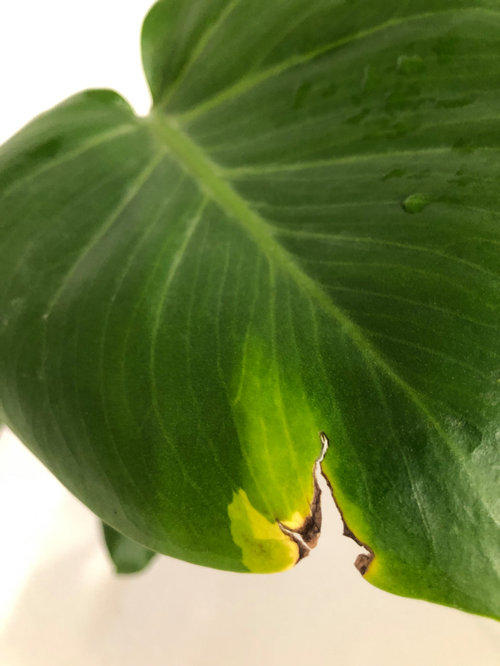
Is this variegation? What do you think?!?!


I have never found one! but looks like I have!!!

Comments (48)

  • 4 years ago

    do you mean the yellow around the injury.. or the vein colorization?


    ken

  • 4 years ago

    The yellow around the injury. can you see the two tone yellow colours? is it an aurea?

  • 4 years ago

    NOT variegation! Just the normal discoloration of the plant tissue surrounding the injury. It is some mild necrosis, as the plant attempts to isolate or seal off the damaged portion.

    Variegation is a very different phenomenon.

  • 4 years ago

    I think injury will be brown instead of 2 tone yellow color. aurea is a yellow variegation

  • 4 years ago

    It will be yellow before it turns brown. But then, you knew that, didn’t you Mike.

    tj

  • 4 years ago

    That plant is NOT variegated.......no matter how much you want it to be!

  • 4 years ago

    The yellow halo reveals the presence of a plant toxin produced by a plant pathogen, usually fungal but there are several bacterial diseases that produce lesions surrounded by yellow or sometimes red halos. The leaf in your image appears to have suffered a mechanical injury, and some brand of ubiquitous fungus has taken up residence in dead tissue surrounding the wound.

    Al

  • 4 years ago

    I think Mike TFLFG may be a Redditor. A large number of the threads on Reddit's plant subs are something about "Is this variegation?" Almost none of them are.

  • 4 years ago

    I was right!

    https://www.reddit.com/r/houseplants/comments/q7874v/is_this_variegation/


    I guess Mike TFLFG enjoys punking on multiple platforms.

  • 4 years ago

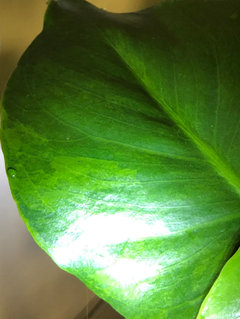
    “Almost” meaning there is variegation? Is this variegation too?


  • 4 years ago

    “Almost” meaning there is variegation? Is this variegation too?


  • 4 years ago

    No and no.

  • 4 years ago

    There are times when the wisest thing to do is nothing, and explain it by not saying anything. Henceforth, that will be my MO whenever these threads pop up. If I'm wrong in thinking these threads aren't designed to garner information, Mike can feel free to contact me to explain why my thinking is wrong-headed.

    Al

  • 4 years ago
    last modified: 4 years ago

    Variegation turns out to be more interesting than one might first suspect.

    I was initially going to respond to this thread by saying that I largely am not a huge fan of variegated foliage, so who cares if that Monstera is variegated or not. Personally, I would only pass on by a variegated Monstera (regardless of its potential monetary value). Then, I wondered, what exactly is variegation anyway? It's one of those terms that's used and abused and tossed around without much clarification. It turns out that variegation is a mutation in plants wherein the green chlorophyll is masked by other pigments. So, in a sense are not all those deciduous trees that are about to turn colors in the Northern Hemisphere, in some sense demonstrating "variegation". Then, apparently there is variegation that is caused by necrosis/pathology (which may be what is seen in the OP's photo). Variegation turns out to be more interesting than I thought.

    It turns out that I do, in fact, have many plants (hardy and tropical) that are "variegated" (Hedera, Aucuba, Pittosporum, Aglaonema, Diffenbachia, Cordyline, Epipremnum aureum, Codiaeum variegatm, Osmanthus heterophyllux 'goshiki'...., etc., etc.. But for whatever reason, when I see other plants that are normally green, being offered in a variegated version, I tend to avoid them especially the tropicals (Philodendrons, Monstera, Ficus, etc). Why? I don't know. I feel like variegated plants need more sunlight in order to look good indoors.

    Okay, I convinced myself that variegation is not, in fact, the worst thing in the world...,

    which explains why I'll be rushing of in the early morning hours to purchase a variegated Banyan (Ficus benhalensis) that I spied earlier in the day.


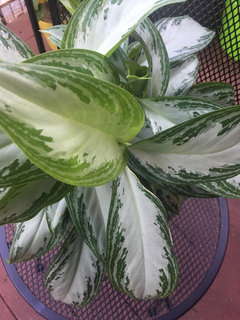
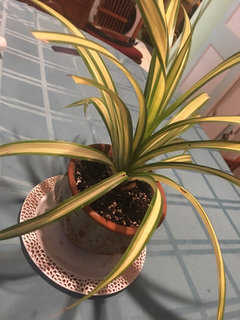
    Algaonema communatum exhibiting variegation


  • 4 years ago

    Fall color change in deciduous trees and shrubs is not considered to be a form of variegation. It is a natural, seasonal process triggered by a change in day length and temperatures. True variegation is a cellular mutation that impedes the development of chlorophyll. It can be inherited (genetic) in which case it is stable; or random (chimeric) and unstable. The only pathogenic source of variegation is a virus, not the physical damage of the leaves in the OP's photo. Physical damage to plant tissue is not pathogenic.

  • 4 years ago
    last modified: 4 years ago

    So, if variegation is a mutation that impedes the development of chlorophyll, does that mean that variegated plants are less robust than non-variegated plants.? I am assuming that variegation occurs in the natural world. What exactly is the evolutional advantage of variegation if it impedes a plant's source of food, chlorophyll?

  • 4 years ago

    Margaritaville, do both of the photos have variegations?

  • 4 years ago

    Some variegated plants are indeed less robust...they grow slower and generally not as large as their nonvariegated cousins. Many more are completely unaffected. The presence of variegation does not eliminate photosynthesis. Chlorophyll typically is present anyway but in lower quantities. Variegated plants often make up for this by having larger leaves, limiting the amount of variegation or swirling it into the green pigmentation.

    Mike, the ONLY photo associated with this thread that shows true variegation is the Algaonema posted by Margaritaville.

  • 4 years ago
    last modified: 4 years ago

    Thanks, gardengal, I am surprised to find myself really interested in what I thought a boring botanical topic, variegation. I still don't understand the apparent, biological success of variegation among some plants. There are multiple, botanical theses in this area yet to be written.

  • 4 years ago
    last modified: 4 years ago

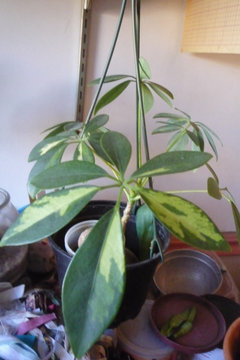
    Pics of plants I've had which ARE actually variegated.

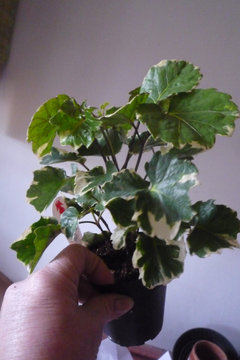
    A Schefflera


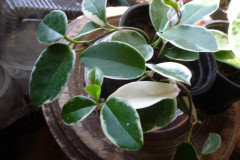
    A Hoya called Krimson Queen


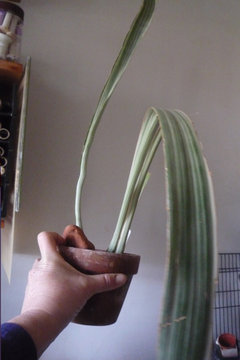
    A Sansevieria called Siam Silver (or Bantel's Sensation), given to me as Siam Silver.


    I'm crazy for Green & White variegates, but don't care for Green & Yellow variegates.

    One of my favorite plants: A Balfour Aralia (aka Polycias Balforiana).


  • 4 years ago

    there are common variegation and there are rare ones

  • 4 years ago
    last modified: 4 years ago

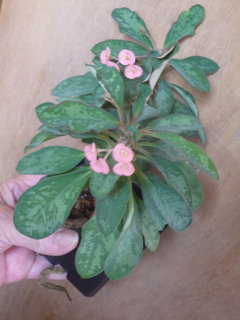
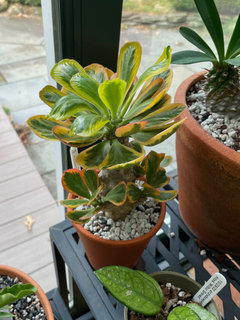
    Yes, here's a rare variegation, light green on dark green of this Euphorbia milii x marlotti.

    This plant is one of those not so commonly sold, rather shared among gardeners, who give each other cuttings.


    There are those of us here who remember OP's prior posts about 'rare' plants & recall he seems to have a different idea of what rare means than most of the others who post here.

  • 4 years ago

    That variegation made the plant looked so ugly

  • 4 years ago
    last modified: 4 years ago

    Well, I happen to think it's quite lovely, especially w/ its coral colored bloom.

    It will be my pleasure not to share any w/ you.

  • 4 years ago

    That plant should not be shared. you should keep it to yourself

  • 4 years ago

    I think that Euphorbia is beautiful, soft and subtle. I wish you'd share it with me :-)

    I love Euphorbias...

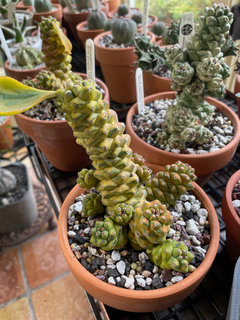
    variegated E. poissonii


    3 variegated Monadenium ritchiei (I guess now considered a Euphorbia, same family anyway)


  • 4 years ago

    Actually I share this plant often, w/ folks happy to receive some of its loveliness. It's a fast grower & blooms 3/4 of the year when kept well watered & in strong light. Most recently shared this past July w/ folks in my Indoor Gardening Group.

    Well SLD, thanks, maybe we can do a swap of some kind, I'm nearby in Brooklyn & I see a Hoya in your pic :>). We'll have to 'talk'.

  • 4 years ago
    last modified: 4 years ago

    Sounds good to me :-) I have lots of Hoyas, Euphorbias, Pachypodiums, and various other stuff.

  • 4 years ago

    Y’all know this guy is *massively* trolling, no?

  • 4 years ago

    ariel7576, unless someone posts something to the contrary, I am assuming Mike is not much more than 12 years old. Certainly his bizarre houseplant focus, lack of any plant knowledge and infantile communication skills would support that theory.

    He could be trolling but think he is just massively uninformed.

  • 4 years ago

    Margaritaville, there are various causes of variegation.

  • 4 years ago
    last modified: 4 years ago

    "Margaritaville, there are various causes of variegation."


    I am listening.


    I know one cause is a genetic mutation, but is this an advantageous mutation if photosynthesis becomes less efficacious?

  • 4 years ago
    last modified: 4 years ago

    It depends on from what perspective you view the question. If you like variegation and are concerned only about eye appeal, it's a good thing. If you look at it from the perspective of what effect it has in the plant's vigor (different than vitality/ health), it's not a good thing.

    Variegation can be inherited via asexual propagation (stable), or initially caused by a virus (pathological), irradiation, a spontaneous mutation (chimeric), or chemically induced mutation.

    Al

  • 4 years ago

    Tapla, I realize that humans can intervene and select for variegation because they may think it looks pretty, but my question is if in the natural world (independent of humans messing around with it), does variegation offer some advantages? Does natural selection ever opt for variegation? It seems that there are different kinds of variegation, many times it takes the form of paler yellows, creams, and silvers, but sometimes red pigments dominate, as is the case with crotons that can display a kaleidoscope of colors. I assume that croton are naturally colorful and did not have their genes messed with for our aesthetic sensibilities. And if variegation is occasionally selected,, why (given it is less effective from the standpoint of photosynthesis)? Feel free to speculate, I will. Crotons are highly poisonous. Is the explosion of color a way to warn animals to stay away?

  • 4 years ago

    I realize that humans can intervene and select for variegation because they may think it looks pretty, but my question is if in the natural world (independent of humans messing around with it), does variegation offer some advantages? Some posit that variegation may camouflage the plant and make it less likely to be the target of herbivory; however, one could also imagine that variegation makes a plant stand out and therefore more likely the target of herbivory. Some think variegation might, in the absence of conspicuous blooms, attract pollinators, or the pink spots on polka dot plants suggest the leaves have already been dined on (look like holes to insects) and as such are already 'taken'. I know temporary expression of the pigment anthocyanin in emerging leaves of a wide variety of plants serves to make leaves less visible to insect predators, which helps to afford them the time it takes for leaves to mature and the leaf cuticle thicken.

    I think any of the perceived benefits variegation offers wild plants in situ would have to be weighed against the facts that very few naturally occurring mutations live long in situ due to their inferior level of vigor and inability to compete with their all green counterparts. Almost all the variegated plants we grow are not stable variegations found in the wild. Since a plant's ability to synthesize protective chemicals as its defense against disease pathogens and insect herbivory hinges primarily on the plant's metabolic rate, which is somewhat to significantly limited in variegated leaves, it's difficult to imagine that variegation could serve as an advantage in a natural selection competition.

    Crotons are highly poisonous. Is the explosion of color a way to warn animals to stay away? We know not all plants which are highly poisonous are variegated and not all variegated plants are poisonous. In my mind, the question which goes straight to the heart of the matter would be: 'is croton an outlier among plants in that they are both toxic and variegated'? I won't pretend to know the answer, but my first impression is the reduction in the vigor shown by variegated plants would appear to certainly outweigh any other perceived benefits, and the fact that tips the scales for me is, variegated plants don't normally live long in situ.

    Al

  • 4 years ago
    last modified: 4 years ago

    Thank you Al, that was a very insightful and interesting response. I think I will copy your response and save it in my botanical resource file. Color is only one potential tool plants can exploit in making them less attractive to potential herbivores, scent and taste as also useful in defending against predators, and some plants even produce toxins to protect themselves from other plants (Ailanthus tree, aka., Tree of Heaven, aka., Tree of He//).

    "I know temporary expression of the pigment anthocyanin in emerging leaves of a wide variety of plants serves to make leaves less visible to insect predators, which helps to afford them the time it takes for leaves to mature and the leaf cuticle thicken.

    '

    Very interesting, that may explain why many plant buds do emerge with a reddish hue (Ficus elastica, Magnolia grandiflora 'Victoria', Photinia, Mangos, etc.)

  • 4 years ago
    last modified: 4 years ago

    Plant central, in some plants, is so tuned to what's going on with the foliage the plant will actually respond differently to a pin prick penetrating the leaf cuticle than they react to an insect with piercing mouth parts. That was written either by Alex Shigo, Ph,D., or Carl Whitcomb Ph,D., I can't remember which and it's probably not important enough to go look it up, but it is interesting.

    Al

  • 4 years ago

    If you want to learn more about variegation, watch plant me ashley on youtube. she discusses the different kinds. she knows it all.

  • 4 years ago

    To accurately declare that Ashley knows it all, you would have had to predetermine the entirety of knowledge on the subject for you to be able note if anything was missing from Ashley's presentation. If you watched her vid(s) before posting here, she definitely left you with unanswered questions. If somebody else learns something new tomorrow and fails to inform Ashley, she will be missing some info. Nobody knows everything. But a lot of people think they do. .


  • 4 years ago

    Is there a way to block a particular user on this forum?

  • 4 years ago

    If there is, you would have been blocked for always asking unrelated questions

  • PRO
    4 years ago

    Looks like it's just leaf damage to me. What does that damaged leaf look like now, a week later?

  • 4 years ago

    Why block a reliable source of surreal entertainment?

  • 4 years ago

    It is now pushing out a new leaf. i will keep everyone update if the new leaf turns out variegated. im so excited

  • PRO
    4 years ago

    Can you take a picture of the damaged leaf for comparison to the OP photo please?

  • 4 years ago

    Yes of course! happy to

  • 4 years ago
    last modified: 4 years ago

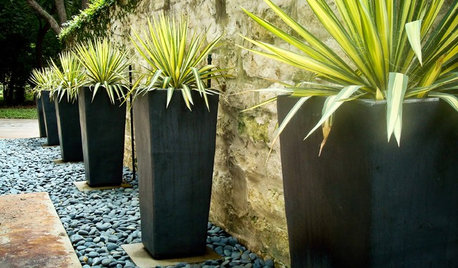
    Mostly, I am not into variegated plants. Having said that, there are about 5 variegated plants (of various genera) with which, I am absolutely obsessed. Here is one of them. Variegated Pandanus, this one is Pandanus baptistii variagata (Pandanus Veitchii is similar but with very prickly spines).