

house plans and energy efficiency
For those of you who have purchased house plans online or are considering doing so in the future, how important is energy efficiency and the cost of future utility bills to your decision? Do you choose a plan based on how it can take advantage of the solar orientation on the lot?
Comments (30)
 4 years ago
You should always plan so that solar orientation helps lower your energy costs.
Have you considered working with a person of talent instead of choosing a generic plan that may or may not work with your lot?
 4 years agolast modified: 4 years ago
You‘ve got it backwards. You design a house for energy ecficiency and lot orientation. You don’t go through a whole orchard of Yellow Delicious apples, searching for the one that has just the right distribution of red vs gold, and with the perfect flattened globe shape, that fits your lunchbox. You're looking in the completely wrong spot if you do. You start off with your lunchbox size as the first parameter, and and then move into why the dividion of red vs gold is a requirement for you. Then your fruit monger has already narrowed down the options to the varietal fits your needs, or gotten to the heart of why you’re thinking Golden Delicious will have any red to it.
Related Professionals
Magnolia General Contractors · Lafayette General Contractors · Concord General Contractors · Kearney Home Remodeling · Charleston Bathroom Remodelers · Edmonton Architects & Building Designers · Newburyport Design-Build Firms · Wilmington Home Builders · Oneonta Home Builders · Saint Joseph Design-Build Firms · Willmar Design-Build Firms · Superior Design-Build Firms · Champaign General Contractors · Chicago General Contractors · Elko General Contractorsl1neage
Original Author4 years agoNo, i get it. I'm an architect who designs many projects with ICF and every project with passive solar in mind. What I'm trying to understand is whether or not the people purchasing house plans online care about these things when they are purchasing plans, choosing an exterior envelope that can save on their utility bills and/or selecting a plan where they can orient a wall of windows south and the wall without many windows north, to simplify.
97 percent of all houses in the US haven't been touched by an architect. The majority of people building homes are choosing the online house plan. How as architects can we provide better choices to them so their homes function at a higher level once they are constructed?
- 4 years agolast modified: 4 years ago
You can start with better transparency of costs. People think architects cost $50-$100k - and many do. Most people can't see the value in that - especially if their build is $500k.
An online plan is real - with an architect, the only real thing is their office and their bill.
Doesn't answer your question but neither did the unusual apple answer....
I picked a lot that has West backyard. Because I didn't have much choice in the location I wanted.
My outdoor space is to the south as our the majority of the windows. So I would be one who designed the house with solar orientation in mind but couldn't find a south facing back yard.
But in very few areas is solar orientation planning going to save enough to fund your office costs let alone your salary. My 10 year utility bills (not counting solar) are about $20k. Only $12k of that is HVAC. If you think with modern windows, orientation can save more than $3k of that, you are probably mistaken. So, again, your office costs, not your salary.
This sounds really negative and I don't mean it to be, I just don't think solar orientation can save enough money to justify an architect over an online plan. But I also cringe when I see these online plans plopped onto a lot that doesn't make sense.
 PRO4 years agolast modified: 4 years ago
"What I'm trying to understand is whether or not the people purchasing house plans online care about these things . . . "
People that purchasing house plans online do not care about a lot of things.
And when it comes to the cost of an architect, they go by hearsay instead of asking local architects what their fees are.
- 4 years ago
I think most people picking online plans don't know the first thing about a good house design, not to mention passive solar. They may have a clue about energy efficiency but probably assume they can handle that with insulation, some solar panels on the roof and a electric vehicle charging station in the garage.
- 4 years ago
To be fain, you can handle "efficiency" with insulation and panels (although panels has nothing to do with efficiency). But good solar orientation is nearly free ... but an architect is not.
(I had a designer but had to push him on orientation and overhangs - not usually his priority)
- PRO4 years ago
"How as architects can we provide better choices to them so their homes function at a higher level once they are constructed?"
Design houses to meet the client's needs and fit the site upon which they will be built at a reasonable cost.
 4 years ago
There are other things to take into account such as well, septic, underground utilities, driveway location, VIEW, etc that may affect exactly where and how a house is placed. One person may want a short driveway so snow is easy to clear. Another may want the house set back for maximum privacy. People simply have different wants and needs, and with efficiency, getting an A++ is not always the most important aspect.
- 4 years ago
You must be very young and very naive to even use “purchased online home plans” and any type of invisible custom design details, like energy efficiency, in the same sentence. If it’s not showy and impressive and useless, it doesn’t catch the eyes of the scrollers. Online home plan creators are mostly carnival barkers. If you want to be one, you’ll have to sell your soul for the 2 story curved staircase dumping into a 5x8 19’H foyer.
- 4 years agolast modified: 4 years ago
The majority of the US has chosen showy, and mediocre to bad, as commodities, over simple, attractive, and efficient. Mr. Potatohead design. Stick on a tower and a gable and paste on some fake stone. If you want to affect your mid life crisis dream, it won’t be here. The immediate future of good low cost design for the masses, will be entirely outside the US. It will be in a less disposable income country, with much higher energy costs.
In any event, Usonian dreams aside, architecture has always been for those who could afford to pay for it. Because building a basillica here and there for the wealthy allowed for bread on the table. That hasnt changed. Architects still only work for those who pay them. They like to eat too much to work on idealstic ideas for free. - 4 years agolast modified: 4 years ago
How have you not read the past decades of this forum? That’s your client base there. ”Help me fix this internet plan to suit me” about a 4500 turreted 1.8M nightmare for someone on a 300K budget. But they won’t give uo 37 of the 60 gables, or that turret. And that is the rule, not the exception.
People demand bad design. Because they cannot ”see” or understand good design. You'd need to change the entire educational system, realtor organization, and the costs of infrastructure and energy, to get people to seriously change their core psychology of covetousness. ”The public” wants to create their very own extravagantly grand mini castle. Why are hime sizes here SO large compared to the rest of the world? Because the cost of living is a lot higher elsewhere. And that is where you might be welcomed to put out (and profit from) ideas that coincide with a better and more efficient core philosophy.
- 4 years ago
Oh oh, one of my favorite subjects to comment on and possibly argue about. I have books printed in the 1970's on passive including solar construction and it seems every generation reinvents this novel Idea as something new. I found a publication digitally transferred to the internet from 1904 with construction details on how to build a passive solar chicken coop, and there are still many old homes from the same era which incorporated passive solar into the design so it's nothing new.
But like @anj_p mentioned people would never look for something they didn't know existed so I say shoppers of passive solar house plans online would be in the lower single digit percentile. These are the thing which should be taught in school and not the brain washing garbage they're forcing on the kids now. But is there a place today for passive solar in high rise living going forward? It would be great to see a young bright architect create plans for medium and high density housing incorporating passive solar which builders could use and still make a profit (hint hint).
 4 years ago
"I'm just not satisfied with the way the world looks right now and intend to do what I can to change it."
It's a steep climb. You're fighting market dynamics, people's conception of what a house should look like, budget, builder sophistication, materials and supply chains, human resistance to change, populism, etc etc etc. You can replace the word "architect" with "farmer" or "urban planner" to realize the same issues many have in their respective trades of 'big ag' and land use.
However, as they say, you eat an elephant one bite at a time. It's probably not possible to get all you want at one time, every time, but you introduce things and chip away at the block one project at a time, and slowly over time things may materialize closer to your vision.
 PRO4 years ago
No, I'm fifty years old and have run a successful architectural practice for over 20 years. I'm just not satisfied with the way the world looks right now and intend to do what I can to change it. I believe we can do better than serving a very small minority of wealthy clients...
Money is what builds houses, people without money can't build a house... let alone pay for architectural anything.
Housing is a complicated thing for a wide variety of different reasons. It's primarily a boom to bust market, but looking at it over the past 10 years one of the longest spans in modern history in which housing just keep rocketing higher.
Someone your age versus new thinking "millennial" or up coming Generation Z as I've read millennial group is more mid aged now at around 30's. So if your plan is to change things these new generations are whom you need to convince or the market to capture.
The longer things go IMHO, is that old fads and foolish things that were done in the past is often repeated (whether architecturally or otherwise) as an example there's this fad to paint everything grey or clinically dead white. (Has little to do with architectural anything, just trying to describe the battle of "change" you're up against.)
What appeals to one, won't to another... regardless the money.
Previous generations before me used to put carpet on nice luxurious hard wood floors. Now carpet is mostly despised... will it change? Probably.
The other is: why is the house being built to begin with? What is the goal? Affordable housing? How can you make something affordable and still make enough to exist?
What is affordable when it comes to housing? Those price ranges vary like the wind across the USA. It's like trying to find two people who view HVAC concerns the same. Now if you come up with a smorgasboard approach to architectural designs, maybe you'll have something. You know where people come to you and they can select with different price points, the challenge to that is making enough people you know exist as most people who build new hire a builder... the mass market isn't to buy land then pick and choose this and that. You get outside the "affordable" range rather quickly going that route... then all the hurdles with new construction, the red tape, codes, HOA's etc... unless your wealthy it's just not a road (likely dirt or gravel) that most people will venture down any great distance.
Things like "master planned communities" is another hard hurdle to get over... much of which the builder or builder(s) control. In that realm it's more about features of the neighborhood, ammenties and such outside the building of a home we may live in for 10 or 15 years. PRO4 years ago
Hi, l1neage,
Before addressing your question, I'd like to challenge the notion that 97% of homes in the U.S. haven't been touched by an architect. Many older homes were constructed from plans in architectural pattern books. These enabled folks in remote areas and/or without the means to commission an architect for a unique custom design to produce homes with proper scale and proportion and architectural character. I grew up in a rural area with many nice Greek revival and Victorian homes that were, no doubt, constructed from pattern book plans.
Fast forward to today, and many folks dive into the home design process by surfing the internet for stock plans--they're the modern equivalent pattern book plans. Many of these stock plans are produced by registered architects like Donald Gardner, Stephen Fuller, Frank Betz, Looney, Ricks, Kiss, John V. Tee, etc. They're dishing up what sells--not necessarily what constitutes "good architecture." Playing to the paying audience, if you will. Some folks are under the impression they need to bring these plans to an "architect" to modify to suit their needs. The phrase "just draw it up," comes to mind. Many don't know the difference between "architect" and "draftsperson" which is a failure of the industry and the AIA, in my opinion, but that's for another thread.
My work is all architect designed, but most of my clients aren't particularly interested in energy efficiency. The exception are the engineers and architects who walk in with plans in hand, having considered every detail--whether correctly or not.
If economics aren't the driver of energy-efficient design, at least take heart that the building codes are setting progressively higher standards for energy efficiency with each code cycle. 4 years ago
I am a statistical data analyst, not a designer, not an architect. I have also been in the camp of "We are here to make the world a better place" for the past 40 years (grew up with the Civil Rights Movement and Anti-Vietnam Movement, still fighting for diversion and inclusion in the workplace, male/female parity, income disparity . . .)
I have made the economics argument on this board many times. Why does someone choose the home they choose? Income vs needs/wants.
Rent - can't afford to buy anythingBuy an existing home
Buy a track home
Build a custom home
Build a custom home designed by an architect for your specific needs.
I think everyone would love to have a home designed by an architect that was designed specifically for the needs of their family and was the style and design that resonates with the owners, is energy efficient, offers solar and/or geothermal, is oriented perfectly on the lot, is the perfect lot . . .
Money is the barrier and sadly more and more families are struggling just to put food on the table and afford a roof over their heads. Even those who have incomes in the top 25% are complaining about the rising costs of groceries and necessities and finding themselves compromising, tightening their belts and worrying about the future.
The number of people who can afford an architect is dwindling. The next group down is looking to do the best they can with the money they have and feel that an online design is a compromise they are willing to make in order to get the biggest bang for the buck.
My sister built her home about 10 years ago. She chose a neighborhood where the builder was going to build only custom homes on the lots. They got about 20 people who built custom homes and then they ran out of potential buyers. Most of her neighbors were her neighbors from her old neighborhood. The nicest lots in phase 1 were filled, a few lots sat vacant for several years. 2 years ago the builder sold the rest of the project to a track home builder. The new builder built spec homes on the few lots left in phase 1 and sold cookie cutter track homes for phase 2 and is now breaking ground on phase 3.
My sister was one of those people who built a home from a plan that she found on the internet. She focused on the floorplan and functionality of the floorplan for her and her family. It was not a perfect fit, but it was very close. The builder helped her make the adjustments to the floorplan (They removed one room and used that space to extend the master bath and create a storage area accessible from the back yard for lawn and garden equipment).
The plan she picked was a Mediterranean style home. My sister loves and wanted a Tudor style home. The builder worked with her to alter the exterior and make it feel like a Tudor home. They added oriel windows on both upstairs bedrooms, changed the exterior materials and installed a wonderful arched storybook door. Being in the northeast, solar orientation was not something she considered. She did consider geo thermal, but did the math and determined that it wasn't worth the additional expense.
She made the decision not to work with an architect. She interviewed several architects and found that the cost of getting exactly what she wanted required a fully custom plan, not one from any of their plan books. The cost was prohibitive and the outcome was dependent on the architects ability to see her vision. The internet afforded her many more options without the risk of spending money on a plan that didn't completely meet her expectations.
So you have a limited number of people who can afford the services of an architect. The mass majority of these people are going to be smart enough to command exceptional salaries. They will weigh the cost benefit. Some will assume that a professional will do a superior job and some will want to hand off the responsibility. The remainder need to be convinced that an architect is worth the money. That increased intellect that puts them at the top of the food chain also gives them the confidence that they can find exactly what they want without employing your services. Often their success is built on their ability to break apart from the status quo, envision and implement change. Unless you are at the top of your field this group may not feel that you are more capable then they are. Mediocrity is not in their wheelhouse.- PRO4 years ago
I find most of my clients are good managers of their money and the amount of money they make/have is not a major factor. The attitude of only the rich can afford and architect is a defeatist attitude, especially when it is based on rumors.
- 4 years ago
Mark, what is the usual fee for an average architect? I've heard it's about 10% of the project price but only hearsay.
- PRO4 years ago
Ask the architect you would potentially use. A lot depends on the scope of services.
- PRO4 years agolast modified: 4 years ago
"Mark, what is the usual fee for an average architect?"
I would not know.
(loaded answer) - 4 years ago
Only 65% of households own a home, the other 35% are renters.Only 10.8% of all homes sold in the past 5 years were new builds.
Only 20% of new builds are custom built (vs track or spec homes).
So 2% of all homes sold in the past 5 years were custom built and assuming that the home buyers over the past 5 years are representative of the home owners that means that 1.4% of all households have a custom home.
I have no statistical figures on how many of new custom homes were designed by architects vs using a draftsperson or online design, but I would hedge a guess that we are down below 1% of all households.
You want me to believe that you are designing homes for the average household (median household income of $67k? You somehow have beaten the odds and found a pocket of Americans who are exceptionally careful with their money and on their average incomes and their focus on money management, have not only saved enough to build a custom home, but also determined (against their penny pinching ways) that using an architect is a financially advantageous move.
I can't wrap my head around your logic. - PRO4 years ago
Maybe it is because they live their lives based upon what they want and not other people's statistics.
You can believe anything you choose to believe.
- 4 years ago
Although I don't know how to solve for those who are not building custom homes, I think you could expand your market and capture some of the current online design shoppers with the correct marketing. You need to know your local market and what is motivating the custom home purchasers. This takes a good consumer insights group that knows how to get to the right answers. A poorly worded survey provides false insights, but a well designed survey of the people who have purchased custom homes in your market could provide the insights needed to convince them that your services are worth the money.
There may also be opportunities to help track home builders and spec home builders with designing homes with better energy efficiency using solar or geo thermal energy options. Every home builder needs to compete against the rest. How can you help one of those new home builders stand out among the crowd?
Is there a place in the market for something between the stock plans and fully custom plans?Are the track homes in your area being purchased by Millennials and GenZs? They are anxious about the future and the continued use of fossil fuels. They are the target market for alternative energy and it is far less about the money than the harm fossil fuels are doing to the environment.
- 4 years agolast modified: 4 years ago
It’s ”tract” home home. Not track home. And as for the rest, there are lies, damned lies, and statistics. And clueless people from the outside looking in that don’t understand the process or the industry.
- 4 years ago
Verbo, You got me fair and square.
This does not change the numbers.Here is a survey of Custom Home Builders
https://www.custombuilderonline.com/custom-builder-survey-defines-demographics-custom-home-market
What is your typical client’s annual household income?- Less than $100,000 9.4%
- $101,000-$150,000 20.4%
- $151,000-$200,000 22.3%
- $201,000-$250,000 10.9%
- More than $250,000 37.0%
Base: 265; Custom Builder Demographics Survey, Dec. 2010
Here is another way to look at these numbers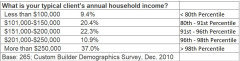
Grabbed the household income by year percentiles here:https://dqydj.com/household-income-by-year/
So per the 29,000 custom home builders surveyed stated that more than 70% of their clients had household incomes that were above the 91st percentile and less than 10% had household incomes that were less than the 80th percentile.
Again, I cannot separate out the custom home buyers who are building homes using architects vs those who are using alternate methods, but it would defy reason that the ones using architects are skewed toward the low end of the income spectrum.
What doesn't make sense is that you are apparently intelligent enough to earn a degree in architecture, but yet not bright enough to understand your business. I just don't get it. What is the barrier that stops you from being able to admit that your target market is wealthy?Can you explain how you are designing homes for people who do not have enough income to build a custom home.
- PRO4 years agolast modified: 4 years ago
"What doesn't make sense is that you are apparently intelligent enough to earn a degree in architecture, but yet not bright enough to understand your business."
I think you will get better responses if you stop insulting others and reeling statistics like a sword.




l1neageOriginal Author