Software
Houzz Logo Print
travisaz

Help with kumquat sunburn

4 years ago
last modified: 4 years ago
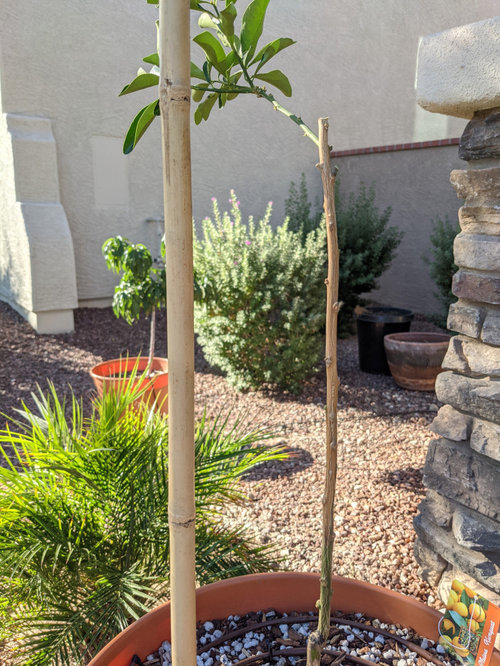
About 1 month ago I purchased a meiwa kumquat from a local nursery. I thought the repot went well, minimal root loss. The root ball was wrapped in cloth, so most of the root damage came from roots that were stuck in the cloth. But still, it seemed like a really clean repot in comparison to some of my earlier repots. Because this tree was born and raised in full Arizona sun, and it was repotted in an airier mix, I made the mistake of not coddling it for a few weeks.

Well, it made its displeasure known. After a week of decline, I placed it in shade and eased up on the watering (thank you @Meyermike(Zone 6a Ma.) for troubleshooting along the way!). I lost all of the branches except one. But the real damage is some really nasty sunburn on the trunk. When I purchased the tree it was tightly tied to a bamboo stake. I wonder if this sunburn is where the trunk was shaded by the stake and thus wasn't prepared for the sun like the rest of the tree.

In any event, this sunburn covers about 50% of the girth for a huge portion of the trunk. In researching this a bit more, I've learned that the sunburn is permanent and the cambium underneath the burn, which is responsible for water and nutrient transport, is dead. So, while the tree continues to live and support the one remaining branch, it is only able to function at 50% of its capacity. I don't think this is sustainable, especially once next summer rolls around. I've read that one solution is to train a new trunk from a new shoot. This seems like the best long-term strategy. My questions are: 1) Will I kill the tree by lopping off the majority of its trunk (and thereby losing all its leaves)? 2) Assuming the answer to #1 is 'no', do I do this now or wait for spring? I'm inclined to do it now because why waste the tree's resources in keeping the top alive when it could divert those resources to growing a new dominant branch? On the other hand, we're not far off from winter and growth really slows down in winter. This is an outdoor tree. Right now we still hit mid 80's during the day, but 60s-70s are typical highs (35+ overnight lows) for Dec-Jan. 3) Do I wait for it to sprout a shoot below the burn before I lop off the top? I think no because who knows when the tree will decide to do that.

I appreciate any feedback.

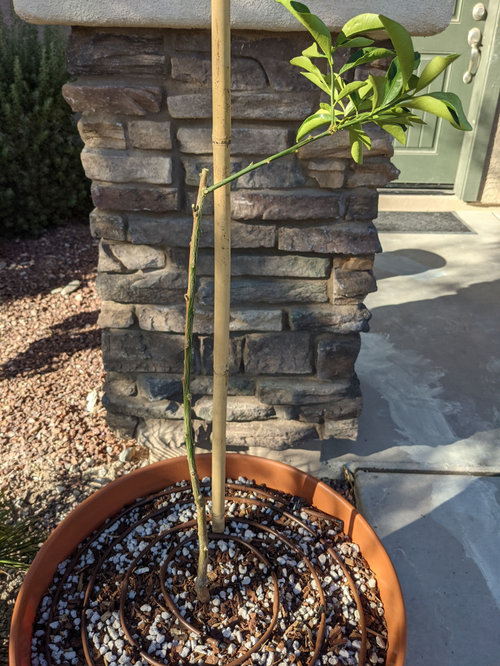
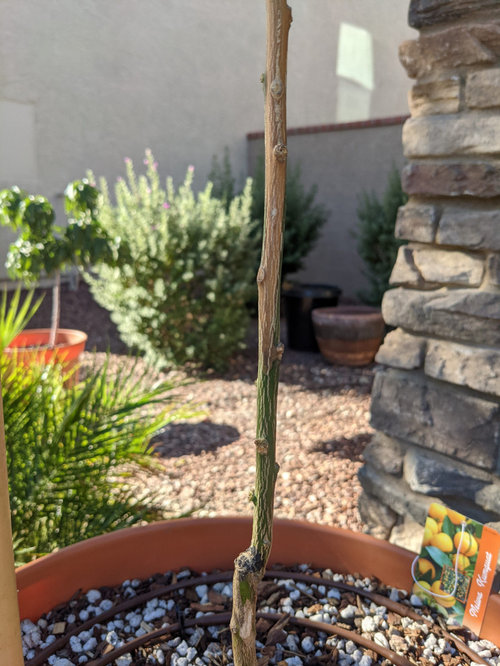
Here you can see the extent of the sunburn. It wraps around the trunk about 50%.


There are a few buds above the graft but below the onset of damage.


I believe the roots are ok because it continues to support this branch and leaves (albeit barely, note the folded leaves indicating thirst). There is even a tiny baby fruit it is still somehow holding on to.


Comments (16)

  • 4 years ago

    your tree will do fine in the long run. let anything grow above the graft.

  • 4 years ago

    Thank you Steve. So you're saying to not train a new trunk, just let it grow?

  • 4 years ago

    Personally I think I would just purchase another tree.

  • 4 years ago

    @Silica, I emailed the seller to see if they would cut me a deal on a replacement. Haven't heard back from them yet so I'm assuming they won't work with me. I'd rather not purchase another one full price, but maybe that's what I'll have to do.

  • 4 years ago

    Travis, I'm not seeing evidence of sunburn on the trunk. What am I missing?

    Al

  • 4 years ago

    Hi Al, perhaps it's not apparent in the pictures. There is a very distinct brown discoloration, running almost the entire vertical length, about half the girth. I'm at the park but I will try and take a better picture later when I'm home. I'm assuming the brown is sunburn. Peeling a flake off reveals more brown underneath.

  • 4 years ago

    Silica That tree has a well establish root system and will take off in growth. In 2 more years the tree will have about the same growth as it would have if nothing bad had happened.

    Steve

  • 4 years ago

    The seller got back to me and will offer half off for a replacement. So, start over for $50, or see if I can nurse this one back into success.

  • 4 years ago

    If you look carefully, and it looks like the green tissue is beginning to 'roll' over the area that's brown, or the brown area looks sunken (compared to the green tissue), it's dead. If it's dead, and the tree is to eventually end up in the landscape, the dead area will eventually be enclosed by callus tissue,, but the part that's dead will increases the probability of heart rot and mechanical failure in the future, no big deal for a containerized tree, but not worth the wasted effort should a tree in the landscape break from wind damage just as it is producing well. Not only that, but many trees have a direct branch to toot connection such that if a branch dies, the root dies. In this case, if the dead area extends all the way to the soil line, the roots sustaining that area of the trunk will die, as they would be separated from their food supply (photosynthate moving through phloem tissues. This creates a candidate for blowdown in the landscape from wind.

    It's common for a bonsai tree to show shari (dead areas on the trunk), natural or created by the practitioner, as seen on this juniper with its live veins purposely accentuated.

    If the dead area does not extend all the way to the soil line or there is part of the scion above the graft unaffected by the wound, simply pruning the tree back will provide back-budding you can then work with. In a couple of years it will seem as though nothing happened to set the tree back.

    .... lots of options, if it's to remain forever in a pot, but I think pruning below the wound and above the graft union would be the only way I'd put it in the landscape.

    Al

  • 4 years ago

    Travis Your tree is way to small to worry about heart rot. Keep it. It will do fine

  • 4 years ago

    Thank you for the detailed information Al! So far, I don't see any indication the brown part is sunken or the green part is rolling over it. But the damage is <1 month old. Too soon to tell?
    The tree would stay in the container, so I don't have the landscape concerns you mentioned. And, there is green wood between the graft and the wound. However, the brown swatch covers 50% of the width for most of the trunk. Doesn't this mean water and nutrients aren't accessible there (if the cambium is dead), which means no buds will come out there and and it will be that much harder for the tree to transport water and nutrients up the trunk? Won't I end up with a struggling, lopsided tree? Or are you suggesting the brown damage is not permanent?

  • 4 years ago

    "So far, I don't see any indication the brown part is sunken or the green part is rolling over it. But the damage is <1 month old. Too soon to tell?" Yes, probably. It will become conspicuous as the tree grows and callus tissue starts to roll over the wound.


    Same tree 2 years hence.

    Because the tree grows around the injury, the rotten part becomes a part of the tree's core (heartwood), and as the tree ages, the rot organisms will destroy the tree from the inside out.

    ".... are you suggesting the brown damage is not permanent?" All damage to trees is permanent in the sense that trees, unlike animals, are unable to repair or replace damaged cells in their same spatial position. Any injury occurring today will be forever recorded in the woody parts of the tree. If the tree lived to be 50 years old and was dissected, the injury would be clear. Knots in boards from conifers tell the story of branches long dead and covered by growth which occurred subsequent to the death of the branch.

    Eventually the cambium would once again become intact by growing around the wound area and be continuous and uninterrupted around the entire circumference of the tree, and because the trunk caliper is so thin, it might only take 10-12 years (in a container) assuming the tree remains healthy. Any new branches that form in/on the callus tissue would necessarily be from adventitious buds as axillary buds in the dead area would not be viable. I don't know how freely Fortunella (or whatever genus they have kumquat in now) forms adventitious buds, or if that is really a concern given how low on the trunk the damage is.

    ".... the brown swatch covers 50% of the width for most of the trunk. Doesn't this mean water and nutrients aren't accessible there (if the cambium is dead), which means no buds will come out there and and it will be that much harder for the tree to transport water and nutrients up the trunk? The tree will adapt to the injury. First, some of the superfluous roots might die. The volume of top growth will adjust to any reduction in water/nutrient flow, and the tree will set to work improving the pathway for water/ nutrients moving upward and photosynthate and other biocompounds moving toward the roots.

    Is there any spot below the wound and above any graft where the circumference of the cambium is undamaged? If so, I'd be thinking about chopping it back to that point come spring.

    Al

  • 4 years ago

    “"So far, I don't see any indication the brown part is sunken or the green part is rolling over it. But the damage is <1 month old. Too soon to tell?" Yes, probably. It will become conspicuous as the tree grows and callus tissue starts to roll over the wound.

    Same tree 2 years hence.

    Because the tree grows around the injury, the rotten part becomes a part of the tree's core (heartwood), and as the tree ages, the rot organisms will destroy the tree from the inside out.”


    Hey Al. if this was true, wouldnt any tree that had a branch pruned be exposing its inner hardwood to rot and eventual downfall of the tree?

  • 4 years ago

    I appreciate the additional details on how the tree will heal. The damage begins 3-4 inches above the graft union, so I have some completely intact cambium. I was considering lopping off the damaged part and training a new trunk, but I wasn't sure if such a dramatic surgery would kill the tree, and if I should do it now or wait until spring. In Phoenix, we have daytime highs of 60-70 and overnight lows of 35-40 during Dec and Jan.

  • 4 years ago
    last modified: 4 years ago
    Every tree gets 100's of dozens of injuries. The trees incapsulate their injuries and grow on. Some grow taller than 300 feet, others more than 20 feet in diameter and others live for 6000+ years.

    Roll with what ever your tree throws you. Every grafted tree has that wound shown above and do very well. You can still buy another tree and keep this one.

    Steve

  • 4 years ago

    Steve, are you referring to the black "scab" like thing over the graft? I wasn't sure what that was, but wasn't stressing out too much about it. What is concerning me is the large strip of brown beginning a few buds up from the graft and running the rest of the way up the trunk.