Software
Houzz Logo Print
webuser_58889218

Should Anderson 400 window do this?

5 years ago
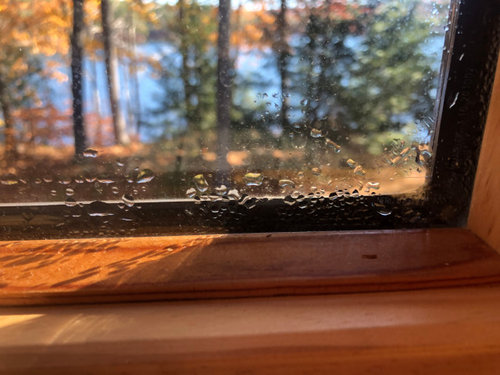
We recentky built an addition and put Anderson 400 series windows in we have duette style toom darkening blinds in the master bedroom when i raise them in the morning im getting condensation inside the glass. should this be happening? TIA


Comments (15)

  • PRO
    5 years ago

    It sounds like just about any window will do this according to you description.

  • PRO
    5 years ago

    If the conditions are right.

  • 5 years ago

    Reducing the indoor humidity should help.

  • PRO
    5 years ago

    The colder the temperature outside the lower the indoor humidity has to be so they don’t condensate.

  • PRO
    5 years ago

    Leave the blinds open slightly as well.

  • 4 years ago
    last modified: 4 years ago

    The link was too longwinded to read so this may be redundant.

    In normal conditions, without insulationg shades, warm moist air against the glass cools and drops before condensation can occur and is replaced with warm air from the room. With insulating shades the air is prevented from droping and eventually condenstion occurs.

    The insulating shades don't casue the condensation but they create a condition that makes it more likely that condensation will occur.

    Reducing humidity enough that condensation won't occur in the trapped air space would probably not be comfortable.

  • PRO
    4 years ago
    last modified: 4 years ago

    All good info above. In short, while a more thermally efficent window will be more resistant to condensation, condensation is RARELY a sign of any defect in the window. Generally environmental factors are the cause, and in this case the blinds are a big one. As temperatures get colder, the amount of that will only increase unless the relative humdity in the home is decreased, or you get glass warmer (open the shades to allow circulation).

    So no, not likely that you have any sort of window problem, however it would be advisable to deal with the cause of the condensation to prevent damage to the windows and shades.

  • 4 years ago

    If you don't fix the problem it will rot out the window wood below in no time. I have Anderson 400 series windows and I even use thermal curtains down to the floor in the living room with no problems concerning condensation. I keep the humidity at 50% right now but I need to lower the humidity level as it gets colder outside.

    Check you humidity level in the room, Look to see if there is any condensation between the two panes meaning it lost it's seal and Anderson will replace it. Lastly check for installation problems which would allow air in from the outside and the most likely if the humidity and glass seal is OK.

    Hate to say it but cold air infiltrating in and around the window will cause the window to condensate like yours.

  • 4 years ago

    It's science. Depends on indoor humidity, glass/insulation, air movement. We crack our blinds in these areas.

  • 4 years ago

    It’s no fault of the window….it’s the blinds. They simply trap the humidity between them and the window. You’ll find if you leave the blinds open, this condensation will normally not form.

  • 4 years ago
    last modified: 4 years ago

    @HomeSealed Exteriors, LLC I'm well aware of all the laws of thermodynamics and believe you don't understand what a hole in a wall will do in a house, or exactly what the 2nd law really means so I'll try to make it simple. Air leaving or entering a leak in the wall depends on pressure difference in the building envelope, or just the air pressure difference in one room, and is not dependent on the temperature of the air . Air movement is not a one way street applied only to warmed air which applies to cold air also, and if air leaves you have negative air pressure and air will enter any way it can to equalize the pressure, this would be through a window's bad installation and sealing in this case.

    This morning it was 37 degrees outside, my house humidity is 53% and when I opened my thermal curtains on my Anderson 400 window and NO condensation, not a drop, nothing. I installed the windows, taped the nailing flanges on the outside, sealed the spaces between the rough-in window framing and window frame and applied the interior plastic barrier right and taped all seams. This is something I see ignored way to often by contractor by lack of knowledge or blatant neglect to save time.

    At this time of the year with only cool temperatures JAB's window should have no signs of condensation even with the blinds down. Looking Through his window the tree leaves have turned color but haven't fallen so he lives in a warmer zone than I do, and unless the humidity in the house is well into the mid 60's, the double pane glass lost it's seal or a crappy window install by an incompetent contractor. Only three causes, and the blinds won't cause it unless it's much colder outside, which takes us back to the 2nd law of thermodynamics (which you spelled wrong by the way). The transfer of energy as heat moves between an isolated barrier from the warmer to cooler side until equilibrium is met. The blinds have a small R value and the thermal resistance is low to the transfer of energy as heat (2nd law) through the blinds and therefore unlikely it would not cause condensation in cool fall temperatures but could assist if the humidity was to high.

    I like 50% humidity in my house, when it gets colder I will need to lower it but right now it's fine for me and my windows. I know the humidity chart and 40% would also be fine but 50% works so thanks anyway.


  • PRO
    4 years ago

    The reason that many of the older homes and windows did fine, despite any marked insulation values, was the fact that they dried to the outside. As one poster indicated, if the warmer air is being lost to the exterior and replaced with cooler and dryer air. We have observed this in countless cases where clients didn't adjust their humidistat setting post window installation or air sealing and insulation. The phone call comes pretty quickly when a client that previously did NOT have any window condensation with their older windows now does. Many times near the meeting rails on vertical sliders and in many cases, when they are windows that are behind blinds or other types or window treatments.


    If the OP wants to look at the installation holistically, a thermal imager inspection of the window in conjunction with a blower door test and smoke pencil would validate if there is any deficiency in the window installation. If the window was otherwise foamed and sealed to the home, the issue is the higher than tolerable relative humidity and the lack of air movement at the window opening given the current humidity levels.


    Lower the humidity and/or stir the air at the window by opening the blinds. There is a reason that there are HVAC vents in front of windows and doors.

  • PRO
    4 years ago
    last modified: 4 years ago

    @outpaientzero, thanks for responding and thanks for correcting my typing error. As a BPI certified energy professional with years of experience performing blower door testing and home energy audits, I'm quite aware what a hole in a wall will do in a house, as well as what it won't. As someone that has also installed, sold, and serviced hundreds of thousands of windows over multiple decades, I'm doubly aware of how those laws and principles apply to window installation. Your comments on pressure are mostly correct in theory, but incomplete if not slightly twisted in terms of the application here.

    To put it simply:

    1) Once again, it's highly unlikely that there is a seal failure. Even if there is, the effect that it will have on the interior surface temperature of the glass will be fairly minimal (not non-existent, but minimal) unless there is air freely flowing in the unit (again, nearly impossible based on the pic). If there is condensation between the panes, or other corrosion or obstruction inside the IGU, that would indicate seal failure. If no visual signs of seal failure exist, again, not likely the case here.

    2) Even IF both negative pressure and a leaky installation exist, again, condensation will be seen on the coldest surface first which will generally be at or near the leakage point. If any air leakage would be causing this in the case of the OP, it would be more likely to be at the sash to frame interface close to the glass, not coming in from around the perimeter of the window frame. This is pretty basic stuff that one need only have common sense to diagnose.

    3) The effect that the blinds have has more to do with airflow than the R value, and again is the most likely culprit here.

    4) I'm not quite following some of the language you are using about your DIY window installation (plastic barrier?), but it sounds like you are happy with it, so that's good.

    5) Lastly, you're welcome. The chart and calculator are great tools that anyone can use to reference what they can actually expect, as opposed to going off of what some guys are saying on the internet.

    I'd love to hear from JAB on whether the pretty univerally recommended step of raising the shades slightly has helped.