Software
Houzz Logo Print
snwbdr94

Range hood questions

4 years ago
last modified: 4 years ago
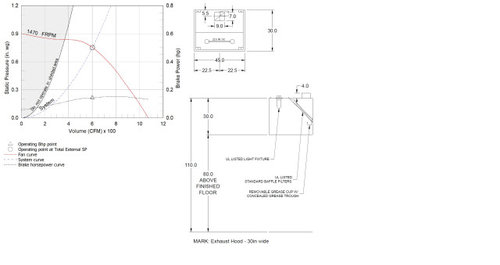
Here is yet another ventilation question. I figure I would just post the set up I have in mind and hope some folks could chime in on anything I may have missed.

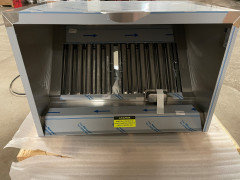
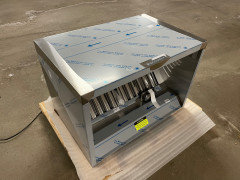
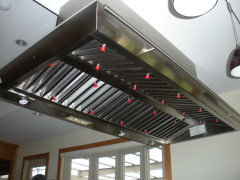
Wife and I are building a new home and will be purchasing a Blue Star RNB 36" w/ griddle. 22k BTU fronts, 15k rear, and simmer. Working with Accurex, our hood size will be 45"Lx30"Wx30H". 2 Lights, 2 20" baffles. Mounted 72" - 80" off the finished floor. We are on the short side but thinking if taller folks are around, having the height would be good. External blower will be XRUD-099-VG. Overall, will this be sufficient for our range?

I cannot comment on the MUA situation as I haven't talked with the HVAC contractors yet. Trying to get this squared away as best as possible.

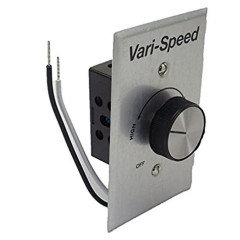
Our controls I would like some ideas on how to streamline it. Currently it will be a light switch to turn the blower on/off that will go through a vari speed dial to adjust the blower speed. I haven't been able to find a simpler solution that costs under $1000 but I'm sure someone here has an idea. Thanks in advance!


Edit: @opaone @kaseki figure I should tag you two.


Comments (21)

  • 4 years ago

    Looks satisfactory to me. Congratulations. Not sure if the lighting would meet my needs; supplemental may be needed, or perhaps filling those bulb fixtures with LED industrial lights may help.

    Fan curve intercept of pressure loss curve presumably accounts for the baffles. Does it account for the MUA and if so, what pressure loss vs. CFM was assumed? If not, then the requirement may be for pressure compensated MUA which will require a control system.

    If the hood blower motor is an induction motor, most dial type motor controls that fit into light switch boxes should work. Find out the current requirement.

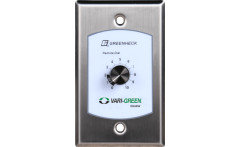
    My expectation is that something as simple as this would be adequate, which is similar to the one provided decades ago by Broan for my auxiliary wall oven ventilation blower. However, that is also a question for Accurex.


    See this link for a few more:

    https://duckduckgo.com/?q=wall+switch+motor+control&t=h_&iax=images&ia=images


  • 4 years ago

    Not going to lie, I'm excited about having a custom hood made. Pricing wise, it ended up being slightly cheaper than an equivalent Wolf. (MSRP that is)


    The fan curve does account for the baffles but I do not believe it accounts for MUA. My guess without speaking with the HVAC company yet, that the dial would be tied in with the MUA system to make sure it all balanced evenly. The builder was thinking they would end up doing an oversize HRV to account for the unit but I'm waiting to hear what they have to say. I'm not opposed to having a fantech option installed. Speaking of fantech, would an inline silencer be beneficial with an external blower?


    Here is a photo of the dial Accurex is including. I'm sure we will find a nice place to install it where it won't look terrible.


    As for the lighting, I could have them add additional lights if two doesn't seem sufficient. I'm on the hook for finding bulbs regardless and was leaning towards a LED light.


    Thanks for the comments!

  • 4 years ago

    A silencer between the hood and blower is helpful in reducing noise.

    Similarly, a silencer between blower and location of MUA release may be helpful in reducing noise depending ...

    Note that like @opaone's setup, Accurex may use a blower that operates under most of your conditions at lower than full speed, and that might ameliorate noise enough for you. I believe opaone's system uses silencers.

  • 4 years ago

    I'll assume you've read the Commercial Range Hood Install thread about our system. Some quick points;

    Yes to a silencer. And make sure the blower and silencer are mounted w/ perf strap or chains and have no other contact w/ structural members of your house.

    We're controlling our hood blower and MUA (Electro-Industries) with Control4 which has worked out very well.

    We have two lamps in ours w/ industrial LED lamps. These are controlled by a Control4 dimmer. They only last about 6-10 months though and the color temp isn't great but they are bright and dimmable.

    If your system works as well as ours you should be quite happy.

  • 4 years ago

    I have read the commercial range hood install thread about yours. Think I recently asked a couple of questions before making this thread. Definitely a lot of information that started making my head spin. Glad I am on the right path of having an amazing system.


    Will take note of the silencer is mounted w/ perf strap or chains. The blower will be roof mounted. Not sure if there is much I could do in that case.


    That's interesting on the short duration of your lamps. Wonder what is causing them to fail so quickly.

  • 4 years ago

    Many "white light" LEDs are actually near UV LEDs that drive a phosphor (or mix of phosphors) to generate white light. Possible life degrading factors are overdriving the LEDs or the phosphors, operating in a hot environment either due to the cooking plumes or to the confines of the glass protective envelope.

    The phosphor mix used to make white looking light may not fill in the spectrum very well. For most natural looking food, the CRI should be up around 90%. Even if this is obtained in new units, the lifetime of the phosphors may vary with color, so some degradation over lifetime is to be expected.

  • 4 years ago

    I would like to mention that my hood was specc’d at 160cfm/ft. Commercial is 225cfm/ft. At 45 inches, that equals 600cfm. The rep I have been working with did state that if calculations were correct, I could see 900cfm at 10v.


    In regards to the silencer, as it currently sits, my hood has a 9x7 exhaust collar. Should I be looking at getting a round collar instead? I think when I looked up an equivalent size diameter it was 8.8”. If I were to upsize to a 10” collar would there be any negative effects?

  • 4 years ago

    According to IRC table M1506.2, the equivalent circular duct (pressure loss wise) for 9 x 7 is 7.9 inches, so an 8-inch duct would be called for. Ten inches will have lower pressure loss. However, the requirement on duct size is that it keep the velocity between 1000 and 2000 ft/min. This minimizes grease condensation at the low end (particularly with cold ducting) and impingement collection at the high end. The volumetric flow rates for 8-inch duct (50 sq. in., 0.35 sq. ft.) for these two velocity limits are 350 and 700 CFM respectively. Given the potential to operate above 600 CFM, 10-inch duct might be better. Note that the 10-inch duct silencer is 14 inches in diameter, so that has to fit somewhere.

    To answer the question, I would think a circular collar would be convenient, but there are rectangular duct silencers and dampers, etc., so architectural factors may be determinative.

    For commentary on the Greenheck method, which I approximate, and the CFM per linear foot historical rule of thumb, see pages 8 and 9 of the Greenheck guide, https://www.tagengineering.ca/wp-content/uploads/2015/02/KVSApplDesign_catalog.pdf

  • 4 years ago

    @opaone woah! Just received our hood this week. Thing is massive! Definitely happy with going this route, the amount of containment area compared to all the other hoods out there is incredible.


    I am confused about how you were able to finish out the facade around the hood. Did they just attach the top of the flat panels to the framing where the hood mounts and use the bottom trim to keep the panels from moving?


    We are thinking about doing a shiplap style around our hood but cannot think of how it would get installed.

  • 4 years ago
    last modified: 4 years ago

    I would think that one would build a box-like frame around the hood that was supported by screws through the ceiling into the joists or added joist-like lumber. Then the exposed decorative wood would be fastened to the frame.

    Alternatively, one could screw into the hood shell, but not only would hole drilling be difficult, but to keep the interior somewhat smooth one should use machine screws with acorn nuts. Spun-on friction-welded studs could also be utilized.

    Also, pressure-reacting bonding agents could be used to attach the trim directly to the hood.

    Unless there were some architectural difficulty, I would go with a framed approach.

    In any case, care is needed to ensure that hood vibrations do not lead to rattles where the wood is close or touching.

  • 4 years ago

    I too was thinking a framed approach would be smart. Just trying to figure out the best way to minimize upper cabinet loss.


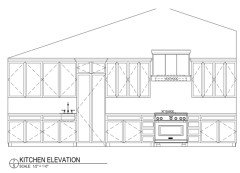
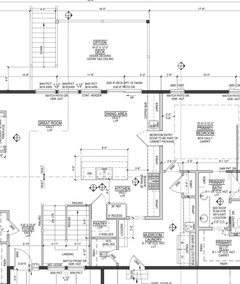
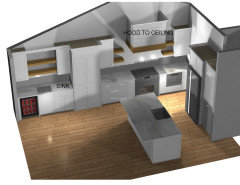
    Attached our plans. It shows how our kitchen is arranged. Cabinets were just place holders. Waiting on our cabinet design and quote still. Currently looking at semi custom cabinets to save money. Guessing uppers will need to get changed again to accomodate the facade on the hood.


  • 4 years ago

    Given attachment to the rear wall as well as the ceiling, I would guess that like cabinets, 3/4 lumber would be sufficient for a frame. Then add 3/4 for the exterior (side) panels. Not sure about fill strips at the adjacent cabinets -- they may be needed for cabinet door opening. Your kitchen designer should be able to help.

  • 4 years ago

    Uncrated the monster to make sure it was in good shape.


  • 3 years ago
    last modified: 3 years ago

    Update! (Had another reply posted but didn't go through and lost text so here is 2.0)

    We broke ground after a long process with the city on July 13th! House has been dried in, electrical, plumbing, and HVAC rough ins are completed. Insulation is scheduled for next Friday and drywall to follow afterwards.

    Everyone told us that when things were framed that rooms were going to look tiny, well it seems pretty big to us. It likely doesn't help that we ended up an extra foot taller on the main level. Not sure how but lumberyard sent out lumber for 9ft sill height main level, but plans called out 8ft. Ended up needing structural engineer to adjust our garage height to match the new height. Can't complain, it's big!

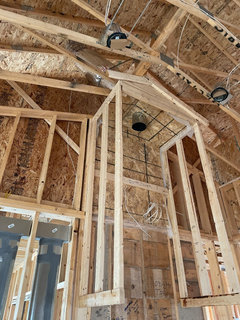
    Added a photo of our kitchen design and current state of hood framing. Our hood will go all the way to the ceiling. Additional bracing will be added to hang the hood from unistrut. The ductwork above has the silencer just above the OSB and attached with perf strap. Just waiting on roofers to come back to seal up all the penetrations in the roof and cut in for the blower curb to make sure that gets sealed up. Don't want to risk rain ruining the duct insulation.

    Our MUA solution ended up being a separate 300cfm heated unit. That will be ran to the stairwell landing (mech room just below mudroom WIC/kitchen pantry).

    Been busy last couple of weeks adding double drywall and green glue to the ceiling of our what will be the theater room but will be unfinished at time of house completion. I should have had that ready to go once the house was dried in but like a fool I waited and ended up getting behind and trades got their stuff in before I was able to. I can already tell a difference in foot noise from above when people walk around so it's a worthwhile venture even if it is more difficult to do.

    Another item I want to check off before drywall is to add sound deadening mat to all of my plumbing lines around critical areas in the basement. I saw that @kaseki mentioned recently that he also did that to his ductwork. Might do that to the range duct once installed.

    Thanks again to all the comments and posts from @opaone, @kaseki, and others in those threads as well. If anything seems odd or needs attention. Please feel free to chime in!


  • 3 years ago

    @snwbdr94

    If you don't mind me asking, who are you working with at Accurex on this? Would you be able to PM me a contact there? I asked our local reps on the west coast about something like this a while back and they effectively told me they wouldn't do any custom residential work. I'm looking for a ~70" wide hood with MUA system, and what you're building sounds quite similar to my needs (apart from a slightly different size), so just curious if you'd be able to share any add'l contacts/info! Thanks so much!

  • 3 years ago

    My understanding is that you have to go through reps and it's up to them if they'll do residential or not. Good alternatives include CaptiveAire and Hoodmart. I think there're a couple more listed in the Hood FAQ.

  • 3 years ago

    @snwbdr94, congrats on getting going and on what looks like it's going to be a great kitchen!

  • 3 years ago

    @snwbdr94 I am curious like @J H is about who you are working with at Accurex. I wanted a hood with dimensions 48"L x 30"D x 30"H which are practically the exact same as yours and was told by our local Accurex rep last month that if I wanted baffle filters and LED lights then the hood could not be smaller than 39"D. I wonder if requesting LED lights rather than the standard bulbs impacted my design. I have been searching everywhere to find a company that would build to my specs.

  • 3 years ago

    Protecting LED lights from the potential maximum rising heat from a high power gas cooktop may take more effort than that from an induction cooktop. Halogen lights won't really notice, although if they are in the reservoir volume they might need to be cleaned often. LEDs would want to be, I think, in a cavity light bar at the cook's side aimed at an angle (see my Pro Island hood for an example), and that would add depth, although 9 more inches seems high to me. But I don't know what Accurex' designs look like. Commercial hoods typically have lights up inside.


    Note that this hood originally came with halogen lights, which required a hat when working under them. The lights shown are an early generation of LED spot lights, and at this writing have been replaced by slightly shorter and wider beam angle bulbs. Consequently, the present lamps don't protrude.

  • 3 years ago

    @ksanchez9 I'm not sure if you tried Dvorson's in Sausalito, CA, yet, but I just came across them when looking for custom hoods. It looks like they work with many major commercial hood manufacturers, some of which will do custom work. I haven't given them a call yet but was planning to do so to see if they could help me with the setup I am looking for. They seem to have reviews from all over the country and from residential customers, so this might be a good option.