Software
Houzz Logo Print
tulevskc

landscaping a large side yard facing cul-de-sac

4 years ago
last modified: 4 years ago
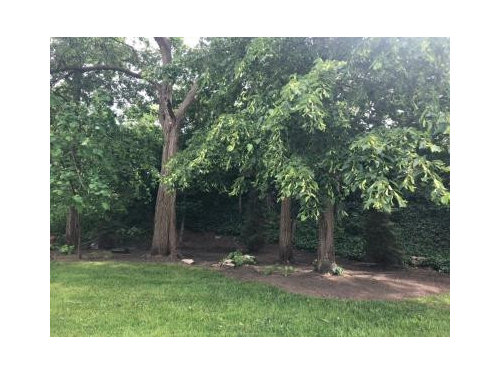


We own a vacant lot next to our garage. It is backed by property owned by the Ohio Dept of Transportation (so it isn't maintained well unless I do it myself). We try to plant on our property to distract from the view of ODOT property. A fence is out because of cost and maintenance so we prefer greenery. We recently realized that this property has a CONCRETE road underneath it! I was digging and start unearthing large junks of broken concrete! (concrete from pre 1950's) So this explains why EVERYTHING (hydrangeas, hemlocks, holly, Serbian spruce shrubs, arborvitae) that we planted dies! I dig very deep, pull out concrete and the plants still die. The only trees that survived (maybe unfortunately) are three Black Locust, one small Red Bud, and One massive Linden tree)...We mulched with black mulch after this pic was taken. But we want Shrubs and Evergreens!!

I need some advice. The soil is unsuitable for planting. I could pay ($$$) someone to dig up the entire area and fill back in with good soil. (I hate to see the cost for this) ....or I could start planting in very large pots. I am in Cleveland Ohio (zone 5) what about the pot idea? Would this work?

Comments (36)

  • 4 years ago

    Hav you sent some soil samples to labs to be tested?

    bathroom thanked apple_pie_order
  • 4 years ago

    Specifically a pH test.

    bathroom thanked mad_gallica (z5 Eastern NY)
  • PRO
    4 years ago
    last modified: 4 years ago

    I think your best bet is to fins an area that does not have concrete buried and is still on your property thenplanting will not be anissue and then go to your garden center to see what they say will grow where you are. I am wondering if what you are digging up is concrete or asphalt/ If ashphalt it probably has poisined the soil. I agree a soil test for sure before doing anything else. I really cannot see potted plants doing very well in Zone 5 for more than maybe a year.

    bathroom thanked Patricia Colwell Consulting
  • 4 years ago

    There is a third alternative. Import some decent soil and construct some berms or mounds (like an informal, unstructured raised bed). This is a common method when soil conditions prove difficult to work with.

    But I also agree that a professional soil test should call out exactly what the issue is and how to correct, if possible. I too suspect pH is significantly off.

    bathroom thanked gardengal48 (PNW Z8/9)
  • 4 years ago

    does that picture represent what the space looks like as a whole? I think it looks good as is. I like bare earth under trees, it reminds me of a park.

    bathroom thanked User
  • 4 years ago

    - I am pursuing professional soil samples (great idea, thank you)

    - berms might work...but I dug a "trench" and filled it with miracle grow garden soil and 1/2 of the shrub is still dying (I realize it is the inverse of a berm but isn't it sort of the same concept?)

    - the picture is a good representation of the SUMMER but the winter it is just bare trees and not very "pretty"....

    - thanks for the info on the pots. Crumbs.

  • 4 years ago

    Are you trying to plant under the trees where the bare soil is? Maybe the shrubs don't like being under the trees. I'd put in some evergreen ground cover. Maybe pachysandra.


    bathroom thanked partim
  • 4 years ago

    Where exactly is this old cement roadbed you are trying to plant on top of in this picture. Those large trees with the cleared ground underneath are not growing on top of an old roadbed and still standing at that size.

    Are you trying to plant evergreen shrubs under these trees? That may be the problem more than concrete chunks in the soil.

    bathroom thanked Christopher CNC
  • 4 years ago

    I think leafless trees look pretty in the winter, and the grass and ivy provide plenty of green all around it. I feel like you're seeing a problem where there is not one.

    bathroom thanked User
  • 4 years ago

    Guess you got to be close to it.. but thank you for saying it does not look too bad

  • 4 years ago
    last modified: 4 years ago

    Christopher....Everywhere I dig (If I dig deeply)..I pull out chunks of about 5" thick.....sort of pretty so we used it as an three tiered wall edging where the Ohio Dept of Transportation land starts. I have no clue why those trees grew....there were some small plum trees that the original owners had there. And both plum trees died. So your question is good but I know everything dies. Not instantly but in a year ....when I dug out the HOLLY's they thrived in their new location. I plant on the edge and make sure there aren't any roots (I cut them out at least 1 ft radius around the new plant root ball. I started removing the soil (I used to just amend it) and replacing with fresh bagged soil. Hosta grows though... I am going to pursue soil testing...maybe something else is going on too.

  • 4 years ago

    Kathleen, I know what a DOT owned roadside looks like so I get the idea of what you are wanting to hide. Who knows what you might find in urban DOT land? I just don't know what the best solution is because there is not enough information to go on.

    bathroom thanked Christopher CNC
  • 4 years ago

    i guess I REALLY need soil samples

  • 4 years ago
    last modified: 4 years ago

    wow that would be awesome if someone else could provide some of the funding to get it fixed!!!! i had better get professional soil,sampling,done....i will call the city arborist for recommendations

  • 4 years ago

    The issue is not the concrete but the Black Locust tree. A Black Locust is known a The Tree Killer. It has high nitrogen and other issues that kill plants around it. It is very successful planted around other nuts trees like the Chestnut as they have the same biological needs and work off each other. It is also so invasive that it has been removed from garden centres in many parts of the country. It has no problems growing on lumps of concrete.
    You need to get it out of there which is a tough task. They have very strong roots and I think you need a professional for the job.
    You need

  • 4 years ago

    Whoa. I wouldnt jump to that conclusion about black locust. i have many in my cultivated landscape. i find their canopies allow much light to filter through, their trunks majestic and branching gothic, with no apparent over competition for water or nutrients by their roots.

  • 4 years ago

    ^^^ Agree. Studies on their potential allelopathic properties have determined those effects are very hit or miss and generally site-specific. In short, not a real concern. And its ability to fix nitrogen is considered a benefit to other plantings, not a deterrent. There are a fair number of trees that are nitrogen fixers and they are often used to offset ongoing N soil deficiencies.

  • 4 years ago

    Black Walnut is the tree with the bad allelopathic reputation, and it is real.

  • 4 years ago

    So I do study these things and I don’t make up stuff to offend a tree. Please take the time to research about them and you would clearly understand that concrete has nothing to do with the death of close plants.

  • 4 years ago
    last modified: 4 years ago

    ^^^ You are aware that you are communicating with several professional horticulturists who have done considerable research and your claims are just not substantiated? OTOH, soil pH - on which concrete (and especially old concrete) can have a substantial effect - can and does cause the death of plants that can be sensitive to improper levels.

    btw, allelopathic properties, even if they were found to have more than a minimal impact, only affect certain plants, not everything that grows within the dripline. Even the black walnut, which is considered one of the most allelopathic of trees, has a rather limited sensitive subject base. Robinia doesn't even come close to that effect!

  • 4 years ago

    With Black Walnut you can see the allelopathic effect in just a general stunting and lack of vigor in shrubs. It's never outright death and easy enough to live with on large properties.

  • 4 years ago
    last modified: 4 years ago

    It looks nice to this untrained eye.

    Maybe the area just under the tree is bare because it is not getting any sun?

    If you have an area that gets sun and you want to grow something, what about :

    Raised beds? Green houses on raised beds?

    I have absolutely no idea what you can grow in your climate, and if you want to invest that kind of work for what you can grow.

    People grow things in Alaska, so you should be able to grow something in Ohio.

  • 4 years ago

    Owned by DOT ... you may have "poison" in the ground (all the fluids used in vehicles and equipment) as well as concrete.

    Since it appears there is no fence at the property line, consider starting your project by creating a dual fence -- an actual fence on the line (budget and code permitting) and a green fence in front of that with shrubs that keep their leaves and look good year round. Does Holly or Aucuba grow well where you are?

    Do you like exercise and/or can you rent a small back hoe or ditch digger or could you hire someone to dig a ditch at least several feet wide and a couple feet deep at your property line? (Dig even deeper if you need to get out all the concrete get out all the concrete and whatever else you find). Then replace at least that much dirt to get your view and privacy.

    Not a pro and not a lawyer but just some thoughts:

    Try the nice, requesting help, approach first.

    Take some of the removed dirt from several parts of the area of dirt you remove and some other dirt samples from that yard adjoining DOT property) in separate small plastic containers with screw on lids (dollar tree) (keeping records as to from where you took it.

    Then take that soil to your county extension agent or to a state college with an agriculture department and see if they can help you get the soil evaluated to see if there is more poison. If there is, the DOT may be motivated to bear cost of removing it via either state or federal EPA helping you nudge them in that direction. Local media might be used if there is a delay in an appropriate state response to finding poison in the soil adjoining the state owned property.

    bathroom thanked suezbell
  • 4 years ago

    I am certainly not a professional but have a property of clay soil. Rock hard and difficult to penetrate through. I have had luck with skip laurels an evergreen) that grow 10-14’ high and 4-5’ depth. And also rose-a-Sharon’s that weed plant their seeds (but they are bare in the winter). Don’t give up! U will find something!

  • 4 years ago

    I agree that you should first have the soil tested. Then do your research. You could use very large frost-proof pots for some plantings - but the plantings would have to be 1 to 2 zones hardier than your Zone 5.

  • 4 years ago

    Apparently big problems here, and many good suggestions. Getting the soil tested is easy and should be your first step. However, nothing is going to grow under these big trees - just not enough sun, and the trees are sucking all water and nutrients. Just let the leaves fall and add bark mulch for a natural look. Seasonally you could cluster some potted ferns and hostas. I am in Zone 9 (SE coast) and nothing grows under our big oak trees either. I have a very old crape myrtle and nothing grows there either except shade plants like ferns and lyriope, and the surface roots make it very difficult to dig. I do like the idea of containers or raised beds. Draw out a site plan of the area, with existing trees to help you decide where the planters should go . . . to contrast to the bare limbs in winter, select evergreen species.

  • 4 years ago

    "You could use very large frost-proof pots for some plantings - but the plantings would have to be 1 to 2 zones hardier than your Zone 5."

    ^^^ A helpful guideline but no guarantee. Plants grown in containers left outside over winter are far more vulnerable to cold damage than the same plant grown in the ground. Roots are the most sensitive and even a zone 3 plant could experience severe damage in a zone 5 winter. What you could find that might work would be very limited in choice.

    btw, LOTS of plant can grow under the canopy of big trees, even big evergreens. It's an issue I deal with constantly as a designer as I live in the giant tree universe of the Pacific Northwest :-)) Enormous native trees are everywhere and most with very happily growing underplantings. You just have to make some good choices on drought and shade tolerant plants suited to your area.

    bathroom thanked gardengal48 (PNW Z8/9)
  • 4 years ago

    It looks beautiful as is, to me.

    bathroom thanked rancherogrl
  • 4 years ago
    last modified: 4 years ago

    Wow thank you EVERYONE!!!....interesting about the black locust being a tree killer! arborist never mentioned that....ODOT has some really jerky managers (and I woukd LOVE to hold them accountable) ...recently I was told (after i cleaned their property because it becomes an eyesore) that they maintain to THEIR standards and NOT my standards...so trash thrown or blown on to their property is fine with them.....and they said I was trespassing AND all the hollies i planted died....hydrangea died....quince died....I have two green giants that might make it but they are still small.......I think the first thing is soil samples....and if it isnt the soil I will have to plant things compatible with locust...or take down those trees

  • 4 years ago

    ".interesting about the black locust being a tree killer! arborist never mentioned that."


    Please!! Do your own research. The arborist never mentioned it because it is simply not true!

    bathroom thanked gardengal48 (PNW Z8/9)
  • 4 years ago
    last modified: 4 years ago

    That is a lot of dead plants for some cement buried in the soil. Plants grow fine in parking lots all over the place. Something else has gone wrong here. It has nothing to do with the Black Locust.

    bathroom thanked Christopher CNC
  • 4 years ago

    It doesn't sound much more suspicious than high pH from the concrete, and poor drainage from Ohio clay and buried concrete. Particularly if the plants were planted in amended soil so the bathtub effect is in full swing.


    bathroom thanked mad_gallica (z5 Eastern NY)
  • 4 years ago
    last modified: 4 years ago

    lamium will grow under there, and lambs ear. i agree with the idea of a high berm, a raised naturally sloping bed. it will settle, go to 12 inches deep if possible.

    bathroom thanked mollyds1
  • 4 years ago

    I have host's planted under black locust trees and they do very well. I agree with the berm idea.

    bathroom thanked Lorna Spaulding
  • 4 years ago

    Thank you everyone. 7.4 PH, Possible issue from Black Locust Trees, possible compacted soil from the removal of a small building adjacent whose driveway is buried under my yard (darn!), So I am going to a local garden center for more advice regarding hiring someone to pull up the concrete, till the soil (at least where I would like to plant, going to use elemental sulfur (I realize this is slow acting), amend planting soil with sulphate, use 5-10-10 and 0-46-0 fertilizer on entire area....AND BUY SOME BIG POTS (for the short term!) Everyone was SO HELPFUL....Thank you again!