

Indoor humidity much lower than outside - in MN ?
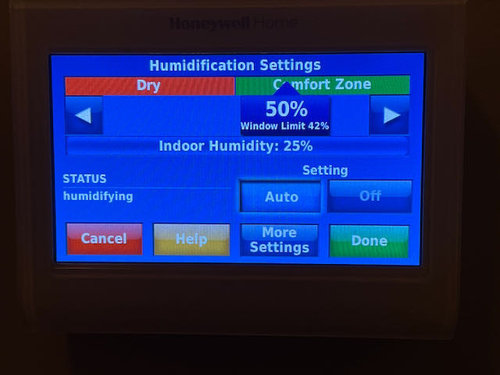
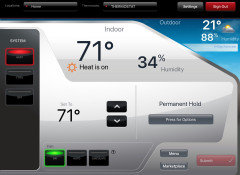
Our indoor humidity has been around 20-25% (68-70°f) for the past several days while outside has been 70% (5-25°f) or more. I think actual moisture content is about the same. Humidifiers both seem to be functioning correctly and have theoretically be attempting to raise the inside humidity - but unsuccesfully. All zones have fans set to ON so it should be humidifying constantly?
Thoughts on this? Too much air exchange? Something else?
Thanks,
Comments (35)
 4 years agolast modified: 4 years ago
Have you computed what the relative humidity result would be when you take the outdoor air as stated and warm it to 68-70 degrees? Would it be 25% as shown?
If the indoor and outdoor stats are accurate (I'd double check with a different measuring device), then what you have indoors is outdoor air unaffected by the humidifier. If the humidifier is working and you are doing some kind of "air exchange", then assuming there's isn't a significant rate of structural leakage, one possibility is that you're exhausting indoor air and bringing in outdoor air at a rate faster than the humidifiers can keep up with. Try turning off the "air exchange" and check humidity level indoors after a good wait, maybe 8 hours later or longer. If it increases above 25%, then you have a potential culprit.
I'm a homeowner, this is my guess.
 PRO4 years ago
I'll second Elmer's guess.
If you heat air that's 30 F and 70% relative humidity to 70 F you drop the relative humidity to around 25% which is what the OP has described as the properties of the indoor air. Since the indoor relative humidity isn't higher, either 1.) the humidifiers at not operating properly (is the water valved off?) or 2.) the combined air leakage rate, make-up air flow rate, and fresh air ventilation rate exceed what the humidifiers can keep up with. It's worth noting that if fresh air ventilation is provided by a HRV, there is no exchange of moisture and it's effectively a dehumidifier in winter.Related Professionals
Fort Smith General Contractors · Philadelphia General Contractors · Georgetown General Contractors · Killeen General Contractors · Kearney General Contractors · Monroe General Contractors · Liberal General Contractors · Gulfport Home Remodeling · Galveston Home Remodeling · Utica Home Remodeling · Kingman Home Remodeling · Alexandria Bathroom Remodelers · Spring Bathroom Remodelers · Manchester Bathroom Remodelers · San Jose Bathroom Remodelersopaone
Original Author4 years agoYes, actual moisture content inside and out is about the same.
Humidifiers both appear to be working properly. Both have hot water going to them, water is running down the panels in both, both seem to have good airflow through them.
I would think humidifiers should be able to raise the inside humidity / moisture content above outside though, especiallly given how closed/sealed the house is during winter.
If not, then is it an issue of humidifiers being undersized?
 4 years agolast modified: 4 years ago
basic speculation could be the wick is caked over with minerals and the water is just running over the mineralized paper and out the bottom, with no or little evaporation. I'd address the most common causes first before moving up the troubleshooting ladder as suspect so What type of humidifier do you have and when was the paper wick last replaced?
Do you even have a heat recovery ventilator and was the humidity fine last year? If so it seems strange to suggest something has changed since last year but this would be higher on the troubleshooting ladder and plausible.
 4 years ago
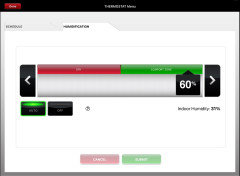
Ugh! I have the same interface since we got our new furnace! I have it cranked all the way up and it still stays low. Damn smart appliances are too smart for their own damn good. I’ve been so sick from the dry air. I’m going to have to get a room humidifier to keep near the bed, I think.
 PRO4 years ago
The term “relative humidity” is a tricky thing to explain. “Relative” refers to how much moisture the air can hold, relative to it’s temperature. Air is made up of particles and the space between.
That's why I just simply call it: Humidity.
But here on "Fantasy Island" - we can't help ourselves.
My job here as "host" as in I am your host on Fantasy Island... well in a free world, I let you decide as any decision you make will most certainly have consequences.
Sometimes good, sometimes not so good. When it comes to HVAC, you're never done while on this rock.
You can take the red pill and chase rabbits. Or you can take the blue pill and pretend. That's essentially what a forum board provides you with in subjects such as this.
I live outside the Matrix. LOL.- PRO4 years ago
"The term “relative humidity” is a tricky thing to explain. “Relative” refers to how much moisture the air can hold, relative to it’s temperature."
It's not all that tricky. And if he understood either the term "relative humidity" or the physics behind it, Ray would have clarified that "relative humidity" is a measure, expressed as a percent, of how much moisture there is in air compared with what it can hold (saturation) at that same temperature. 50% relative humidity at a particular temperature means the air is holding half of what it could hold at that temperature if it were fully saturated.
Every profession has its nomenclature. In this case, it comes from 9th grade earth science class. The terms "relative humidity," "specific humidity" and "absolute humidity" are used by HVAC professionals, but they are not interchangeable. HVAC professionals don't lump them together. - 4 years ago
Wow, I thought some of the interior designers here were some of the biggest insufferable jackasses. I guess I’ve been visiting the wrong topics. At least you dont couch your contempt in catty remarks pretending to be helpful. Brutal honesty is so rare these days.
opaone
Original Author4 years ago@outpaientzero, We have two HVAC systems. Each has an Aprilaire 600M humidifier. Panels were replaced about 3 weeks ago so both have new panels. Each system includes a 200 CFM ERV (189 CFM & 192 CFM actual). I believe ERV's run 10-20 minutes per hour or based on CO2 levels. They would have run a lot Christmas eve & day based on occupancy and CO2 but since then should have only been running about 10 mins / hr.
- PRO4 years ago
It's not all that tricky. And if he understood either the term "relative humidity" or the physics behind it, Ray would have clarified that "relative humidity" is a measure, expressed as a percent, of how much moisture there is in air..
yeah it's not tricky because it's invisible. How much moisture there is in air... how much air?, you go to a different room the measure is different? Yes, because often times the temperature is different as well.
So just saying you measure 50% RH in the house, you assume all the air in the house is 50%? Sure go ahead this is Fantasy Island / Matrix which ever you prefer. It's not that tricky. That's why we're here discussing these things in the Matrix rather than investigating these things in person.
Rabbit holes aren't tricky to a rabbit. Go for it. LOL.
Ray might have clarified if he was a teacher, but I am here to do it for you... not teach you how.
Roles remember? (to the builder: "contractual obligations") It's 2022, this still hasn't changed. If you want to learn? Plunk your money down at a trade school... the internet isn't the place to learn these things.
I live in a very humid climate in Katy, Tx I work in a profession that deals with these things on a regular basis... yet I don't understand it?
The Matrix also allows you to think whatever you want. There's little I can do to change your mind as that would require me to pull you out of the Matrix. Some people are better off staying there. LOL. - PRO4 years ago
"Ray might have clarified if he was a teacher, but I am here to do it for you... not teach you how."
Pros on houzz.com contribute knowledge and professional expertise which should help posters remedy their problem--or at least provide some direction for further investigative work. Sharing those is "teaching," Ray. If you're unwilling or unable to do that, I wonder why you post anything on houzz.com - PRO4 years ago
Charles,
If your opinion is what it is and my opinion is what it is... how many times we have had similar disagreements and you somehow think that your opinion now is going to change my opinion?
Freedom of choice. What is freedom really?
If you don't like what I have to say you have the freedom to ignore it, trying to change me? Like you've had any influence on me thus far? Except to provide some rhetoric to fuel various discussions or arguments if you want to argue semantics? You're clever to come up with new arguments of which I don't mind. I am always up to a challenge... because unless you're a magician there is two sides to every coin. If you're heads, I'm tails... if you're tails, I'm heads. The ying vs the yang.
If I were to side with your opinion the world would be out of balance. Major destruction would ensue, chaos! LOL.
I wonder why you post anything on houzz.com too? For me it's mostly something to do while I drink my morning coffee. HVAC is what I do professionally 7 days a week. I do 'occasionally' get people who find me from here.
I've asked myself the same thing about you btw, why does Charles Ross need to post anything on an HVAC forum board. Most places builders can't keep up with demand of new homes... so why Charles?
It's early 2022, not to late for you to come to some resolution. LOL. - 4 years agolast modified: 4 years ago
Opaone, if the humiditiers are working with new wicks and no restrictions in the small inline strainer in the water solenoid, and with good air flow Then attention to the ERV's would be the next step.
ERV's require maintenance and include cleaning the filters and core. If the outside air inlet filter plugs up air and moisture will exit the home and not exchanged. This would cause high negative pressure and pull in cold air through any source possible including exhaust fans, the other ERV, air leaks and a large inrush through doors when opened. Another problem that would do the same thing as above is ice blockage in the core.
With just one ERV not working properly it would still cause the pressure inside to become negative relative to the outside.
- 4 years ago
"I do 'occasionally' get people who find me from here."
I'm probably not the only one to find this comment shocking. - PRO4 years ago
I'm probably not the only one to find this comment shocking.
The reason? I tell it like it is. People want to be told what they want to hear, not the truth.
Money gets in the way of rational decision making. People would rather post comments on here of someone not doing their job whether it be a new home build problem or post questions that they can argue over semantics of what a HVAC tech is saying vs what they think is right or wrong.
Or they are here to do it themselves. Another big shocker?
People from the outside looking in, like to say: Hey, HVAC is easy. I'm a home owner and I could do it. Yet, you never go to even half the places I must go on any given day...
Pay vs. Free
People love to waste their time for a high pressure sales event because it's "free". Or to spend days if not weeks or more trying to fix it themselves. How many times in my career have I gone to a system in pieces? Yeah, let's not think about that even for one second. This job is easy anyone can do it, remember?
How many different brands I've put back together? Let's not consider the knowledge required to do such things. Today we get our knowledge from the internet of things, tik tok, you tube and social media. You're a dummy if you spend money on a college degree. People with college debt are shunned as being fools. Let's not base anything on facts only opinion we can't let questionable facts get in the way of anything.
I don't do free. There in, lies the rub. The techs that work for free are forced to do it by men who sit behind desks and bark orders. That all changed for me over 14 years ago.
So because I don't do free? how much nonsense does that cut me out of?
Considerable. I know how to solve your problem. If your spincter muscle is clamping over your wallet -- I don't perform those kinds of surgeries. LOL.
Yeah another shocker I am sure... spelled out for clarity on a board that would rather skirt these kinds of issues than own them. opaone
Original Author4 years ago"With just one ERV not working properly it would still cause the pressure inside to become negative relative to the outside."
??- PRO4 years ago
Not likely. ERVs are designed with balanced air flows : fresh air intake = exhaust. Any problems with the enthalpic core would affect transfer of moisture, but shouldn't affect air flow or depressurize the home.
- 4 years agolast modified: 4 years ago
"With just one ERV not working properly it would still cause the pressure inside to become negative relative to the outside."
2 ERVS. One is balanced but if the other has a blocked fresh air inlet from ice or dirty filter it is not balanced and will cause negative pressurize in the house. It's simple math Tim, and I'm rather disappointed with your comment.
With one ERV if you remove 200 Cfm's and add 200 it's balanced. But between the two ERV's if you remove 400 and only add only 200 it is not balanced, it will be in a vacuum (negative pressure) and suck in air any place it can. .
400 in and 400 out ='s balanced. 200 in and 400 out ='s unbalanced.
Put a vacuum pump on a tank and evacuate 400 Cfm,s per minute, and with a air pump add only 200 cfm's per minute. You will get a vacuum in the tank, you're pulling out more than put in. If you pump in 400 cfm's it would be balanced, and if you pumped in 401 cfm.s it would be pressurized.
Take a full glass water and remove 4 oz's of water then add 2 oz's of water. it doesn't balance out and the glass no longer stays full. Keep taking 4 oz's out and adding 2 and the glass becomes empty.
400 in - 400 out ='s zero. (balanced) 200 in - 400 out ='s negative 200. (Unbalanced)
- PRO4 years ago
We'd need to know more information about how the ERV is installed and the leakage rate of the OP's home is before concluding that an ERV which operates only 10 minutes/hr. would depressurize it. I don't think it's likely. It would be disappointing if an HVAC contractor in a cold climate installed any intake or vent so it could get blocked by snow. Recommended practice for vents in those climate zones is either in a soffit or a wall, not a roof.
- 4 years agolast modified: 4 years ago
Tim I believe you don't understand what an ERV is, how it works and confusing it with a HRV. A ERV exchanges heat and moisture and the fresh air intake can freeze up the core in cold climates. They're equipped with a defrost element and defrost cycle when the temperatures get into the 20's. They also have fresh air intake filters which needs cleaned a couple times a year. Have the filters been maintained?
The ERV's need examined or even shut off as Elmer said in this remote troubleshooting process to continue forward.
"I believe ERV's run 10-20 minutes per hour or based on CO2 levels." Tim, you said only 10 minutes when even the OP isn't sure, so why did you you emphasize only ten minutes? I've spent a a good part of my life troubleshooting problems for others and very proficient doing so, and won't dismiss something as unlikely just because of this or that. I troubleshoot, I don't shotgun hoping to hit the problem with replacement parts.
- PRO4 years ago
Kevin,
I am familiar with ERVs. It's what we install in our climate zone. Thankfully, freeze ups are not as likely here. "Not likely" doesn't dismiss an ERV air flow imbalance as a possibility, but suggests it's a lower probability than other causes. Finding out the root cause is what troubleshooting is all about. Doing that efficiently starts with the most probable cause and works down to the least.
Most homes--McMansions being the notable exception--require fresh air make up around 50 cfm. That's not much. It's comparable to the rating of a cheap-o bath exhaust fan--the kind that might get installed in a Powder Room of an entry-level townhouse. Whole-house ERVs typically have flowrates on the same order as the OP's-- around 150-200 cfm. With two 200 cfm ERVs, the fresh air make up requirement in the OP's home would get met in less than 8 minutes of operating time/hr., so 10 minutes/hour is, I think, a reasonable assumption of run time for on/off control based on time. The run time can, of course, be longer, but than that comes with an energy penalty.
It's easy enough to determine whether the ERVs are contributing to the issue by simply turning them off. Elmer suggested that early in this thread and I seconded it. - 4 years agolast modified: 4 years ago
@opaone I’m not sure if this will help in your case, but we just replaced the wick in our Aprilaire and in the span of an hour or so went from 29% to 33%, and cooking tonight would not account for it. It was not particularly old or seemed too crusty, but apparently it was. Hopefully it goes up a few more points because I’ve been miserable. I think our water is just that hard that we need to be extra diligent. (We have some of the hardest water in the country. It’s brutal on our water heaters. We have to buy them by the gross, lol!) I’m even starting to feel a little better already.

opaone
Original Author4 years agolast modified: 4 years agoThe ERV filters are cleaned each spring and fall (along w/ furnace filters (MERV-13) replaced, dehumidifier filters cleaned, humidifier panels replaced, batteries in remote sensors and thermostats replaced, etc) . I checked and both are curretly quite clean.
We have CO2 monitors and high CO2 levels will trigger one or both ERV's to ON. The only time it's triggered recently was Christmas Eve when it was ON from 6:14p - 11:04p and then several times overnight until 7:13a Christmas morn. All due to high occupancy that drove CO2 levels up.
Otherwise they run based on the 'Automatic' settings in the Honeywall Zone Controller. I've been told 10 mins / hr and 20 mins, both by our installer and Honewell so it's a bit of a ?
One ERV's fresh air inlet is high enough to avoid snow drifts. The other does have potential for snow drift blockage (unlikely but possible) and has a pressure diff monitor to alert if there's a pressure diff between IN and OUT.
ERV's are locked out for high outside temp and high outside RH. I'll have to check to see what these are set to.
I've not noticed core freeze up, even during last year's -34°f run. So defrost does appear to be working.
- PRO4 years ago
Are you sure you have energy-recovery ventilators (ERVs) and not heat-recovery ventilators? HRVs are normally the choice for colder climate zones and the lockout for high outdoor relative humidity makes me think that's what you have.
opaone
Original Author4 years agoThey are Braun ERV200's. They'd originally and correctly spec'd HRV's given the house size and permenant occupancy but changed them to ERV's when they realized the occupancy load with entertaining and overnite guests.
ERV's are quite common here and based on occupancy / interior volume. High occupancy = ERV, low occupancy = HRV.
- PRO4 years ago
I think you got some bad information regarding when to use a HRV vs. ERV.
Fresh air make up systems should be designed to meet the fresh air make up needs of a particular home. The fresh air make-up rate is a function of the volume of the home's interior, the number of occupants and the leakage rate determined from a blower door test. A fresh air make up system with energy-recovery capabilities could include a heat-recovery ventilator (HRV) or an energy-recovery ventilator (ERV.) A larger home or number of occupants doesn't make one or the other inappropriate (larger home or higher occupancy = higher make-up air flow rate,) but your climate zone might.
The difference between an HRV and ERV is the ability to transfer moisture to/from the leaving air stream. In our (coastal VA) climate zone that allows us to dehumidify incoming fresh air in the summer by transferring some of its moisture content to the exhaust stream and to humidify incoming fresh air in winter by transferring some of the moisture content from the exhaust stream to the incoming air. The concern in cold climate zones is the potential for damage to the ERV's core, depending on its construction.
Fresh air make-up requirements for a given home can change with occupancy, but not seasonally unless your ventilation strategy includes opening windows for ventilation. ERVs are fine dealing with hot, humid conditions and should not require a lockout during periods of high temps or high humidity. If they did, they wouldn't operate most of the year in my climate zone. I recommend you consult with a local HERS rater or someone from your utility company that is knowledgeable in energy-recovery ventilation systems to take a look at what you have and the control strategy. opaone
Original Author4 years agolast modified: 4 years ago@Charles Ross Homes, you seem to be confusing two very different functions?
Ventilation is the exchange of bad air (high CO2 and various contaminants) for fresh air (low CO2 and hopefully fewer contaminants). This is done with an ERV or HRV and is a balanced system.
Make Up Air or MUA is bringing in outside air to 'make up' for air removed by a range hood, clothes dryer, bath exhaust, etc. The MUA itself is an unbalanced one-way system of ONLY bringing air in to the house. When combined with the exhausting appliance it is balanced.
MUA may accomplish some bit of ventilation function when running but is inefficient in doing so.
I forgot to include this earlier but our house is 1.3 ACH50 ResNet which is about 1.9 ACH50 International Std.
- PRO4 years ago
I'm using the term "make-up air" in the context of a fresh air ventilation system which is what is being discussed. The air exhausted by a fresh air ventilation system (ERV or HRV) could be referred to as exhaust air or the leaving air stream; the air introduced by the same fresh air system is make-up air which "makes up" for the system's exhaust air flow. You can use the term "intake air," if you like. Same thing. Both flows should be balanced at start up following the manufacturer's installation instructions.
Make-up air for a fresh air ventilation system is not a substitute, nor am I confusing it with make-up air that may be needed to deal with high volume exhausts such as range hoods. Those are typically dealt with using a dedicated (stand-alone) make-up air system, the controls of which are integrated with the range hood. - 4 years ago
"The problem is that consumers really don't know if their heat exchanger has been damaged by water or ice. When the ERV core is damaged, it may not be evident. Deterioration of the ERV core leads to leakage and a loss of efficiency and airflow - another major problem." Source: Should ERVs be Installed in Northern Climates?
ERV's are not recommended for northern climates tim, right but I don't understand why you recommend consulting a HERS rater or utility company. How would this advice address and fix the problem the OP has now?
unplug the things like Elmer suggested but I still suggest cleaning the inline filter in the solenoid valve outlet on the humidifiers, and the water supply tube going to the wicks for mineral build up. It's not an unusual request and part of the preventive maintenance recommended by the manufacturer.
- 4 years ago
Opaone, I don’t pretend to know anything about ERVs, etc, but you guys are really in the weeds about it all. Why are you quibbling over air when your question was about humidity? Per your original questions… you wondered how it could be 70% H outside, but only 25% H inside. The percentage refers to the amount of humidity the air can hold at a certain temperature. Given that frigid air can basically hold zero water vapor, 70% of zero is zero. So, back to your aprilaire… what have you done for it? Have you tried changing the wick? I did that last night and my humidity instantly went up! Today it is at 34%. Not as high as I like it, but much better. I also spoke to my furnace person and she said if we need to, there may be a way to rewire the humidistat to bypass the outdoor sensor, depending on which model it is. That way I can manually toggle it higher. I’m going to wait on that option since this is an improvement. Just trying to give you some workable options. Hope it helps.
- PRO4 years ago
Kevin,
I agree that the humidifiers are--still-- the mostly likely culprit. That's where I'd look first. Turning off the ERVs is an easy and fast way to take them out of the equation as Elmer suggested early on. If the indoor relative humidity doesn't increase with them turned off, you've either got one heck of an air infiltration (leakage) rate, which is not likely for a recently completed home built to code, or the humidifiers aren't getting the job done. The model humidifiers the OP has are each rated for 17 gal/day so I don't think they're undersized. That said, for a sophisticated HVAC system like the OP's, I'd would have recommended steam humidifiers over the ones they have because they are more reliable in my experience and don't harbor bacteria growth.
The control strategy for the ERV doesn't seem appropriate--specifically, the lock out If it's indeed locked out during periods of high humidity or temperature--which would be appropriate for an HRV and not for an ERV. I'm not convinced the installation contractor knows what they're doing and the need for a second opinion from someone who can put both eyes and hands on the system is indicated, at least in my opinion. A HERS rater or an expert from the OP's utility company is a good place to start. If they aren't, either one should be able to refer the OP to someone who is. - 4 years ago
Well, at least we’re back on topic, but my suggestion only costs about $20 give or take. Might want to start with basics before jumping into a pro visit 😏







Elmer J Fudd