Software
Houzz Logo Print
webuser_152201452

Help with drooping bird of paradise

4 years ago
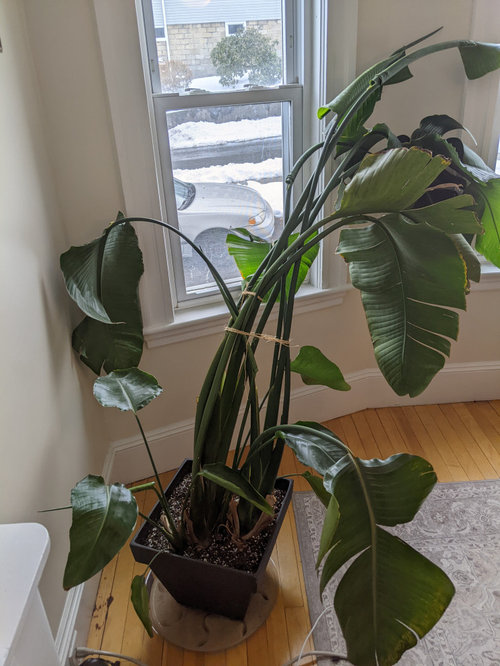

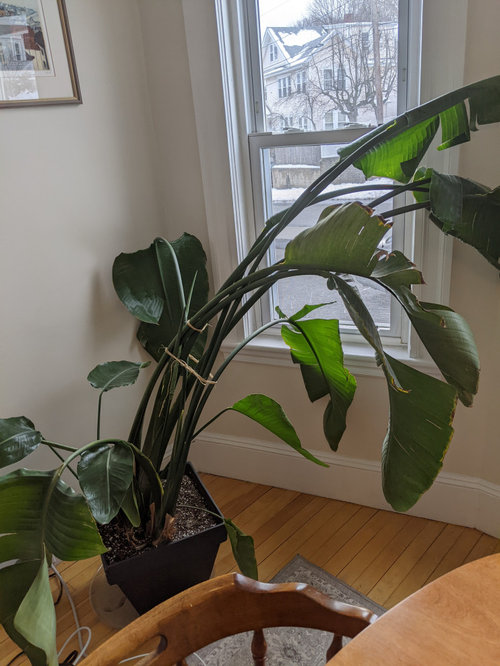
I've had a bird of paradise palm for about 6 years now. It still grows 3-4 leaves per grow season, but it's been developing a droop to one side, which I've tried to contain by tying it up. Old and new grown has been leaning in the same direction. Also, some of the new leaves have come out with strange wrinkles in them that don't go away.


I haven't repotted this in probably 3 years, which may be part of the problem. I'm wondering if the plant can be salvaged or if i should try to cut it back and try again. I'd like to rehab it, but it no longer looks good and takes up too much footprint.


Other information that may help - I live in New England, the plant lives in a very bright South-facing window and i'm fairly confident it hasn't been overwatered.


Comments (9)

  • PRO
    4 years ago
    last modified: 4 years ago

    It needs a lot bigger pot it needs to be turned often to get the stalks to grow staright and when you transpalnt it there will be some shock to the plant since it is proably hugely pot bound . You could even try cutting some of those roots that go around and around in the pot.They like moist soil at the roots and so letting the soil dry for about 2 " down then watering is best . Full sun where you live and that means a much bigger window than what you show . BTW the sun is much lower in the sky in the winter so sometimes the sun does not get into the window depending on what is outside

  • 4 years ago

    Thanks so much Patricia, great info! Regarding the window, do you mean that even with southern exposure, my windows aren't big enough to give it "full sun"?

  • PRO
    4 years ago

    Exactly in the winter the sun is not a big source of light fo plants that need a lot of light so maybe try a grow light for the winter but for sure do the other things I mentioned to see if they help.

  • 4 years ago

    get a trivet on wheels.. so you can turn it 180 degrees.. every time you water it ... that how to get even growth ...


    https://duckduckgo.com/?t=ffab&q=palnt+trivet+with+wheels&ia=web


    and it would probably love being outside in full bright shade in the summer ... when you do that ... they can handle a lot less light in winter .. when they arent that active anyway ...


    the stalks do look etoliated ... stretched somewhat.. telling you its lacking the light it needs ...


    good luck wrestling that beast into a new pot.. and dont forget.. the most important thing in the pot.. is a good media... not the plant ... we might have opinions on what is good... lol .. in fact.. we argue about it all the time ... lol....


    and when you get new media.. learn how to water it.. the schedule will probably be different that it was with the rotten old media ....


    ken


  • 4 years ago

    Thank you Ken! Great advice. Do you think it's a good idea to re-pot in winter given that it's in some level of distress, or should I wait until spring?

  • 4 years ago

    Hi Tapla,


    Wow! Thank you for the thoughtful response. I appreciate you starting with the fundamentals - I learned more than I anticipated.


    I have a followup question, if you don't mind: does 'over- watering' refer to having roots that are chronically saturated, or is it about frequency (I.e. watering 'in sips' ) which causes salt build up?


    Also - would you recommend some periodic flush of root systems for most plants, or just ones in distress?


  • 4 years ago

    I like rotating it.

    Also, it might not be a bad idea to stake it.


  • 4 years ago

    Does 'over- watering' refer to having roots that are chronically saturated, or is it about frequency (I.e. watering 'in sips' ) which causes salt build up? Over-watering can be a 1-time thing, or a grower with a heavy hand on the watering can can turn it into a chronic issue. For a huge % of the plants we grow as houseplants, the medium that offers plants the best opportunity to maximize realization of their genetic potential will hold its water A) in a microscopically thin layer on the surface of soil particles, within the pores of ingredients that offer open-cell internal porosity (which means they act like a sponge), at the interface where soil particles contact each other, and as water in vapor form between soil particles. Broadly speaking, the water that so often proves to be a limiting factor is that held in the spaces/pores between soil particles. This annoying water table is technically referred to as 'perched water' or a 'perched water table', however, since many growers don't quite understand what physical properties drive water retention, the synonym of 'excess water' is often used to avoid confusion.

    Watering in sips brings it's own issue, i.e., it ensures that dissolved solids/salts in tap water and fertilizer solutions are left behind to accumulate as water continues to evaporate from the medium. This leads to 2 issues. 1) A high level of salt in the medium, which limits a plant's ability to take up and move water (and the nutrients dissolved therein) efficiently, and often leads to die of thirst even while roots are awash in a sea of plenty. 2) Salts build-ups also tend to seriously skew the level of nutrients in the grow medium/ soil solution. One of the primary goals of supplemental nutrition is to make sure the ratio of nutrients, each to the others, is appropriate. When the ratio is such that certain nutrients are available in excess of what is essential, it can limit the plant's ability to take up other nutrients. For instance, an excess of magnesium can limit uptake of calcium, and an excess of phosphorous can limit uptake of calcium, potassium, iron, copper, and zinc, so those growers who use 'bloombooster' fertilizers for containerized plants are not doing their plants a favor by providing as much as 13X as much P as a plant can/will use.

    The ideal way to avoid salt build-ups is by using a high porosity fast-draining medium and flushing it regularly. How often it should be flushed depends on your watering habits, the aeration/drainage characteristics of the grow medium, the ratio of your fertilizer components, and what is dissolved in your tapwater. More often than not it will have a lot of (bi)carbonates in it, which should be flushed asap so the accumulation can't raise pH out of a favorable zone.

    Also - would you recommend some periodic flush of root systems for most plants, or just ones in distress? For anyone trying to offer the best opportunities for their plants to realize their potential, regular flushing of the soil is essential for the reasons already outlined. In summer, all my plants are outdoors and get watered directly from the garden hose. I water slowly until water flows freely from from the drain hole every time I water. For indoor plants, I also fertilize at a low rate at every watering ...... during the winter ...... all winter long ...... flushing the soil with a weak fertigation solution to prevent the ratio of nutrients in the soil solution from becoming skewed. The water collects in collection saucers or trays and is then allowed to evaporate. All plants are sitting well above the effluent that exits drain holes so what is flushes out has no pathway back into the soil.


    Al