Software
Houzz Logo Print
sringarika_pandey

Tips to improve clay soil?

Hello!

Its that time of the year again! I am currently planning out the spots to plant my roses in the ground and I was wondering if I should amend my soil before I plant them?. Last year, i didnt amend my soil at all and i planted them in dead summer. They did pretty well but i did notice some spots where the water was draining down a lot slower (2-3 minutes) compared to others. The faster draining spots were those where i planted the 5 gallon plants with their potting soil in the ground.

Do i need to amend my soil with something to improve drainage, reduce compactness, retain moisture, etc?

I’ve been looking at peat moss, perlite, vermiculite, soil amend, etc and its all so confusing and overwhelming! :(

Zone 9B Los Angeles.

Comments (34)

  • 4 years ago

    I'm liking this "argilla espansa", aka "expanded clay" stuff. It helps to aereate the soil very well. Also, lots of organic matter helps. Peat moss doesn't seem to produce very long-lasting effect, plus it's NOT environmentally friendly to use. I've never tried perlite or vermiculite; they are not readily available here in Italy. I also like the expanded clay because it's pretty light-weight, and probably much, much less expensive than peat moss, vermiculite or perlite. It's used in construction work, too, for places where light-weight cement is needed-mixed in with the cement in lieu of sand.

  • 4 years ago

    Check out the Organic Rose Growing forum, there is lots of information about how to tell what amendments your soil needs. I would probably start with compost and sand.

  • 4 years ago

    Lots, and lots and lots of organic matter. I’ve gardened in three states: Utah, Indiana and Georgia. All three were nothing but clay. Adding compost, soil conditioner or manure are the best ways to see improvement in your soil.

  • 4 years ago

    Applications of organic matter is the standard for improving clay soils.........MasLovesRoses has the correct approach. No sand (unless you want to make adobe!), no perlite, no expanded clay or any other non-organic amendment. What you choose for OM is up to you but compost or composted manure is a great place to start.

  • 4 years ago

    Magpie, anything besides fava beans? And just to make sure I am understanding correctly. You just sow the seeds, let the plants grown and then wack them down, leaving the copped up plants to decompose over time?

    And then those plants are gone, with no seedlings left behind but nice healthy dirt?

  • 4 years ago

    "water was draining down a lot slower (2-3 minutes) compared to others."

    If the water or pudding is gone in 2-3 minutes, then you have very good and reasonably fast drainage!! Slow drainage would be 20-30 minutes.

    @oursteelers 8B PNW, any leguminous cover crop would work. But that means any planting of roses is delayed for at least a season. These things don't work fast. And if in a very visible area, they are not a great look :-) Pretty much will resemble a fallow planting area allowed to go to weeds.

    Cover crops for west of the Cascades

  • 4 years ago

    I was thinking of doing it on the other side of the fence where I dont add fert or anything because I dont want to draw the attention of the deer and elk.

    At least 150 feet of fence with roses and clematis already planted against it, I was thinking of doing the cover crops in the bare spots, just to improve the soil.

    Thoughts?

  • 4 years ago

    Lots of high quaility compost every year works for me. Never add sand to clay. Do you want to make pots or something? Diane

  • 4 years ago
    last modified: 4 years ago

    @Diane Brakefield - this is for in-ground planting.
    Do i layer compost on top for existing plants? Or do i need to till it a few inches deep?

  • 4 years ago
    last modified: 4 years ago

    @gardengal48 (PNW Z8/9) Ah, didnt know 2-3 minutes was great! Haha! Thats really good to know and definitely eases my stress. So I will just include soil amend and manure while planting.

    How do I add manure to my already in-ground planted roses?

  • 4 years ago

    I add gypsum to break down the clay. I spread the dry stuff on unplanted areas, and use the liquid on plants that are already in the ground. In places I have 2-3" of loam over clay that you could use for mud bricks.

    I think Diane was joking!

  • 4 years ago

    Gypsum is only effective with clay if using in sodic soils. You can have your soil tested to see if it sodic (high sodium content) but most soils are NOT.

    Rose Beginner, just apply the manure (or any compost) as a mulch or top dressing around existing plantings. For new plantings you want to amend the entire area, not just individual planting holes.

  • 4 years ago

    Actually, I meant to say cement, not pots above. Rose Beginner, I think it depends on how claylike your soil is, but the trend has been to just layer compost on top of the soil, and not disturb the structure and microbiome present in the soil. Solid clay is another matter and someone else should speak up about that--like Trish above. When I plant a rose or perennial, more compost is added to the planting soil and it all goes in together. This has worked for me, but there are lots of other good suggestions above. So, once a year, compost on top of the soil, and when planting something, more mixed in with the planting soil. Diane

  • 4 years ago

    @oursteelers 8B PNW Yes. Step 1, plant the cover crop. (Heck, if you don't really have plans for that spot I would try something like comfrey. Fava is not the only choice, but is a good one for clay conditons).

    Step 2, let it grow to maturity.

    Step 3, mow/weedwhack/cut it down at the base, leaving roots in the soil, and foliage laying on top of the soil to cover it. If it's a thick layer of foliage, roughly chop so it doesn't become a waterproof mat.

    And then you just wait for winter to break it down. The roots will decompose leaving behind little tunnels for air and water in the soil, and the foliage above retains moisture in the soil, protects it from wind and erosion over winter while it composts in place.

  • 4 years ago

    I didn't know that gardengal. I think the liquid I used is called claybreaker, and may not be gypsum at all. I just assumed it was. Do you know anything about it?

  • 4 years ago

    It is not a product I am familiar with but all the info I could pull up on Claybreaker was a granulated/dry material that is indeed just gypsum. Not sure if it comes in a liquid form or not but the product label would clearly indicate the ingredients.

    But making the assumption that Sydney refers to Sydney Australia, using gypsum is fully justified as sodic soils are commonplace there. 😁

  • 4 years ago
    last modified: 4 years ago

    I’m in the triple-digit zone. I add chicken manure and, yes, perlite to my alkaline clay soil. I use the same mix, minus the manure, in pots with Miracle GronMoisture Control potting soil. For mulch, I use coffee grounds, but add commercially bought compost in the summer. The beds get a new cover of redwood bark every spring for additional mulching.

    You never know. A few years ago I started a new rose bed and dumped in vermiculite instead of perlite. I panicked, and posted about it here. Everything turned out ok, as below.


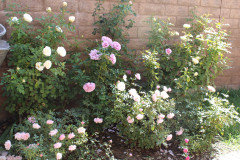
    Last spring. From upper left: Moonstone, climber Lavender Crush (one opening bud visible), Love Song (two of them), another Moonstone.

    Bottom row: Our Lady of Guadalupe (three of them from left to right). in the right foreground, the mini Marriotta.

    Personally, I swear by perlite. But that’s just one opinion.

  • 4 years ago
    last modified: 4 years ago

    @SylviaWW 9a Hot dry SoCal thank you for sharing your experience. Did you notice the plants needing less water when you added perlite or vermiculite?

  • 4 years ago

    The reason that I like the expanded clay is that it doesn't break down! and it seems to help with aereating the soil, as well as retaining moisture. In some areas of my land my clay is so heavy and so dense that adding organic matter alone didn't seem to work; it was just never enough,never...maybe if I could've added a truckload of it every square meter it could've done the trick,lol.Of course it's an essential element,but I definitely needed something more.Vermiculite or perlite might work, though I think they are expensive. Adding sand to clay will give you adobe,so that is a definite no-no.

  • 4 years ago

    TCM had Lillies of the Field on 2 nights ago. I watched it.

  • 4 years ago

    Rose beginner, it’s hard to say because I have never gardened without perlite. I’ve had enough experience with plants dying to know how crucial drainage is, so I always put it in.

    As for how much water, for in-ground roses I use a drip system, very unfancy, that’s on a timer. Roses in pots get watered via a bubbler attachment on a hose, 25-30 minutes per week, more in summer. Even with only the 25-30 roses i have now (down from 65), I honestly don’t think it‘s possible to measure how much water each rose uses.

    I’ll amend that. Of course it’s possible. it’s just not possible for me. 😏

    I only used vermiculite that one time, by mistake, so I can’t generalize.

  • 4 years ago

    I live in inland Southern California and also deal with clay soil. I have started using John & Bobs to amend my clay soil. Hope to see some results in a few months. The video below talks about California clay soil and what product to use to help amend it.


    https://www.youtube.com/watch?v=RxI8uZtFFeY

  • 4 years ago
    last modified: 4 years ago

    Think about good soil as a place where there is lots and lots of microbiome activity and life, then work to feed and support that biome. I have terrible hard packed clay here in Middle Tennessee where I get 50+ inches of rain a year. Packed clay has no air to support life, no space pockets for life to set up their homes and no waterways and byways to move food and water. But it's fabulous stuff once you solve those problems.

    What I do is when I'm starting a new bed I deep dig it then add copious amounts of horse manure--like 6+" inches. (I minimze digging after the first time!) I add an amendment made up of biochar, compost & mycorrhizal/bacillus which is showing to be excellent in jump starting soil life. The mycoorihizal/bacillius are the life forms that are your new tenants. The biochoar which when seen microscopically is incredibly porus--that's your new condominium project for your tenants. And the compost is Whole Foods delivery service. As long as you keep them fed the tenants will do the work of keeping the spacing open in your clay for the waterworks and transportation.

    Ideally I dig that all in, throw on the magic dust then let it sit for a couple months making sure it gets watered. (Although sometimes I just go ahead and plant.)

    When you plant your roses into these active communities--the "soil food web"-- they do really well. Because roses are heavy feeders I might add some organic fertilizers during the season but feritlzers only work as well as your plants can access them and the more active your biome community is moving things around the more availble the nuitirents in the soil are. Add more compost (I use horse manure) over the top once or twice a year going forward and all your little buddies will make sure it gets dispersed through the soil.

    Feed the soil not your plants.

  • 4 years ago

    Subk3, what a wonderful explanation of a healthy soil microbiome! Once organics get incorporated earthworms start making tunnels to let water flow as well. I keep my coffee grounds, banana peels and egg shell in a bag in the freezer. Once I get enough to fill my Vitamix I blend the frozen contents with hot water and then move the mulch around a rose and dump the contents and put mulch back. After a few blenderfuls on one rose, when I pull mulch back it’s teaming with worms. The worms will also move the organics placed on the top of the soil into the deeper levels of soil. I live on the edge of the Angeles National Forest so my soil is sandy loam, but organic material improves all soils. I use drip irrigation.

  • 4 years ago

    I've become convinced that erosion is not responsible for the poor soils we see. If erosion caused the loss we would see huge first steps into our homes. Suppose when your home was built you had 6 inches or a foot of good topsoil. If that topsoil had eroded, or blew away, your first step would be 13 or 19 inches high instead of 7 inches or so,


    What has happened is that so many of us use bagged fertilizers or nothing. I came to this realization after wondering what happen to the topsoil here at my place. There's been a house here for for at least 70 years. I've been here for 16 of those years. I spray my grass clippings back onto the lawn and totally shred some of the many leaves but that obviously isn't enough to add enough organic matter to improve the topsoil. What I have is maybe a 1/4 to 1/2 inch of sod and then raw clay under that.


    I recently converted a 34 x 64 foot plot of the lawn to a vegie/orchard garden. I added 3 inches of horse manure or mushroom manure and while it wasn't enough to make a really nice topsoil it grew wonderful crops. i then would add more manure the second year. So the 6 inches recommended above sounds about right if your establishing a perennial garden where you wouldn't want to dig up the roots of your plants to add more later.


    I think it doesn't really matter what kind of organic matter you use unless you have something that keeps plants from growing. Like Black Walnuts. Or horse manure with wood chips used for bedding in the stalls. I find it may be fine for seedlings, but not if you want to plant seeds in the beds where manure with wood chips was applied. In fact it wouldn't surprise me if that is responsible for many of the horror stories you hear about manure in the garden. Going only from my own memory while it used to be hard to find manure if you waited to long in the spring it was about the time that folks started using wood chips as bedding that it started being easy to find manure at any time of the year;

  • 4 years ago
    last modified: 4 years ago

    Rose Beginner, you call it clay but have you tested it to be sure? If you have a salt imbalance it will act like clay, but the solution for one is not the solution for the other. I and others have been on gardening forums for 20 years, about the time forums started on the Internet, and in those years probably only 5 to 10% of the people claiming to have clay actually have clay. Here's a quick test to get a basic hint about your soil. It's called the Jar Test. Get a straight sided jar like and olive jar. Fill it half way with dry soil and fill it all the way with water plus 3 drops of dish soap or shampoo. With a ruler measure how high the soil is in the jar (let's say 3 inches). Cap the jar and shake, shake, shake until all the little clods are broken up and swimming in the liquid. Put the jar down and leave it alone for 1 minute. A layer of sand/grit/gravel will form on the bottom of the jar. Measure the height of the sand level and write that down. Still leaving it alone, come back in 1 hour to measure the height of the next layer of material, the silt. Leave it alone for 24 hours to measure the clay content. Clay will usually remain suspended in the water making it far too cloudy to see through. If you have a new layer of material and can read a newspaper through the water, then you don't have a clay problem. If it is cloudy, then you should move on to the next test. Oh, take pictures of the jar at 1 minute, 1 hour, and 1 day so you can share, because you might still have questions.

    The next test would be a soil chemistry test. There are two soil test labs in the US which test for salts, organics, micros, pH, and the ability to hold nutrients included in their most basic test. Those are Logan Labs in Ohio and the UMASS labs in Massachusetts. I'm sure the UC system will provide the same tests, but they would be special order tests. Check with the LA County Ag Extension Service for more info. If you have a magnesium problem, you need one of these better tests.

    So I have some questions about your initial post. You say "Its that time of the year again!" and talk about planting roses. Do you dig them up every year???

    Then you talk about planting roses in the summer and they did pretty well. That has been my experience, too, but I prefer to plant in the winter. Although you noticed differences in drainage, I think you have been convinced that those differences do not amount to an actual problem, so that's good. I agree with GardenGal. Then you mention planting a 5-gallon plant. Was that a rose? Yikes?

    Then you asked, "Do i need to amend my soil with something to improve drainage, reduce compactness, retain moisture, etc?" I would say, don't pull out the plants. The more roots you have in the ground 12 months of the year the better the drainage will be. Roots along with fungi open up the soil allowing it to breathe, reducing compaction (if any), and moisture retention. Adding a soil surfactant never hurts moisture retention. It allows moisture to flow deeper into the soil where the temperatures are cooler and thus reducing evaporation. If you do have bare soil anywhere in the garden, keep the surface mulched to help with everything.

    Then you asked about peat moss, perlite, and vermiculite. Personally I believe those are for potting soil and not garden soil. The best thing you can do for your soil is put roots in it. Oh, and always fertilize with organic fertilizer like alfalfa pellets (rabbit chow) or corn meal, both available at your local feed store in 50-pound bags. The application rate I use is 1 heaping handful under each plant once a month.

    Also, for whoever it was who thinks that mixing clay and sand makes cement, that's not even close. Sand and clay makes sandy clay which is not useful for anything except growing things. Cement is its own product made by firing crushed limestone with all the clay and sand contaminants cleaned out before firing it. Then concrete is made from cement, sand, gravel, and water - no clay.

  • 4 years ago
    last modified: 4 years ago

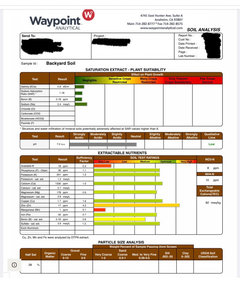
    Dchall, yes great advice on getting a soil test. Since RoseBeginner lives in Los Angeles area, I am posting the results from my soil test from Waypoint, which is a local lab here. Also it’s best to plant roses anywhere from November until March in SoCal. And best to avoid planting them July-Sept when the weather is very hot and dry. I haven’t lost a rose yet, but have never been brave enough to plant one in the summer here.

  • 4 years ago

    Here is the test results

  • 4 years ago

    In the jar test I described above, I forgot to mention what you do with the measurements. When you know what the total height of the soil is, you can divide the measurement for sand by the total to get the fractional amount of sand in your mix. To get the fraction of loam you take the measurement to the top of the loam, subtract the sand, and divide by the total. The rest is clay. You might see some stuff floating on top of the water. That is the organic matter that floats. The best of the organic matter is/are the microbes living in the soil, which cannot be measured in the jar test.

  • 4 years ago

    All I can add to the excellent advice you have been given so far, from which you can formulate your best and most feasible solution, is to be careful in adding too much organic matter. Yes, strange as it may sound, too much organic matter incorporated into a predominantly clay soil can result in a poorly draining too, "mucky," soil.


    There has to be a certain amount of inorganic aggregate constituents present in a well balanced garden soil. This means particles of aggregates ranging in size from builder's sand to pea sized (about 1/4" to 1/2"), sharp gravel.


    I recommend small amounts of such aggregates dug in, little by little, over a period of years, to get the percentage just right. Yes, you can still incorporate aggregate constituents in permanently planted beds. Dig in where you can, and surface scatter where roots of permanently planted roses cannot be disturbed.


    Moses

  • 4 years ago

    I've never had the problem of adding too much organic matter! It seems impossible to me, lol. However,seriously,Moses is definitely right about the need for "inorganic aggregate constituents". This is why I'm liking the expanded clay so much-it DOESN'T break down; it remains, helping to aereate the soil. Naturally in combination with organic matter, but om alone just doesn't seem to do the trick for me. Maybe after 50 years or so it would if I kept adding tons of it per square meter,but I'm too impatient for that, lol...

  • 4 years ago

    @tapla (mid-Michigan, USDA z5b-6a)

    I wish tapla could be induced to present his thoughts on this topic, even though gardening in the ground is not his area of focus (as far as I know).

    I believe we would learn a lot.

  • 4 years ago

    The depth that you're incorporating the organic matter makes a big difference. When I say I dig in 3" of manure I'm digging that into soil the depth of a spade. Seems to me that 6" dug a foot deep is about the same as 3" dug 6" deep.


    Also; If you want to obtain 10% organic matter you have to remember that if your doing it visually that when you dig that manure in your putting it under the weight of many pounds of soil that you throw in with it. I'm not going to try to guess what the resulting percentage will be with these visualizations and guesses.


    I will say that even if I were starting to grow in a foot of rich black loam for the first time or if I had been growing in that soil for a number of years that I would add an inch of manure and whatever compost I could come up with each year..