Software
Houzz Logo Print
westes

Rhododendron That Does Not Bloom

4 years ago
last modified: 4 years ago
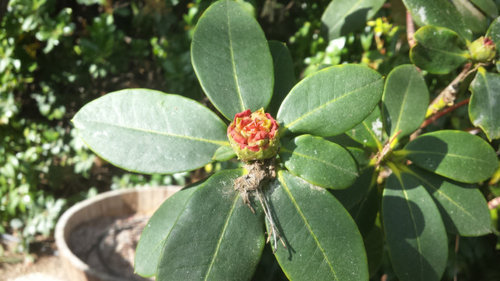
I have two Horizon Monarch Rhododendrons in separate containers. The container soil is half small bark and half turface. The plants have survived for years in that soil. One of the two plants develops flower buds but never blooms. It looks to me like the plant has just enough energy to develop the first stage of the buds, but it lacks the energy to finish the process and actually bloom. The other plant blooms well. My questions:

  1. Would the failure to develop a finished bloom be more about a lack of nutrients or lack of water?
  2. How should I try to recover from this situation? We are about to enter Spring here in zone 9b in California.

I realize these plants should be in the ground, but our soil will never support Rhododendrons. I have been using Osmocote once a year, and people here assure me that Rhododendrons are not heavy feeders. Other growers have told me to use Rock Phosphate with Boron (brand Espoma), although I do not understand if boron is a separate ingredient or is always included.


Comments (14)

  • 4 years ago
    last modified: 4 years ago
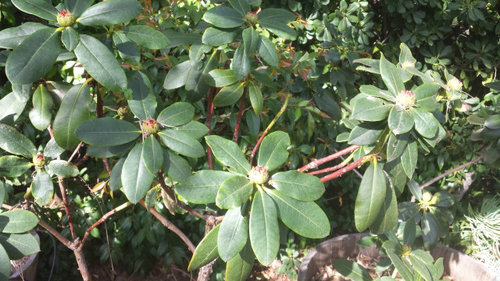
    Some general possibilities to consider and rule out for plants in the ground and in pots:

    Disease may attack the flower buds before they open. If it is a fungal infection, the dead bud will be covered with short hair-like structures.

    The problem may also be caused by a late frost or by a late fall application of a nitrogen rich fertilizer which prevents the buds from hardening off before winter sets in; the flower buds then get killed and turn brown or black.

    The buds may actually be foliage buds as opposed to flower buds so consider causes where flower buds do not set.

    The flower buds could be flower buds that froze very early. Early frosts are especially destructive and plants need time to harden progressively. Otherwise, if an early frost occurs before hardening is complete, the frost can kill the flower buds. Late frosts in the spring after dormancy is broken are also in a similar situation. The same applies to early bloomers like as PJM that break dormancy very early and signal the arrival of spring in many places. Very cold climates may be too cold for many rhododendrons as many rhododendrons have a low temperature at which the flower buds are damaged and will not produce flowers. This temperature varies greatly from variety to variety and somewhat from season to season. Flower buds can also be damaged by cold, dry winds, particularly when warm winter weather is followed by a period of bitter cold.

    Improper nutrients may be a problem that affects cold hardiness and flower bud set so, for example, make sure you fertilize with phosphorus (super-phosphate) correctly per product directions to increase hardiness and flower bud set and watch out for lawn fertilizers that get applied close to rhododendrons as these fertilizers are notoriously high in nitrogen.

    Very acidic soil can prevent the roots from taking up nutrients and some applications of dolomite in late winter/very early spring and a light top-dressing of mushroom manure in late spring may be necessary.

    When soil moisture is too low in winter, the buds will not open (in summer, they will not devepo flower buds) but watering will usually resolve this condition if detected soon enough. Also, summer drought with a moist fall can contribute to fall blooming. So you lose spring bloomage as a result.

    Deer, squirrels and rabbits may eat many of the flower buds as they browse in the winter, particularly if the weather is harsh and other food is scarce.

    westes Zone 9b California SF Bay thanked luis_pr
  • 4 years ago
    last modified: 4 years ago

    I added some photos of the plant to the original post.

  • 4 years ago

    @luis_pr How would you use Rock Phosphate on a mature plant? Would that be instead of Osmocote or together with it?

  • 4 years ago
    last modified: 4 years ago

    @gardengal48 (PNW Z8/9) I would love to have a place with massive 50-year-old Rhodies!

    What do you think is a proper use of Rock Phosphate in a garden? I have had arborists claim that a phosphate-rich fertilizer will make a hedge plant form denser leaf growth and focus less on stem growth.

  • 4 years ago
    last modified: 4 years ago

    Since my latest soil test had no issues in that regard, I do not use extra levels of phosphate. only what the fertilizer tupically includes.

    westes Zone 9b California SF Bay thanked luis_pr
  • 4 years ago

    First, phosphorus is pretty immobile in the soil and unless your garden has been developed on land that was previously heavily farmed, it is highly unlikely you are deficient in this nutrient.

    Second, virtually all plants require and absorb the three primary nutrients in a relatively standardized ratio of 3:1:2 or 3 parts N to one part P and 2 of K. Plants just do not require P in very substantial levels regardless of their stage of growth. And applying more than is necessary or can be utilized is not going to benefit plant growth in any regard and could achieve quite the opposite.

    Finally, the misuse and overuse of phosphate heavy fertilizers is a leading cause of groundwater pollution and contamination of lakes, rivers and streams. To the point where many states are restricting the availability of phosphate rich ferts. Here, triple P fert is not widely available on store shelves and most lawn ferts omit P entirely.

    Rhododendrons abound here - it is our state flower - and there are many, many plantings of very large and venerable rhodies all over. I am never good at remembering to take photos of my own garden but I will try to keep it in mind when they start to pop flowers and post back.

    I understand your desire to want to grow rhodies but IMO, they are not at all well suited to container culture. I have gardened with containers for many years and with a wide variety of plants both exotic and commonplace. And other than by my own negligence, I have lost very few....except for the rhodies. They never thrive in containers and after a couple of seasons they begin a pronounced decline, despite whatever care they've had. I wish you better luck than I had.

    westes Zone 9b California SF Bay thanked gardengal48 (PNW Z8/9)
  • 4 years ago

    @gardengal48 (PNW Z8/9) Much of the South San Francisco Bay Area was very fertile fruit orchards for a hundred years before the high-tech explosion in the 1970s turned it all into housing and commercial buildings. That said, the home is 50 years old, so you would think the soil had a chance to work its way back. What you are really saying is do a soil test and remediate the soil only if the test suggests you need to do that.

  • 4 years ago

    👍👍

    westes Zone 9b California SF Bay thanked gardengal48 (PNW Z8/9)
  • 4 years ago

    I don't know much about rhodies (except that my dad in the PNW thinks they are a menace for shading out his precious lawn and blocking the view) but blooms or not, @westes Zone 9b California SF Bay, that looks positively lush for a local rhododendron! I don't think they like it here. :)

    westes Zone 9b California SF Bay thanked Fori
  • 4 years ago

    'Bud blast', can be broadly described as the aborting of buds before or soon after opening. Deficiencies of the immobile nutrients are a common cause. Major changes in the amount of light and water the plant is acclimated to, but over or under-watering can also be causal. Radical temperature, cold air from air conditioners or warm air from heat sources can either cause buds to be aborted, and night to day temperature changes can cause condensation within the bud sheath, which can cause the bud to rot. Chemicals/fumes from gas/diesel engines or ethylene gas from any source can cause bud blast. Aphids and thrips can feed on buds or cause infections that cause them to abort. Humidity too low or plants too close to supplemental lighting are often issues, as is chemical damage related to EC/TDS (salt levels). And sometimes, often infuriatingly, the issue is often idiopathic.

    I think directing your prophylactic efforts toward maintaining those cultural practices the plant approves of, particularly soil moisture levels, temperature, and fertility. Make sure the fertilizer you're using includes all nutrients essential to normal growth. If you have any suspicions that water/condensation in buds might be an issue, first, don't mist or spray the foliage with water. After the bud erupts, you can try carefully peeling back the bud sheath, which will help prevent water or condensation from causing rot issues. If you find aphids/thrips, treat appropriately.

    I can't be more specific w/o seeing the plant. Often, though, in cases like this and given a list of potentialities, the grower is able to eliminate a goodly number of possibilities and concentrate on the more likely of the causes.

    Also, Nitrogen applications in fall have no effect on whether or not buds that begin forming during the prior summer are likely to be injured by chill. Diminishing day length (technically, it's increasing night length) starts the plant/buds on the path toward dormancy, and increasing chill seals the deal by stimulating the plant to enter deep dormancy. Too, plants that are provided with a full compliment of nutrients, including nitrogen, in the months immediately prior to a predictable dormancy will be better able to resist chill injury, which is probably not even what is affecting your plant.

    Fertilizing with super phosphate is far more likely to result in an iron deficiency that a greater profusion of blooms when used on containerized plants; and, you'll find no scientific evidence that "extra phosphorous" increases a plant's resistance to chill injury. In fact, dosing with any element or compound aimed at providing only one or two nutrients is not a good choice for conventional container culture. What IS true, is the right amount of phosphorous as relative to all other essential nutrients will produce more blooms than an over-abundant supply, which has only the potential to be limiting. In fact, anytime you supply any nutrient at rates that surpass the needs of the plant, it can only be limiting. Foliage-Pro 9-3-6 is an acid-forming fertilizer with the "right" amount of phosphorous (compared to the amount of N it supplies), and would supply complete nutrition from a single source.

    Please do not add 'mushroom compost', or dolomite beyond what is required to bring the pH into line, to containerized plants. The urea the compost contains can cause plasmolysis (fertilizer burn) and it can raise the EC/TDS of the soil solution when the salts it contains leaches into the grow medium. Stick with a nutritional supplementation program that gives you control and minimizes the likelihood of damage that so often results from relinquishing control.

    Al

    westes Zone 9b California SF Bay thanked tapla (mid-Michigan, USDA z5b-6a)
  • 4 years ago
    last modified: 4 years ago

    @tapla (mid-Michigan, USDA z5b-6a) Going through your list, how would I treat for "immobile" nutrients? In addition to an all-purpose acid-loving fertilizer, would a micronutrient powder like Azomite make any sense? The acid-loving fertilizer for containers that I want to try is Nelson Plant Food:

    https://www.amazon.com/gp/product/B004F1Y5E2/

    I do not have the other issues you listed. The plant might want more water, but I suspect nutrient issue.

  • 4 years ago

    In addition to an all-purpose acid-loving [acid-forming] fertilizer, would a micronutrient powder like Azomite make any sense? It depends on what fertilizer you are using. With FP 9-3-6, you wouldn't need it. If using a fertilizer that doesn't have Calcium (Ca) or Magnesium (mg), and lacks several micronutrients, it would make more sense to use a micronutrient produce like Micromax or STEM. Mineralization occurs much more slowly in containers than it does in the mineral soils found in landscapes, gardens, and beds. Even bone meal, an entirely organic product should be considered insoluble in containers because of the severely depressed rate of mineralization that takes place in conventional container culture. IOW, just because it's in the medium doesn't mean it's available for uptake. The acid-loving [acid-forming] fertilizer for containers that I want to try is Nelson Plant Food: What immediately comes to mind: A plant uses about 6x as much phosphorous (P) as nitrogen (N), so a fertilizer containing 9% N should provide about 1.5% P. The product packaged by Nelson provides 5.6% P, which is about 3.7X as much as your plants can/will use. That can have a negative effect on uptake of Ca, K (potassium), Fe (iron), Zn (zinc), and CU (copper). It also lacks the secondary macronutrients Ca, and Mg as well as almost all micronutrients. Personally, I think it makes maintaining control over what your plants get, in terms of nutrition, and when they get it, much more complicated than it could be.

    Al

    westes Zone 9b California SF Bay thanked tapla (mid-Michigan, USDA z5b-6a)
  • 4 years ago

    @tapla (mid-Michigan, USDA z5b-6a) Those are great criticisms of Nelson, thank you. What is a slow-release fertilizer for acid-loving container plants that you would recommend that includes micronutrients?