Software
Houzz Logo Print
travisaz

Best pot-in-pot filler for insulation?

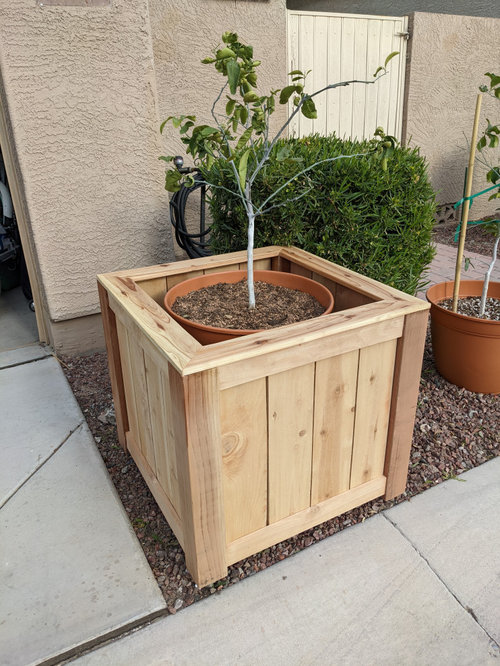
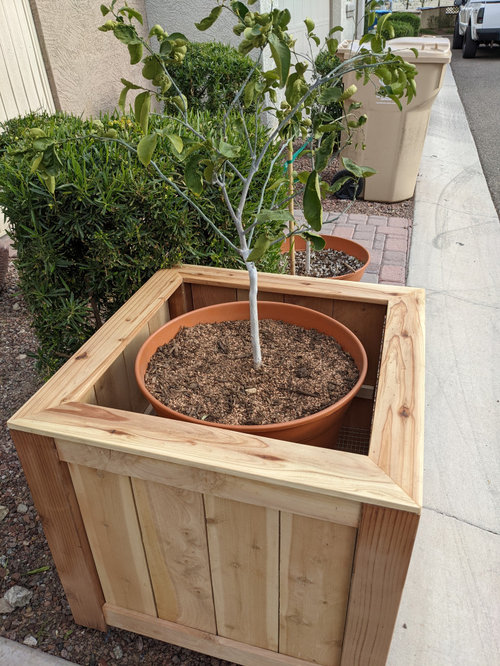
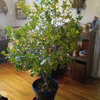
My container citrus always struggle in these Phoenix summers. In an effort to help the roots stay cooler, I built a container out of cedar pickets to place the tree's pot in. Sort of a pot-in-pot approach. I built the planter very large so that I don't have to build new planters as the trees get bigger. As such, there is quite a bit of open air in between the two containers. I was thinking of filling the gaps with mulch or something. Do you think wood mulch or rubber mulch would be better for this? I've heard great things about the rubber mulch, including that bugs don't like to live in it. But I have no idea if one works better as an insulating material.
Right now, my tree doesn't have much of a canopy to shade the surface of the pot. I can put some boards or something over the top until the tree flushes and leafs out.
Any recommendations on filler material, especially wood vs rubber mulch?

Comments (25)

  • 4 years ago
    last modified: 4 years ago

    Oh!

    Coincidentally I just watched a video where someone had a very similar setup!

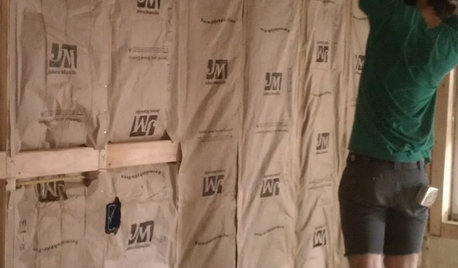
    She said she lined the pot with 1-inch insulation foam boards:

    https://youtu.be/4FUlLxAQ2JA 

    Not really a mulch but I guess you could use it that way too... it might work for you?

  • 4 years ago

    I like that idea. I've still got all that air space to address. But maybe I can do the insulation and some mulch :)

  • 4 years ago

    That's what I was thinking, styrofoam sheets. For the air space issue, styrofoam peanuts. If you bag them they will be easier to handle. Check Arizona Bag Company for some ideas on bags. You could cover the whole mess with some nice fabric maybe. HTH

    Travis in PHX (9b) thanked MaryMcP Zone 8b - Phx AZ
  • 4 years ago

    The problem with those godforsaken styrofoam peanuts is they fly away everywhere. Also they are an environmental nightmare. Also they are ugly.

    I agree that a nice geotextile fabric would be a good cover.

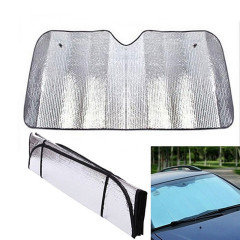
    If you wanted to insulate optimally, I am thinking instead of a foam board you could use the kind of aluminized, thick sheeting that is used as a windshield sunguard.

    One or two of these sorts of things and cut them to size:


    Travis in PHX (9b) thanked seasiderooftop
  • 4 years ago

    I don’t know much about growing citrus but I grow lots of things in pots. Do small citrus trees like growing in such a big pot? Just curious.

    Travis in PHX (9b) thanked littlebug zone 5 Missouri
  • 4 years ago

    @littlebug zone 5 Missouri the pot is a bit oversized for the tree. Helps keep the roots cool, and isn't a problem unless watering is a problem, which I'm still trying to figure out. It's a very fast draining mix, so that mitigates some of the risk. Also, the pot is in on 4-inch risers because the container cavity was too deep for the pot. So, it looks bigger than it actually is.


    @seasiderooftop the pickets making up the sides started out flush but as the wood dried, they shrank considerably. So I have 1/4"-1/2" gaps in between the pickets. The nice thing about insulation sheets is I can paint them. If I put the reflective aluminum in there, they will stand out like a sore thumb.


    @MaryMcP Zone 8b - Phx AZ thank you for that store recommendation. I have never heard of them before. It looks like they would have almost everything I need. Cool!

  • 4 years ago

    Not to hijack your question, but would this work for insulating my fig tree in my New York winter??

  • 4 years ago

    @kitasei2 It would certainly help. I don't grow figs nor do I live in NY, so I can't say if it would help enough.

  • 4 years ago

    Related question: I only made one planter as a test to see if it would improve my situation. For the other citrus, would something like a tree skirt made of shade cloth help? I could even drape it over the sides of the containers.

  • 4 years ago
    last modified: 4 years ago

    Noon Sun is solar heat addition in a hot climate. It heats up fast and can kill. In your case you have cold days and nights with low level sun , short days and long nights of no heat. insulating will save your fig from dying at midnight until 3 AM instead. If you insulate and provide a pot heater that will help a lot. You will need a heat source.

  • 4 years ago

    For the other citrus I might paint the pots white or use a reflective medium, and then utilize a shade cloth. Preventing direct sun can make your trees considerably cooler and keep them alive on hot days.

  • 4 years ago

    You're in swamp cooler territory so you can help cool the pot by wrapping it with a wicking product and either wet the wicking material daily or putting the end in water containers in the bottom. With AZ low humidity, you can cool below ambient easily 20-30 degrees, but your mostly closed external box (only the small opening) will limit the evap some. They make synthetic wicking material for use in plant watering, hydroponics which would be ideal (but up front cost). But you could use burlap or other organic materials which will decompose over time

  • 4 years ago

    @ken, would wrapping it in a wet towel work?

  • 4 years ago

    Travis, anything which can offer evaporative surface would, so wet towel would. Burlap and synthetic wicks are more porous so aid in evaporation. Given heat and low humidity of AZ, a towel wrapped on a wire frame to keep it upright and around the pot would likely work fine. Towels are often used for traditional swamp coolers (though they're in open air versus a wooden box).

  • 4 years ago

    I have some burlap fabric but it's fairly thin. It's hard for me to imagine that would stay damp for very long.

  • 4 years ago
    last modified: 4 years ago

    I wonder if the spray styrofoam would work. It would certainly fill the space, but you don't want it to adhere to the pot or wooden container, so that you couldn't get it out. Probably I would line the wooden planter and the pot with plastic FIRST (and maybe even spray the plastic with cooking oil), and then spray in the styrofoam spray.

  • 4 years ago

    I'm not an expert in this at all, but I've started to conceptualize the problem as two-pronged. There is protecting the pot from the sun (and the heat that brings). I think the cedar box will accomplish that. The other source of heat is from the ambient air temperature. I don't think the cedar box will do anything about that. I'm not sure what function adding insulating material to the box will have. As I understand it, we insulate our homes so that heat doesn't escape the house in the winter, and so heat doesn't enter the house in the summer. But we still have to run heating and cooling to set the internal temperature. I wonder if adding all this insulating material to the box will make it harder for heat to escape in the summer. Ken's idea about the evaporative cooling is attractive because it would actually add a cooling element to the equation. But, I worry it will also attract all kinds of pests seeking shade and water.

  • 4 years ago

    One important thing you can do is paint the cedar box white to reflect the sunlight.

  • 4 years ago

    A terracotta (clay not colored plastic) would provide natural cooling.

    Travis in PHX (9b) thanked getgoing100_7b_nj
  • 4 years ago

    Something to keep in mind is that insulation helps to maintain the temperature inside an enclosed space, that temperature can be both hot or cold. Once the pot heats up inside, your insulation will then maintain the temperature. Your thermal problem is then to figure out how to either prevent the temperature inside the pot from raising enough over the course of the day to be problematic, or find a way to add some form of active cooling so that the temperature doesn't raise too much. I might look less at a static insulation and more at something dynamic that can both maintain temperature AND cool if necessary. Painting white can be helpful because it reflects heat.

    Travis in PHX (9b) thanked bonsai_citrus_and_indoor_gardening
  • 4 years ago
    last modified: 4 years ago

    if you are considering wet towel wrap to cool by evaporation you'll need a denser fabric then burlap and not organic (cotton mildews and disintegrates fast). i used acrylic felt for passive hydro wicking (it is used by crafters and is cheap by the yard), easy to cut to size. it needs to be prewashed to wick (sizing on fabric prevents wicking) and it will mildew if continuously wet and cool, so no light no dark color, but maybe medium green: easy to see mildew, but not as dingy with time.

    It will need to be washed from time to time as there will be dirt/mildew buildup, so it needs to be removable. perhaps adding a bit of bleach (or vinegar?) to water will help without being too smelly...and also kill bugs on contact? or you can let it dry overnight ev few days.

    you'll need some sort of a pan inside to hold 1-2" or water, depending on how fast it evaporates and lift the pot up above water level.

    painting the outside pot white will help a LOT! in FL people do double potting for bare root orchidsd and other plants, 2" free space between walls is good (it is not filled, as orchid roots need air circulation.

    an intermediate (3rd) clay pot instead of fabric...sitting in 1-2" of water will wick and evaporate too , but such large pots are expensive and not easy to find.

  • 4 years ago

    Took a while to find the part about insulating with insulation board. Does anyone have any insight as to whether 1/2" board would knock down heat sufficiently in a fiberglass large cube container, or would I need to go the full 1"?

  • 4 years ago

    I would go a full inch.

  • 4 years ago

    My house builder friend seems to think the idea is futile. That it will eventurally heat up and then will stay hot longer than normal....I'm so confused. I'd like to keep the roots of a Japanese Tanyosho Pine as cool as possible. I have double layers of grow bags as it is...wonder if that would help. Plus the container is huge....about double the side of the rootball. Maybe I can forgo insulation?