Software
Houzz Logo Print
buckwheatlouise17

Advice on how to prune my fiddle leaf fig [PICS]

4 years ago
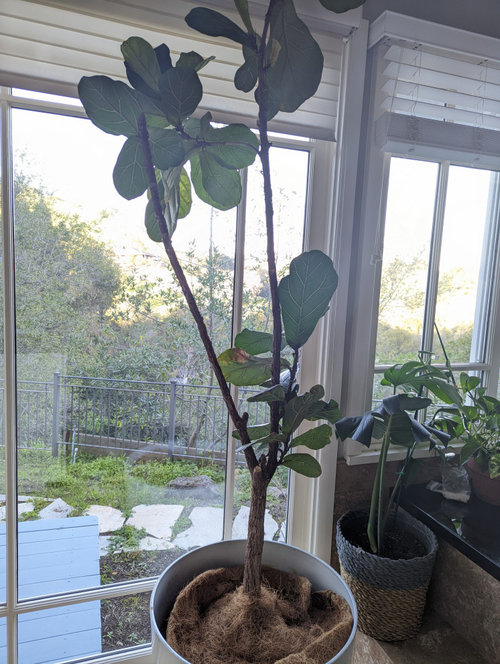
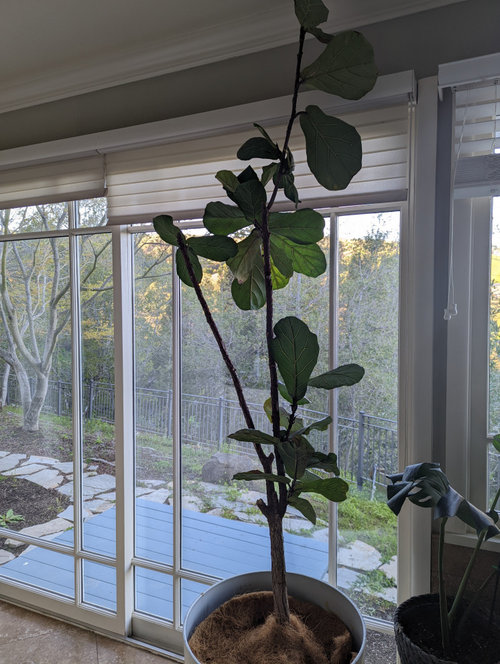
Hello! My FLF hasn't been doing great for a few years now. It dropped most of its leaves about a year ago and then suffered some sunburn after a hectic move to a new house. It's starting to recover, and new growth looks good. However is very sparse with unbalanced branches. I'd like to try and prune it back so that it will grow much fuller, but I have no idea where to begin. Should I cut it all the way back to the base trunk?


Comments (3)

  • 4 years ago

    Even if it's not the fastest or easiest, the best way to achieve any goal is to choose the route that best ensures success, and avoid choosing a path solely because it offers the chance of success. I'll provide you with an outline of the actions needed to return the plant to a much higher state of vitality (health), while making allowances for the plant's weakness and taking advantage of its coming strengths.

    First, some questions. Where do you live? Would you provide an image of the plant and pot, and perhaps an image of what's going on under the hemp mat? Has the plant ever been fully repotted (includes bare-rooting, root pruning, and a change of soil. Do you fertilize regularly? .... with what? .... when last? Does the pot have a drain hole? .... and, after watering do you allow the pot to sit in any effluent that exits the drain hole? When you water, do you ensure the entire soil column is moistened and a good measure of water flushes through the soil, carrying mineral build-up from tapwater and fertilizer solutions out of the pot?

    The plant definitely needs a hard pruning, but now isn't a good time to prune, and your plant is too weak to do the kind of pruning required to reduce the plant to a framework you can build on. IOW, between now and an appropriate time to prune (possibly as early as this coming June, if you live in the Northern Hemisphere), the best use of time would be by focusing on betterment of the plant's vitality so it's able to tolerate the hard pruning. To do that, I would:

    * Figure out a way you can flush the soil as you water. That will 'reset' the level of fertility to close to 0.

    * After flushing, fertilize with a full production strength solution. I highly recommend using Foliage-Pro 9-3-6, as it contains ALL nutrients essential to normal growth, from a single source. It has many other attributes as well.

    * Start using a 'tell' to 'tell' you when it's time to water. More re using a tell below.

    Move the plant outdoors as soon as night temps are reliably above 55*. This will make a big difference in the plant's level of vitality. Currently, on a 1-10 scale with 10 being the peak of health, your plant is probably a 3, so it needs your help.

    * The plant will respond very favorably to being outdoors. Once it's pushing some new growth, it can be repotted. The best timing of that depends on where you live, but it will be sometime in June for Ficus in the Northern Hemisphere.

    Leaves are individual factories where the plant's true food (sugar/glucose) is synthesized, so removing green leaves by way of pruning always represents a setback. That's fine when a plant is robust/healthy and it's ability to make food is at or approaching peak levels, but your tree is not a good candidate for any type of pruning other than pinching, and pinching will not provide you with the response required to fix the fact that all foliage on major branches is concentrated at branch tips where new extension growth occurs. That is occurring likely because the plant is very root-bound

    The plant's level of vitality is not a constant. All else equal, it will be weaker in late fall through early spring than at any other part of its growth cycle, which is why it's best to do serious work like hard pruning and repotting in the weeks immediately prior to the summer solstice. The reason is simple - your plant will tolerate the work better and recover faster when light is most intense and days longest

    Using a 'tell'

    Over-watering saps vitality and is one of the most common plant assassins, so learning to avoid it is worth the small effort. Plants make and store their own energy source – photosynthate - (sugar/glucose). Functioning roots need energy to drive their metabolic processes, and in order to get it, they use oxygen to burn (oxidize) their food. From this, we can see that terrestrial plants need plenty of air (oxygen) in the soil to drive root function. Many off-the-shelf soils hold too much water and not enough air to support the kind of root health most growers would like to see; and, a healthy root system is a prerequisite to a healthy plant.

    Watering in small sips leads to avoid over-watering leads to a residual build-up of dissolved solids (salts) in the soil from tapwater and fertilizer solutions, which limits a plant's ability to absorb water – so watering in sips simply moves us to the other horn of a dilemma. It creates another problem that requires resolution. Better, would be to simply adopt a soil that drains well enough to allow watering to beyond the saturation point, so we're flushing the soil of accumulating dissolved solids whenever we water; this, w/o the plant being forced to pay a tax in the form of reduced vitality, due to prolong periods of soil saturation. Sometimes, though, that's not a course we can immediately steer, which makes controlling how often we water a very important factor.

    In many cases, we can judge whether or not a planting needs watering by hefting the pot. This is especially true if the pot is made from light material, like plastic, but doesn't work (as) well when the pot is made from heavier material, like clay, or when the size/weight of the pot precludes grabbing it with one hand to judge its weight and gauge the need for water.

    Fingers stuck an inch or two into the soil work ok for shallow pots, but not for deep pots. Deep pots might have 3 or more inches of soil that feels totally dry, while the lower several inches of the soil is 100% saturated. Obviously, the lack of oxygen in the root zone situation can wreak havoc with root health and cause the loss of a very notable measure of your plant's potential. Inexpensive watering meters don't even measure moisture levels, they measure electrical conductivity. Clean the tip and insert it into a cup of distilled water and witness the fact it reads 'DRY'.

    One of the most reliable methods of checking a planting's need for water is using a 'tell'. You can use a bamboo skewer in a pinch, but a wooden dowel rod of about 5/16” (75-85mm) would work better. They usually come 48” (120cm) long and can usually be cut in half and serve as a pair. Sharpen all 4 ends in a pencil sharpener and slightly blunt the tip so it's about the diameter of the head on a straight pin. Push the wooden tell deep into the soil. Don't worry, it won't harm the root system. If the plant is quite root-bound, you might need to try several places until you find one where you can push it all the way to the pot's bottom. Leave it a few seconds, then withdraw it and inspect the tip for moisture. For most plantings, withhold water until the tell comes out dry or nearly so. If you see signs of wilting, adjust the interval between waterings so drought stress isn't a recurring issue.

    Questions ..... or was that informational overload. Don't be shy about asking questions. If you're serious about honing your growing skills, the key will be gaining a better understanding of how your plant works and how to work WITH the plant's natural rhythms instead of just ignoring them.

    Al

  • PRO
    4 years ago

    @tapla (mid-Michigan, USDA z5b-6a) Thank you so much for such a comprehensive response! Before I follow up with my own questions, let me get to yours:


    - The tree lives in northern California (hardiness zone 9b)

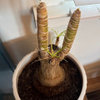
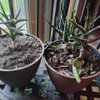
    - I've attached some extra pics of the plant in the pot and of the soil under the mat

    - The plant has lived in this pot most of it's life, but it is not root bound in there. There is no drainage hole.

    - I've changed the soil 2 or 3 times in its 8ish years of life.

    - I water it once monthly and fertilize it once every three months.

    - See attached photos of the fertilizer I've been using


    And now some questions for you:

    - I'm guessing you would recommend replacing the pot with one that has a drainage hole? Should it also be smaller?

    - Do you think this is a good fertilizer? (see attached photo)

    - Should I use cactus soil as a replacement? Or just regular potting soil?

    - I'm already seeing some new growth as spring comes a bit early here (see attached) how many more months should I wait until repotting and pruning?

    - You mention putting it outside, is full shade OK? I'm worried about sunburn as the sun here can be intense.

    - What signs should I look for which might suggest the plant is ready for a full prune? I think I will probably just return to the forum at that time for the specific advice on where to cut...unless you think it will be straightforward?


    Again, thank you so much for your help!


  • 4 years ago

    - I'm guessing you would recommend replacing the pot with one that has a drainage hole? Should it also be smaller? In the immediate, the best course would be to add a couple of drain holes through the bottom where the bottom and sidewall meet, then flush the soil thoroughly by slowly pouring a volume of room temp water equal to at least 10X the volume of the pot through the soil. When that is completed situate the plant above a collection saucer so there is no pathway by which the effluent that exits the pot can make its way back into the grow medium.

    While you've done very well to keep the plant alive in a pot so large w/o a drain hole, there remains the fact that dissolved solids from fertilizer and tapwater have been accumulating in the soil for a very long time. This means that the TDS/EC (total dissolved solids and electrical conductivity ..... roughly the level of salts) levels in the soil solution are very high; and, even though the NPK ratio of the fertilizer is appropriate, it has undoubtedly become badly skewed over time. When that occurs, an access of one nutrient can cause a deficiency (antagonistic deficiency) of one or more of the other nutrients.

    - Do you think this is a good fertilizer? (see attached photo) There is no way to tell from the information on the label. All we know is it provides a slow release form of Nitrogen, phosphorous and potassium favorable to the plant. What is missing is which of the other 9 essential nutrients does it contain, if any. There are many fertilizers that contain only NPK, and those would be inappropriate for container culture. I have a large number of Ficus (40 or so, not including a few dozen cuttings I started for some reason that will probably forever remain unclear to me. The Lord knows I don't need more plants, but propagating is pretty much a reflex for me.

    I use Foliage-Pro 9-3-6. It contains all nutrients (absorbed via the root pathway) essential to normal growth, from a single source. It has many other attributes as well, and would serve very well for almost everything you're apt to grow in a container.

    - Should I use cactus soil as a replacement? Or just regular potting soil? You'll find that what the bag says a soil is appropriate for is more often than not misleading. Usually, if brand X makes an all purpose potting medium and one especially for cacti/succulents, the product for cacti/succulents will likely be not quite as bad for cacti/succulents as the all-purpose medium.

    Living where you do, you should have ready access to graded (for size) fir bark from Shasta Forest Products, from up Yreka way. Media for Ficus should be rather chunky. These are what I use, in order of preference:


    - I'm already seeing some new growth as spring comes a bit early here (see attached) how many more months should I wait until repotting and pruning? If I lived in NoCAL, I'd be repotting Ficus second week of June. Growth should kick into second gear once the vernal equinox is behind you (Mar 21), but still, it's best for the plant if you repot after it has regained a good measure of vitality, and it's current ability to make food is about to peak. The plants natural defenses are a byproduct of its metabolism, so repotting w/o consideration of the timing can mean an unnecessarily long recovery during which the plant is more vulnerable to insect herbivory and attack by disease pathogens.

    - You mention putting it outside, is full shade OK? Best is dappled or open shade, but full shade is still much better than indoor light. I'm worried about sunburn as the sun here can be intense. The plant is genetically programmed to tolerate full tropical sun, but that doesn't mean the foliage it carries now will be able to adapt to full sun. How much sun they can adjust to is directly related to the light intensity they were growing under when the individual leaves came on line. With healthy trees, I move them from indoors to direct sun. The leaves burn, fall off, and the plant pushes a new flush of pristine growth. Sometimes, I completely defoliate healthy trees when I move them outdoors,

    Ficus benjamina ^^^

    but that's too risky when dealing with plants in decline.

    - What signs should I look for which might suggest the plant is ready for a full prune? No need to look further than the images you provided. If you listen close, you'll hear it asking you to, "Please prune me" when I'm ready for it. I think I will probably just return to the forum at that time for the specific advice on where to cut...unless you think it will be straightforward? It won't be at all difficult, but you'll need to supply some more images so I can get a sense of what the plant looks like in 3D. 2D images are too misleading to make pruning decisions from unless there are several images to help establish an image in the mind's eye.

    This sequence might interest you. It's another Ficus (microcarpa).

    June - 95% of foliage removed:

    August, after 8 weeks of growth:

    Pruned again and wired for branch placement:

    Al


Sponsored
Peabody Landscape Group
Average rating: 3.5 out of 5 stars8 Reviews
Franklin County's Reliable Landscape Design & Contracting