

Hi, has anyone had problems with their kitchen hood and grease?
The first time i used the hood, grease got all over the interior of the hood and leaked down the back onto the backsplash. the hood is vented straight up through the attic. i had the hood on high. it was cold out. i was cooking burgers and beyond burgers. however, it started leaking grease out the back again the next time i cooked burgers. that time, it was not very cold outside. what gives? my installer thinks maybe it is too powerful and is sucking up grease, but the second time this happened, i had it on a lower speed. he went on the roof and said it is blowing up there when on. the only other thing i can think of is that it is too close to the range. I've got 25” instead of the 27” the manual calls for (distance between flame and hood). Would


that do this???? I'm so sick of dealing with kitchenaid, i hope this is not a hood defect!!!
Comments (56)
 4 years ago
I cook hamburgers on the grill outside! No mess to clean inside. I'm in a warm climate now, but used to grill outside all winter long when we lived in the Boston area.
Related Professionals
Cape Girardeau Kitchen Remodelers · Springfield Kitchen Remodelers · Hilton Head Island Kitchen Remodelers · Manhattan Architects & Building Designers · Providence Architects & Building Designers · Athens Kitchen & Bathroom Designers · Oneonta Kitchen & Bathroom Designers · Poughkeepsie Kitchen & Bathroom Designers · San Bernardino Kitchen & Bathroom Designers · Middletown Kitchen Remodelers · Washington Custom Countertops · Martinsburg Custom Countertops · Youngstown Custom Countertops · Santa Rosa Custom Countertops · Spokane Custom Countertops 4 years agolast modified: 4 years ago
This could be caused by a number of things.
First, the filters are horizontal so any grease trapped is likelly to drip off. Filters should be angled so that grease runs to one end.
Mesh filters are also a poor choice since even when angled they will tend to drip.
For the same two reasons the Braun hood recommended above would be a bad choice. As well, the Broan hood also lacks any containmnet volume.
As others mentioned, cleaning the filters frequently would likely help though horizontal mesh filters like that can begin dripping with just one use.
If you're in a cold environment and your duct isn't insulated then you could be getting condensation drip making the problem worse.
Good advice from @kaseki.
Your hood is not too powerful.
Realistically your best option is a better hood. More: https://bamasotan.us/range-exhaust-hood-faq/
jh72 thanked opaone- PRO4 years ago
The hood is filthy and needs cleaning so just bcause you used it the first time does not mean the hood was ever cleaned by who ever owned the house before . I do hope you mean the hood id vented through the roof properly and also insulated and no flex at all .
 4 years ago
my installer thinks maybe it is too powerful and is sucking up grease
Isn't that why you use it, to suck up grease?
If you had this unit newly installed, and your installer makes such a silly statement, then you might want to get a second opinion from a different installer. Actually, I would contact Kitchenaid, explain the problem, and ask for advice, a service call, and/or a certified installer. I doubt that this is a fan defect, but if it is new, it is under warranty and that needs to be your first move.
(I had a problem with a newly installed attic fan, so I called the manufacturer and learned that the "experienced roofer" had put in the wrong size, with inadequate venting for it to function properly. Of course that roofer told me that the manufacturer "didn't know what they were talking about!" LOL)
 4 years ago
Are you sure this is cooking residue and not mechanical grease? Your hood--mesh or not--isn't gonna get clogged with one use.
Smell it. Looks like some kind of manufacturing goop.
Also, you're supposed to peel off the blue. :)jh72 thanked Forijh72
Original Author4 years agoHi, thanks for your thoughtful posts. ill have to respond more fully later, but intrigued by @Fori and will investigate suggestions by @kaseki and @opaone
FYI: the hood is kitchenaid DVUB600DSS. 585 CFM. $1200 so not a $50 piece of junk. not saying its not a $1200 piece of junk. But I’m not looking to buy a new hood any time soon.
You can feel it blowing on the roof (so yes, vented out through the roof), if that might mean its adequately powered (i underdtand what you mean @kaseki). I had ordered a baffle-type but it came in dinged and kitchenaid replaced it with this one. loooong story. Anyhow, unless KitchenAid takes this back, I'm stuck with it. I did have a kitchenaid tech come out — he took out a piece of insulation that was supposed to be there and threw it out; said it was packing material. needless to say, i dont have a lot of faith in them. i do have a lot of faith in my contractors. They just redid my entire house. They put in the vent - said its insulated but I’ll have to ask about the top 4”. we talked about the cold and the condensation theory - i had read about that. He doesnt think thats the case bc he said is well-insulated. @Fori say more. there was an awful smell for a couple weeks despite multiple washings.
btw, yes i cleaned the filters multiple times — after this. it wasnt ”filthy.” Like I said, it was straight out of the box and the venting and everything is brandspanking new.
My last crazy theory: maybe the Beyond Burgers have a weird “grease???😁
Thank you for your help. I have a phD — but sadly its not in engineering or chemistry. I am a damn good researcher, though, and many ideas here resonate with what I’ve read. Send more if you have them!- 4 years ago
Well, um...it looks gorgeous.
Just confirm that it is actually FOOD grease. Because that's Amityville horror leakage and I don't think burgers of ANY sort will do that in one or two runs.jh72 thanked Fori - 4 years ago
“My last crazy theory: maybe the Beyond Burgers have a weird “grease???”
We cooked 4 Beyond Burgers on our Thermador rangetop, yesterday. The Vent A Hood took care of any grease, and the effluents, as a quality vent hood should. There was no dripping of grease “down the back, and onto the backsplash.”
The hood you have is not much better than an over the range microwave, vented to the outside. However, even the OTRMW I had in my former home, had two mesh screens…and never had grease dripping down the back. A venting hood of any quality, will not use mesh screens. Rather, they have baffles, or a unique system like Vent A Hood. Yes, theyre more costly, but in this category, you get what you pay for. And, the health of your family is worth it, is it not?
- 4 years ago
There are two grease filters (A), one at the left and one at the right. The blower/motor assembly is in the center space. The OP's 2nd photo shows only one of the filters, after the pull-down stainless steel baffle panel (B) is opened.

There's a kit for non-vented installations which adds a couple charcoal odor filters that attach directly to the blower/motor assembly ... which the OP shouldn't have for a vented installation.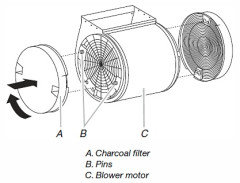
- 4 years ago
"i do have a lot of faith in my contractors."
"my installer thinks maybe it is too powerful and is sucking up grease,"
I would not have faith in anyone who says the latter. That is a level of ignorance rarely seen.
-----
Your first photo seems to show grease in the grout going up behind the hood? Something's not right with that. @dadoes mentioned that this same hood can be recirc? I wonder if something is causing it to partially recirc and that's throwing grease towards your wall and it's dripping down?
jh72
Original Author4 years agoi think whay ny contractor mrant was that it was not just sucking up vapor but was sucking up grease.
- 4 years ago
Not many would want to put up with the noise level of a hood that could actually suck up grease. Horizontal hoods used for welding fume removal from a welding booth might be capable of actually pulling heavier grease splatter toward them, but an over cooktop hood is not going to manage that, even at 24 inches gap, and particularly not with a minimal CFM blower operating through the restriction of a mesh filter.
Again, everyone, kitchen cooktop ventilation hoods operate by capturing and containing the naturally rising effluent plumes produced by cooking. Hoods certainly create slight breezes under them and along the counter and past the cook. But this modest airflow has only a small effect on a hot plume.
Consider a 3 x 2 wall hood achieving 90 ft/min at the entry aperture (not the hood in this thread). If 3 ft above the counter, it has a 7 ft x 3 ft boundary that air flows toward the hood through. So roughly, the 6 sq. ft. breeze at the hood base passes through a 21 sq. ft. periphery area. The average breeze there is reduced to 26 ft/min or (0.3 mph). A maximally reported energetic plume at 240 ft/min is 9 times as fast, and can only be slightly deviated by the incoming breeze.
- 4 years agolast modified: 4 years ago
@Jennifer Hemler
I've seen something like what's in your photos a couple of times, both on newly installed range hoods at friends' new homes. My recollection was jogged by Opaone's last question.
First instance was that the hood came set up for rear venting and had been converted to vertical but the installer had left the rear vent panel cover off with results like that seen in your first photo (grease and goo coming out at the edge of the back and down the wall.)
Second instance had similar symptoms. What I found was that, for some unknown/unknowable reason, the hood apparently had arrived with the blower mounted for rear venting when it was supposed to arrive set up for vertical venting. Or maybe it was the other way around. (It was a few years ago and I no longer remember). Anyway, the installer had not noticed the mismatch. The force of the blower was enough for some air to push out through the exterior vent (so it seemed to be working when the exterior vent was checked) but the majority of the grease was going elsewhere much as seen in your photos.
Dunno if this is the case with your set-up but worth checking if it already hasn't been done.
As for the "sucking grease" idea --- I'm trying to make sense of that. Do you know if your contractor is thinking that the hood is strong enough to suck grease right out of the pan but not strong enough to pass it to grease traps or out the vent?
jh72 thanked jwvideo jh72
Original Author4 years agoThank you.
I will ask the Danmarc guy about the partially recycling idea. Looking at the picture of the filter (imagine that for both of them), there’s no way that residue could have dripped down the back from there (so the stuff on the backsplash had to have come from somewhere else).
Yes, the diagram @dadoes shows are correct: there are 2 filters behind a panel (s/he calls this a baffle panel, for those of you who are writing about baffle filters — does this meet the definition?). We don’t have the charcoal filters because it is vented, correct.
Thanks for your thoughts. DanMarc tech is coming on Monday, so if anyone has other things I should put on the list to ask…. Much appreciated.jh72
Original Author4 years agoOmg @jwvideo that’s incredible!!! thank you. and thanks @dadoes and @opone for triggering this. feels like a good lead.
(@jwvideo to your second question, maybe not out of the pan but because of short distance getting more particles in the air).
@kaseki 6” i believe - will check but i believe that is ehat the manual indicates.jh72
Original Author4 years agoOh but one more interesting tidbit: when the first DanMarc tech mistakenly took out the back insulation, wouldnt there have been grease on that if leaking out the back?

Looks like back panel not removed here. idk. will ask!!!
- 4 years agolast modified: 4 years ago
i think whay ny contractor mrant was that it was not just sucking up vapor but was sucking up grease.
when you cook oily foods, that vapor is mixed with tiny oil droplets so of course it's going to get sucked into the vent. does your hood have another filter inside (sitting on top of the mesh)? those must be cleaned or changed about every six months. they fill up with grease which could flow along the bottom of the hood, back towards the wall, and drip down.
for example, check out my kitchen ceiling vent. see that black spot? the previous homeowners didn't clean the filter so oil flowed out and stained the ceiling. when our inspector took the frame off, there was an alarming amount of liquid oil flowing along the edge of the frame. and being an old ceiling vent, it is not powerful. it's far from the stove it was still sucking in grease anyway!

jh72
Original Author4 years agoThanks. the filter is just three layers of mesh, and they were clean. There isn't a way grease from the filter could have leaked out the back. It is not constructed that way:

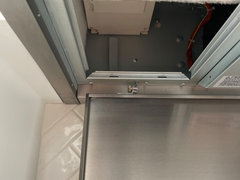
this was before:
- 4 years agolast modified: 4 years ago
I see. maybe the problem is that greasy vapor is floating straight to that part of the wall instead of being sucked into the vent. like others mentioned, this does not look like a very powerful hood.
jh72
Original Author4 years agoCan you guys give me specs on what a powerful hood would be (volts, hz)? apologies if i missed this above. Please take into consideration that this is not a restaurant/industrial kitchen. what do you think of Hauslane?
- 4 years agolast modified: 4 years ago
I think that the 585 cfm that you said is fine. Certainly sufficient not to cause grease to drip down because it's not being pulled by enough cfms. Where the exhaust power is likely curtailed could be in two areas. First the mesh filters. The mesh filter looking like it's clogged as mentioned in this thread already. You said you cleaned it, but the photo looks like it is not clean and clear. Your note about getting a baffle filter hood, but then not, is mystifying to me, can you demand the original baffle filter hood? Also your particular hood appears to have two small mesh filters as opposed to the hood in the photo that @User posted above where the mesh filters cover the entire underside of the hood.
Second, possibly the duct that goes from out of the hood is too small. I saw @kaseki asked the size of the duct, but you did not answer, perhaps because you don't know. If the size of the duct is too small, that could be a reason things are not exhausting out. It looks like this model needs 6" rigid duct to the outside, perhaps you can find out if that is what you have.
- 4 years agolast modified: 4 years ago
"Certainly sufficient not to cause grease to drip down because it's not being pulled by enough cfms."
CFM's aren't the problem with this type of grease drip. The first problem is mesh filters rather than baffles. The second problem is that they are flat rather than sloped. With a sloped baffle filter the grease flows down to the low side and collects there. Without the slope it drips straight down. This is just a really bad design for moderate to high grease and in numerous ways just beyond this.
Also your particular hood appears to have two small mesh filters as opposed to the hood in the photo that @Verbo posted above where the mesh filters cover the entire underside of the hood.
That hood has all of the same problems.
jh72
Original Author4 years ago@RoyHobbs It is 6”. thanks. the first photo of the filter is obviously not clean. That is the ”after” picture. I wanted to show you what happened. After that picture, which was the first time i used the hood, i washed them a zillion times by hand and in the dishwasher and they still look a little stained (hence i am wondering if this really was food grease or something else as someone else wrote). forget about the baffle comment — didn’t didn’t mean to confuse you. the photo @Verbo showed is not my hood; he was suggesting i buy that one.
- 4 years ago
“the photo @Verbo showed is not my hood; he was suggesting i buy that one.”
Yes, I know. My comment above compared yours to the one that Verbo pictured. I said ”your particular hood appears to have two small mesh filters as opposed to the hood in the photo that @Verbo posted above where the mesh filters cover the entire underside of the hood.”
jh72 thanked RoyHobbs - 4 years agolast modified: 4 years ago
Staining on mesh filters may be due to the mesh being aluminum instead of stainless steel. The acids in foods cause a reaction that allows stains to resist being washed off.
A baffle filter is an alternating series of slots with the bottom structure configured as \_/ \_/ ... and the top as the same shape except upside down and shifted. This forces the passing air and effluent to enter a slot and take a path that reverses twice, causing centrifugal impingement of the greasy air onto the baffles, which, ideally, are sloped to drain the grease. Else it will puddle and the baffle assemblies have to be washed more often.
My baffle filter residential hood:
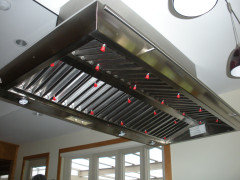
The OP may not realize that any hood blower's claim to having a specific CFM is based on the blower/fan hanging in free air and not operating in the hood system where pressure losses decrease actual CFM. These pressure losses are from the mesh/baffle resistance, the duct resistance, the hood transitions resistance, and the make-up air (MUA) resistance from outside to inside.The result of these pressure losses is to seriously degrade the actual CFM. Under good conditions of baffle filter, adequate duct size, and reasonable MUA, one might expect to get 2/3 of the rated CFM. Under poor conditions, 1/2. With a sealed house and no MUA, nearly zero.
Also, w.r.t. @User's comment: "I see. maybe the problem is that greasy vapor is floating straight to that part of the wall instead of being sucked into the vent. like others mentioned, this does not look like a very powerful hood." If the blower is causing a low pressure area above the mesh filters because they are too restrictive, the greasy vapor rising to the hood structure might be pulled through any gap that is available. Ideally, the hood should be welded into a sealed assembly where the only openings are the filters and where the duct connects.
Volts and Hz are not the relevant parameters, as almost all US hoods will work on 120 Vac and 60 Hz. The requirement that I tout is 90 ft/min air flow under the hood, or the hood area x 90 CFM, actual. Given adequate characteristics for all the pressure losses I listed above, then a blower providing 1.5 x that value should do. I don't think the OP has anywhere near the actual flow that is desirable, but it might not be the blower's fault, but the filter design fault. Mesh filters are effective at low flow rates where the effluent plumes are very weak. Searing meat is not a weak plume source.
jh72 thanked kaseki jh72
Original Author4 years agoI used the calculations according to build.com to determine CFMs needed. i accounted for size of kitchen, size of range, cachement area around range (which i realize has a technical name but i cant think of it right now), gas, total BTUs, length/turns in vent, etc. The CFMs on this unit should be fine. if every manufacturer misstates their CFM, not sure how anyone can figure this out. I realize baffle filters are better — and i know what they are and how they work — but there are other things to consider in buying a hood and this met the other requirements. I’m sorry it sucks. If the biggest problem here is the mesh filters, well, there’s obviously nothing I can do about that but keep them clean and use a splatter guard. I mean, I could buy another hood, which seems to be the only option everyone’s advice leads to. Hauslane has one that’s received rave reviews, it’s 985 CFM, and its really inexpensive (how is it do cheap????). I’m not buying a Vent-a-Hood. I’m not sure how this unit costs so much if it’s no better than a microwave. But KitchenAid sucks. i got the entire kitchen suite from them. what I said before about “switching” to a baffle vent was that i originally bought a hood from KitchenAid that had baffles; it arrived dinged. i fought with them to take it back. then they couldnt replace it bc out of stock and i guess not being manufactured. they gave me this one as a replacement. they do have another model with baffles I should have chosen. if this hood continues to give me problems, maybe i can get them to switch it out for me with that one. That one is 1” lower, and that will cause other problems, though. Hence, if this one still gives problems, I guess I could eat the $1200 and buy another hood. Hauslane gets good reviews, as does Zephyr. And those are nit nearly as expensive as this KitchenAid lemon.
- 4 years ago
Do you find yourself frying a lot? It just seems that the average kitchen would be ok with that vent (if installation isnt the issue). You may need commercial venting if you do high heat frying. that picture you posted is the equivalent of smokers lung. Im not a health nut, but think of your arteries. I hope you get help here, thats got to be a pain to clean.
jh72 thanked M Riz - 4 years ago
I am wondering how those mesh filters even filter if there is a stainless panel covering them?
- 4 years agolast modified: 4 years ago
A brand new hood does this on its very first use?
That amount of grease simply isn't generated in a single cooking session.
Something else is up.
(Is the duct new?) - 4 years ago
I'm not going to critique build.com which I don't use and for which I haven't analyzed their process. I will state that basic fluid dynamics is in play here, and the physics as generally described in HVAC texts determines ventilation performance. There are positive displacement blowers, such as Rootes makes used on drag racers, and piston air compressors, that to first order are not affected by small pressure drops due to filtering and imperfect MUA performance. But for all of the kitchen ventilation fans I know about, including axial, centrifugal, squirrel cage, and other variants that look like out of place desk fans, the total pressure drop across the fan determines how much air it will move per unit time (CFM).
The example "fan curve" shown below illustrates blower performance with pressure losses in tiny fractions of an atmosphere.

The image following shows an example from the Broan/Best/NuTone hood blower stable.
Note: one inch of water column equals = 0.00246 atmospheres.
 4 years ago
Mine is a 48" 1200 cfm chimney one, just very happy with the brand. I also have their wine fridge which is totally silent and works great!
jh72 thanked lucky998877jh72
Original Author4 years agolast modified: 4 years ago@Fori i know, right!?! I’m going to do an experiment and cook the same things and see if it happens again. I’ve made burgers since and there was a little leaking down the back but the filters and inside were OK. I cooked a steak a week later and all was fine.
yes, the duct is new.
- 4 years ago
Conjecture 22: Your contractor cooked burgers for all his guys when you weren't home and didn't turn on the hood.
- 4 years ago
If you do figure it out, please come back and let us know what the problem and resolution turn out to be!
jh72
Original Author4 years agoI just saw the same comment from a thread 2 years ago. $&@! I am furious. wtf. I will post what DanMarc says, but not super optimistic.

jh72
Original Author4 years agoSo just curious, but say i rip out the hood and the next one needs an 8”+ vent. How hard would that be to do?
- 4 years ago
Moi? Who is "he"?
I don't think the difficulties of vent duct size increases can be clear without more information. Your 6-inch duct rises straight to the roof? If there are no joists, rafters, or inconvenient plumbing in the way of growing the hole radius by an inch, then hole sizes just need to be enlarged and a new roof cap used.
Anyway, I don't think the duct is your issue. The issue is how greasy air is treated by the hood. That peripheral slot scheme leading to undersized mesh filters seems to me to add a lot of restriction such the the blower might pull air through unintended paths in the sheet metal causing grease condensation where it isn't wanted. The leak might be amenable to being sealed, but I myself would upgrade.
Upstream in this thread the flow rate is given as 585 CFM. With the peripheral slot and mesh filter design, I'd be surprised if more than 300 CFM were actually passing into the hood. A 6-inch duct has a sectional area of 0.2 sq. ft. So 300/.2 = 1500 ft/min, right in the middle of the recommended range of duct velocities. An 8-inch duct would be a bit too large for this case.
A proper baffled hood of this overall size, however, with a blower sized to provide the desired 90 ft/min through the entire hood entry aperture, might be best served with an 8-inch duct.
I suggest the following experiment. Take a pan with some peanut oil in it and heat to the vapor point of the peanut oil. Observe whether the hood is actually collecting all of the vapor. Compare behavior with windows and doors shut to operation with at least one window wide open.
What is the nature of your make-up air 'system'?
- 4 years ago
Duct size and routing (each bend or change adds static pressure which reduces CFM throughput) may limit the airflow (CFM's) of what hood you can have. HOWEVER, appropriate capture area and containment volume are actually more important so if you get these right then you're likely in good shape. Commercial hoods can use fewer CFM's than consumer but CFM's look good for marketing.
Read the FAQ I posted above.
jh72
Original Author4 years agolast modified: 4 years agoHey all. so DanMarc came out and spent a lot of time with me. they determined the hood is ”functioning as designed” and said that the hood ”is powerful.” I then called kitchenaid to tell them the design is obviously faulty and what are they going to do about it. They are sending new filters and said i could have them send out a second opinion, but if this tech determines nothing is wrong, then i pay for the visit. I do have an HSA but i don't think they'd deal with this because the hood is still under warranty.
so, i get that there are problems with virtually every aspect here. I have a 6” vent that I’d need to upgrade if i get a ”more powerful” hood; I’d also need a serious make-up air system; i likely need to replace the cabinets because every baffle-filtered hood i see needs 30” of space from flame to hood and I only have 25 if i measure from grate top, 27 if countertop to hood (kitchenaid did ask if i had enough distance from cooktop to hood... prob would void the warranty).
The DanMarc dude said, as others in this thread have, to just use a splatter guard or cook burgers outside. (He did inquire about the fat content of said burgers; super fatty for my underweight 12-yr-old.) He said the hood is fine unless I want a crazy commercial-grade hood, which I mostly do not need.
I’m not sure I want to or can remodel my remodel, but for the sake of discussion, who do i call to come do a full assessment of vent, air flow rate, make-up air needs, etc.? let me guess….
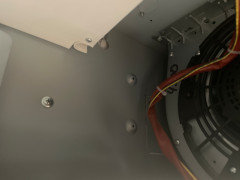











M Riz