Software
Houzz Logo Print
caitlin622

Major backyard renovation turned my soil upside down

4 years ago
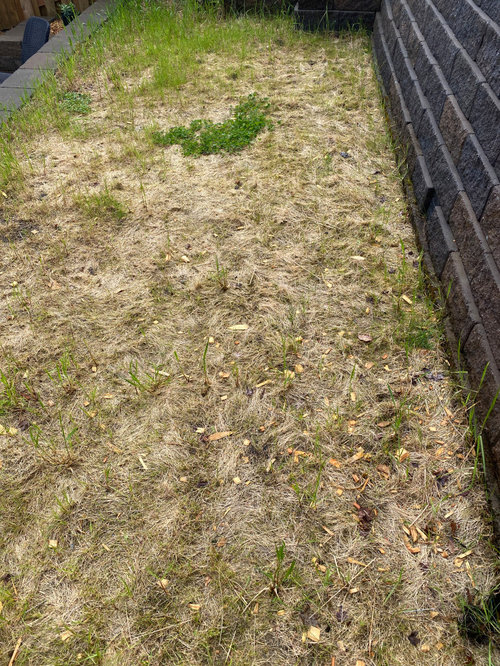
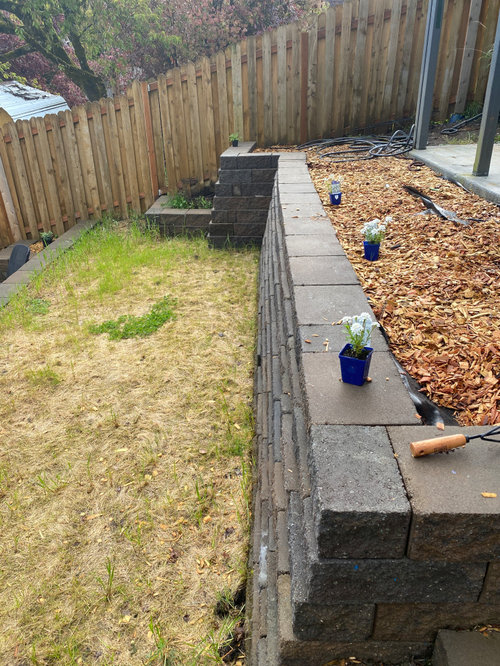
Lasy Spring we did some terracing in our hillside, adding retaining walls to gain some flat spots.

The result is our new "lawn" is a dead grass spot and our retaining wall planter is barren. We backfilled the retaining wall planter with dirt from the construction.


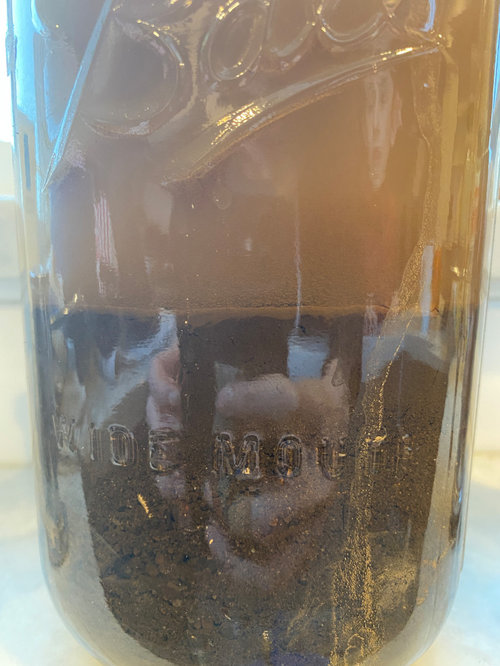
Retaining Wall: I did a jar soil test, see pic. When I was digging the dirt for the test there were worms in the soil which seemed like a good thing. Results show there is about 1% clay and no organic matter, 74% sand, 25% silt- so that makes loamy sand? sandy? sandy loam? I can't tell because the lines do not intersect on the soil test chart. In any case, I do not want to engage in an endless battle if neccessary. Can I use plants that would like this type of soil and be good? Russian Sage, Blackeyed susan, Lavender??, Hostas, COneflowers? Will I need to constantly emmend the soil with compost? Do I need to start a compost farm?


Sad Lawn: My landscaper insisted that after we shaved the hillside off 6-24" we would only need a 2" layer of topsoil and the grass would grow. And it did, for a second, now its like dead hay. This is a very difficult location to get access too so I am trying to avoid bring in any heavy equipment or lots of material. I read about "BIOChar", that is great for sandy and nutrient weak soil. Would it work to help improve the soil structure??


Comments (30)

  • 4 years ago

    Where are you (geographic location)? Do either of the areas have irrigation? Do you know what kind of grass(es) comprise your lawn?

  • 4 years ago

    I am in Vancouver, Washington - PNW. The glass seed mix was Vigaro Constractors Grass Seed Northern Mix - no specific species is listed :/ I used a sprinkler on the grass last spring/summer on a timer but it didn't seem to do much good.

  • 4 years ago

    I would aerate the lawn areas and reseed with a seed that's not from a big box store. And then I would cover that with an inch or so of bulk mushroom compost. I'd also amend any beds that aren't already planted with the same compost, at least 2" of compost.


    I would go to a garden center and buy seed out of a large container with a scoop and a handy scale. The place I go has a large selection of grass seed. I'd make a recommendation but I don't know where you are. I'd sow 3-6 pounds per 1000 sq ft.. Scatter it by hand, don't get it into beds.

  • 4 years ago

    LOL!! I had a long response typed out yesterday but then for some unknown reason, lost my internet connection before I could post (suspect a lot of construction activity in the neighborhood). By the time things were up and running again, I forgot all about it :-)

    Soooo.......I would agree to using a regional seed source. Oregon grows more grass seed than just about anywhere else in the country so it shouldn't be hard to find. You want a blend formulated for areas west of the Cascades that eliminates the inclusion of Kentucky bluegrass, as that does not thrive in our climate and rarely overwinters. I suspect a heavy percentage of your Vigoro product contains KBG, which could help account for the dismal appearance now.

    The scraping/regrading/removal of topsoil with the terracing is also not helping the matter. As you noted and was confirmed by dchall, the lack of any organic matter is going to limit the growth of anything and certainly the lawn. Only 2 inches of decent soil layered above the almost impervious subsoil is not sufficient to support the lawn nor provide sufficient moisture to the roots. But not much you can do now except to topdress with a screened compost before and after re-seeding. Doesn't need to be mushroom compost - any compost will work equally as well

    dchall would recommend you using baby shampoo to help soften the soil but IME, while it may help with water penetration, it does nothing to reduce compaction. I'd recommend any manual form of aeration you can manage to loosen that subsoil.

    Last year's extreme heat and extended summer drought probably didn't help much either. It would be helpful to know how often and for how long you watered. With only 2" to work with, the soil would dry out very quickly and you would need to bump up the duration and frequency.

  • 4 years ago

    "dchall would recommend you using baby shampoo to help soften the soil but IME, while it may help with water penetration, it does nothing to reduce compaction. I'd recommend any manual form of aeration you can manage to loosen that subsoil."

    gg, Soil compaction hasn't been mentioned until you mentioned it. With sandy soil I don't usually get concerned with compaction. What do you think about taking a season off to grow a deep rooted, leguminous, PNW friendly, cover crop where the lawn goes?

  • 4 years ago

    By definition, subsoil almost always is compacted. And sure, a cover crop would work well. I'd probably go with alfalfa.

  • 4 years ago

    Thanks guys!

    Good to know Biochar wouldnt be a quick fix. Sounded too good to be true.

    I did some exploratory digging in the lawn area and there is a good 2-3" of topsoil and then rocky sandy loam. I did the same terracing on the side of my lawn a couple years earlier and while the grass is sparse, it is growing.

    I would not suprised at all if that extreme heat wave we had last summer was part of the problem. And honestly, we want to minimize watering our lawn as much as we can. It feels like such a waste of resources. I am leaning towards some sort of cover crop.

    Has anyone here had success with micro clover?? There is a big patch of green clover growing in the middle of my dead grass. And I like the idea of using a cover crop that will help rejuvenate my soil. Would it be possible to overseed with the microclover or alfafa and NOT till the dirt up? And, I would need to wait until late August to do the reseeding? This is too late in the season?

  • 4 years ago

    I recommended aerating so that some of the compost would get deeper into the soil.

  • 4 years ago

    If the plan is not to keep 'lawn' growing there but to have other types of plants growing (which to me would make sense from the pictures), load up on whatever type of compost you can get cheap and in bulk. (I'm thinking perhaps not exclusively wood chips - and if a mix, wood chips on top. ) Aeration- eg just using a pitchfork to 'crack' after some compost down would be good. And cover crops would make sense and periodically some more compost (composted leaves for example) to encourage some worms to get busy. For ground cover plants (if you want more plants), have to check what's available locally.

  • 4 years ago

    I was thinking the same thing about using a pitchfork. Not a hay fork, but a potato fork that has 4 heavy flat tines that you can drive into the soil with your foot. Wiggle it a bit and pull it out. Move a few inches and repeat. Then spread some fine compost and rake over, so as to get compost down in those holes.


    You could even do this after a lawn gets going in there, because it doesn't disturb much of the ground.

  • 4 years ago

    If you compost the lawn as suggested here you'll need to be cautious when fertilizing. If you apply fertilizer as recommended on the packaging you'll be mowing 2 or 3 times a week.

  • 4 years ago

    Sounds like aerating is heavily suggested. Im starting to think compost with tilling in the fall and then planting a ground cover into the dirt is the way to go. I start a dual-chamber compost tumbler on the side of my house. Im strangly giddy about composting our scraps.

  • 4 years ago

    Garden Gal - Do you think tilling will make a big difference or should I just start layering ?

  • 4 years ago

    I would advise as little tilling as possible. Layering is good and if you are planting some deep rooted cover crops, even manual aeration is not necessary. No need to wait for fall......you can plant alfalfa now and by next spring that soil should be loose and fertile and ready to seed or sod!

  • 4 years ago

    I would seed, mulch with mushroom compost an inch deep, and then aerate NOW. Why wait for fall and why grow another crop. But don't till. On a lawn aerating is gentle tilling. The only reason to wait is drought conditions, but such a small lawn can be watered. And if you grow a cover crop thru a dry season you'll either water it or get no cover crop. Put your money into a lawn if you want a lawn.

  • 4 years ago

    The reason for the deep rooted legume is to completely avoid tilling, digging, double digging, rotovating, lifting, or any other synonym for the mechanical disturbance of the soil. Let Nature do it with roots. Alfalfa would have been my suggestion, so I'm glad to see GardenGal suggest it for the PNW. When the alfalfa is killed out, then those roots in the ground become the organic matter you want to have. There is no better organic matter than roots...except maybe for the living microbes in the soil. As the roots shrivel and decompose, they leave air gaps which become important to the soil structure. Tilling, etc., destroys those air pockets which requires the soil to start reforming its structure from scratch.

    To respond to John D, the main reason for not seeding now in much of the country is that spring-seeded northern grasses cannot develop a root system that will stand up to the summer heat and that NOW is the time when crabgrass seed wants to germinate. For those two reasons now is not a good time for most of the country. As GardenGal has pointed out in other discussions, neither of those reasons is important in the PNW. So what she and I more or less concluded is that the main problem is with the bulk of her soil being subsoil and not enough top soil on top. With that in mind we are suggesting to improve the OP's soil using a botanical and biological approach with deep rooted alfalfa and some mulch. Then later the alfalfa can be mowed down and replaced with grass seed. That's the logic. The OP is welcome to ignore that and go with new grass now, though. I'm a firm believer that organic fertilizer can fix a lot of soil issues, and I do understand that no amount of organics will fix most chemistry problems. I suggested a soil test earlier. It could be that even the new top soil needs some work.

  • 4 years ago

    OP needs to decide whether the "to be a lawn spot" is a permaculture study plot or a lawn. This soil was filled in last year and is still very loose. I have rented a very small backhoe, ordered topsoil which was dumped and got a load of mushroom compost in my pickup truck, Using the backhoe I mixed the mushroom compost into the topsoil which in this area is shredded clay and sand mix. I then spread my mix with the backhoe, but it's too late to do that here.


    If you want a lawn put in a lawn. You can repeat the inch of MC every spring and in a few years you'll have a beautiful lawn with lots of organic matter in the soil. Crab grass seed has already sprouted here and I suspect in the PNW. Close to half of new construction is finished in the spring here and they all need a new lawn. The builder doesn't promise a new lawn next fall they put it in come spring. They get a landscaper that knows how to grow grass when the grass is needed.


    My last post here!

  • 4 years ago

    "This soil was filled in last year and is still very loose."

    Wrong. The area was scraped and graded, exposing the subsoil, which is never loose, hence the issues of or potential need for aeration. Only a scant 2 inches of topsoil was used to topdress and plant.

    A backhoe is going to be a tricky item to get to that area and completely unnecessary as well. To what purpose would one need to use a backhoe here? And there is no magical property to mushroom compost that can't be found in other types of compost and arguably, the mixed ingredient kitchen waste/yard waste type has the greatest diversity of nutrients.

    The PNW is a recurring summer drought area and always under the potential for summer watering restrictions. Most turf grasses require a whole lot more irrigation than the deep rooted crops like alfalfa simply because they are not very deep rooted....and most certainly with only 2 inches of topsoil to work with!!

    "Close to half of new construction is finished in the spring here and they all need a new lawn. The builder doesn't promise a new lawn next fall they put it in come spring. They get a landscaper that knows how to grow grass when the grass is needed."

    Boy, is that a fallacy! LOL! All any developer wants is the place to look pretty for sale and meet the requirements of a COO. And in new developments it is generally only the front lawn that gets planted - the back is left bare. In my area, these are done by sodding, not seeding, and all the developer/landscaper needs to do is keep it green for as long as it takes to sell. Period. They could care less about lawn care or even know much about it.


  • 4 years ago

    GG You need to learn to read and THINK.


    "Lasy Spring we did some terracing in our hillside, adding retaining walls to gain some flat spots.

    The result is our new "lawn" is a dead grass spot and our retaining wall planter is barren. We backfilled the retaining wall planter with dirt from the construction."


    Backfilled from construction means they took soil off a pile of saved soil and dumped it back behind the walls. I'd "guess" that 30-40% of the soil was back filled. The high wall is 28 inches high looking at 8 rows of 4" block.


    The soil should have been mixed with any kind of mulch as it was being back filled. I would have planted grass seed in March, but I'm here not there. But I don't think there's too much of a difference in planting time. The grass should be up and looking very nice. At it would need water this year and every year in the future.


    GG you have about the same respect for builders as every other group you discuss. Excepting the fertilizer/potting soil industry.

  • 4 years ago

    I thought you were done? And do you really need to come back to this discussion just to insult me?? How about you do so some rereading and thinking as well??

    "landscaper insisted that after we shaved the hillside off 6-24" we would only need a 2" layer of topsoil"

    The removal of 6 inches or more of any soil is very likely going to result in subsoil as what is left to work with and 2 inches of topdressing with any kind of "topsoil" (whatever that is) is not going to cut the mustard for growing any kind of decent lawn. There was no mulching involved and a soil devoid of organic matter. How precisely is that going to create the conditions necessary to grow a healthy lawn? Short answer - it's not!!

    You know nothing about the PNW climate or growing conditions so please don't offer suggestions that do not apply. All that does is confuse the issue. They are quite unique and not anything like you would encounter an entire continent away!

    I am a professional horticulturist and I do this for a living. I work with developers and new build homeowners all the time so I have more than a little experience with these situations. Do you?

    You know nothing about me, my education, background or experience so please refrain from commenting about me personally. And you can't even do that with any degree of accuracy. I have never had much respect for the fertilizer industry....most of it is marketing shill. Other than containers, I rarely fertilize anything.

    You can go crawl back under your rock now. Further comments from you are unwanted and unnecessary.

  • 4 years ago

    Yeah, this backyard makes me miserable too.

  • 4 years ago

    caitlin, sorry for taking your post off track. But I get very tired of comments from misogynistic know-it-alls that don't. 🤣 And that consistently make inaccurate statements with nothing more than "it works for me so it must be right" to substantiate them.

  • 4 years ago

    I know grass, how to grow it. I can grow a lush lawn on hard clay with an inch of most any compost. You need to reread the back fill statement. And you need to reread my backhoe story. Also you need to reread how many times I didn't make a suggestion that required local knowledge.


    And if you can't take criticism then you might watch your own tone. I don't believe your experience especially any current work. You spend your entire day trying to get to top of the number of posts list and schilling fertilizer.

  • 4 years ago

    Caitlin, which direction does the terrace face? I'm hoping you'll say it faces to the south.

  • 4 years ago

    The backyard faces North :(


  • 4 years ago

    Gg- You were correct interpreting that the soil is not loose, it was scraped and backfilled into the Upper planter. The lawn area is all compacted subsoil with 2" of topsoil. I ordered some clover seeds and hope those will germinate with what time we have left this season. I figure its worth a shot. There is alot of matted down grass thats almost mossy (maybe is just decomposing?). Ill try to scrape as much up as I can before seeding. The alfalfa sounds interesting but also really ugly. In reading it grows pretty long and raggedy and can be difficult to get rid of?

  • 4 years ago
    last modified: 4 years ago

    In my expereince biochar would be very beneficial in this situtation--along with a goodly amount of compost. Biochar at a mircoscopic level is incredibly porous. That porousness provides space for air and water to move as well as habitat for microscopic soil life. That microscopic life also redistributes the biochar application. Compost feeds the soil life. It is the entire kit and caboodle that is absent from subsoil.

    About 40 years ago, 45 acres of what is now my farm was phospate mined--a process that digs up the top foot or so of soil, runs it through machinery to extract the phosphate then dumps it back out to be redistributed across the field.. The result being that what was top soil becomes subsoil--not dissimilar to what you see pushed back against the foundations of new homes. Except here its acres and acres of it.

    The 30 years prior to our buying the place it was mostly used for hay--a process that removes the organic matter from being reincorporated with the soil only compounding the problem. As one freind said: "yeah, it's terrible hay, but it's better than snowballs."

    A couple years ago we began trialing a biochar product (49% biochar, 49% compost, 2% mycorrhizal fungus) in our pastures. And in my lawn. It is not like throwing down nitrogen where you get a quick hit, but over the course of time we're seeing some significant improvements in what the soil is able to grow and sustain.

    The spring following application I get a naturally occurring cover crop of white clover. Good stuff clover: fixes nitrogen, a thick root system that breaks up the packed soil and the horses love it. Then following the clover the ground becomes much more receptive to grass seed (fescue.)

    Undesirable weed grasses such as foxtail (terrible in grazing applications) that thrive in hard pan that won't support quality forage grasses is now getting out competed. I was told by my ag sources that the only way to get rid of foxtail was to start by rounduping the whole pasture, yet in the first year after the biochar application we had half what we normally have.

    I've done heavier applications in lawn areas around the house and again I've now got a bumper crop of clover in places that a year or two ago was packed dirt that grew nothing. Now if I lived in town, waiting a couple years for it to pan out to good lawn might be more patience than most have. But I'm happy with anything that is green and mows nicely.

    So in my expereince, when trying to remediate severely disturbed soil, biochar is not showing itself to be a gimick at all.

  • 4 years ago

    That brown grass could be perfect protection for the clover seed. If it's matted, you could gently rake it with a leaf rake to fluff it up, then spread the seed.

  • 4 years ago

    LOL!! Cover crops are not intended to be pretty :-) They are there to serve a function and then be cut back or tilled in. But in flower, alfalfa is not unattractive!

    Clover can work as well but does not have the same deeply penetrating root system so not as effective in breaking up or loosening compacted soil. And it could also be tricky to remove as it flowers early and often and can then disperse seed which will germinate and start the plant cycle all over again.

    But any cover crop is better than NO cover crop!