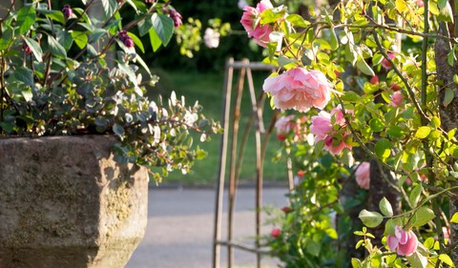
It's raining this morning, started yesterday and forecast to continue, increasing in intensity, until tonight. It should flatten the roses nicely, just in time for the arrival of my horticulturalist sister and her friend and my two nieces from the U.S.; this, after most of a year of low rainfall. The roses were at the peak of their splendor. These are the warm climate roses that grow around the house, the only place on our property where they do well, owing to the steeply falling ground, rock, rubble, and weedy organic debris, that we terraced and backfilled with dirt. They like the good drainage and the soil, lighter than the modeling clay that makes up most of the rest of our land; and they like the thick planting, the presence of trees and other shrubs that moderate the effects of wind and sun and keep humidity levels higher than in more open ground. Teas, like most roses, I imagine, like moderate temperatures, not too hot or too chilly, and a degree of atmospheric moisture, and this spring, we've had them all. Flowering is somewhat earlier than what I'm used to, probably the result of a spring that really began back in January, with unusually sunny weather and warmish days even during the winter. The once-blooming European old roses haven't started yet: I expect them to get going around the middle of the month.
So, the Teas. The warm climate roses that grow around the house are 'Archiduc Joseph', 'Etoile de Lyon', 'Sanguinea', 'Clementina Carbonieri' (of commerce), 'Souv. de Mme. Leonie Viennot', 'Safrano', 'Général Schablikine', 'Crépuscule', 'Cl. Papa Gontier' (supposed to be, but I have serious doubts), 'Comtesse du Cayla', 'Odorata', 'Maréchal Niel', 'Noella Nabonnand', 'Jaune Desprez', "Miss Mystery", ''Mme. Antoine Mari', 'Mrs. B.R. Cant', 'Duchesse d'Auerstaedt', and 'Mme. Alfred Carrière'.
These have been in the garden for years, the oldest planted around 2003 or 2004, all at least a decade ago; they're a mixture of grafted roses and ownroot roses that I propagated myself. Some are more prosperous than others, though all are solidly with us.
'Mme. Antoine Mari'. What a compliment Monsieur Mari paid his wife when he named his rose after her. For elegance, for loveliness, this rose has no superiors and few rivals: it epitomises the peculiar beauties of Tea roses. The blooms are large, shapely from the bud stage to fully open, creamy white touched and shaded with pink, with thin stems and healthy dark slender shining foliage. None of this puts into words how heartstoppingly beautiful this rose is. It's a good plant, too, that grows well and unfussily and keeps on going year after year. Now, faults. There are few. The growth of my plant is awkward, probably because of awkward maintenance. The blooms turn an ugly yellowish color at the end of their lives, though only after several days of glory; in fall, when the weather cools, the pink tints go away and the flowers are whiteish and insignificant, but we're talking about November. The scent, of Tea, is only moderate; the short thin stems aren't the best for cutting. My plant is about eighteen years old and the basic canes look battered and, dare I say it, diseased, but it continues to put out new growth and canes and bloom lavishly, so I dare say all is well, or at least, well enough. It lives on the water nature supplies it and such organic debris as I toss down at its base: a frugal creature. At perhaps two meters high and wide, it display less of the tendency to take over the world that some Teas do. The foliage is healthy, and the plant is tough.
'Clementina Carbonieri'. I think it has been determined that this is not the true variety, but it continues to be sold under this name. This is one of those Teas that, given the chance, will climb. Ours doesn't climb, but scrambles all over the escarpment, the small sharp drop, planted with shrubs, at the edge of our yard, lolling over pittosporums and rosemary and descending to meet the ceanothus on the bottom. This rose is about as bright as a rose can be, the luminous light-shot hues shading from gold through orange juice orange to hot rose red. Aside from the amazing and beautiful color, the blooms are large, shapely, and abundant, and the foliage is healthy, dark, and handsome, the green suffused with wine red. It has a decided Tea fragrance. Drawbacks? Well, it burns. It needs mild temperatures and some moisture in the air, otherwise it fries rapidly. The blooms die off badly and hang on the bush. The variety is a great grower and as lovely as a rose can be, and just amazing for color, but it needs a certain kind of climate, and it won't look good unless conditions are right. Like most Teas, in my experience, it's a frugal grower and an easy plant.
'Etoile de Lyon'. The flowers are beautiful: large, full and shapely, and a wonderful color, soft blended yellows passing through numerous subtle changes as the bloom develops. The growth is somewhat stouter than that of many Teas, making a large shrub--that wants to get ever larger--tough and frugal as Teas tend to be, and healthy. The flowers last well when cut and are more weatherproof than some. Fragrance is moderate, of Tea. This rose in my garden has a sole but ruinous fault: the beetles adore it. No rose in the garden suffers more from their depredations: they ruin the blooms on the plant and so its overall appearance, and I have to look hard to find a few blooms to cut that the beetles haven't damaged yet. The only good times are when the rose blooms unusually early, before the beetles are out, and I get a couple of weeks of happiness. I know of no solution to this problem.
Just one more rose, not a Tea: 'Mme. Alfred Carrière'. Sometimes I take this rose for granted, when I have to scramble around on the steep slope, dodging shrubs, to cut back aging growth, or when it gets a bit of fungal disease in the summer. But. In spring it's coved with blooms, large, shapely, highly fragrant, with a scent that travels, color a creamy white tinged with pink and buff. No beetle problems here, no burning, and the flowers are excellent for cutting, with stems long enough, though thin, and they're certainly numerous enough, and they last some days in a vase, looking good the whole time. We had to move all our pots from under the wisteria pergola because of foundation work to be done later this month, and so they went under the rose pergola that runs along the periphery of the paved terrace of the second house. The principal occupant of this pergola is 'Mme. Alfred Carrière', and she's doing a great job of sheltering all the pots of roses, bouncing bet, sarcococca, honeysuckle, and so on, under her generous skirts.





jacqueline9CA
Sheila z8a Rogue Valley OR
Related Professionals
Cookeville Landscape Architects & Landscape Designers · Montréal Landscape Architects & Landscape Designers · Sanford Landscape Architects & Landscape Designers · El Dorado Landscape Contractors · Florence Landscape Contractors · Alexandria Landscape Contractors · Napa Landscape Contractors · Orange County Landscape Contractors · Ogden Landscape Contractors · Decatur Home Builders · Rome Home Builders · South Sioux City Home Builders · Guymon Home Builders · Kennewick Home Builders · York Home Builders