Software
Houzz Logo Print
roseseek

Not bad for NEVER fertilizing...

4 years ago
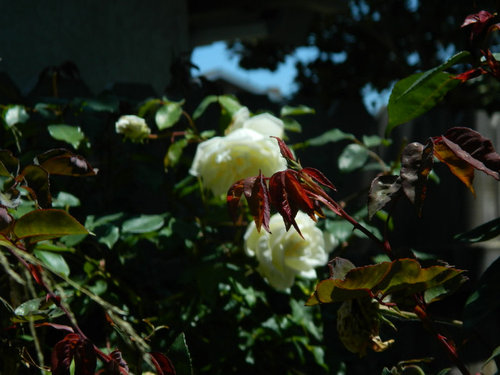
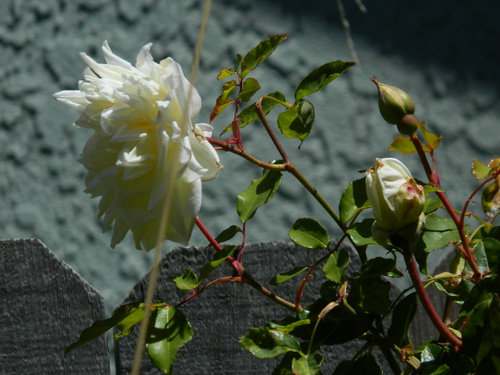
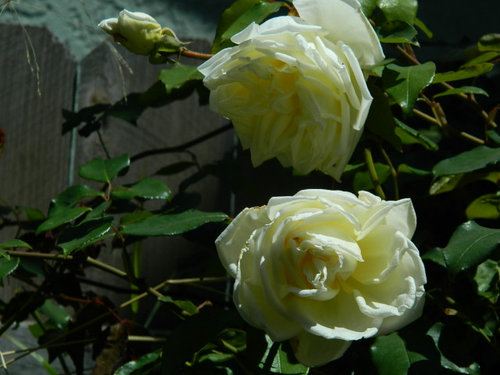
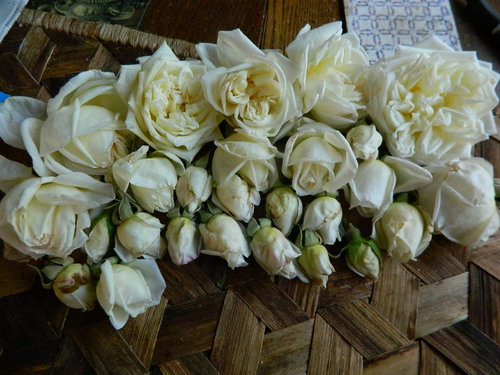
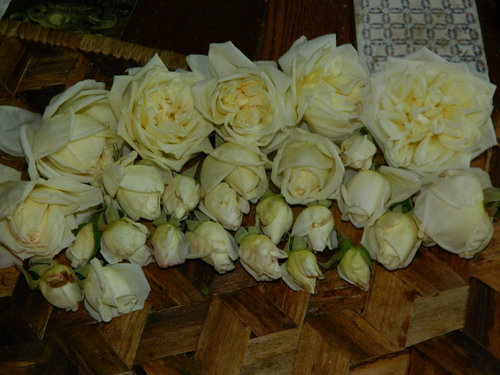
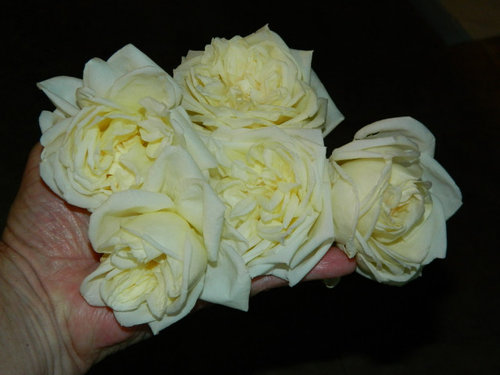
I don't fertilize. I grow everything in large nursery cans for a variety of reasons so the plants have to survive on the potting soil. The cans rest on plastic sheeting to help keep the grasses and liquid amber roots out of the cans. This is Jesse Hildreth. It grows on the north side of a 6' wooden fence on the east side of the house. There is a large Hollywood Juniper on the south side of that fence which filters the sun it receives for many hours in the mornings. It receives filtered sun through that tree, reflected sun off my house wall, then a bit of overhead sun (when the sun is high enough to shine over the Hollywood Juniper, then reflected light from the neighbor's house wall, over the fence and reflected off our house. The plant receives ONLY hose water. I harvested these buds and blooms for pollen yesterday. Jesse spasms these regularly nearly year-round. Canned, not "full sun", no chemicals OR organics, just hose water and the soil is several years old potting soil.


Natural light

Flash


Comments (14)

  • 4 years ago

    Pretty, pretty, PRETTY!! I want 'Jesse Hildreth'!

    I do a lot of soil amending when digging planting holes in much of the garden because most of the soil is so poor in organic matter, and lately have been adding sand, too. While plants are getting started, I often mulch. I don't fertilize. I don't water plants in the ground after the first year. I can't show pictures of how the garden looked before the deluge of the last two days (we got over two inches!) that flattened everything, but the roses were magnificent, so abundant, large, and full: as good as I've ever seen them. And they just happened, with no input of mine beyond occasional pruning away of old growth.

    roseseek thanked Melissa Northern Italy zone 8
  • 4 years ago

    How beautiful, Kim! Jesse is amazing.

    roseseek thanked Sheila z8a Rogue Valley OR
  • 4 years ago

    Beautiful! You know, I'm with you Kim - I have been fertilizing once a year, but I'm beginning to think maybe it's just not necessary. My soil is pretty good, I think, so I wonder if it's really making that much of a difference. Maybe next year I'll try skipping it entirely except for any roses that are really struggling, and see if it makes a lot of difference. Fertilizer (I get the organic granular stuff) is expensive, and if you have a lot of roses it sure adds up!

    roseseek thanked User
  • 4 years ago

    I really want Jesse Hildreth!

    roseseek thanked Stephanie, 9b inland SoCal
  • 4 years ago

    I want that rose soo badly! I look it up as often as I think of it, near daily to see if it's in stock!

  • 4 years ago
    last modified: 4 years ago

    @jacqueline9CA I grow Atmore Lamarque and Jesse may be related, but it is not Lamarque. Lamarque is a bright white with a strong lemon scent, while Jesse is pale yellow fading to a tinted white and its scent is not a pleasant one to my nose, being rather bitter and chemical-like. Its foliage is brighter, lighter green with a more matt texture. Add that it is a rampant climber compared to a huge, messy bush which builds into what resembles a climber, and Lamarque holds its flowers on short laterals where Jesse holds his at the ends of fairly long stems and those are the most obvious differences. Of course it is possible they both share Park's Yellow Tea-Scented China as a common ancestor. Lamarque's other parent is supposedly Blush Noisette and Jesse has no Noisette character to him at all. Unfortunately there are no known plants of that to compare against. Lamarque is a first generation offspring from Park's as are Blairii #1, #2, #3; Devoniensis; Jaune Desprez; Lamarque; Le Pactole; Safrano and Smith's Yellow. The last one is also apparently extinct, and @jerijennings is of the opinion Jesse may well be Smith's. At least there are some available offspring against which to test it, if that ever happens.

  • 4 years ago

    I too have Jesse and Atmore Lamarque and as Kim explains they are different.

    Westside Road Cream Tea might be Jesse Hildreth. Ingrid described WRCT's blooms in extreme heat and Jesse does that here too.

    roseseek thanked Sheila z8a Rogue Valley OR
  • 4 years ago

    Thank you roseseek! You always have the right answer to everything, and I appreciate it very much. Also you give me fun things to look up - I am going to look up 'Smith's Yellow' in my rose books (must admit that I have gotten carried away collecting them - I think I have over 40 at this point) just for fun. Would it not be wonderful if Jesse IS Smith's Yellow? I love these old mysteries, even if they don't get solved, they are fascinating.


    Thanks for chiming in, Sheila - WRCT is another rose for me to look up, although being a mystery with a study name itself, not quite as intriguing, although it would be neat if it was the same rose as Jesse.


    Anyway, now I am going to assume my rose is Atmore Lamarque, and that is another rose name to look up and have fun with!


    Jackie

    roseseek thanked jacqueline9CA
  • 4 years ago
    last modified: 4 years ago

    Thanks, Jackie. Your rose appears to be Lamarque. Atmore Lamarque is also Lamarque, only it's propagated from the historic plant brought by covered wagon from Placerville to Santa Paula where it was planted on the Atmore family Queen Anne mansion. It still grows there. Look at Jeri's comment here on HMF dated 01/03/2016.

  • 4 years ago

    Another person here who wants a Jesse Hildreth. I had her for awhile but she died in our horrendously hot summer a couple years ago. She was in a much too hot spot and I've learned that lesson. Love this rose!

    roseseek thanked debbym, Tempe, AZ Zone 9
  • 4 years ago

    High on the list of why I prefer old roses to modern varieties is my experience that they really don't need a lot of fertilizer to do well, nor a lot of water once established (though you won't get maximal repeat on remontant/continuous-blooming varieties with reduced water). I toss a handful or two of alfalfa pellets under each once a year, during the winter, and that's pretty much it, along with leaving dropped leaves and such to decompose naturally (no leaf blowers in my yard).


    Many older rose varieties were developed when synthetic fertilizers weren't readily available and are sort of like what crop varieties were like before the Green Revolution. Green Revolution varieties of corn, wheat, etc. were developed with assumptions that optimal amounts of fertilizer, water, and weed control could and would be present and, in fact, most of these varieties are unable to survive in the "wild" or without constant human input and support. Similarly, many modern roses, developed under the same assumptions (but, add grafting), are very needy and seem to require a lot of extra resources for them to do well, or even survive. There is no rose tougher or more resilient than an old rose found in a pioneer cemetery in California!


    I am a great fan of the 'Park's Yellow Tea-Scented China' descendents, and firmly convinced that "Jesse Hildreth" and "Westside Road Cream Tea" are in that group and are actually the same variety, whatever it was. It certainly would be interesting to see genetic comparisons of the group @roseseek mentions.

  • 4 years ago

    What a beautiful rose and great conversation!

    roseseek thanked librarian_gardner_8b_pnw
  • 4 years ago

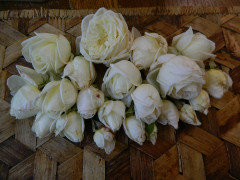
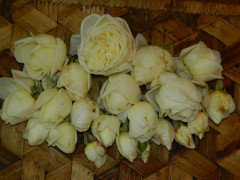
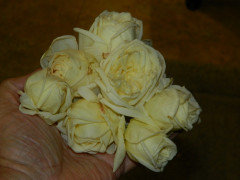
    It's four days later and Jesse is at it again! It's too windy to expect them to look decent outside so they got harvested. Remarkable what plain old water can produce and remarkable for these appearing so reliably in such gawdforsaken nasty cold windy weather.