Software
Houzz Logo Print
webuser_815983604

Yellow St. Augustine

4 years ago

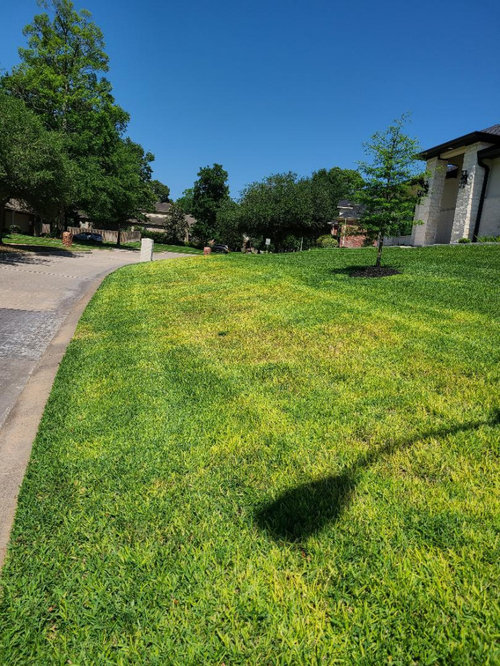
I'm having a terrible problem with my lawn. I had brown patch in the winter and now a large part of my lawn is bright yellow. I have fertilized and treated again with Scott's fungicide about 1 month ago. It seems to be getting worse. See the pictures. Any suggestion in the cause and solution? Thank you.


Comments (5)

  • 4 years ago

    It may not matter, but where do you live? That helps with climate and soil conditions. Your zone is meaningless. If you live in Frisco, then tell us. We're not going to swing by and see the lawn.

    What is your watering schedule? How often and for how long do you water?

    You are going to be both surprised and very skeptical with my suggestion for you, but there are many happy readers who have done this with success. Here goes.

    Apply ordinary, whole ground, corn meal at a rate of 15 to 20 pounds per 1,000 square feet. Give it 3 weeks to work and then get back to us with an update to your skepticism. Tell me where you live and I'll tell you where to buy 50-pound bags of cornmeal. I don't know why but this only seems to work in St Augustine lawns. Others with other grasses tell me that the disease does not go away, but those with St Augustine almost invariably agree it works for them. I used it for 15 years in a row and it worked every year. Then I moved away to a place where I never got the disease. Now I'm back in San Antonio where I had it before, so we'll see what happens.

    The reason (I believe) that this works is because the disease is caused by fungal microbes. When cornmeal decomposes in the soil, it is decomposed by different fungal microbes. As part of the soil food web, there are still other microbes which feed on the fungi which are decomposing the corn. Those microbes continue to feed on the microbes causing the disease in your grass thus clearing it up completely. If, after 3 weeks it looks better but not best, you can apply more corn meal. With these mild grain type organic fertilizers, you can apply any day of the year, or every day of the year, and you cannot hurt the grass. The grains feed the beneficial soil microbes and restore the health of the soil.

    The disease is caused by too much water, so don't be surprised if I suggest you water less often once you give me those particulars. I realize Mother Nature has a hand in the watering, so your location is important.

    And NOW is a great time to apply the corn meal, because it also is a mild organic fertilizer. In 3 weeks you should see a noticeable improvement in color and density. So you need enough corn meal for the entire lawn or else you will have dark green spots.

    Here is a motivational picture in favor of organic fertilizers.


    Notice the improved density, color, and growth. This was taken by mrmumbles in 2011 and posted to this forum. In mid May he dropped a handful of alfalfa pellets (rabbit chow) onto that spot in his zoysia lawn. In mid June he took the picture and posted it.

  • 4 years ago
    last modified: 4 years ago

    Thanks for the suggestions!! I live just north of Houston, TX. This is a new house and the lawn is almost 1 year old. I have a sprinkler system and am watering 3 times per week. The amount per zone is not yet up to 1 inch / week (I have the sprinkler design doc with the watering schedule / timing specs for each zone to equate to 1 inch of rain). I'd say we haven't had an unusual amount of rain since spring started. Let me know if you need any other detail. Thanks again!!!


    P.S. Here's a

    more close up picture of the grass.

  • 4 years ago

    So you're not really letting the soil dry out before watering again. That is a problem.

    Watering: Deep and infrequent is the mantra for watering. This is for all turf grass all over the place. Deep means 1 inch all at one time. Put some cat food or tuna cans around the yard, and time how long it takes your sprinkler(s) to fill all the cans. Memorize that time. That will be the time you water from now on. My hose, oscillator sprinkler (full sweep) and water pressure takes 8 full hours to fill the cans. Your time will likely be less. I like gentle watering. As for watering frequency, that depends on the daytime air temperature. With temps in the 90s, deep water once per week. With temps in the 80s, deep water once every 2 weeks. With temps in the 70s, deep water once every 3 weeks. With temps below 70, deep water once a month. Note that you have to keep up with quickly changing temps in the spring and fall. This deep and infrequent schedule works in Phoenix and for the most part, in Vermont, so it should work for you. The reason for deep and infrequent is to grow deeper, more drought resistant roots and to allow the soil to dry completely at the surface for several days before watering again. If it rains, reset your calendar to account for the rainfall.

    St Augustine is pretty resilient. You could likely go to once a week watering, cold turkey, if you adjust to watering a full inch every time.

    Also the best garden pictures are taken on an overcast day so there are no sun reflections or deep shadows. Here are some pertinent pictures for you to mull over.


    THIS is the disease that St Aug gets all the time, and that is what gets killed out by the corn meal EVERY time. If you have already used a chemical fungicide (and you did) then be sure to wait at least 3 weeks before using the corn meal. The corn meal approach relies on a healthy population of beneficial microbes and the chemical fungicide does a number on them. Again you can use as much as you want.


    Here is the difference between sunlit and shady pictures of grass. You can see a lot more detail in the shady pictures.


    North of Houston. Afraid to tell us where you live??

    I'm going to assume you live in The Woodlands. Here is a link to the feed stores in The Woodlands area. Don't bother with the ones that sell tractor supplies or specialize in pets. Call the others and get a price on ORDINARY corn meal. There is a similar product called corn gluten meal, that at least some of them will get confused on. Price for corn meal is subject to commodity prices, but that last time I bought corn meal it was $8 per 50-pound bag while corn gluten meal was $30 for 30 pounds. One bag should cover 2,500 square feet. Corn meal seems to attract birds, but no other wild life. The birds will get distracted by insects in the lawn, and they cannot possibly eat enough corn to make a difference. They also leave droppings, so the net is no effect. Enjoy them.

  • 4 years ago

    Good advise. I live in Conroe, so you were very close. In previous homes, I watered once a week and had no problems. I'll go back to that schedule at this new house. I'll also get the corn meal and let you know how it goes in the next few weeks.

  • 4 years ago

    You might have figured this out. Feed stores near Conroe. Almost sailed at Lake Conroe once, but couldn't figure out how to get a Hobie down into the water.