Software
Houzz Logo Print
themarcanthony

Help! Large Monstera Repotting

4 years ago
last modified: 4 years ago
Hi there, everyone!

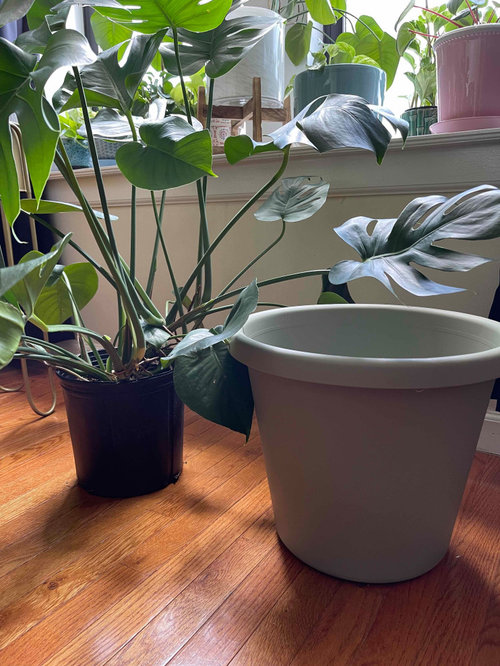
I currently have this really amazing Monstera Deliciosa. She's about a year old and I am looking to get her to grow much bigger.

It is currently in its original 10-inch grow pot and I bought this 14-inch pot from Amazon. I am not sure if the new pot I bought is too large and may make the plant more prone to root rot.

What does everyone think? Should it be ok in a new pot that much larger? Should I do anything proactively in terms of potting mix if I keep the large pot?

Thank you all so much for your feedback!


Comments (5)

  • 4 years ago

    The pot does look a bit too large to me, but you can still use it if you use a very loose mix. I would recommend a very generous portion of Orchid bark, maybe as much as 50% to whatever soil you would ordinarily use, they will be fine. Not sure where you are, but if you put it outside for the growing season, il will become the MONSTER for which it is named. Should be positioned in either shade or partial shade (especially when first put out). It will eventually take better sun, but as long as your summers are hot and HUMID, it will grow like a beast even in the shade. I would also suggest to create a sphagnum totem for the pot and will only a bit of encouragement, the branches will soon use the totem to root and go vertical, Good luck.

  • 4 years ago
    last modified: 4 years ago

    I agree with Jurassic Park that the new pot does look a bit too big for a transition. I wouldn't go more than one size up.

    Also much to my surprise, these plants can thrive in the same pot for years and years . I recently saw a video of one in the MIssouri botanical gardens collection that is like 18 feet tall and still in a small pot. Granted the plant is climbing so it gets much of its nutrition that way. But still. They grow regardless of their pot.

    A support system of some kind will be important so planning for that now was also a good tip from Jurassic Park.


    I put mine outside in the Summer in Colorado in a filtered sun location and it definitely likes that.

  • 4 years ago

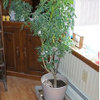
    This is my 50 year old Selloum philodendron in the same pot it's been in for the last 20 years. I don't think there's any soil left--just decomposing old roots! But it is perfectly happy being totally pot bound.


  • 4 years ago

    Really awesome, johnsaunt!

  • 4 years ago
    last modified: 4 years ago

    Marc - what primarily determines whether a pot is appropriate (for size) is the soil you are using. The more water-retentive a medium is, the more critical pot size is; and the more highly aerated a medium is at container capacity (see "Container Capacity) below), the less the need to fret about our planting being over-potted. I use media that holds no, or precious little water between soil particles,


    so I can plant a tiny seedling in a 55 gallon drum of soil w/o need to worry about over-potting.

    In addition to using media that holds little or no water between soil particles, there are tricks which employ a little simple science to limit the amount of excess water a planting can hold. See fig D below as an example of how to use an over-turned pot as ballast to reduce retention of the type of water that causes root damage or limits root function. When comparing the shaded area (perched water) in D compared to A, it's easy to see the conspicuous difference. Your pot would easily allow you to use this type of set-up to passively limit excess water.


    If you want to take this path and want to start a dialog re the best way to set things up, let me know. I'd be happy to help.

    Container Capacity -

    is a measure of how much water the grow medium in a pot or container holds at the moment it has stopped draining, after having been watered to the point of complete saturation. When plants are at 'container capacity', the medium often supports a layer of grow medium that remains 100% saturated (a perched water table [PWT]) which occupies a layer of grow medium at the bottom of the pot, defying the force of gravity and refusing to drain. The ht of the PWT and how long it affects root function is usually key/critical in determining what opportunity a plant will have to realize as much of its genetic potential as possible (within the limiting effects of other cultural influences). The factor that most affects the ht of a PWT is the size of the particles from which the medium is made.


    Choosing an Appropriate Size Container

    How large a container ‘can’ or ‘should’ be, depends on the relationship between the mass of the plant material you are working with and your choice of grow media. We often concern ourselves with "over-potting" (using a container that is too large), but "over-potting" is a term that arises from a lack of a basic understanding about the relationship we will look at, which logically determines appropriate container size.

    It's often repeated that you should only move up one container size when "potting-up". The reasoning is, that when potting up to a container more than one size larger, the medium will remain wet too long and potentially cause root rot issues, or at a minimum, limited root function. In reality, it is the size/mass of the plant material you are working with, and the physical properties of the medium you choose that determines both the upper & lower limits of appropriate container size - not a formulaic upward progression of container sizes. In many cases, after root pruning a plant, it may even be appropriate to step down a container size or two, but as you will see, that also depends on the physical properties of the medium you choose. It's not uncommon for me, after a repot/root-pruning to pot in containers as small as 1/5 the size as that which the plant had been growing in prior to the work.

    Plants grown in ‘slow’ (slow-draining/water-retentive) media need to be grown in containers with smaller volumes so the plant can use water quickly, allowing air to return to the medium before root issues more serious than impaired root function/metabolism become a limiting factor. We know that the anaerobic (airless) conditions that accompany soggy media quickly kill fine roots and impair root function/metabolism. We also know smaller medium volumes and the root constriction that accompany them cause plants to both extend branches and gain o/a mass much more slowly - a bane if rapid growth is the goal - a boon if growth restriction and a compact plant are what you have your sights set on.

    Conversely, rampant growth can be had by growing in very large containers and in very fast (draining) media where frequent watering and fertilizing is required - so it's not that plants rebel at being potted into very large containers per se, but rather, they rebel at being potted into very large containers in a medium too slow and water-retentive. This is a key point.

    We know there is an inverse relationship between media particle size and the height of the perched water table (PWT) in containers. A PWT is water that fills spaces between soil particles and defies gravity by refusing to leave the pot. As particle size increases, the height of the PWT decreases, until at about a particle size of just under 1/8 inch, media will no longer hold perched water. If there is no perched water, the medium is ALWAYS well aerated, even when it is at container capacity (fully saturated).

    So, if you aim for a medium (like the gritty mix) composed primarily of particles larger than 1/16", there is no upper limit to container size, other than what you can practically manage. The lower size limit will be determined by the medium volume's ability to allow room for roots to ’run’ and to furnish water enough to sustain the plant between irrigations. Bearing heavily on this ability is the ratio of fine roots to coarse roots. It takes a minimum amount of fine rootage to support the canopy under high water demand. If the container is full of large roots, there may not be room for a sufficient volume of the fine roots that do all the water/nutrient delivery work, and the coarse roots, too. You can grow a very large plant in a very small container if the roots have been well managed and the lion's share of the rootage is fine. You can also grow very small plants, even seedlings, in seemingly inordinately large containers if the medium is fast (free-draining and well-aerated) enough that it holds no, or very little perched water.

    I have just offered clear illustration why the oft repeated advice to ‘resist potting up more than one pot size at a time’, only applies when using heavy, water-retentive media. Well-aerated media are not bound by the same restrictions. As the ht and volume of the perched water table are reduced, the potential for negative effects associated with over-potting are diminished in a direct relationship with the reduction - up to the point at which the soil holds no (or an insignificant amount) of perched water and over-potting pretty much becomes a non-issue.

    Al