Software
Houzz Logo Print
webuser_548328692

Concrete cracking after 1 month!

4 years ago
last modified: 4 years ago

Hello,
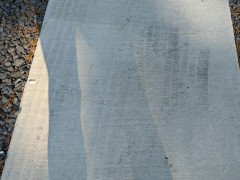
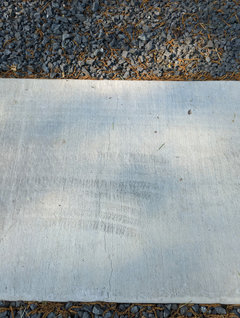
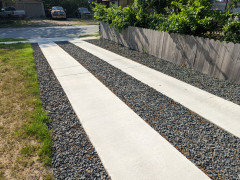
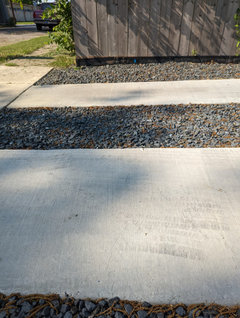
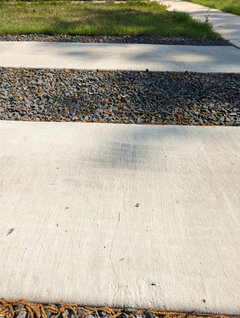
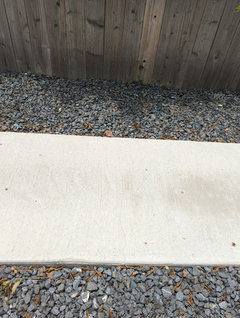
We had a concrete ribbon driveway installed about a month and a half ago. We watered as instructed and haven't had any heavy machinery on the driveway. Today we noticed cracks on both ribbons in the same location. I have contacted the concrete contractor. But what could have caused this? How can it be fixed?
We are so disappointed. We had done extensive research on best practices, had received this contractor's contact info from a friend who had completed 2+ successful jobs with him, and had endless discussions with the contractor to ensure a job well done. And still this.. ugh.

Comments (32)

  • 4 years ago

    Pics? Did the contractor explain shrinkage cracks?

  • 4 years ago


  • 4 years ago


  • 4 years ago

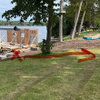
    3onthetree: Pics uploaded. No, I don't think he mentioned shrinkage cracks.

  • 4 years ago

    Millworkman: Yes, I suppose! But I just figured it would take a bit longer than 1.5 months to crack. We do have joints.


    Let me upload a few other pics. I attempted already,but Houzz on a mobile device is not user-friendly (at least I struggle with it!).

  • 4 years ago


  • 4 years ago


  • 4 years ago


  • 4 years ago

    The fact that the cracks are at the same location on both ribbons makes me wonder if some grading/slope in the land wasn't accounted for and left that area prone to cracking...

  • 4 years ago

    The expansion joints occur every 11' (slightly less). The slab where the cracks have appeared is just under 9'.

  • 4 years ago

    Those are shrinkage cracks, which occur during the initial curing of the concrete. You place "control" (or "construction") joints to try and direct where you want the shrinkage cracks to occur. There are a whole bunch of causes that are hard to tell which allowed the cracks to happen outside your finisher's tooled control joints. Concrete is a fickle installation.

  • 4 years ago

    Thank you or educating me on the shrinkage cracks! Do these tend to expand further over time? Are they done cracking? Hard to say? Anything I can do to prevent them from getting worse?


    It's just so odd that the cracks are in the same location on both ribbons.

  • 4 years ago

    Shrinkage cracks usually occur within the first 24-48 hours of the pour, maybe up to a week depending. They will not get bigger, but go all the way through the slab, so if your slab has movement and is not held together with rebar or wire mesh, then each piece on either side of the crack could move independently. Also, once you have a crack, in freeze/thaw climates eventually a crack will start to spall at the edges.

    Same location on each ribbon, so maybe the soil near the sidewalk is different than up by the house. If the soil underneath a fresh concrete pour is too dry, it can "suck" the moisture from the bottom side during curing, so the bottom shrinks faster than the top, causing a crack. At the sidewalk it is also the last of the mix truck and last to be finished, so the mix is a tad drier and the control joints need to be put in sooner. Just theories, as I said, it is hard to tell what caused them.

  • PRO
    4 years ago

    "So you should be fine without rebar for pedestrian areas, but you will be pushing the limit when it comes to driveways."


    Any concrete contrator who guarantees concrete against cracking is bankrupt or on the road to it. Get used to the cracks please. He's not doing anything and you have no case.

  • 4 years ago

    Thanks everyone for their feedback! Overall, it sounds like this is not atypical nor is it necessarily a result of poor worksmanship. I only wish that my contractor had discussed this as a possibility in advance!

  • 4 years ago

    @Joseph Corlett, LLC I don't see that quote in this thread, and you've linked it to a clickbait site. Fibermesh is not under consideration here. And one-way slabs can perform perfectly well without rebar under any loading conditions, so I don't know what your quote is referencing in this thread.

  • 4 years ago

    And just to be clear we do have rebar. I cannot recall the spacing of it, but I do believe the horizontal and vertical spacing was appropriate based on my research.

  • 4 years ago

    11’ is way too far apart for cntrol joints.

  • 4 years ago

    Really? I read 8' to 12' is acceptable.

  • PRO
    4 years ago

    These cracks are typical, especially with minimal control joints.

  • 4 years ago

    Thank you, Jeffrey! I thought our control joints were within "best practices" but maybe not...

  • 4 years ago

    You are correct, in general a 4" slab thickness should fall somewhere between 8'-12' for control joints. However, there is an aspect ratio for a slab panel designed like yours that limits control joint spacing to 1.5:1. You can see that in sidewalks, where a 3' wide sidewalk is usually tooled in approx 5' lengths. Though that alone does not necessarily determine you will get shrinkage cracks, as the remainder of your driveway did not experience cracks with 11' spacing.

  • 4 years ago

    Oh, I see. So 6 foot spacing would have been better if I understand correctly. Darn. Though like you noted, there seem to be other factors at play since there were no cracks on the longest slabs.

  • 4 years ago

    Oh no. We found another one of these cracks on another slab? I thought this type of cracking would end by now!

  • 4 years ago


  • 4 years ago

    "Unfortunately there are only two types on concrete, cracked and yet to crack."


    My quote from 3 weeks ago. As mentioned above is the purpose of control joints is you want the joints to crack so the cracks are not truly visible.

  • 4 years ago

    I thought these specific types of cracks (shrinkage) would not still be forming at this time, given that the curing process is over.


    I also notice now a network of extremely fine, hardly cracks over a wide area. Is that "normal" too?


    I wish our contractor had shared with us the inevitability of cracking... But then he might not have had the job with us!

  • 4 years ago

    Like I said, concrete is a fickle installation.

    The cracks I refer to are plastic shrinkage cracks, that is, when the concrete is still "pliable" initially when poured, and environmental and mix conditions can contribute to this phenomenom when water "leaves" (either through hydration or evaporation) at different rates. This is the more common type of shrinkage cracks.

    There is another type of shrinkage crack - "drying" - which occurs over a longer period of time and results from the loss of water after the concrete has hardened. Drying cracks are less common and I personally don't see them when control joint spacing is adequate.

    The other cracks you speak of, "network of extremely fine" cracks, is probably crazing (aka spidering). These can occur when the mix is too wet, the finisher has troweled too much and brought up too much cream to the surface, high wind, hot sun, whatever that is causing the surface to dry too quickly beyond hydration. Usually they are minimized with a broom finish, which it appears you have.


  • 4 years ago

    You are the best, 3onthetree! I have learned so much from your posts and they have made me feel infinitely better about the situation. I've also been keenly observing all the concrete features during our recent neighborhood walks. And, yes, there is a lot of cracking (and other defects) - including on the brand new sidewalks the city installed - and I need to just stop obsessing (easier said than done for me!).

  • PRO
    4 years ago

    I don't see control joints. Those are what help keep concrete from cracking.


  • 4 years ago

    They are there! They are about 11' apart. 8' for the shortest slabs. It sounds like with these ribbons that the spacing maybe should have been closer? But even then cracks may still happen..

Sponsored
Kuhns Contracting, Inc.
Average rating: 5 out of 5 stars26 Reviews
Central Ohio's Trusted Home Remodeler Specializing in Kitchens & Baths