Software
Houzz Logo Print
mary_purtee

Fiddle Leaf Fig in dire need of help

4 years ago
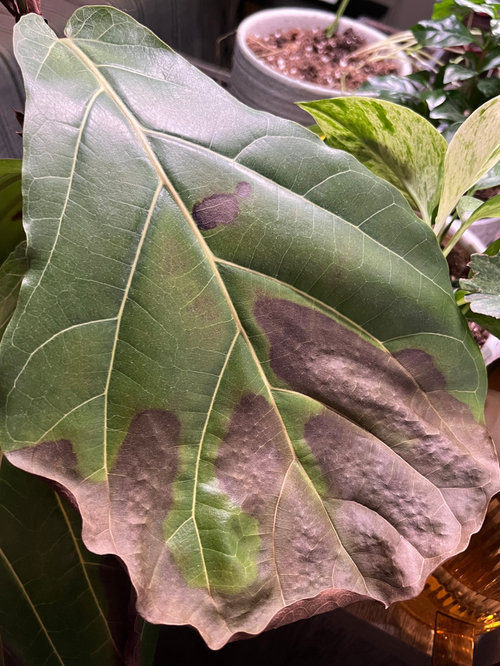
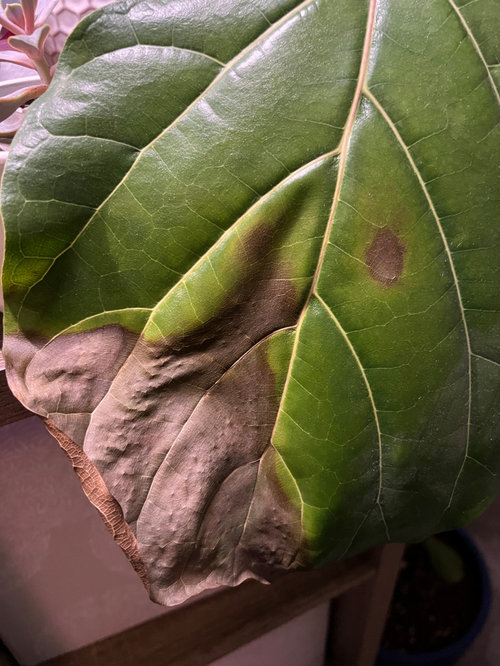
Hello! I’m generally new to plants and have recently addopted a fiddle leaf fig that was dieing in my bf’s care. It has lost a lot of leaves over the course of two months. The pot does have a drainage hole and the soil is currently dry. I plan on buying new soil, some fertilizer, and re-potting it soon so I can inspect the roots before I water it. Does anyone know what the brown spots mean? I will be looking up different help websites for info, but also appreciate any feedback so I have the best chance at saving it. Thanks!


Comments (3)

  • 4 years ago

    The grow medium (GM) shouldn't be dry, as drought stress becomes a factor before the GM is completely dry. The trick is to allow the GM to dry down to the point there is still some detectable moisture remaining before you water next. The best way to monitor moisture levels deep in the pot is by using a "tell" to "tell" you when it's time to water. See more below.

    The necrotic (dead) areas on the leaves is from over-watering, a high level of dissolved solids (salts) in the soil (from tapwater and/or fertilizer solutions). Has the water you use to water your plants been routed through an ionic exchange water softener (uses salt)?

    In all honesty, I think you would benefit from a back and forth conversation regarding the upcoming repot, the difference between repotting and potting up, fertilizing, and what to do about the GM, which will have a significant impact on how much of an opportunity you will be able to offer your plant(s) to realize as much of their genetic potential as possible. Timing of the repot, what part of the year you repot is also important to achieving best results and the fastest recovery.

    One tip to remember as you search for advice you can trust: If you receive advice to water when the top inch or two of the GM is dry to touch, ignore it. That is commonly parroted on the internet and it's a recipe for over-watering and the problems inherent in that practice. If your pot is 8-10" deep, the top 2" of the GM can be 100% saturated with water. It doesn't much matter, when pots are over about 5" deep, how dry the top of the soil column is. What IS important is the air:water ratio deep in the pot, and you can use the information below to learn how to accurately monitor moisture levels where it counts.

    These are links to 2 things I wrote. One is An Overview of Good Growing Practices, and the other is devoted specifically to long term Care of Ficus Trees in Containers. I have 45 ficus trees in containers (finally decided to count them this year as I was bringing them up from the basement grow area to the outdoors where they spend every summer), not counting the young starts from cuttings.

    Using a 'tell'

    Over-watering saps vitality and is one of the most common plant assassins, so learning to avoid it is worth the small effort. Plants make and store their own energy source – photosynthate - (sugar/glucose). Functioning roots need energy to drive their metabolic processes, and in order to get it, they use oxygen to burn (oxidize) their food. From this, we can see that terrestrial plants need plenty of air (oxygen) in the soil to drive root function. Many off-the-shelf soils hold too much water and not enough air to support the kind of root health most growers would like to see; and, a healthy root system is a prerequisite to a healthy plant.

    Watering in small sips leads to avoid over-watering leads to a residual build-up of dissolved solids (salts) in the soil from tapwater and fertilizer solutions, which limits a plant's ability to absorb water – so watering in sips simply moves us to the other horn of a dilemma. It creates another problem that requires resolution. Better, would be to simply adopt a soil that drains well enough to allow watering to beyond the saturation point, so we're flushing the soil of accumulating dissolved solids whenever we water; this, w/o the plant being forced to pay a tax in the form of reduced vitality, due to prolong periods of soil saturation. Sometimes, though, that's not a course we can immediately steer, which makes controlling how often we water a very important factor.

    In many cases, we can judge whether or not a planting needs watering by hefting the pot. This is especially true if the pot is made from light material, like plastic, but doesn't work (as) well when the pot is made from heavier material, like clay, or when the size/weight of the pot precludes grabbing it with one hand to judge its weight and gauge the need for water.

    Fingers stuck an inch or two into the soil work ok for shallow pots, but not for deep pots. Deep pots might have 3 or more inches of soil that feels totally dry, while the lower several inches of the soil is 100% saturated. Obviously, the lack of oxygen in the root zone situation can wreak havoc with root health and cause the loss of a very notable measure of your plant's potential. Inexpensive watering meters don't even measure moisture levels, they measure electrical conductivity. Clean the tip and insert it into a cup of distilled water and witness the fact it reads 'DRY'.

    One of the most reliable methods of checking a planting's need for water is using a 'tell'. You can use a bamboo skewer in a pinch, but a wooden dowel rod of about 5/16” (75-85mm) would work better. They usually come 48” (120cm) long and can usually be cut in half and serve as a pair. Sharpen all 4 ends in a pencil sharpener and slightly blunt the tip so it's about the diameter of the head on a straight pin. Push the wooden tell deep into the soil. Don't worry, it won't harm the root system. If the plant is quite root-bound, you might need to try several places until you find one where you can push it all the way to the pot's bottom. Leave it a few seconds, then withdraw it and inspect the tip for moisture. For most plantings, withhold water until the tell comes out dry or nearly so. If you see signs of wilting, adjust the interval between waterings so drought stress isn't a recurring issue.

    Al

  • 4 years ago

    what al said.. as always ...


    but next time.. show us the whole plant.. the pot ... etc ...


    just showing just a brown leaf .. usually leads to us telling you you have a brown leaf.. and then start guessing why ...


    you may be surprised how much can be figured out by looking at a stinky old pot ...


    ken

  • 3 years ago

    Did you put any of the advice you received into practice, Mary? What results?

    Al