Software
Houzz Logo Print
popmama

Pruning Ficus Audrey

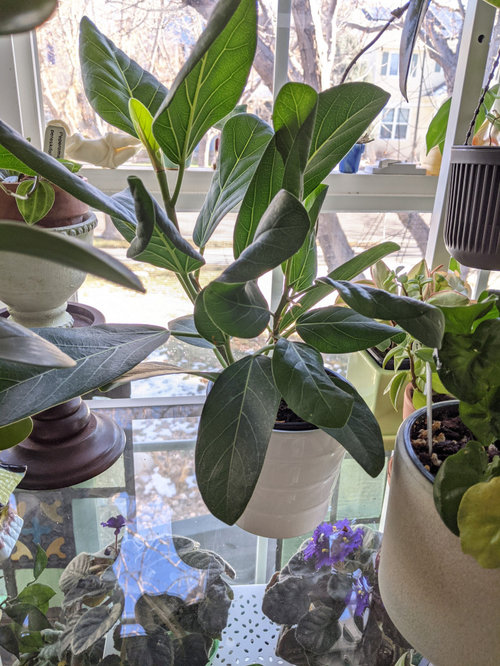
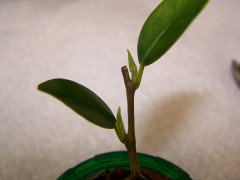
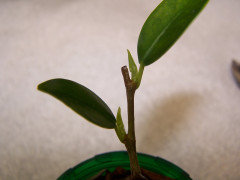
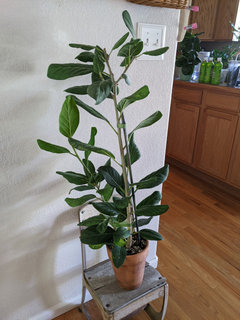
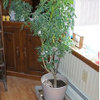
I can't say enough good things about Ficus Audrey. Here's a picture of the plant when I first got it in November 2020.


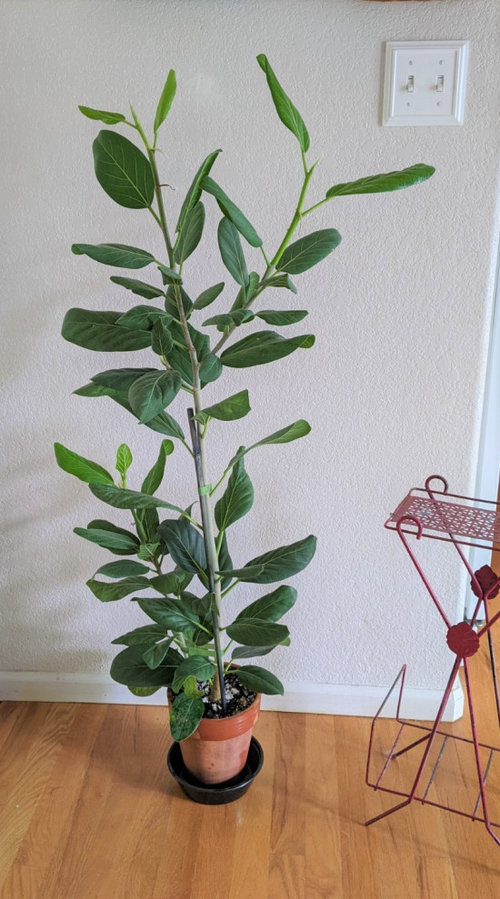
And today.


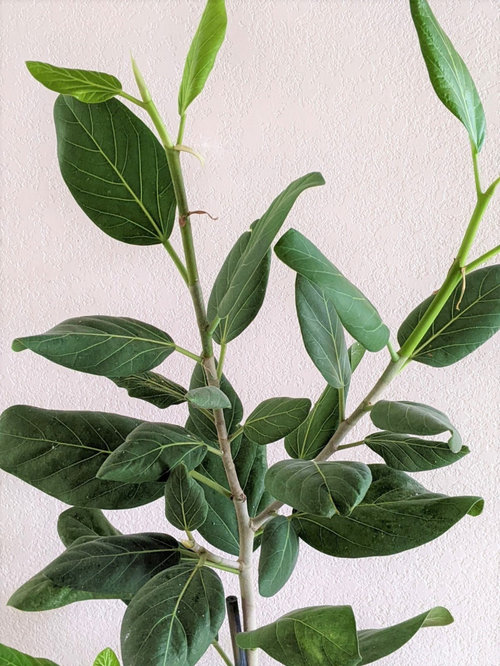
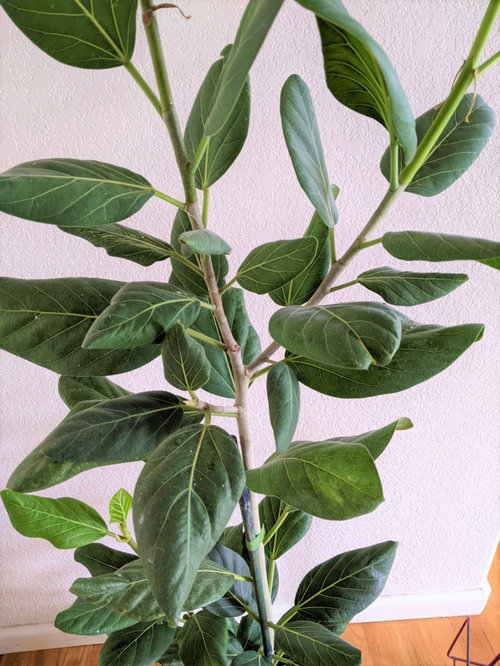
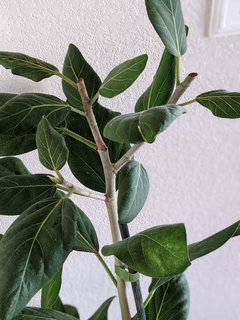
It still has two separate trees in one pot. I repotted it last summer and did cut the tip off the taller tree and it branched nicely. But now I see that the side branch is getting taller than the center and I think it may be time to consider some additional pruning. At some point, I may separate that smaller tree but for now, my main focus is the taller one. The goal would be for it not to get much taller but to create more of a canopy just above the support stake that I have in there. Here are a couple of close up pics of the leader and the branching.


Looking for advice on where to cut or how to manage this. Thanks in advance!

Comments (16)

  • 4 years ago

    If I'm not mistaken, this is a good time to prune still. Yes?

  • 4 years ago

    Should be easy as snip snip snip if I'm correct in thinking we're dealing with a central leader with a very small branch moving to the left and another branch moving to the right just above it. Yes?

    If you live in the US, or somewhere in the Northern Hemisphere, it's prime time for major pruning and repotting of most houseplants.

    Al

  • 4 years ago

    Hi Al! Yes, there is a smaller branch on the left and a really bossy branch on the right. I'm thinking that bossy branch definitely needs to be trimmed.

    I'm also thinking I should pinch the top again.


  • 4 years ago
    last modified: 4 years ago

    Little branch moving left: Pinch it - remove the growing tip of the branch (the apex/ apical meristem) only.

    Large branch moving right: Notice how the length of the internodes changed at the end of last summer, producing only long internodes after that. To maximize fullness and compactness of the canopy, the branch should be pruned back at least to where the internodes are short.

    How to choose where to prune it: Notice that the little branch and the branch growing to the right are both growing in the axil (crotch) of a leaf, and the branch grew at roughly the same angle as the leaf. This means that by selecting a leaf growing in the direction you want a branch to grow, you can predetermine the direction the branch, not withstanding the effects of phototropism (tendency to grow toward the brightest light source). Since you have 3 branches to consider (main leader, left branch, right branch) the ideal direction for the large branch moving right would be growing outward exactly halfway between the little branch and the main leader. Another way of saying it would be, when you choose the leaf to prune back to, the branch that will occur in the axil of that leaf should bisect the angle formed by the main leader and the small branch. I can't tell which is appropriate from a 2D image.

    The central leader should be pruned back into the area with short internodes as well. Simply choose the leaf that will produce a branch growing in the most favorable direction. This is called directional pruning, and I utilize it constantly as I pinch and prune my trees. It is a very good skill to have in your bag of tricks.

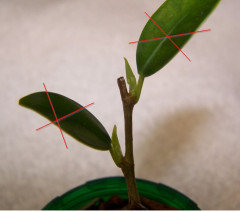
    Now, let's go back to the 2 leaves which have branches growing in their axils. Those leaves should be removed. The reasons are A) it tidies up the plant, and B) it slows growth of the branch such that internodes will be shorter and leaves smaller. Then, as soon as your tree starts to push new branches in existing leaf axils, remove the leaf that supports an axillary branch.


    This ^^^ is about the stage at which the 2 mature leaves should be removed from established trees. If this wasn't a newly rooted cutting, I would have removed them already. I regularly go through my ficus trees and remove all leaves with branches in their axils to slow growth. You have probably seen many images I've posted that show complete or partial defoliation of branches used as a tool to promote compact growth or to manage the tree's energy flow. As long as you're going to learn how to manipulate your trees and bend them to your will, you might as well know all the methods and advantages.

    Finally, it's much easier to start pinching and pruning regularly right out of the gate, as it's much more heart rending to have to cut a tree back extremely hard after it's become way to far out of bounds.

    Questions?

    Al

  • 4 years ago

    I need an Al at my house! Do you make housecalls? Haha.


    I think I follow most of the instructions. Specifying the part where the internodes get big really helped me to understand where. So that was a good way to provide me with simple instructions.


    I don't see this "2 leaves which have branches growing in their axils" at all. So that part I am not grasping.


    I agree it is very difficult to do this with only a 2D view. So I appreciate your effort to help!

  • 4 years ago

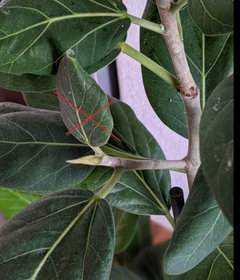
    I don't see this "2 leaves which have branches growing in their axils" at all. So that part I am not grasping. Examine the small branch moving left, the large branch moving right, and ignore the main leader for now. Follow those branches back to where they attach to the main stem. You'll find a leaf growing there at the attachment point.


    What looks like a leaf growing in the axil (crotch) of the middle leaf is actually a branch. Using the image as an example, the mature leaf with a branch growing in its axil (the middle one) should be removed; not for health reasons, but because it makes the plant tidier AND it slows the branch down (the one growing in its axil). Slowing the branch's growth rate down means leaves along the new branch will have shorter internodes and smaller leaves, highly desirable when you're aiming for a full and compact plant.

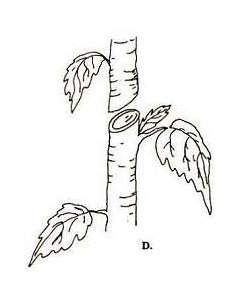
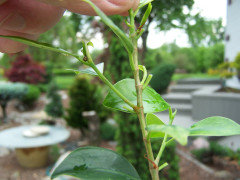
    After you do the pruning, you'll start to see many new branches growing in leaf axils. Once you see a bud is activated and the first leaf on the branch is starting to form, remove the mature leaf. Example:

    If this ^^^ was a branch on a tree and not a cutting, and because I can see the first leaf is forming on the branches growing in both leaf axils, I would remove the mature leaf growing from the point where the branch attaches. That treatment doesn't serve a cutting well, but your tree is much further along and you are trying to increase leaf and branch density (ramification), and removing those leaves, where they occur, is helpful to that end.

    See before/ after images showing where I actually went through a tree and removed these mature leaves.

    You can see several leaves with branches growing in their axils ^^^


    Same branch but with the leaves supporting axillary branches removed ^^^. As the tree matures, this practice also increases the amount of light and air movement reaching the inner branches, which promotes more prolific back-budding and shorter internodes. The stubs usually fall off on their own within a week or two; or, you can cut through the leaf stem (petiole) with scissors closer to the leaf's attachment point. I left the stubs long to make it easier to see what I actually did. Never pull the leaves off as it can damage the row of dormant buds in the leaf axil. Always snip them off.

    Al


  • 4 years ago

    Thank you for the additional information. It's a bit like when you pinch the sucker on a tomato plant, you pinch that growth between the stem and a branch. I get it!


    I didn't see any of those on my tree but I will look more closely.

  • 4 years ago

    ..... except in this case you're allowing the sucker to remain and removing the leaf that gave rise to the sucker (new branch).

    I didn't see any of those on my tree. You have 2. Follow the small left branch and the larger branch moving right to their attachment points where you'll find the leaves. After the back-budding begins, you'll have many instances where there are new branches growing in leaf axils.

    Al


  • 4 years ago

    Ok, so I was thinking the opposite of what should be done! Good thing I am getting more clarification. So in your example, these leaves would be removed?


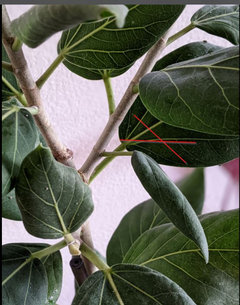
    I think I found the two you were referring to here and here:


    Should I wait for that bud to do more before removing the leaf next to it?


  • 4 years ago

    The leaves to be removed will be found directly below the point where the branch is attached to the next lower order branch. In this case, they will be found attached to the central leader immediately below where the two branches are attached to the central leader.

    Should I wait for that bud to do more before removing the leaf next to it? The little leaf remains. The leaf to remove is at the other end of the short branch. You can remove the growing tip of the short branch now, or wait until 1-2 more leaves have been added to the branch. Normally, the formula for pinching is to wait until the 3rd leaf on any given branch is starting to open, then pinch the branch back to 2 leaves.

    As a branch grows/ extends, it will produce a series of leaves. Those first leaves can never be replaced and new leaves can never be grown in the same position. When a leaf falls off, it's gone for good and can never be coaxed to grow another in its place. Only new branches will grow from the leaf axil or from immediately above the scar leaf when a leaf was shed. You can see that by examining your tree. Only 2 branches have grown from a node where a leaf was/ is still attached.

    Al

  • 4 years ago

    Step 1 (the easy step) is complete. "leaves to be removed will be found directly below the point where the branch is attached to the next lower order branch"


    Now I have to contemplate the pruning of the two largest branches. I thought the one looked like a good leader but now I'm thinking that it may be better if the two larger branches were allowed to both be side branches at this point which would keep the tree short with a canopy at the current height. I will copy and paste all this great advice for future too.


    When I prune the two largest branches I will aim to prune where the shorter internodes end and the longer ones begin. Then see what happens. :-)


    I will root the two pieces for my mom.

  • 4 years ago

    The guidance I provided was with the intention you would do exactly that. From above: "The central leader should be pruned back into the area with short internodes as well. Simply choose the leaf that will produce a branch growing in the most favorable direction."

    Al

  • 4 years ago

    Yep, I can handle the simple instructions. The rest are sometimes mind boggling to me. I have to read, then walk away for a while, come back and read again.

    I imagine it is the same way that my customers may feel when I'm trying to walk them through resolving their computer issue.


    I'm going to get a fresh look at it tomorrow and collect all my gumption!

  • 4 years ago

    Just wanted to give an update. Last week, I worked up the courage to make two chops.


    And now we wait to see what Miss Audrey decides to do with my pruning. I probably want to pinch that bud there on the end of that branch but will "wait until the 3rd leaf on any given branch is starting to open, then pinch the branch back to 2 leaves."

    Thanks, Al!

  • 4 years ago

    I have to say that I would not have had the confidence to do this without everyone here! Thanks for the support everyone. I promise to update you when the new growth takes off!